
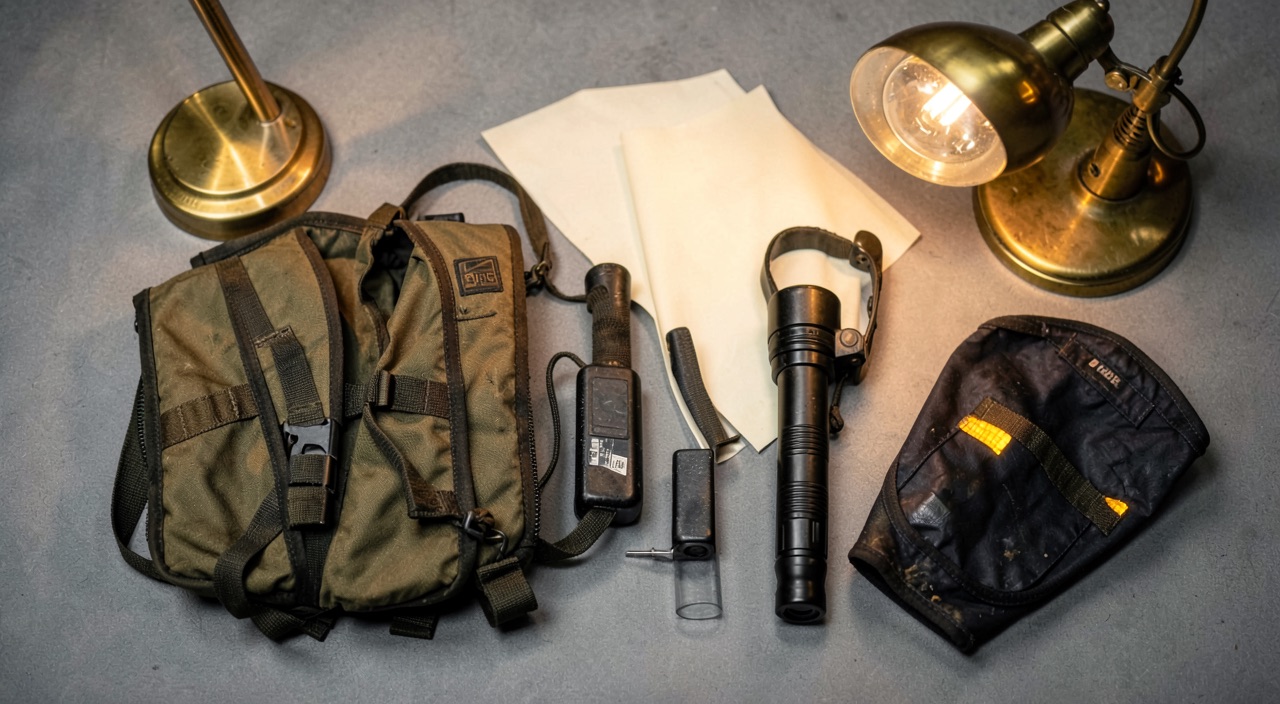
The auditor does not ask to see an aircraft. They ask for a name, pull up the training file, and ask a precise question: when did this pilot last wear a respiratory protection hood, on what equipment, and who verified it? All annual ground training boils down to this question: skills demonstrated in the classroom, on representative equipment, and tests that must be reconstructable years later with no other witness than a well-maintained file.
What ground training actually covers
In crew conversation, maintaining competence often boils down to the simulator. That’s a pilot’s view, not an operator’s: the periodic program includes a full section that never leaves the ground, and it’s the first thing auditors scrutinize—precisely because it’s easier to overlook than a simulator session scheduled months in advance.
This section groups four families of modules. First, system and procedure reviews: recalling what changed in the documentation, type evolutions, fleet particularities. Then, emergency and survival equipment training: location, handling, emergency actions with extinguishers, exits, life vests, respiratory protection. The periodic elements of CRM, which are partly treated in the classroom and partly integrated into other modules. Finally, dangerous goods, whose training follows its own logic and schedule. Depending on the applicable national program, security is added.
A distinction structures everything else: these modules are training, not checks. What is verified is not performance under reproduced conditions, but maintained competence: knowledge that is tested, a gesture that is demonstrated. And since the demonstration takes place in the classroom, on mockups, sometimes in a pool, the question of proof becomes central: none of this leaves a trace in a flight data recorder.
Ground training is about proving you know how to do things without actually flying. It’s like studying for a driving test—you practice in a classroom or on a simulator, not on real roads. The key is showing you can do it right when asked, even years later.
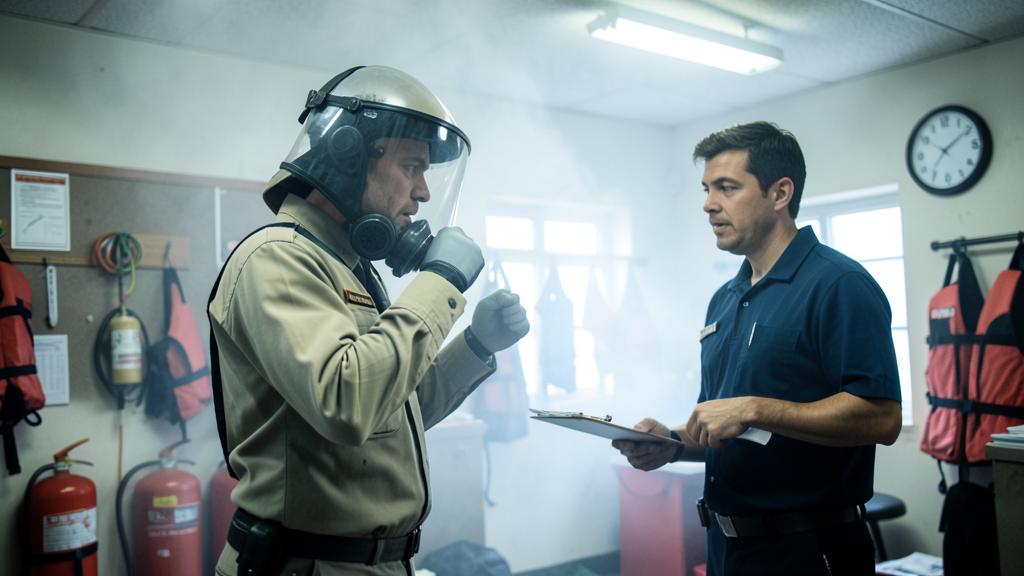
An A320 pilot must demonstrate donning a respiratory protection hood every 36 months. During training, they wear the exact same hood model as on the aircraft, in a smoke-filled room. The instructor checks their time (under 90 seconds) and proper seal. This is recorded in their file, proving competence without ever boarding an actual A320.
Three clocks that don’t march in unison
The reference periodicity is the year: ground review and emergency equipment training return every twelve months, as do the periodic elements of CRM. But two other clocks run in parallel. Dangerous goods are renewed every twenty-four months. And a series of actions must be physically performed—not just reviewed—in a cycle of about three years: discharging an extinguisher, donning respiratory protection in a simulated smoky environment, operating an exit in emergency mode, and, depending on the fleet’s equipment, deploying a slide or a raft.
The « calendar month » is not a drafting detail: validity runs until the end of the month, giving the program a few weeks of flexibility, but also creating dreaded alignments. And the year when the three clocks coincide, the classrooms, instructors, and demonstration material all run short at the same time.
| Module | Typical periodicity | What is demonstrated | Expected trace |
|---|---|---|---|
| System and procedure review | 12 calendar months | Updated knowledge of the type and documentation updates | Session content linked to the manual edition, proof of acquisition |
| Emergency and survival equipment | 12 months, real actions distributed in a cycle of about 36 months | Location, handling, real actions (extinguisher, respiratory protection, exits) | Session sheet that names the material used and its representativeness |
| CRM—periodic elements | Annual, full coverage of topics in 3 years | Active participation, scenarios, debriefing | Topic coverage matrix maintained during the cycle |
| Dangerous goods | 24 months | Skills linked to tasks actually performed | Dated certificate, content adapted to the role |
Knowledge is verified, actions are demonstrated
The most useful dividing line for building—or auditing—a program is this: an element of knowledge can be acquired remotely, an action never. System reviews, dangerous goods theory, and survival principles lend themselves well to online teaching, provided a test validates the acquisition and connection time is not the only metric recorded. The action, however, requires practical material.
« Never touching an aircraft » does not mean touching nothing. The demonstration is performed on representative material: a training door that reproduces the kinematics of the fleet’s doors, a training extinguisher of the same model as those on board, a hood identical to the supplies on board. Representativeness has no numerical definition—it’s a judgment, and this judgment is documented: the program file indicates what material represents what equipment, and why.
That’s also what makes the classroom irreplaceable: you can fail an action there. The crew that dons a hood for the first time since the last cycle rediscovers the tightness of the neck seal, the reduced field of vision, the muffled voice—exactly what no slide can convey. The gap between knowing how to describe an action and knowing how to perform it widens in silence; only hands-on practice closes it.
The chain of evidence, link by link
In the face of an audit, ground training is defended as a chain of four links. At the top, the part of the operations manual dedicated to training establishes the approved program: contents, periodicities, methods, means. The annual plan schedules the sessions and resources. Each session produces its trace: date, duration, content actually covered, instructor, material used, participants. And the individual file aggregates everything into validities, module by module.
The auditor follows this chain in reverse. They start with a name, verify the validity calculation, demand the session that supports it, compare the traced content with the approved program, verify the instructor’s qualification and the identity of the material. Each missing link has a finding name: incorrectly calculated validity, untraceable content, instructor not qualified for the module, material without justification of representativeness.
The trap: the attendance sheet that proves nothing. A signature establishes presence, not content. If the session sheet does not refer to the manual edition in force that day, the version of the course material or the material handled, the operator cannot demonstrate what was taught—and a program review during the year makes the gap evident: two sessions of the same module no longer say the same thing.
Calendar traps that cost a finding
The validity calculation has a subtlety often discovered too late: the end-of-validity window. A session completed in the last months—typically the last three—extends from the existing deadline: the anniversary does not move. Completed before this window, it runs from its own month: the deadline moves earlier, and a program that systematically trains early « just in case » sees its anniversaries slide year after year, until the modules it had carefully aligned become desynchronized.
Content has its own traps. A fleet with multiple variants does not carry the same equipment everywhere: training must cover what each crew can actually find on board, and a file demonstrating a door from a variant that the pilot no longer flies proves the wrong thing. Dangerous goods, now based on task-based competencies, add a dependency: the content follows the role performed, and a role change may require a supplement before the 24-month deadline.
The correct reflex: reference each session three times. The edition of the operations manual in force that day, the version of the course material, the identifier of the material handled. These three references transform an attendance sheet into evidence: they allow reconstructing, years later, what was taught, on what, and to what standard.
CRM: covered by cycle, not by session
The periodic elements of CRM follow a different logic from other modules: the annual session does not have to cover everything, but the three-year cycle must cover all major topics—communication, situational awareness, workload, stress and fatigue, surprise and automation, full crew work, including cabin.
This is the module where proof is most easily lost, because topics are often integrated into other sessions—a simulator scenario, a debriefing, an emergency module—and an untraced integration equals, for the auditor, an absence. The facilitator, finally, is not interchangeable: the qualification of trainers for this module is demonstrated like the rest.
What to check in your own file
For the crew: your exact validities, month by month, and the position of your next sessions in relation to the window—your personal planning depends on it. For the training manager: the CRM topic coverage matrix, the inventory of demonstration material with its representativeness justification, and the qualification of each instructor, module by module. For those aspiring to a position in a training organization: knowing how to reconstruct a chain of evidence is a hiring interview skill as much as an audit requirement—the preparation paths are detailed at formations.fl330.com.
The gray area that remains is that of representativeness: no text quantifies what makes a mockup « sufficiently » close to the on-board equipment. It’s the operator’s judgment, accepted as long as it is documented and defended—that’s where two rigorous operators can diverge, and where the discussion with the authority is prepared in writing, piece by piece.
The practical rule remains: this article describes mechanisms, not your applicable framework. The regulations in force and your operator’s approved documentation prevail over all of the above—it’s the operations manual, in its current edition, that has authority.


Leave a Reply
You must be logged in to post a comment.