
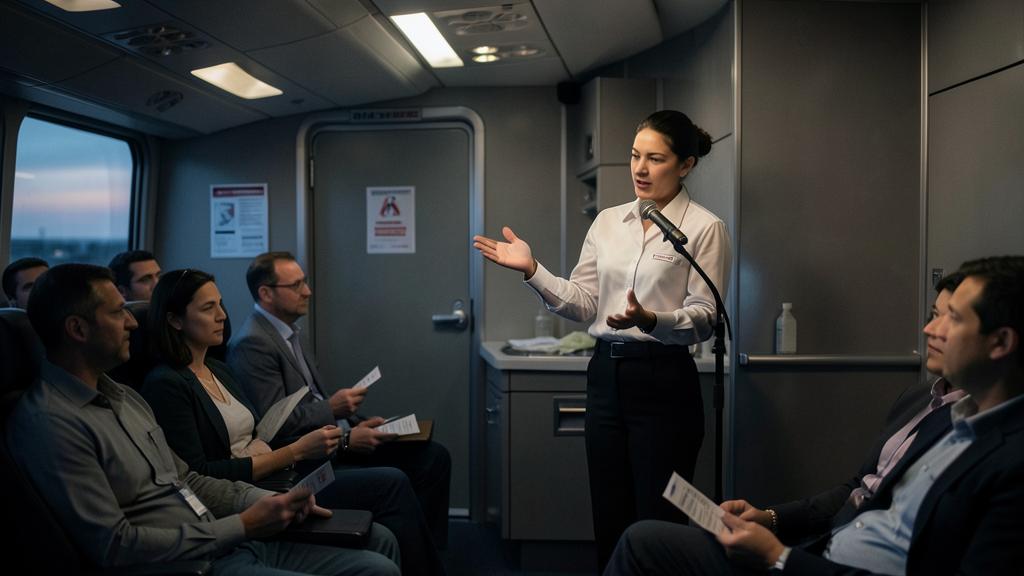
A safety instruction understood by two passengers in three has not produced the effect the manual credits it with. How many languages a cabin announcement uses, and above all in which order, decides who actually acts — and every language added is paid for in seconds that the pre-departure phase does not have. Treating that as a matter of courtesy, decided by whoever holds the handset, is how a briefing quietly becomes decoration. It is an operational choice, it has a cost, and it belongs in the operations manual rather than in the habits of the day.
What the rules require, and the large gap they leave
The obligation itself is not in doubt. ICAO Annex 6 requires the operator to ensure that passengers are made familiar with the location and use of seat belts, emergency exits, life jackets or flotation devices where carried, oxygen equipment, and the other items relevant to the aeroplane and the flight, and that passenger briefing cards are provided. EASA Part-CAT restates the same substance for European operators and requires the card to carry picture-type instructions for the emergency equipment and exits concerned.
What none of these texts do is name a language. The obligation is framed by its effect — passengers are to be familiarised — and the means are left to the operator. That is a deliberate gap, because a rule that named languages would be wrong on most routes in the world within a year. But a gap in the regulation is not a gap in the obligation: if the briefing does not reach the cabin, the operator has not discharged it, whatever was said over the handset.
Two things do get prescribed, and both are regularly overlooked in this discussion. The first is that certain passengers are to be briefed individually rather than collectively: those whose condition, mobility or age means the general announcement cannot serve them. A public address, in any number of languages, does not satisfy that requirement. The second is that crew members must be able to communicate with one another in a common language. That constraint bites on the roster, not on the cabin, and it is the reason a language-rich crew is not automatically a well-composed crew.
National requirements sit above these texts and vary sharply. Several States require their own language on flights departing their territory, whoever operates them; others impose nothing. A policy that is compliant on one route can be non-compliant three sectors later — a good argument for deciding it per route rather than per fleet.
Four kinds of message, four different rules
Most policies fail because they treat every announcement as one category. They are not. What a message must produce, and how much delay it tolerates, differ enough that the language rule should differ with them.
| Class | What it must produce | Language logic | Tolerance to delay |
|---|---|---|---|
| Pre-departure safety briefing | Recognition of exits, belts, oxygen, flotation; readiness to act later | Every candidate language, supported by card and demonstration | Some, on the ground — bounded by the cabin-secure report |
| Time-critical instruction (turbulence, brace, evacuation) | Physical action within seconds | Shortest possible, one dominant language, gesture and crew action carrying the rest | None |
| Operational information (delay, diversion, connections) | Understanding, and the patience that follows from it | Two languages usually sufficient; content matters more than coverage | High |
| Commercial and courtesy | Goodwill | The only class where additional languages genuinely pay their way | High |
Read the second row again, because it is the one most often got wrong. The instinct that says a safety message deserves more languages than a commercial one inverts the correct answer for anything time-critical. A brace command delivered in four languages is not four times safer; it is four times longer, and the last three versions arrive after the event they were meant to prepare the cabin for.
When seconds count, like during turbulence, using too many languages makes the message useless. A short, clear command in one main language, backed by actions, works best.
On an Airbus A330 flying from Paris to New York, a sudden turbulence warning is given in English only, with crew pointing to seats. Passengers are seated and belted within seconds, avoiding injuries. A four-language version would have delayed the response, missing the critical window.
Where the candidate languages come from
Five sources compete for a place in the announcement, and they rarely agree.
| Source | Typical case | Strength of the claim |
|---|---|---|
| Language of the State of the operator | Flag carrier operating anywhere on its network | Often mandatory; also the language the crew produces most reliably under stress |
| Language of the departure aerodrome’s State | Any sector leaving that territory | Sometimes mandatory; strongest during boarding, when the cabin is still local |
| Language of the destination State | Inbound sector, arrival announcements | Moderate; strongest for arrival, immigration and connection information |
| Dominant passenger group on the route | Labour flows, pilgrimage, diaspora and seasonal leisure traffic | Strongest of all when it applies, and the one no network map reveals |
| English as the working lingua franca of travel | Almost every international sector | High coverage among frequent travellers, unreliable among first-time and leisure travellers |
The fourth row is the one that separates a written policy from a guessed one. A sector between two English-speaking States can carry a cabin that is majority third-language, and a sector between two States of the same language can carry a majority of transfer passengers from neither. The manifest tells you this; the route map does not. Any operator with passenger nationality or point-of-sale data already holds the answer, and reviewing it once a season is a modest amount of work for a decision that is otherwise made by tradition.
The right reflex. Build the language list from the manifest of the route, not from the two endpoints. Then check it against the roster: a language on the list that nobody on the crew can deliver is a policy that fails on its first application.
Order is not politeness
Order is the part of this decision with the largest effect and the least deliberation. The first language spoken gets an attention no later position recovers. Just after doors closed the cabin is still moving: conversations finishing, bins being negotiated, children being settled. Whoever hears the first version hears it against that noise; whoever waits for the second or third has usually stopped listening — and once a passenger has classified an announcement as background sound, the versions that follow do not win them back.
There is a countervailing argument: the version delivered immediately before an expected action is the one most likely to be acted on. It argues for placing the operationally decisive language last when the announcement demands something now, and first when it is informational — a refinement available at zero cost that few operators exploit.
What matters more than either effect is that the order be fixed and published. Rotating it between sectors to be even-handed breaks two expectations at once: the passenger who has flown the route before no longer knows when to listen, and the crew member loses the rhythm that makes a long briefing reliable. Fix the order per route in the manual, justify it with the manifest, and take it out of the hands of the senior on the day.
The trap. A language that appears late in the sequence is easy to treat as covered because it was said. Coverage is not comprehension: the third version of a briefing delivered to a cabin that has stopped listening leaves those passengers less briefed than a well-drawn card would have.
What each additional language actually costs
The cost is not abstract, and it is not paid by the announcement. It is paid by whatever the announcement displaces. The full briefing must finish before the cabin-secure report; the report must precede line-up. Adding a third and a fourth language does not extend the taxi — it compresses the checks that follow, or it pushes the demonstration into the taxi turn where nobody watches, or it ends with a briefing still running as the aeroplane lines up.
| Phase | Concurrent cabin task | What an overrun displaces |
|---|---|---|
| Boarding | Seating, stowage, individual briefings, exit-row assessment | The individual briefings, which are the ones that are actually required to be individual |
| Doors closed to taxi | Safety demonstration, cabin and galley securing, crew seated | Compression of the securing check, or a demonstration performed during the taxi turn |
| Taxi and line-up | Sterile phase, crew seated and braced for departure | Cabin crew still standing at line-up — the single most visible symptom of an overloaded sequence |
| Descent and approach | Second cabin secure, final compliance checks | Late compliance sweep, or an arrival announcement running through the final segment |
The arithmetic is yours, since it depends on type, cabin layout, crew complement and aerodrome. Do it properly once: time the complete briefing in each language, then compare the total against the shortest taxi you genuinely fly on that route, not the average. Policies built against the average taxi fail on the day the departure runway is the near one.
The channels that do not compete for time
The public address is the only channel that is strictly sequential — one language at a time, and time is what is short. Every other channel is simultaneous, and every one is under-used.
- The safety briefing card is the only element of the briefing that is available in full, at every seat, at the same instant, in whatever form its pictograms carry. A well-drawn card outperforms a fourth spoken language by a wide margin; a badly drawn one wastes the entire channel.
- The demonstration, live or by video, is language-independent to the extent that it shows rather than narrates. A video whose meaning lives in the soundtrack has thrown the advantage away.
- Exit marking, floor proximity lighting and cabin signage are standardised precisely so that they do not need translating.
- The crew member’s own presence — pointing, demonstrating at the seat, checking a belt by hand — resolves in five seconds what an announcement cannot resolve in five minutes.
The conclusion follows directly: reserve public address time for what has no pictogram. Exit location, belt operation and brace position are all better carried visually. A twenty-minute holding delay, a diversion, a change of arrival gate or the reason the cabin has just gone dark are carried by nothing but the voice, and they are exactly the messages that get the least linguistic care.
Where multilingual policy stops: the time-critical commands
Brace commands, turbulence instructions and evacuation commands are trained as short, standard, shouted phrases for reasons that have nothing to do with language policy. They are short so they can be repeated; loud so they carry over the noise of the event; standard so the crew produces them without composing them; and paired with unmistakable gesture and posture so they work on a passenger who does not speak the language at all.
Applied to these, the multilingual instinct is actively harmful. The correct construction is one dominant language, repeated, with crew action visible throughout the cabin, and — for evacuation — the able-bodied passengers briefed at the exits during boarding, which is the moment when a language capability on board can genuinely be assigned to a place where it will matter. Turbulence is the everyday case: the instruction has to be actionable within a couple of seconds, the crew has to be seated first, and any version that arrives after the aeroplane has moved has cost more than it delivered.
The language list on a crew profile, and what it must mean
Operators reward language qualification, sometimes with an allowance, often with a rostering preference. That is sound, and it carries a specific risk: a self-declared language becomes both a constraint on the roster and a false assurance to the flight. Three quite different abilities hide behind one entry on a profile.
- Reading a scripted announcement accurately and intelligibly.
- Improvising — explaining a diversion, a medical event or a two-hour delay to an anxious cabin, answering questions individually afterwards.
- Producing standard commands under stress, at volume, without reverting to a first language.
Define which of the three your qualification actually covers, and assess it accordingly. The first is the only one a written test measures, and it is the one that matters least when something goes wrong. Pre-recorded announcements solve that first case completely — correct pronunciation, consistent phrasing, no fatigue on the fifth sector — which is a good reason to use them and a good reason to be clear about what remains uncovered.
The trap. A pre-recorded set is written for the flight as planned. After a diversion, a change of arrival aerodrome or an extended delay, it announces a situation that no longer exists, in every language, with perfect diction. The policy has to say who inhibits it and at what point, or the recording will contradict the crew in front of the whole cabin.
Wet lease, codeshare and the policy that does not travel
Under a wet lease the operating crew works to the operating carrier’s manual — including its language policy, which may share nothing with the marketing carrier’s. The passenger booked on the marketing carrier expects otherwise, and the mismatch surfaces on the first announcement. It costs nothing to settle in the contract and brief before the first rotation, and a good deal of goodwill to discover in service.
Diversions produce the same problem without a contract to fix it. The aeroplane is now on the ground in a State whose language nobody rostered for, facing passengers who need to know about accommodation, customs and onward carriage. The realistic answer is not a language, it is preparation: a short standard set of written messages, available on board or on a device, covering the handful of situations a diversion generates. Operators that have built such a set describe it as the cheapest resilience measure in the cabin manual, and the topic recurs regularly on the FL330 professional forums whenever a network disruption puts crews into unfamiliar territory.
Writing a policy that survives a bad day
A usable policy fits on a page and answers five questions without ambiguity. Which languages, per route, drawn from the manifest and reviewed each season. In which fixed order, with the reason recorded so a successor does not reopen it every year. Which message classes are exempt from the multilingual rule — the time-critical ones, explicitly, so no crew member feels obliged to translate a brace command. What a language qualification covers, of the three abilities above, and how it is assessed. And who decides, in flight, to depart from the script, because a diversion or a medical event will require exactly that.
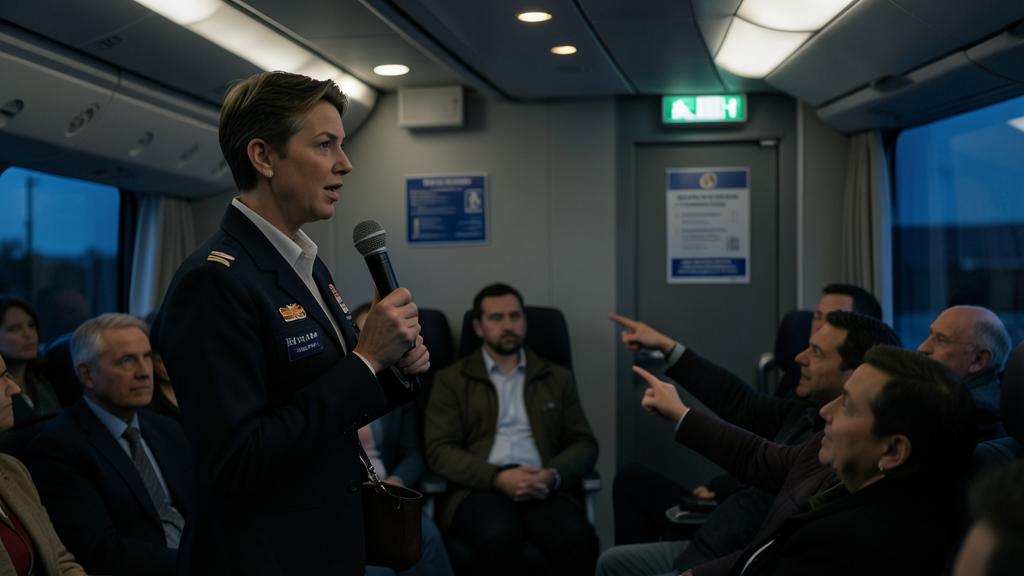
Add one measurement that almost nobody takes: after a full multilingual briefing, walk the cabin and ask a handful of passengers, in the language they were addressed in, where their nearest exit is. The answers will settle the question of how many languages your operation should be speaking faster than any argument about fairness — and they will usually point in the direction of a better card and a shorter announcement rather than a longer one.


Leave a Reply
You must be logged in to post a comment.