
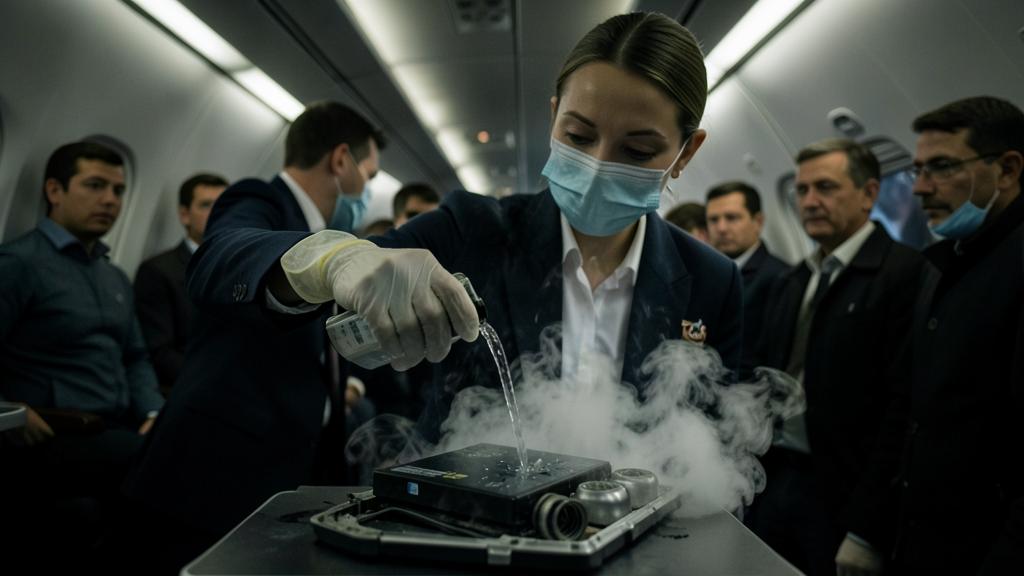
A lithium cell in thermal runaway is a fire that supplies its own oxygen, restarts after it has been put out, and gets worse if you seal it in a bag. Every reflex trained on a galley fire points the wrong way here: knocking the flame down is not the objective, smothering does not end the reaction, and the extinguisher that stops the flames leaves the cell exactly as hot as it was. What ends the event is cooling, sustained long past the point where the fire looks over.
What is actually happening inside the cell
A lithium-ion cell stores a large amount of energy next to a flammable organic electrolyte, separated from a highly reactive electrode by a plastic film a fraction of a hair’s width thick. Thermal runaway begins when something defeats that separation: an internal short from a manufacturing defect, physical crushing or puncture, overcharging, or heating from outside. The cell warms, and the warming starts a chain of exothermic reactions in which each stage produces enough heat to trigger the next.
Two features of that chain explain everything the cabin procedure asks you to do. The first is that the reaction is self-sustaining: as the cell breaks down, the positive electrode material decomposes and, in the chemistries used in most consumer devices, releases oxygen inside the cell. A fire supplied with its own oxidiser cannot be smothered, which is why an agent that works by displacing oxygen cannot be relied on to end it. The second is that heat propagates. In a multi-cell device — a power bank, a laptop battery, a spare pack — one cell in runaway heats its neighbours until they enter runaway in turn, in a cascade that can take seconds or many minutes. That is why a device can appear extinguished, sit quietly, and then vent again.
What comes out of the cell is not smoke in the ordinary sense. The vent gas is a mixture of flammable gases and electrolyte vapour that can ignite on contact with the flame, together with carbon monoxide and, from the fluorinated salts in the electrolyte, hydrogen fluoride. It is both an ignition hazard and a toxic one, and in a confined space it accumulates.
A lithium battery fire is different from a normal fire because it creates its own oxygen, so smothering it doesn’t work. Instead, you need to cool the battery down for a long time to stop the fire completely. If you don’t, the fire can restart because heat spreads to other cells.
On a flight from Paris to New York, a passenger’s power bank in the overhead bin started venting. The crew noticed a sweet smell and saw the bin’s contents swelling. They moved passengers away, opened the bin carefully, and doused the power bank with water for 20 minutes. Even after the flames stopped, the crew kept cooling it until landing, as another cell could have reignited.
The signs, in the order they arrive
The window between the first recognisable sign and open flame can be very short, and the earliest signs are not visual. Crews who catch these events early almost always catch them by smell or sound, from a passenger reporting that something is hot, or from the peculiar silence of a cabin where several people are staring at the same seat.
| What you observe | What it means | What it demands |
|---|---|---|
| Device unusually hot, casing swelling or seams opening | Cells gassing internally; runaway may be imminent | Isolate now: disconnect from power, move people, get water to hand |
| Hissing, popping or crackling; sweet or acrid chemical odour | The cell is venting; electrolyte vapour is entering the cabin | Treat as a fire in progress even with no flame visible |
| Dense white or grey vapour, often jetting from one point | Active venting; the gas is flammable and toxic | Protective equipment, ventilation, crew fire drill in full |
| Open flame, sometimes jetting sideways | Vent gas has ignited | Knock down the flame, then cool without pause |
| Flame gone, device still hot or still hissing | Not over; adjacent cells are still heating | Continue cooling with water and keep it under observation |
| Renewed venting or flame minutes later | Cell-to-cell propagation has reached another cell | Expected behaviour, not a new event; keep cooling |
Why water beats the extinguisher
The extinguisher and the water bottle do two different jobs, and the mistake is to believe the first has done the second. A halogenated agent, or any gaseous agent, attacks the flame. It is effective at that and it is what you reach for when there is fire in an occupied cabin, because the flame is what threatens the immediate surroundings. What it does not do is remove heat from the cells. When it dissipates, the cells are at the same temperature they were, the chain reaction continues, and the flame comes back.
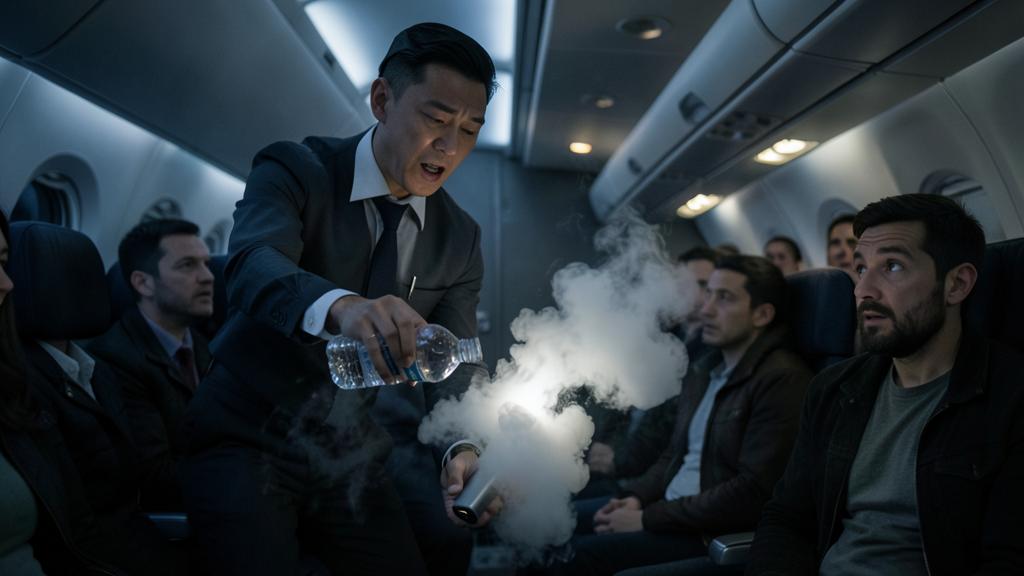
Water does the job the agent cannot. It carries heat away, and by cooling the cells that have not yet entered runaway it interrupts the propagation that is the whole mechanism of a multi-cell fire. It is not being used to suppress combustion in the conventional sense; it is being used as a coolant. Any non-alcoholic liquid to hand serves the same purpose — water, soft drinks, juice. Alcohol does not, for the obvious reason.
Two refinements of that instruction are as important as the instruction itself. Cooling has to be generous and it has to continue: pouring a single glass and standing back is the commonest way these events restart. And ice must not be used, nor dry ice. Ice insulates the device rather than drawing heat out of it, and it can leave neighbouring cells heating undisturbed under an appearance of control.
| Response | Effect on flame | Effect on cell temperature | Effect on propagation |
|---|---|---|---|
| Halogenated or gaseous extinguisher | Effective | None | None; flame typically returns |
| Water or other non-alcoholic liquid, in quantity and sustained | Effective on flame from the device | The only thing that removes heat | Interrupts it; this is what ends the event |
| Dry chemical powder | Effective | None | None, and it obscures the device you need to watch |
| Ice or dry ice | None | Insulates; heat is trapped | Can make it worse |
| Sealing in a closed container with no cooling | Contains flame | Traps heat inside | Accelerates it; gas and pressure accumulate |
Containment: what it is for, and when it turns against you
Fire containment products for cabin use exist in several forms, from heat-resistant pouches to rigid boxes, and they can be genuinely useful. They are not, however, suppression equipment, and the difference is where crews get into trouble.
A container manages flame and some of the smoke. It does nothing about heat, and a device sealed inside one continues exactly the reaction it was already running, in an enclosure that now holds the heat in. If cells are still propagating, the container becomes a vessel accumulating pressure and flammable vent gas, and opening it later admits air to hot cells in a gas-rich volume. That is a deflagration scenario, and it is the reason containment is treated in many operator procedures as a step that follows cooling, or a means of managing a device that has already been brought under control, rather than the first move.
There is a second objection that has nothing to do with chemistry. Using a containment device means approaching a cell that may be jetting flame and gas, picking up an object that may be hot enough to cause immediate burns, and manoeuvring it into an opening. Guidance from several authorities is explicit that a burning or venting device should not be picked up or moved, and no procedure should require a crew member to put their hands and face next to a vent path in order to satisfy a piece of equipment.
Where containment earns its place: a device that has been cooled and is no longer venting, needing to be secured for the remainder of the flight and handed over on the ground; a device showing early warning signs but not yet in runaway, isolated as a precaution; a controlled means of keeping a cooled device submerged and separated from cabin materials. Where it does not: as a substitute for water, and as the first action against an active runaway.
The trap. « The fire is out » is a provisional statement for a lithium event and must be passed on as one. A device that has vented and been extinguished can vent again some minutes later as heat reaches the next cell. Report it as controlled and under observation, never as extinguished, and keep a crew member and a water supply with it until the aircraft is on the ground and the device has been handed over.
Where the device is changes the whole problem
The same battery produces a different event depending on where it sits when it fails, and one location in particular has caused repeated incidents.
| Where the device is | What changes |
|---|---|
| Inside an electrically actuated seat mechanism | The classic cause: a phone or tablet slips into the seat and is crushed by the motor. If a device is reported lost in a seat, the seat must not be moved until it is found, and the passenger must be told why |
| In a bag in an overhead bin | Out of sight, and enclosed with other flammable contents; smoke may be the first sign. The bin has to be opened cautiously and the bag brought where it can be seen and cooled |
| In a lavatory | Detection exists but access is poor and the space is confined; the waste bin extinguishing system protects the bin only. A device in runaway does not belong there, and moving one into a lavatory is not a containment strategy |
| In the hold | Inaccessible in flight, which is precisely why spare batteries and power banks are required in the cabin rather than in checked baggage |
| In a galley, on a metal surface, with water available | The best place available in most cabins: visible, accessible, non-combustible surroundings, and a water supply within reach |
Talking to the flight deck
The commander does not need a narrative, and does not need it later. What is needed early, and in a form that supports a diversion decision, is short: what is burning, where it is, whether flame is present, whether smoke or fumes are in the cabin, whether passengers have been moved, and whether the source is a lithium battery. That last item changes the decision, because it changes what « under control » means.
The specific information a flight deck can act on is the possibility of recurrence. A galley oven fire that is out is out. A power bank that is out may not be. Saying so plainly gives the commander the one fact that distinguishes a manageable cabin event from one that may repeat at a worse moment, and it is the fact most often lost in a calm and reassuring report. Equally useful is a realistic estimate of the fume situation, since smoke or fumes in the cabin bear directly on the urgency of getting the aircraft down.
Cabin-side, the drill runs as it always does: someone fights, someone communicates, someone manages the passengers and keeps the aisle usable. Protective breathing equipment has a finite duration and vent gas is genuinely toxic, so relief needs to be planned rather than improvised. And the extended monitoring period after the flames stop is a real assignment that has to be given to a named crew member, not an assumption that someone is watching.
The right reflex. Fill something before you need it. The single most useful preparation once a device is reported hot or swollen is a container of water standing next to it, because the interval between the first hiss and open flame does not leave time to walk to the galley. Water first, extinguisher within reach, then everything else.
After the event, and after landing
A cooled device is still a hazard. It should stay submerged or thoroughly wetted, in a non-combustible container, under observation, and it should not be stowed in a galley waste bin or handed to a passenger. On arrival, the crew that receives it must be told what it is; a wet, blackened object on a tray means nothing to someone who has not been told it is a lithium cell that has already vented once.
The event is reportable, and the report is worth making properly. Occurrence reporting is what turns a series of isolated cabin incidents into evidence about a device type, a chemistry or a charging accessory, and passenger-carried batteries reach the aircraft with no shipper’s declaration, no performance packaging and no state-of-charge limit. The reporting system is the only visibility anyone has into them.
What the carriage rules assume about you
The dangerous goods rules for passenger-carried batteries are built around a specific assumption: that a battery failure in the cabin will be seen and dealt with, and a battery failure in the hold will not. Everything else follows from that. Spare batteries and power banks travel in the cabin only, with terminals protected against short circuit. Devices in checked baggage must be switched fully off and protected from damage and inadvertent activation. Damaged, defective or recalled batteries are not accepted at all. Electronic cigarettes and vaping devices go in the cabin, and must not be used or charged in flight.
- The energy thresholds are the part crews are most often asked about. Lithium-ion batteries up to 100 watt-hours travel without operator approval; between 100 and 160 watt-hours they require operator approval and the number of spares is limited; above 160 watt-hours they are not permitted in passenger baggage at all. For lithium metal batteries the equivalent limit is expressed in grams of lithium content rather than watt-hours. Beyond those thresholds sit operator-specific rules that vary and are tightening — restrictions on using or charging power banks in flight, and on stowing them out of sight, have been introduced by a growing number of operators, and they are operator policy rather than a single global rule, so the operations manual is the authority and not a colleague’s recollection of another airline.


Leave a Reply
You must be logged in to post a comment.