
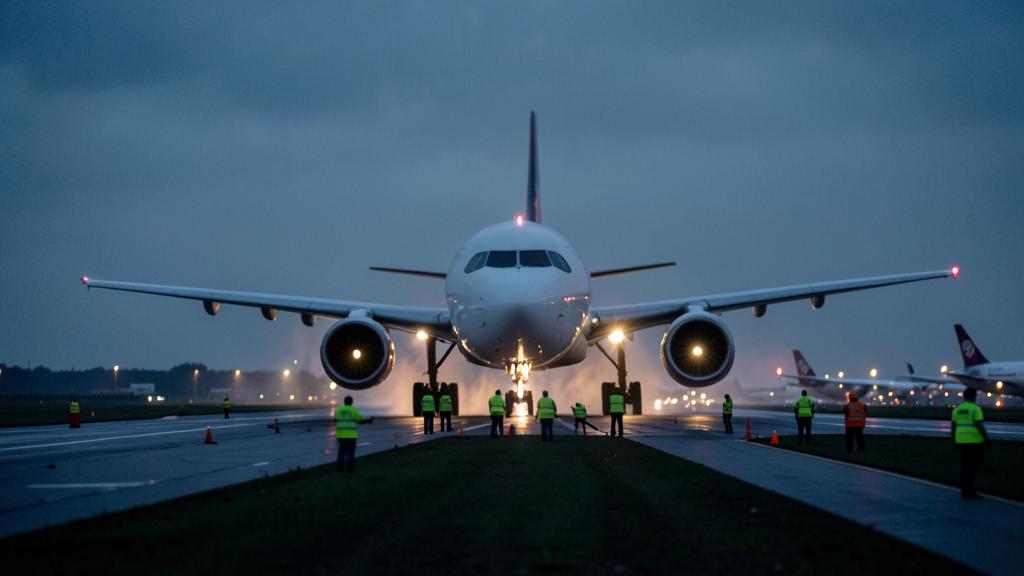
Taxi fuel is the only item in the fuel plan that is routinely a single number typed into a field and never revisited. It is also the only item consumed entirely before the flight begins, which means an error in it does not stay contained: it comes off the top of everything downstream. At a small aerodrome the flat allowance is a rounding difference. At a saturated hub, on a bad evening, it can quietly eat most of the contingency fuel before the aeroplane has lined up.
Where taxi fuel sits in the fuel scheme
In the standard structure used by ICAO Annex 6 and reflected in Part-CAT, the fuel required for a flight is built from named blocks: taxi fuel, trip fuel, contingency fuel, alternate fuel, final reserve fuel, additional fuel where required, and any extra fuel the commander decides to carry. Taxi fuel is defined as the fuel expected to be consumed before take-off, taking account of local conditions at the departure aerodrome and of auxiliary power unit consumption.
Two words in that definition do the work, and both are routinely ignored. Local conditions means the allowance is meant to be aerodrome-specific, not fleet-wide. Auxiliary power unit consumption means the rule already anticipates that a substantial part of the ground burn has nothing to do with moving.
There is a second structural point worth stating early: the scheme has no taxi-in item. Trip fuel runs to landing at destination. Whatever the aeroplane burns taxiing to the stand at the other end is taken from whatever is left — normally from the margin intended for an approach that did not happen as planned. So a long taxi at a big airport is charged twice to the same flight, once explicitly at departure and once silently at arrival.
The ground burn is not one thing
A single flat number is being asked to represent at least six physically distinct consumers, which respond to completely different drivers.
| Consumer | What drives it | Does a flat allowance track it? |
|---|---|---|
| Engine start | Number of starts; a fixed quantity per start | Yes — it is the one genuinely constant item |
| Ground idle burn | Engine-running time, number of engines running | Only if the taxi time is the assumed one |
| Auxiliary power unit | Time, and the electrical and pneumatic load on it | No — it runs on the stand, in the queue, and during de-icing |
| Breakaway and acceleration | Number of stops and starts, ramp and turn geometry, aeroplane mass | No — a queue is a sequence of breakaways, each above idle thrust |
| Queue and holding-point time | Departure demand, runway configuration, flow restrictions | No — this is the whole tail of the distribution |
| De-icing and anti-icing | Contamination, fluid application time, holdover management | No — and on the days it applies it can be the largest single item |
The flat taxi fuel number can’t account for all the different ways fuel is used on the ground. Some things, like engine starts, are predictable, but others, like waiting in line or de-icing, can vary a lot and aren’t covered by a single number.
At a busy airport like London Heathrow, a Boeing 777 might burn 1,200 kg of fuel taxiing in normal conditions. But on a snowy day with de-icing and a long queue, the same aircraft could burn 3,500 kg—nearly three times as much. A flat allowance can’t cover this difference.
The instructive line is breakaway. Idle thrust will not usually get a loaded aeroplane rolling from rest; breaking away requires a deliberate thrust increase, and the fuel flow during those seconds is well above idle. A taxi consisting of one long roll and a taxi of identical distance made of eleven stop-and-go movements in a queue are not the same event, and no distance-based estimate can tell them apart.
Time, not distance, is the real variable
Flat allowances are usually justified by an implicit distance argument: this aerodrome is big, so the number is larger. The physics does not agree. Every significant consumer on the list above, apart from start and breakaway, is proportional to time with the engines or the auxiliary power unit running.
The consequences are worth spelling out, because they are counter-intuitive.
- A short taxi with a twenty-minute wait at the holding point burns far more than a long taxi with no wait.
- A close-in stand at a congested airport can cost more than a remote stand at a quiet one.
- An aeroplane sitting at the gate with the auxiliary power unit running past its target off-block time is burning taxi fuel without having taxied at all.
- Two aeroplanes of the same type, same stand, same runway, thirty minutes apart, can differ by a factor that no static number can straddle.
Airport collaborative decision making addresses part of this, by moving waiting time from an engines-running queue to an engines-off stand. Where target start-up approval times are honoured, engine-running time on the ground falls with it. Where the target times are advisory and the queue reappears at the holding point, the fuel is burnt exactly as before — with the difference that it is now burnt after push-back, where it lands squarely in the taxi fuel account.
Why calibrating on the average is the wrong target
Taxi times at a busy aerodrome are not symmetrically distributed. They have a floor — the aeroplane cannot get to the runway faster than the taxiway geometry allows — and no ceiling. The distribution is skewed to the right: a dense cluster near the minimum, and a long tail of peak-bank departures, runway changes, single-runway operations, flow restrictions and de-icing days.
For such a distribution the mean sits above the median, and both sit well below the tail. An allowance set at the typical taxi time is exceeded on a large fraction of departures by construction — not because the estimate was careless, but because a central-tendency figure is being used as a planning value for an asymmetric variable.
The trap. A flat allowance that “works on average” is guaranteed to be short on precisely the days when everything else is also going wrong: peak bank, weather, runway change, de-icing. The errors do not cancel across flights, because the crew who needed the extra fuel and the crew who saved it are not the same crew, and only one of them is affected.
What an over-burn actually eats
An over-burn on the ground does not reduce trip fuel or alternate fuel — those quantities are still required. It reduces the fuel physically present at take-off below the planned take-off fuel, and the shortfall is absorbed by the softest layer available.
| Layer | What it was there for | Consequence of spending it on the ground |
|---|---|---|
| Extra or discretionary fuel | The commander’s own margin | Consumed first; the margin that was deliberately added disappears before departure |
| Contingency fuel | Unforeseen deviations in flight: route changes, level restrictions, wind error | Eroded before the deviations it exists for can occur |
| Alternate fuel | The diversion the plan assumes is possible | Cannot lawfully be traded on the ground; if it is short, the plan is short |
| Final reserve | The fixed holding reserve that must remain on landing | Never available; reaching it changes the flight’s status entirely |
The proportions are what make this operationally serious rather than academic. On a short sector, contingency fuel is a small quantity — a percentage of a small trip fuel, subject to a minimum — and an unplanned taxi over-burn at a congested hub is not small. The result is a flight that departs with its in-flight margin already partly spent, on a day when congestion at departure correlates strongly with congestion at arrival.
The right reflex. Compare the fuel on board at take-off with the planned take-off fuel, not the block fuel with the planned block fuel. The block figure hides the ground burn inside a larger number; the take-off figure is the one every downstream calculation was built on.
Burning less than planned is also a problem
The asymmetry is not total. If the taxi is much shorter than assumed — an immediate departure clearance, a close runway, no queue — the aeroplane arrives at the runway heavier than the plan said it would.
That matters because take-off performance was calculated for a mass. A take-off mass above the performance-limited mass is not a margin question; it is a limitation. Operators handle this with a check at the holding point rather than a rule of thumb, and it is one of the arguments for setting taxi fuel from data rather than generously: an allowance padded “to be safe” is an allowance that will sometimes leave the aeroplane above its permitted mass, or force a burn-off delay that costs more than it saved.
Winter is where the flat number fails hardest
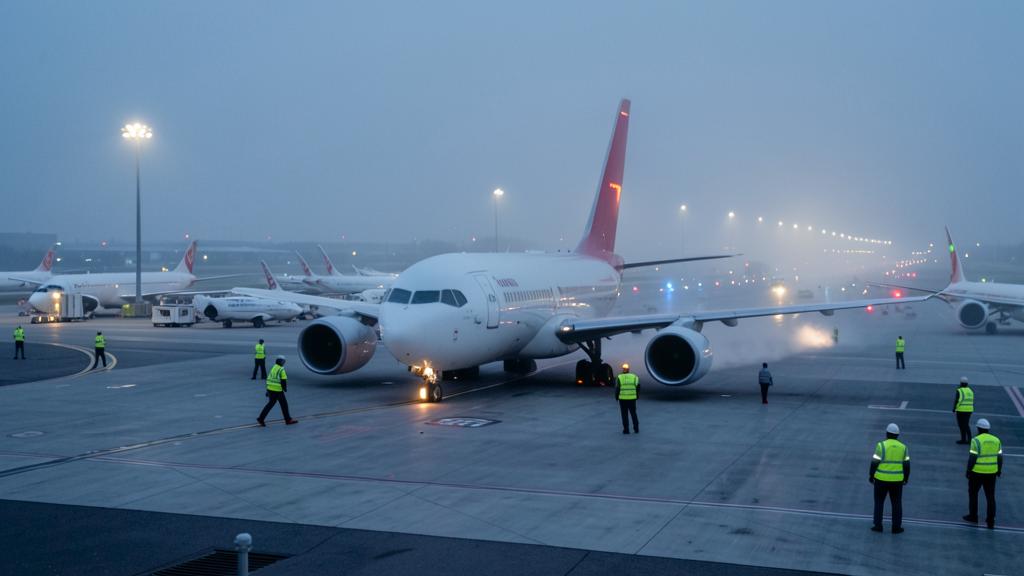
De-icing breaks every assumption in a flat allowance simultaneously. The aeroplane is stationary with engines and auxiliary power unit running, sometimes for a long period. It may taxi to a remote de-icing pad, adding both distance and a second queue. Holdover time then imposes a deadline, and a missed deadline means a return for a second treatment, doubling the whole sequence. Snow and slush on the taxiways raise rolling resistance, so breakaway and taxi thrust are higher than on a dry surface.
A single annual allowance cannot represent both a July afternoon and a January morning at the same aerodrome. The minimum credible refinement is seasonal; the honest one is condition-based, with the de-icing sequence estimated as its own item rather than folded into a taxi figure.
Building an allowance from data instead of habit
The rule asks for local conditions to be taken into account, and most operators already hold the data that would do it. Off-block and take-off times are recorded automatically on most modern fleets, which yields a measured engine-running time for every departure recorded. From that, a defensible allowance can be built with the same logic used elsewhere in the fuel scheme.
- Segment the data. By aerodrome first, then by departure runway, by stand area, by hour of day and by season. These are the variables that actually move the distribution.
- Choose a percentile, not a mean. The choice is an explicit statement of how often the operator accepts being short, and it is a policy decision that belongs in the fuel policy document rather than in a planning system’s defaults.
- Separate the auxiliary power unit. Its consumption is time-based and type-specific, and it behaves differently from the engines; folding it into a single figure hides the largest source of variation on delayed departures.
- Treat de-icing as its own item, triggered by conditions rather than averaged into the year.
- Review against outcomes. The measure of a good allowance is not that it is never exceeded, but that the frequency and size of exceedance match what the policy said would be accepted.
The same data supports the opposite conclusion where it is warranted: many aerodromes are consistently cheaper than their flat allowance, and carrying fuel has a cost of its own, since additional mass burns additional fuel for the whole sector. Precision cuts in both directions, which is what makes it worth doing rather than simply adding a margin everywhere. Operators and flight planning specialists compare approaches to this on the FL330 forums.
What is still available after push-back
Once the aeroplane is off the stand the fuel on board is fixed, and the options narrow to managing the burn rate and re-assessing the plan.
- Reduced-engine taxi, where the type and the conditions permit it, removes a substantial share of the engine component — subject to the published minimum warm-up period before take-off, brake and steering considerations, contamination, and the higher breakaway thrust required on the remaining engine.
- Auxiliary power unit management, which is a real lever precisely because its burn is time-based and independent of movement.
- An early, explicit re-assessment. If the queue is visibly long, the useful moment to recompute the fuel at take-off is while returning to stand is still cheap, not at the holding point where the only remaining options are expensive.
And the general principle behind all three: a known long taxi should be planned as taxi fuel, openly, with the aerodrome and the conditions named. Disguising it as extra fuel or as commander’s discretion produces the right quantity of fuel and the wrong record, and the record is what allows the allowance to be corrected for everybody else next time.
What a constant cannot represent
Taxi fuel is a time-driven, right-skewed, aerodrome-specific quantity being represented by a constant. That works where the variance is small and fails where it is large, which is exactly where the consequences are worst. The fix is not a bigger constant. It is a distribution, a stated percentile, and a de-icing item that is allowed to exist on its own.


Leave a Reply
You must be logged in to post a comment.