
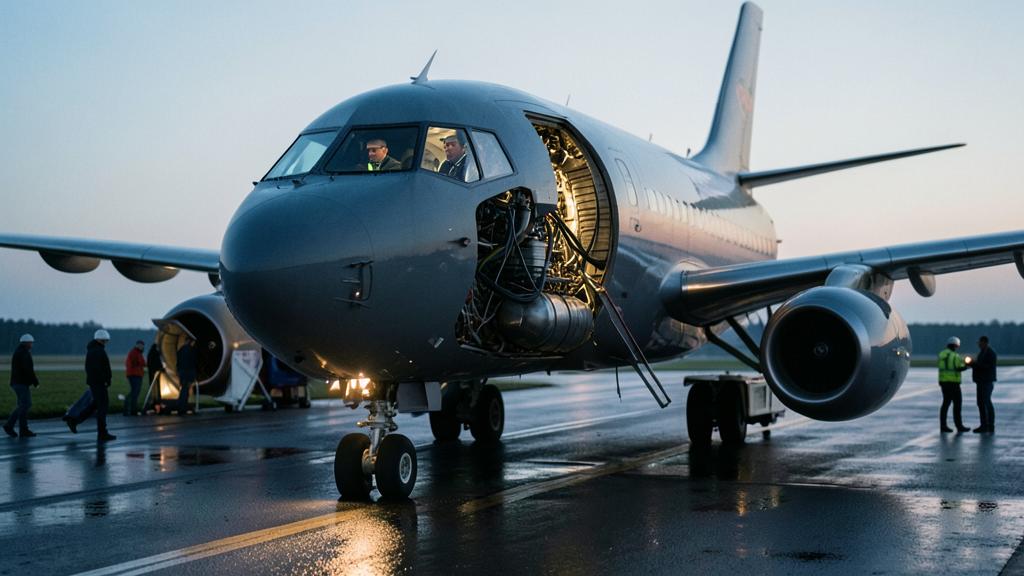
Mass and balance is computed once, before the doors close, and what comes out of it is a takeoff figure. From engine start onwards the centre of gravity moves — dragged by the tank sequence, nudged by everything that walks up and down the aisle, and travelling towards a destination that was fixed the moment the last bag went into the hold. The envelope has to hold for the whole sector, not for its first minute, and the number on the loadsheet says almost nothing about where the aircraft will be balanced when it touches down.
The loadsheet is a snapshot of a moving quantity
A loadsheet gives a small set of instants: a dry operating mass and index, a zero fuel mass and its centre of gravity, a takeoff mass and its centre of gravity, and — depending on the operator and the format — an estimated landing mass with its own balance figure. Everything the crew does with that document happens at one of those instants. The stabiliser trim setting is derived from the takeoff centre of gravity, with the flap setting as a second input on the types that use one; it is a single number computed for a single moment of a single flight phase.
The obligation is broader than the document. Certification demonstrates handling and structural compliance at the critical loading conditions of the envelope, and the operating rules require the aircraft to be within its limits throughout the operation. Between the takeoff instant and the landing instant nobody re-computes anything, which means the drift has to be predictable enough to be trusted without being measured. It is — but only if you know what is driving it.
The loadsheet only shows balance at a few key moments, but the aircraft’s balance changes constantly in flight. Crews must understand how fuel burn and passenger movement affect balance over time, not just at takeoff.
Zero fuel is where the centre of gravity is heading
The most useful figure on the loadsheet for understanding the sector is not the takeoff centre of gravity. It is the zero fuel one. That value depends on the payload distribution alone: crew, catering, passengers by zone, bags and freight by hold. It does not change in flight, barring movement in the cabin. Every kilogram of fuel on board is a temporary correction applied on top of it, and as that correction is consumed the centre of gravity travels back towards the zero fuel value.
That gives a free piece of situational awareness on every flight. Compare the zero fuel centre of gravity with the takeoff one: the difference tells you the direction of travel and roughly how far the aircraft will move over the sector. If zero fuel is forward of takeoff, the aircraft will get progressively nose-heavy as it burns. If it is aft, the opposite. Neither is a problem in itself. Not knowing which one you have is.
The one thing the comparison does not give you is the shape of the journey. The path is not a straight line between the two points, because tanks do not empty simultaneously and each one sits at its own distance from the reference datum.
On an Airbus A320, if the zero fuel CG is at 25% and the takeoff CG is at 28%, the aircraft will gradually become more nose-heavy as fuel burns. At 10,000 feet, with 12,000 kg of fuel remaining, the CG might shift to 26%. The exact path depends on which tanks are being used.
The tank sequence is a structural decision before it is a balance one
Fuel in the wings is not simply stored there for want of space. In flight the wing carries the aircraft, and the bending moment at the wing root is set by the lift outboard of it minus the weight distributed along the span. Fuel in the wing is weight in the right place: it relieves the root, and it also contributes mass distribution that matters to flutter margins. That is why the usual sequence empties fuselage and centre tanks first and keeps wing fuel — particularly outboard wing fuel — for last, often by transferring outer tank contents inboard rather than feeding an engine directly from an outer tank.
The longitudinal balance consequence of that sequence is a by-product the designers then had to live with. On a swept wing it is not a small one: outboard fuel is not only further from the fuselage, it is significantly further aft. Burning it moves the centre of gravity forward, and it happens at the end of the flight, when the aircraft is light and the shift per kilogram is at its largest. This is why the fuel balance correction published in aircraft data is presented as a curve or a table against fuel remaining rather than as a single coefficient.
| Tank group | Position relative to the balance reference | Normally emptied | Why the sequence is set this way |
|---|---|---|---|
| Centre or fuselage tank | Close to the centre of gravity; short arm | First | Contributes nothing to wing bending relief; emptying it early has the smallest balance effect per kilogram |
| Inner wing tanks | Near the mean aerodynamic chord; moderate arm | After the centre tank, feeding the engines | Main feed tanks; keeping them full early preserves root bending relief |
| Outer wing tanks | Outboard and, on a swept wing, distinctly aft; long arm | Last, usually by transfer inboard | Maximum bending relief and mass distribution kept as long as possible |
| Trim or stabiliser tank, where fitted | Far aft; very long arm | Managed actively, not simply consumed | Deliberate control of the cruise centre of gravity to reduce trim drag |
| Auxiliary or body tanks, where fitted | Type-specific; usually in the cargo compartments, forward or aft of the wing box | Type-specific, per the flight manual | Range extension; the balance consequence is handled by procedure |
Trim tanks turn the centre of gravity into a control input
On the types fitted with an aft trim tank, the drift is not a drift at all. Fuel is pumped aft during the climb and cruise to hold the centre of gravity near the rear of the usable range, because a rearward centre of gravity reduces the download the tailplane has to produce and therefore reduces trim drag. The system then moves the fuel forward again before descent, and it does so automatically on a range of failure conditions.
The crew’s task on those types is different in kind. It is not to predict a drift but to monitor a system that is deliberately holding the aircraft near a limit, and to know what the aircraft becomes if the transfer stops working in the wrong direction. A forward transfer that fails leaves the aircraft light and aft-loaded for the approach, which is a demanding combination in the flare. The procedures exist and they carry configuration and speed consequences; they are worth reading before the day you need them rather than on the day.
The trap. A mass-neutral loading error is invisible on every total on the loadsheet. Two zones swapped, or a hold count entered against the wrong compartment, leaves the takeoff mass correct, the fuel figures correct and the performance calculation apparently valid, while the balance is wrong from pushback and stays wrong for the whole flight. Only a zone-by-zone and hold-by-hold check catches it; comparing totals never will.
What the cabin actually contributes
The honest answer depends entirely on scale, and generic advice on this subject is what makes crews either complacent or needlessly anxious. On a large transport aircraft, one occupant moving the length of the cabin is a small moment against a mass measured in tens of tonnes, and it is absorbed by the margins the envelope was drawn with. On a nine or nineteen seat commuter, that same person is a meaningful fraction of the useful load and the aircraft flight manual may well restrict where they sit and whether they may move.
What does not scale away, on any size of aircraft, is the difference between movement and misdeclaration. Movement is bounded by cabin geometry and by how many people can physically be in one place. A zone loaded with the wrong number of passengers is not bounded by anything: it is a static error, present before the aircraft moves, and it can be larger than every in-flight movement of the sector put together.
| Event | Mass involved | Arm | Visible on the loadsheet? |
|---|---|---|---|
| Passengers moving during the service | A few occupants at a time | Bounded by cabin length | No — absorbed by envelope margin on large types, restricted by the flight manual on small ones |
| Crew rest occupation on long haul | Several crew members | Can be substantial where the rest compartment is at one end of the aircraft | No — accounted for in the operator’s standard crew distribution, not per flight |
| Galley carts moved for service | Type and configuration dependent, but not negligible | Galley to galley, so often the full cabin length | No |
| Potable water consumed, waste accumulated | Small net change; the two are usually at different stations | Fixed by tank position | Included in the dry operating figures, not tracked in flight |
| A zone or hold loaded against the wrong compartment | Whole groups of passengers or bags | Full aircraft length in the worst case | Not in any total — only in the detail lines |
| Last minute change accepted after the loadsheet is issued | Whatever was added or removed | Wherever it was put | Only if the change is processed through the approved procedure |
Both ends can be legal and the middle not
The envelope is drawn against mass, and its edges are not vertical. Forward and aft limits vary with weight, for reasons that have nothing to do with each other: pitch authority and structural cases on one side, static stability margin on the other. The aircraft’s journey through the flight is therefore a curve on that diagram, moving down in mass and sideways in balance at the same time, and the curve bends every time the active tank group changes.
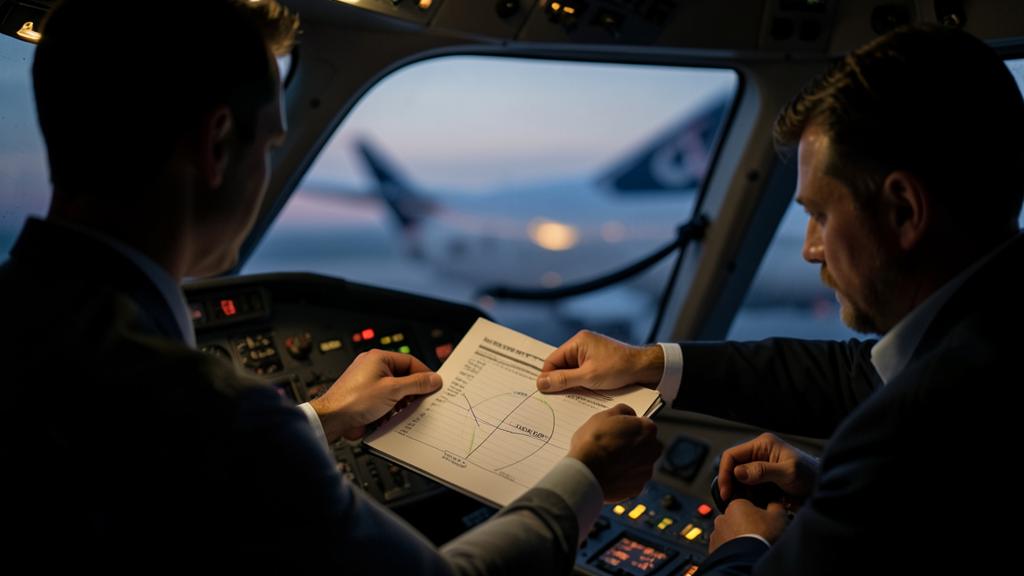
Two consequences follow. The first is that a takeoff point inside the envelope and a landing point inside the envelope do not, by themselves, prove that everything in between was inside it — which is precisely why the balance correction for fuel is published against fuel quantity rather than assumed linear, and why some operators compute an intermediate check point on loadings known to be near an edge. The second is that the reverse case exists: a loading that is out of limits at takeoff mass can be comfortably inside once a fuselage tank has been consumed, which is a planning fact, not a licence to depart out of limits.
Lateral balance follows the same reasoning. Fuel imbalance limits between wing tanks are published, the allowable figure varies with fuel quantity or flight phase on some types, and an imbalance that develops slowly through a transfer fault is the kind of thing that is noticed late precisely because nothing else changes.
| What you observe | Direction of travel over the sector | What deserves attention |
|---|---|---|
| Zero fuel balance forward of the takeoff figure | Progressively nose-heavy as fuel burns | Trim and elevator demand in the flare, go-around pitch behaviour, approach handling at low mass |
| Zero fuel balance aft of the takeoff figure | Progressively tail-heavy as fuel burns | Pitch sensitivity on approach, over-rotation and tailstrike exposure, nose gear loading on landing |
| Large fuselage or centre tank load | Small early movement, then a marked change when the wing tanks take over | The knee in the curve rather than the endpoints |
| Swept wing with outboard tanks emptying last | A forward shift concentrated at the end of the flight | The lightest phase is also where a given fuel quantity moves the balance furthest |
| Trim tank fitted and active | Commanded aft in cruise, commanded forward for descent | Failure of the forward transfer, and the approach that results |
The end of the sector is the demanding end
By touchdown the aircraft is at its lightest and its balance is usually close to the zero fuel value. The handling consequences depend on which side of the envelope that value sits.
Forward, at low mass, the tailplane is producing its largest download relative to the aircraft’s weight. The wing therefore has to lift more than the aircraft weighs, which raises the stall speed slightly for a given mass, and the flare requires more elevator and more sustained back pressure than the crew’s recent experience may suggest. A go-around from that condition combines a large nose-up thrust couple on an underwing-engined type with an aircraft already trimmed nose-up, and the pitch response is a specific case worth having thought about.
Aft, at low mass, the aircraft is light in pitch and willing. Rotation in the flare comes easily, over-rotation comes just as easily, and the tailstrike geometry does not care that the loading was legal. The nose gear is lightly loaded, which changes steering authority and weight transfer under braking on a contaminated surface.
The right habit. Before pushback, read the zero fuel balance figure alongside the takeoff one and say out loud which way the aircraft will move. It costs no additional computation, it uses two numbers already printed in front of you, and it converts an abstract envelope into a concrete expectation for the approach you will fly three hours later.
What this changes in daily practice
Nothing in this makes the loadsheet less authoritative. It makes it narrower than it looks. The document certifies a loading state and produces a trim setting; it does not describe the flight, and the drift it implies is left to the crew to anticipate.
The practical takeaways are short. The zero fuel balance is where the aircraft is going, and it is already on the paperwork. The tank sequence explains the shape of the trip, and it was chosen for the wing, not for the balance. The cabin matters in inverse proportion to the size of the aircraft, while zone and hold errors matter at every size. And the approach is flown at the far end of the drift, not at the takeoff figure — which is the whole reason for looking at both numbers before you leave the gate. Type-specific behaviour near the edges, and the fuel curves that go with it, get compared in detail on forums.fl330.com.


Leave a Reply
You must be logged in to post a comment.