
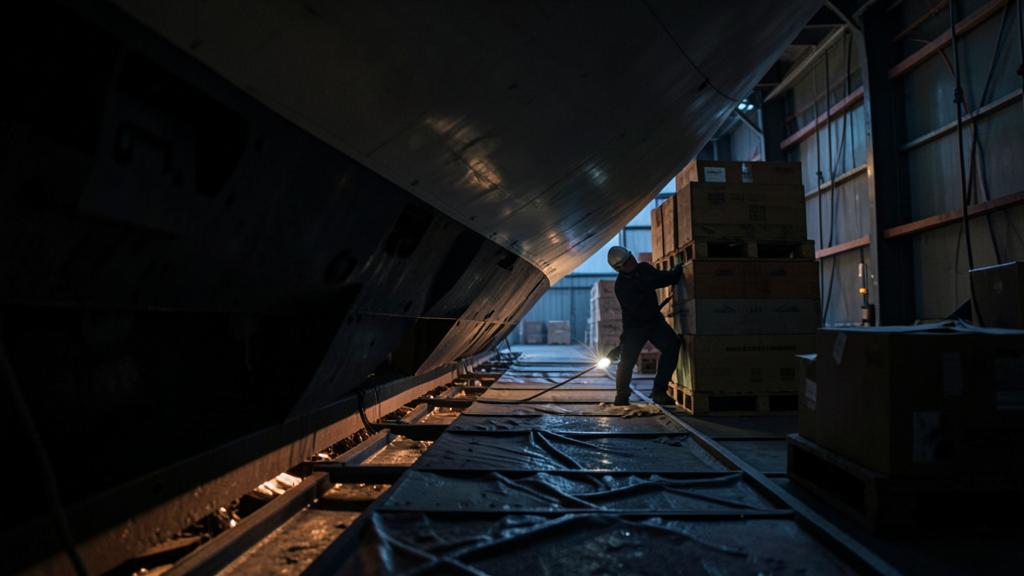
The index on a loadsheet is one of the most efficient pieces of arithmetic in commercial aviation: it turns a fuselage full of scattered masses into a single additive number that a crew can check in seconds. Its efficiency comes from throwing information away, and what it throws away is everything except the moment. Two loads of the same mass with the same centroid produce the same index whether they are spread over three metres of hold floor or stacked on one. The centre of gravity is identical. The force on the floor beams underneath is not. A loadsheet can be entirely correct while the aeroplane is loaded outside its structural limits, and nothing on that sheet will say so.
What an index is, arithmetically
Balance is a moment problem: each mass contributes its weight multiplied by the distance from a reference. Working directly in moments is possible but unpleasant — the numbers are large, they change with the units used, and some of them are negative depending on where the reference datum sits. The index is a rescaled, offset moment designed to remove all three annoyances.
| Element | What it is | Why it is there |
|---|---|---|
| Mass | The mass at the position considered | The physical quantity being balanced |
| Balance arm | The distance of that position from the aeroplane’s datum | Converts mass into a moment |
| Reference arm | A chosen station, often near the middle of the envelope | Makes typical index values small and centred, so errors stand out |
| Scaling constant | A divisor chosen by the manufacturer or the operator | Keeps the numbers to a readable size for a trim sheet |
| Constant offset | A fixed number added to every index | Keeps every value positive, so nobody loses a minus sign |
Because the mass appears linearly and the rest of the expression is fixed for a given position, index contributions are additive. That is the property everything else rests on. A dry operating index is published for the aeroplane as prepared; each hold, each cabin zone and each fuel state has a published index influence per unit of mass; the loadsheet adds them up and reads a centre of gravity, and on many operations a stabiliser trim setting, off the result. It is fast, it is checkable by hand, and it has been the backbone of load control for decades for exactly those reasons.
What the index quietly assumes
The index influence published for a compartment is the influence of mass placed at that compartment’s assumed centroid. That assumption is invisible on the loadsheet and it is not always true. A long hold loaded entirely at its forward end has a real arm different from the one the table used, and the resulting index is slightly wrong — in the direction nobody computed.
Aircraft designers deal with this by subdividing. Holds are broken into sections with their own arms and their own index influences precisely so that the assumed centroid stays close to the real one. That subdivision is also why the loading instruction speaks in sections and positions while the loadsheet speaks in compartment totals: the finer document exists because the coarser one had to assume something.
So the first thing the index cannot see is a distribution inside a compartment that differs from the assumed one. The second thing, and the more consequential, is that it cannot see the floor at all.
The limits on a hold, and the one the index checks
A hold carries several independent constraints, each protecting a different piece of structure. Only one of them is a moment question, and it is the only one the index was ever built to answer.
| Limit | Expressed as | Protects | Does the index see it? |
|---|---|---|---|
| Compartment maximum mass | A total mass for the compartment | Local structure and restraint provisions | No — the loadsheet checks it separately, from the compartment total |
| Distributed or area load | Mass per unit area | The floor panels themselves, against puncture and permanent deformation | No |
| Running or linear load | Mass per unit length along the fuselage | The floor beams and the fuselage frames carrying them | No |
| Cumulative load across adjacent compartments | A combined mass for two or more compartments together | Fuselage shear and bending in that section | No |
| Centre of gravity | An index, or a percentage of mean aerodynamic chord | Controllability and stability in flight | Yes — this is the only one it is for |
Point loading is a further case sitting underneath the area limit: a heavy item resting on a small footprint, or on castors or feet, concentrates its whole mass into a few square centimetres. Spreader boards exist to convert a point load into a distributed one by enlarging the footprint until the pressure falls under the limit. Their sizing is arithmetic, not a habit — a board too small does nothing useful.
The loadsheet index only checks the balance of the plane, not how the weight is spread on the floor. Even if the total weight is correct, stacking heavy items in a small space can damage the floor because the index doesn’t account for how much weight is pressing down per square metre or per metre of length.
An Airbus A320 has a maximum area load of 1,000 kg per square metre for its cargo hold. If you load 600 kg of dense cargo (like machinery) into a 1.2 m² space, the area load becomes 500 kg/m², which is safe. But if you load the same 600 kg into a 0.6 m² space, the area load jumps to 1,000 kg/m², which is at the limit. If you load it into a 0.3 m² space, the area load becomes 2,000 kg/m², which is way over the limit and could damage the floor, even though the total weight is still 600 kg.
Same index, different structure
The clearest way to see the gap is a comparison in which the loadsheet is literally identical. Take one hold section and two ways of filling it with the same mass, centred on the same station. The figures below are an illustration, not limits: the permitted values are type-specific and come from the aeroplane’s weight and balance documentation.
| Loading A — spread | Loading B — concentrated | |
|---|---|---|
| Mass in the section | 600 kg | 600 kg |
| Centroid | Section centre | Section centre |
| Length of floor occupied | 3 m | 1 m |
| Floor area occupied | about 6 square metres | about 1.2 square metres |
| Running load | 200 kg per metre | 600 kg per metre |
| Area load | 100 kg per square metre | 500 kg per square metre |
| Moment about the datum | Identical | Identical |
| Index contribution | Identical | Identical |
| Loadsheet | Correct | Correct, and possibly outside structural limits |
Three times the running load and five times the area load, for the same line on the loadsheet. This is not a corner case: it is what happens whenever dense cargo goes into a bulk hold. Machinery, engine components, stone, batteries, dense printed matter and metal stock all concentrate a substantial mass into a very small footprint. The compartment total looks unremarkable; it says nothing at all about the pressure underneath.
The trap. Every check performed on the loadsheet — total mass, compartment totals, index, centre of gravity, trim setting — can pass while the floor is overloaded, because none of them takes a dimension as an input. The loadsheet arithmetic works in mass and distance from the datum; running load and area load work in mass per unit length and per unit area. There is no path from one to the other. A compliant loadsheet is evidence about balance and about totals, and about nothing else.
The limit that lives between compartments
Cumulative limits are the least intuitive of the four and the easiest to miss, because nothing in either compartment looks wrong. Adjacent holds each have their own maximum, but the sum permitted across a pair or a group is often lower than the sum of the individual maxima. The reason is structural: the fuselage between them is carrying the shear and bending produced by both, and the section has a limit of its own that neither compartment’s figure reflects.
The failure mode is a load plan that fills two adjacent holds to somewhere near their individual limits. Each compartment total passes its check. The pair does not, and the only document that says so is the one that states the combined limits — the aeroplane’s weight and balance manual and the loading instruction built from it. A crew reading only compartment totals on a loadsheet has no way of detecting it.
Two documents, two signatures, two different responsibilities
The reason the system works at all despite everything above is that the distribution is not supposed to be controlled from the loadsheet. It is controlled from the loading instruction, which is a different document produced for a different reader.
- The loading instruction and report states where each item, container or pallet goes: compartment, section, position. It is built against the compartment maxima, the running and area load limits, the cumulative limits, the restraint provisions and any segregation requirement. It goes to the loading supervisor, who loads to it and returns it reporting what was actually put where — including any deviation.
- The loadsheet states totals and the resulting balance: operating mass, traffic load, fuel, take-off and landing masses against their limits, index and centre of gravity, and the trim setting. It goes to the commander, who accepts the flight on those figures.
Two documents, two acceptances, two distinct competencies. The commander is not in a position to verify running loads in a hold and is not asked to. What the commander is entitled to rely on is that a returned loading instruction reflects the aeroplane as actually loaded — which is exactly why a deviation reported late, or not reported at all, breaks a chain that has no other link.
The right reflex. When a load changes after the loading instruction has been issued, ask two questions rather than one. First, what does it do to the index — the one the loadsheet answers. Second, what does it do to the distribution: which compartment, which section, what footprint, and does the compartment total, the running load or a cumulative limit move. An answer to the first question alone is not an answer.
Where last-minute changes go wrong
The last-minute change procedure exists because traffic moves after the loadsheet is produced, and reissuing the whole document for every bag would stop the operation. Its logic is a correction: a mass change and its index effect, applied on the face of the sheet, within limits of mass and index that the operator’s procedures define, beyond which a new loadsheet is required. Those limits are type- and operator-specific and they are stated in the operations manual.
The mechanism handles balance correctly and cannot, by construction, handle distribution. A late addition of freight into a hold produces a correct index correction, a correct new centre of gravity, and no statement whatsoever about whether that hold is now over its compartment maximum, whether the item’s footprint respects the area limit, or whether the pair of holds it belongs to has now exceeded a cumulative limit. Where operators get this right, the procedure requires the change to be routed back through load control and the loading instruction rather than applied as a figure on the sheet alone. Where they get it wrong, an index correction is treated as the whole answer, and the structural question is never asked by anyone.
What this changes in practice
None of this makes the index unreliable. It is exact for what it does, and treating it with suspicion would be the wrong lesson. The right lesson is narrower: the loadsheet answers a moment question, and a moment question has no opinion about a floor. Structural loading is answered by a different document, by a different person, against limits that never appear in the balance calculation.
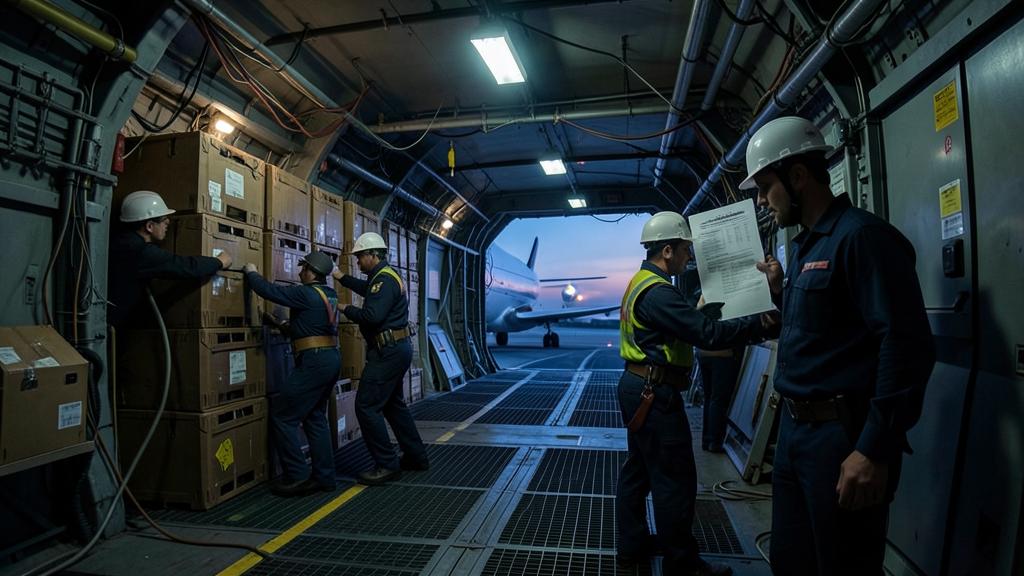
That has a concrete consequence for anyone reading these documents professionally. When something is unusual — dense freight, an outsize item, a late addition, a load concentrated in one part of a hold, an aircraft change with different compartment geometry — the question to ask is not whether the index still closes. It will. The question is whether the distribution was re-examined against the limits that mass per unit length and mass per unit area impose, and whether the person who signed for that distribution saw the load as it was finally arranged. Damage from an overloaded hold floor is usually found long afterwards, on an inspection, with no way left to trace which sector caused it. The paperwork that would have prevented it existed the whole time; it simply was not the sheet everybody was looking at.


Leave a Reply
You must be logged in to post a comment.