
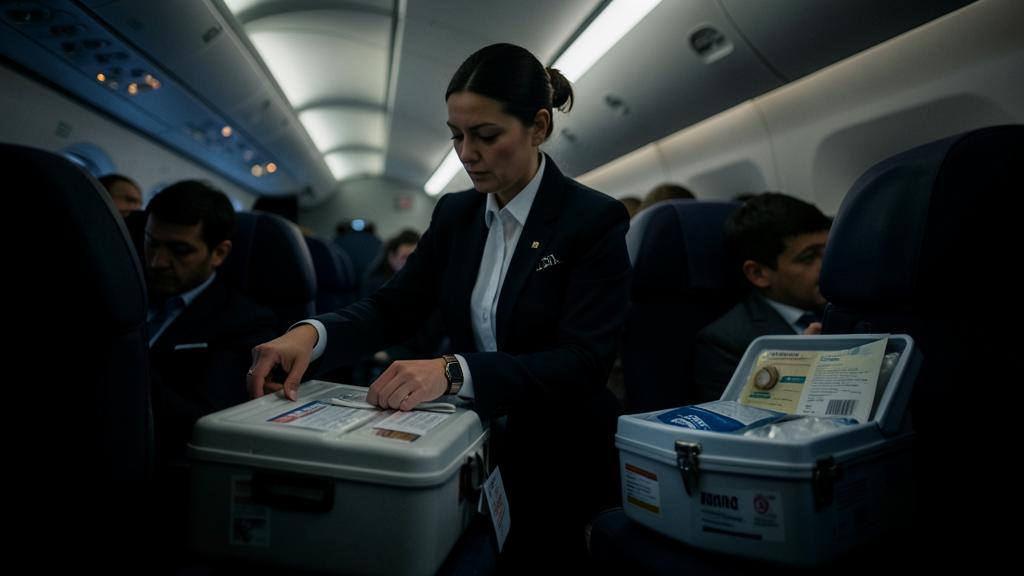
Two kits sit in the cabin and they are not two sizes of the same idea. One is opened by cabin crew whenever it is needed, and nothing much follows. The other is sealed, opened on the commander’s authority, and its opening starts an administrative chain that runs from the cabin log to the operator’s medical adviser and, on a bad day, to the dispatch of the next sector. The separation is not caution for its own sake: it follows from a single question, which is who is qualified to decide.
Two kits, two different questions
A first-aid kit answers the question a trained non-clinician can answer. Someone is bleeding, has burned a hand, has fainted, has been sick. The response is dressing, positioning, reassurance, observation, and there is no decision in it that requires a diagnosis. Cabin crew are trained to that standard, they are recurrently checked on it, and the kit is stocked so that everything inside can be used correctly by someone with that training and no more.
An emergency medical kit answers a question that a trained non-clinician cannot answer. It contains prescription medicines, injectable drugs, airway devices and instruments whose correct use depends on a diagnosis, on knowing the contraindications, and on being able to manage what happens if the intervention goes wrong. Nothing about the aircraft changes that; a syringe on board is the same syringe as on the ground, and so is the judgement it requires.
That is the whole logic of the separation. The kits are divided by the competence needed to use their contents, not by the seriousness of the event. A serious event handled with dressings and oxygen stays in the first kit. A minor-looking event that needs a prescription drug goes to the second one, with everything that implies.
The first-aid kit is for simple injuries that cabin crew can handle. The emergency kit is for serious medical issues that need a doctor’s expertise. The difference is about who can safely use the tools inside.
What is in each, and why the line falls there
Content lists are set partly by rule and partly by the operator, and the balance differs by jurisdiction. Both the ICAO framework and the European operating rules require a first-aid kit on passenger aircraft, in a quantity that scales with the number of passenger seats, and require an emergency medical kit on aircraft above a defined seating threshold operating beyond a defined flight time from an aerodrome where qualified medical help could be expected. The threshold figures themselves belong to the applicable rule and to the operator’s approval; they are not universal, and quoting one carrier’s numbers at another is a good way to be wrong.
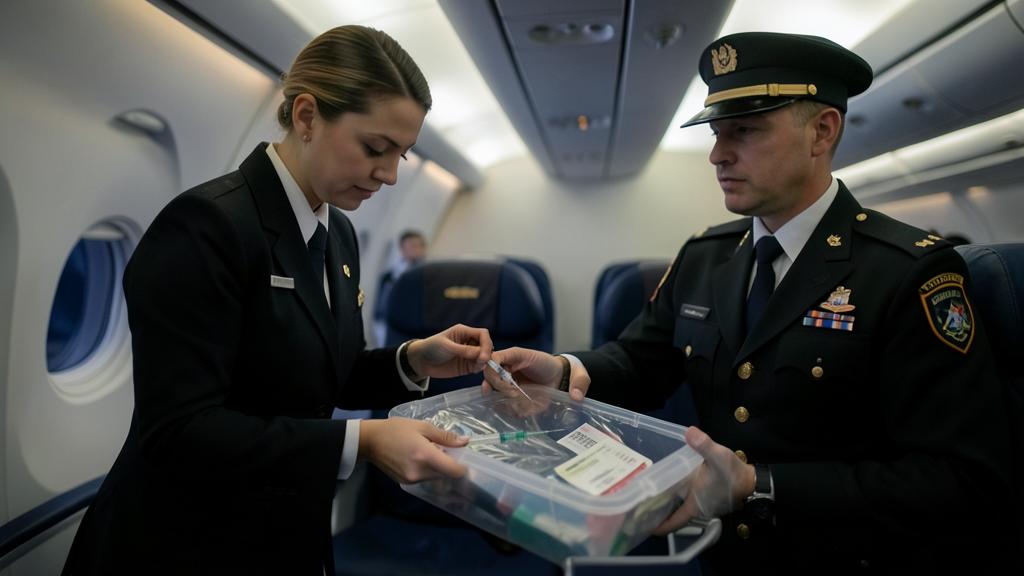
The FAA takes a more prescriptive line on contents, publishing a minimum list for the emergency medical kit in an appendix to its air carrier rules and requiring an automated external defibrillator on aircraft meeting stated criteria. The European rules state the requirement and publish a suggested content list as guidance rather than as a binding schedule, leaving the operator, advised by its medical adviser, to settle the detail. That is why two European carriers can carry visibly different kits and both be compliant. Neither approach is loose: the difference is where the discretion sits.
There is also, on most passenger operations, a third item that is neither of the two: a universal precaution kit, carried to deal with potentially infectious material and to protect the crew handling it. It is not a medical kit at all. It is personal protection and contamination control, and it is opened as part of the same sequence as the first-aid kit rather than as a clinical decision.
| First-aid kit | Emergency medical kit | Universal precaution kit | |
|---|---|---|---|
| Intended user | Cabin crew, trained in first aid | Qualified medical professional | Cabin crew |
| Content family | Dressings, bandages, simple non-prescription items, basic instruments | Prescription and injectable drugs, airway and vascular devices, diagnostic instruments | Gloves, mask, absorbent material, waste containment, disinfectant |
| Access | Open as required, no prior authority | Sealed, opened on the commander’s authority | Open as required |
| Typical trigger | Any first-aid situation | A qualified responder is available and requests it | Blood or body fluid to be handled or cleaned |
| Quantity carried | Scales with passenger seating | Generally one, where required at all | Operator policy, commonly more than one |
| Paper generated by use | Cabin log entry and restock | Full medical incident file | Cabin log entry and restock |
On an A320 with 180 seats, the first-aid kit must contain at least 100 bandages and 10 pairs of scissors. The emergency kit, if required, might include 5 ampoules of adrenaline and 2 doses of aspirin, but only if a doctor is on board to use them. If the seal is broken, the aircraft may not be dispatched until a replacement kit arrives.
Who may open what, and on whose authority
Cabin crew open the first-aid kit on their own initiative. There is no permission to seek, and hesitating over it is a training failure, not a procedural nicety.
The emergency medical kit is different, and the difference is not that it is locked away from crew who might misuse it. It is that opening it is a decision with a defined owner. The commander authorises the opening. In almost every operator’s procedure that authorisation is given after two things have happened: a qualified responder has been identified on board or ground medical advice has been obtained, and the situation has been described well enough for someone to say that the kit is what is needed.
Ground-based medical advisory services matter here more than most crew realise. A contracted service, reached by satellite communication or through company frequencies, gives the flight deck an actual physician who can take a history relayed by cabin crew, advise on management, recommend or discourage the use of specific kit contents, and — critically — give a view on diversion. Their advice is also the record that shows the decision was taken on medical grounds rather than improvised.
Some operators permit cabin crew to remove specific named items from the emergency medical kit without a clinician present, typically the least ambiguous ones. That permission exists only where the operations manual says so, item by item, and it is one of the details that changes when a crew member changes airline. It is worth checking rather than assuming, because assumption in this area runs in the dangerous direction.
The trap. Procedures for opening the emergency medical kit are operator-specific and not transferable. A crew member arriving from another airline who acts on the previous employer’s policy is not being resourceful; they are operating outside their current operations manual, and the report afterwards will say so.
Finding a medical professional, and verifying one
The passenger-address call for a doctor is the most visible part of an in-flight medical event and the least standardised. Operators differ on the wording, on whether nurses and paramedics are solicited explicitly, and on what verification is expected.
Verification is real but limited. Crew are generally instructed to ask for professional identification and to record the volunteer’s name, qualification and country of registration. Nobody expects a cabin crew member to assess a foreign medical credential at cruise level, and the procedure does not ask them to. What it asks is that the identity and claimed qualification are recorded, that ground medical advice is informed that a responder is present and what they say they are, and that the commander retains the decision on the aircraft.
Liability is the question volunteers ask most often, and the honest answer is that it depends on where you are. In the United States a federal statute protects medically qualified volunteers assisting in flight, and the carrier along with them, other than in cases of gross negligence or wilful misconduct. Elsewhere the position is governed by national law and by the law of the state of registry, and some legal systems go the other way and impose a positive duty to assist a person in danger. The practical consequence for crew is simple: do not offer reassurance about legal protection you cannot vouch for. Record, relay to ground medical support, and let the professionals speak to each other.
The seal: what breaking it starts
The emergency medical kit is sealed, usually with a numbered tamper-evident seal recorded in the cabin equipment documentation. The seal is not security theatre. It is the mechanism by which a kit’s integrity can be established at a glance during a pre-flight check, without anyone opening it and counting ampoules.
The consequence is that the seal, not the contents, is what crew verify before departure. Present, intact, correct number: the kit is serviceable. Broken or missing: the kit is not serviceable, regardless of how full it looks. Crew do not restore serviceability by re-sealing, and they do not restock item by item. In the usual arrangement the kit is exchanged as a unit by the department that owns it, against a controlled inventory.
Once it has been opened in flight, a chain runs. The cabin log records the opening and the seal number. The medical incident is documented on the operator’s form, which typically captures the time, the symptoms, what was administered and by whom, the ground medical advice received and the outcome. Where the kit contains controlled drugs, national drug legislation adds accountability requirements of its own — a large part of why kit contents differ between operators and states, and why some carriers carry fewer controlled items than the regulations would permit.
| Step | Owner | What it produces |
|---|---|---|
| Authorisation to open | Commander, on medical advice | A recorded decision, not an improvisation |
| Use and observation | Qualified responder, crew assisting | The clinical record for the incident form |
| Cabin log entry | Senior cabin crew member | Seal number, time, kit now unserviceable |
| Medical incident report | Operating crew | The file the medical adviser reviews |
| Kit exchange | Cabin equipment or maintenance | Serviceable sealed unit, controlled inventory updated |
| Content review | Operator’s medical adviser | Evidence for changing what is carried |
Dispatch, the minimum equipment list and the next sector
This is where a medical event stops being a cabin matter and becomes an operational one. An aircraft with an opened emergency medical kit and no replacement available is an aircraft whose dispatch depends on the minimum equipment list.
What the list allows varies by operator and by aircraft, and it is frequently conditional: dispatch may be permitted for a limited number of sectors, or only on routes that stay within a stated distance or time of an aerodrome where medical help is available, or not at all where the kit is a requirement for the intended operation. The same applies to first-aid kits, where the required quantity scales with seating and a single missing kit can put the aircraft below its required number.
The practical instruction that follows is unglamorous and matters: report the opening immediately, not at the end of the duty. An operations department told at top of descent can have a replacement kit at the gate. Told at debrief, it discovers the problem at the same moment as the crew waiting to take the aircraft out.
Oxygen is a third system, not a kit item
Crew who think of medical equipment as two kits regularly forget that the most frequently useful item in an in-flight medical event is in neither of them.
Aircraft carry oxygen for several distinct purposes and the supplies are not interchangeable. Flight crew oxygen exists for the flight crew. Passenger emergency oxygen — the drop-down masks or their equivalent — exists for decompression: a fixed system that releases automatically above a set cabin altitude, and on the flight crew’s command. First-aid oxygen is a separate portable provision, carried where the operating rules require it, and it is the one intended for a passenger who needs oxygen for a medical reason in a normally pressurised cabin.
The distinction has operational consequences. Portable first-aid oxygen has a finite duration that depends on bottle size and flow setting, and it is the crew’s job to know how long the supply on board will last at the flow being used, because that duration feeds directly into the diversion decision. It is also administered by cabin crew under their own training, without the authorisation chain that governs the emergency medical kit, which makes it the fastest meaningful intervention available in the cabin. Recurrent training, and the practical refreshers many crews take alongside it through providers listed on the FL330 training directory, spend proportionally more time on it than on anything in the sealed kit for exactly that reason.
What the reports are actually for
Crew fill in medical incident forms believing they are administrative closure. They are not. They are the only dataset an operator has on what its cabin actually encounters, and they are what changes the contents of the kits.
An operator’s medical adviser reads incident files to answer questions that cannot be answered any other way: which presentations recur, which items were reached for and found missing, which contents have never been used in years of operation, whether the crew’s first-aid training is aimed at what actually happens. A kit that is stocked from a regulatory minimum and never revised against operational experience is compliant and mediocre. A kit that has been adjusted because the reports showed a pattern is the point of the whole system.
The right reflex. Write down what was not there. The line in the report that says an item was needed and unavailable is worth more to the medical adviser than three pages describing what went well, and it is the only route by which the kit in the overhead ever changes.
The two kits, in the end, encode a distinction that aviation makes everywhere else as well: between what a trained professional may do on their own authority and what requires a different qualification and a recorded decision. The seal is where that line becomes physical.


Leave a Reply
You must be logged in to post a comment.