

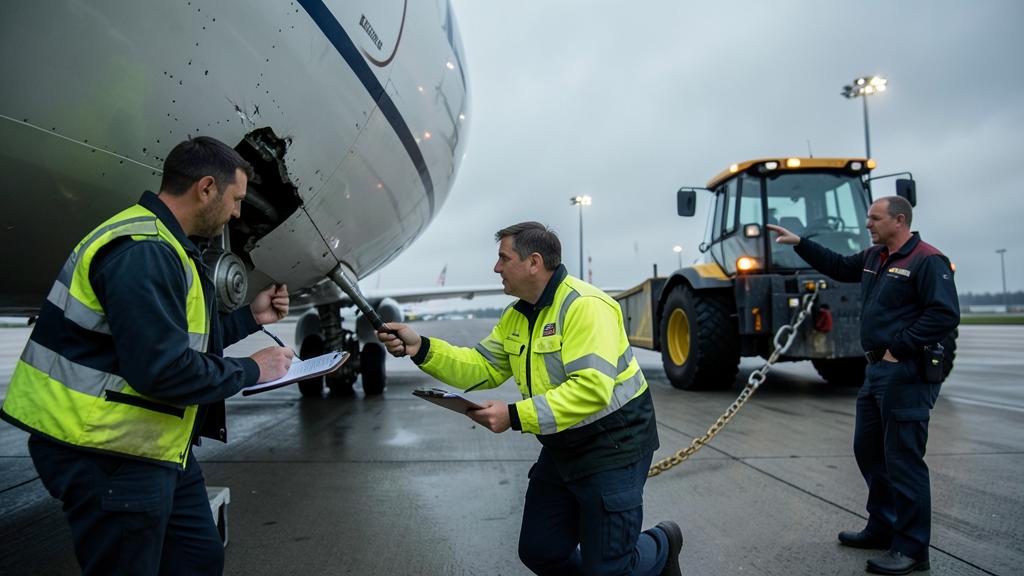
The pushback tractor stalls, the team goes off to fetch another towbar, and the next sector begins with the discovery of a dent on a landing gear door. Or else the descent clearance arrives with the neighbouring aircraft’s callsign, the crew takes it for its own, and only the onboard alerting system closes the sequence. In both cases the root cause does not belong to the operator; the obligation to report does. What remains is to write a report that serves some purpose without pointing at anyone.
The obligation follows exposure, not fault
The European regulation on occurrence reporting attaches the obligation to a position, never to a liability: the person who, in the exercise of defined duties, is involved in an occurrence or witnesses it is required to report it. Nothing in that construction makes the report conditional on the origin of the cause. An occurrence caused by a third party remains an occurrence of your operation as soon as it has involved your aircraft, your crews or your margins. The question “is it up to us to report it?” therefore has no answer in the register of fault; it has an immediate one in the register of exposure.
This is not a legal subtlety, it is a constraint of method. An occurrence caused by a third party always comes in two halves that overlap only partly. The controller knows what they meant to say, in what order they were handling their calls, what the load on their sector was and which coordinations were under way. The crew knows what it heard, at what moment, in which phase, with what configuration and what workload. Neither of the two sees the discrepancy, because the discrepancy exists only between the two sides. If the operator abstains on the grounds that “it wasn’t us”, the analysis opened at the third party closes on an unverifiable hypothesis and concludes, most often, with a mention of nil consequence.
The report is about what happened to your aircraft, not who caused it. Without your report, the full picture is missing, and the problem might repeat.
It is worth repeating to a reluctant crew: the report is neither a claim form, nor a complaint, nor a procedural document. It creates no liability and extinguishes none. It feeds a system whose purpose, written into the text itself, is exclusively prevention, and whose use for any other purpose is prohibited. What the crew writes does not “incriminate” the third party; what it does not write, on the other hand, deprives the third party of the only external description of its own deviation.
An A320 at Paris CDG receives a descent clearance meant for an A321. The crew accepts it, but the onboard alert detects the conflict. The operator’s report notes the exact timing, the read-back, and the alert activation. The ATC report confirms the miscommunication. Together, they reveal a procedural gap in sector coordination.
Three third parties, three channels, three perishable forms of evidence
The reasoning is shared, the actions are not. What really distinguishes the three families of third parties an operation runs into is not the form to be filled in: it is the speed at which the evidence disappears, and therefore the action that has to be taken within the hour.
On the air traffic side, the material is recorded: communications, trajectory data, label history. These recordings are kept for a limited period — typically from a few weeks to a few months depending on the units and on local rules — then overwritten. A report filed three weeks after the occurrence may arrive after the only thing that would have allowed a choice between two recollections. What is to be noted immediately: the frequency, the time to the minute in universal time, the callsign used by the unit, the exact wording received and then read back, and the position of the aircraft at that moment.
On the ground handling side, the evidence is physical and mobile. A dent gets repainted, a piece of equipment moves on to another stand, the team changes at handover and no one will know any longer who was holding the towbar. A time-stamped photograph taken before the aircraft moves is worth more than a paragraph written the following day. The sensitive point lies in the decoupling: the damage report drawn up jointly with the handling agent is a contractual document, it does not by itself trigger the safety report, and that is precisely where most ground handling occurrences are lost.
On the refuelling side, the evidence is a liquid. Sample drawn and sealed, delivery note reference, density recorded, quantity requested and quantity delivered, tank concerned, identity of the truck. An error caught before departure remains a reportable occurrence: what is noteworthy is the failure of the barrier, not the consequence it did not have. An operator who reports only what has produced an effect deprives itself of every weak signal, and sees only accidents coming.
| Third party concerned | Typical triggering event | Perishable evidence to be preserved first | Useful recipient of the feedback |
|---|---|---|---|
| Air traffic services | Instruction in error or intended for another aircraft, absence of clearance at a reporting point, unintended altitude deviation, aircraft proximity | Radio communication recordings and trajectory data, kept by the service provider for a limited period before being overwritten | Air navigation service provider, through the authority and, in parallel, through the safety focal point |
| Ground handling | Contact of a piece of equipment with the aircraft, non-compliant pushback, loading departing from the loadsheet, door or hatch operated outside procedure | Physical condition before return to service, time-stamped photographs, identity of the team and time of the shift | Handling company and aerodrome operator, local apron safety body |
| Refuelling | Wrong product or quantity, non-compliant distribution, suspected contamination, bonding or coupling anomaly | Sample drawn and sealed, fuelling delivery note, density and quantity readings, identity of the truck | Fuelling company and person responsible for product quality at the airport |
Writing the facts without writing a culprit
Three registers slip into the same paragraph without the writer noticing: what was observed, what is deduced from it, what is attributed to the other party. The first is verifiable and can be held against anyone. The second is useful provided it is announced as a reconstruction. The third has no analytical value, cannot be verified, and makes the document unpublishable to the third party, that is to say useless.
The rewriting is mechanical once the principle is accepted. “The controller forgot us on descent and only called back at the last minute” becomes: “last clearance received at such a time, descent to such a level, read back; no instruction received until such a time; the published level constraint required the descent to be started; the crew requested descent at such a time”. “The refueller used the wrong tank” becomes: “distribution requested on the delivery note, distribution observed at the pre-departure reading, discrepancy of so much, detected at the pre-departure check by the crew”. Nothing of the fact is lost, everything of the trial is.
The practical rule fits into a single rereading: delete the verbs of intent (forget, neglect, refuse, ignore, let), the adverbs of appreciation (manifestly, obviously, of course), and every qualifier that has no unit of measurement behind it. Name the functions and the organisations, never the people. What remains after that pass is exactly the report.
The trap. A single sentence is enough to tip a safety report into the register of a claim: “to be recharged to the handling agent”, “clear failure by the service provider”, “air traffic control is at fault”. It makes the document usable outside the safety system and weakens the protection its author enjoys. The reverse movement costs just as much: copying the safety report into the insurance file or into a formal notice takes out of the system information that had no business leaving it, and the next crew will hear about it.
The deadline runs from knowledge, not from certainty
The European regulation sets a period of seventy-two hours for the transmission of a mandatory report, counted from the moment its author became aware of the occurrence. That starting point is regularly misread: it is neither the date of occurrence, nor the date on which one finally understood what had happened. Damage discovered on return from a sector opens the count at its discovery, not at the previous day’s pushback — and the fact that the origin is external shifts nothing.
The most common mistake is to wait: for the handling agent’s reply, for the result of the sample analysis, for the engineering department’s opinion on whether the damage is repairable, for the air navigation service provider’s feedback. Meanwhile the clock is running and the evidence held by the third party is fading. A report that explicitly states “items pending: sample analysis, delivery note reference, structural assessment” is complete in the sense of the system, because it triggers the preservation of evidence at everyone’s end. A perfect report filed three weeks later is not: it arrives after the recordings have been overwritten and after the equipment has been returned to service.
The right reflex. File on what is known, at the time it is known, with a heading of missing items explicitly left open, then complete it. And, from the moment of filing, name the third party’s focal point from whom feedback will be requested, with a due date: that is what turns a filing into a loop, and a loop into corrective action at the party able to implement it.
Your barriers count, even when the cause lies elsewhere
The second reason to report is the least invoked and the most profitable: an occurrence of external origin is the best test bench for your own defences. The clearance was wrong — what should have stopped it on your side? The listening watch of the pilot monitoring, the cross read-back, the consistency check against the published procedure and the loaded flight plan, the onboard alert. Which one worked, which one was breached, at what point in the sequence, and what finally closed the matter? That part, no third party will write for you, and it is the one that produces corrective action on your side rather than a grievance about the other.
Phrasing it that way has a considerable secondary advantage: the report leaves the ground of attribution without taking anything away from the facts. Writing “the first instruction, in error, was not detected at read-back; detection occurred at the onboard alert, some forty seconds later” gives the service provider’s reader an exact description of its deviation, without judgement, and gives the internal reader a barrier to strengthen. The same text serves two organisations. That is the operational definition of a communicable report, and it is what the system expects from a mature operator.
Two files for a single fact
Damage during a turnaround opens two files that do not resemble each other and must not contaminate each other. The contractual file establishes who pays: it names, quantifies, relies on the signed damage report, on the local annexes to the handling agreement and on the deductible thresholds. The safety file explains how the sequence was able to unfold: it de-identifies, describes the conditions, the layout of the stand, the workload and the barriers, and has value only if it remains unusable elsewhere.
The regulation protects this separation in one direction: information from reports may not be used for purposes other than safety, and the employer may not use it against its author, except in the case of wilful misconduct or manifest and serious disregard of an obvious risk. That is the heart of just culture, and it is also its limit: it protects the reporter, it does not protect a writer who has themselves poured into the report what belonged to the claim. Only one thing must be common to the two files: the time stamp and the identification of the equipment. The rest is written twice.
Two configurations break this reasoning and deserve to be settled in advance. When the operator handles itself, the third party disappears: there is no longer a contractual file to absorb the attribution part, and the matter is readily settled internally between the ground operations department and the crew, without any filing. That is the most discreet leak in the system, because no outside recipient comes to claim the document. Conversely, at a distant station served by a subcontractor with no identified safety focal point, the direct channel does not exist: all that remains is the route through the authority and, where applicable, the contracting party that placed the subcontractor. Filing is all the more necessary there because nothing else will come back up, and it is also the moment to check what the handling agreement provides for regarding safety reporting — many provide only for the damage report.
Feedback to the third party: who receives what, and when
The official channel is slow but robust: report to the national authority, entry in the European central repository, access by the authorities and organisations concerned, use in trend analysis. It does very well what it exists for — revealing repetition, comparing airports, feeding a safety programme — and very badly what is often asked of it: dealing with your particular case within the month. It should not be blamed for the one on account of the other.
The channel that is useful for the case is direct, and it is lawful as long as the document transmitted is de-identified and descriptive: safety focal point of the operator to safety focal point of the service provider, of the handling agent, of the aerodrome operator. Many airports have local bodies — runway safety committee, apron safety committee, periodic review with the fuelling companies — where the same facts are put to those who can change a procedure the following week. An operator who does not sit on them then complains of never seeing anything come back.
And the feedback must be demanded. A report that leaves without an acknowledgement of receipt, without the name of a focal point and without a reply deadline produces exactly the feeling it is reproached with: reporting is pointless. The first indicator of the vitality of a reporting system is not the number of filings, it is the proportion of files that come back with an identified action at the party that was able to act. Practitioners who compare their standard wordings on the FL330 forums all note the same thing: the quality of the feedback is proportional to the descriptive precision of the initial filing.
What to check in your own documentation
Three points on which manuals regularly diverge from practice, and which are better resolved in advance. First, what your manual designates as the starting point of the deadline — occurrence or knowledge — and who, named by function, files when the crew has been relieved in the meantime. Next, whether the ground damage form automatically generates a report to the SMS or whether it has to be entered separately: that is the most common leak, the damage goes to litigation and never reaches safety. Finally, whether the retention of samples, of time-stamped photographs and the request to freeze the third party’s recordings come under a written procedure or under the crew’s own initiative.
The grey area does not close: you will generally not have access to the report filed by the third party, and the de-identified feedback that reaches you will sometimes be too thin to close your own analysis. You therefore have to decide in advance at what level of proof you accept to conclude, failing which files remain open, the system clogs up and the credibility of the channel erodes more surely than with an assumed and cautious conclusion.
For anyone preparing for a safety function, a nominated post holder position or simply an interview in which their relationship to reporting will be probed, the question to work on is no longer “should it be reported?” — that is settled. It has become: what do you write when you do not yet know, and how does your text remain readable by the person who made the deviation? That is what the FL330 training courses devoted to safety management examine, and it is what distinguishes an operator who accumulates filings from an operator who obtains corrections.
This text describes a mechanism and professional practices; it is not a substitute for anything. The applicable regulation, the instructions of the national authority and the operator’s approved documentation prevail in all circumstances over what is written here.
Questions fréquentes
Must an occurrence caused by a third party be reported if the aircraft suffered no consequence?
Yes. Whether a fact is reportable depends on its potential to degrade safety, not on the effect it produced. A refuelling error caught at the pre-departure check, an erroneous clearance detected at read-back, a piece of equipment stopped a few centimetres from the airframe are full occurrences: the barrier was called upon, and that is the useful information. Reporting only what left a trace amounts to observing nothing but accidents.
Can the safety report be used against the crew or against the third party?
The European regulation prohibits the use of information from reports for purposes other than safety, requires de-identification and protects the author against measures taken by their employer, except in cases of wilful misconduct or manifest and serious disregard of an obvious risk. That protection is real, but it does not cover a text in which the writer has themselves formulated an attribution of blame or a request for recharging. The quality of the writing determines the extent of the protection.
Who files when the deviation comes from air traffic control: the crew or the operator?
Both, in different roles. The person involved or witnessing files their report in respect of their duties, in the operator’s internal system. The operator, as an organisation, then ensures transmission to the national authority within the regulatory deadline, followed by analysis and follow-up. A crew that has filed internally has met its obligation; it is up to the organisation to ensure that the report does not stop there.
Is damage found several days after the turnaround still reportable?
Yes, and the deadline runs from its discovery, not from the turnaround presumed to be at its origin. The discovery itself must then be described — who, when, on what occasion, what the condition was at previous inspections — and it must be explicitly stated that the station of origin is not established. That uncertainty is part of the report; it does not disqualify it and, on the contrary, makes it possible to identify shortcomings in the traceability of exterior walk-around inspections.
Can the photographs and the joint damage report be attached to the safety report?
Time-stamped photographs are valuable factual elements and have every place in the safety file. The joint damage report, on the other hand, is a contractual document that names people and prepares an attribution of liability: it is better to reference it by its number and date than to incorporate it. The rule is simple: attach what describes, reference what attributes.
How can a reply be obtained from the service provider after reporting?
By systematically doubling the regulatory channel with a direct transmission from safety focal point to safety focal point, with a de-identified version of the report, an explicit request for acknowledgement of receipt and a reply deadline. Local safety bodies — runway safety committee, apron safety committee, periodic review with the fuelling companies — are the second lever, because they bring together those who can change a procedure without going through the authority.


Leave a Reply
You must be logged in to post a comment.