
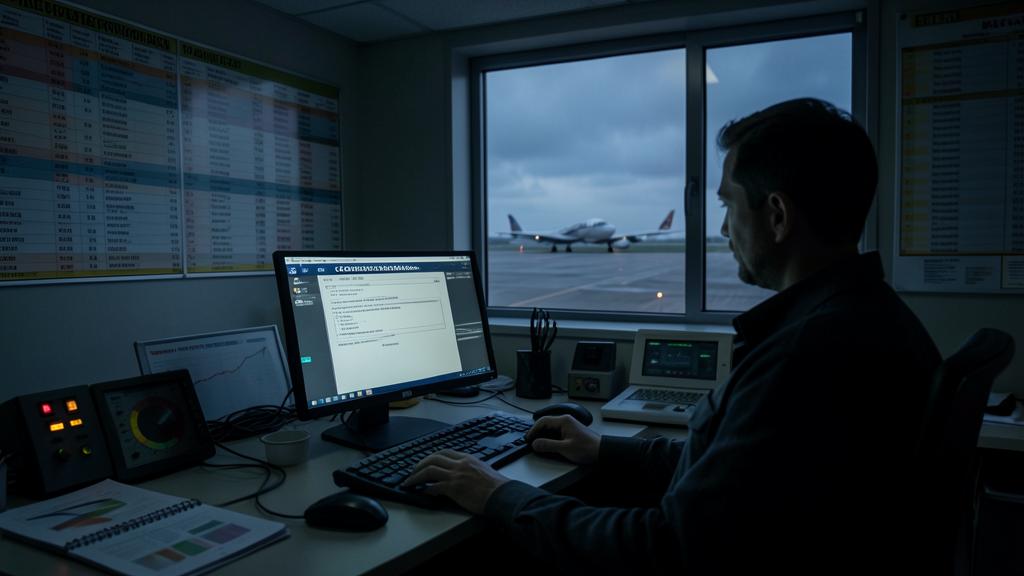
Three aircraft, seven crew members, one maintenance engineer: the report arrives on a Tuesday and describes a late go-around at an aerodrome served by only two crews that week. The name has been removed from the form. By midday, everyone will know who wrote it. In an organisation of that size, disidentification no longer protects anything on its own; what still protects is a set of organisational measures that have to be written down before they are needed.
Anonymity, disidentification, confidentiality: three distinct mechanisms
Everyday language runs the three together, yet they act neither at the same point of the chain nor on the same object.
Anonymity applies to the act of submitting: the author is known to no one, not even to the recipient. It is workable only in a voluntary scheme, and it carries an immediate cost — no one can call the author back to ask about the exact configuration, the setting displayed, what was on the screen at the moment things tipped over. Yet most usable reports call for a second exchange.
Disidentification applies to content: the name is removed, and so is everything that allows the person to be traced back — registration, exact date, flight number, precise duty, a recognisable turn of phrase. The European regulation on occurrence reporting makes this an obligation before the record leaves the restricted circle of the persons designated to handle it.
Confidentiality applies to access: who may open the raw version, on what conditions, leaving what trace. It is an organisational measure, not a drafting one.
At an operator with several hundred crew members, the three take over from one another and make up for each other’s gaps. In an organisation of a few dozen people, the first collapses as soon as a follow-up question arises, the second becomes largely decorative, and the third carries the whole load on its own. This is not a degradation to be endured: it is a transfer that is either organised, or not made at all.
In small organisations, anonymity and disidentification often fail because there are too few people to hide among. The real protection comes from strict rules about who can see what, and when they can see it. It’s like having a safe with a combination lock – the lock itself isn’t enough, you also need to control who gets the combination.
At a regional airline with 5 ATR 72s and 30 pilots, a report about a hard landing on runway 27 at 14:30 on a Tuesday would immediately point to one of only 3 pilots scheduled for that flight. Even with disidentification, the small fleet size and published roster make the author obvious to anyone who knows the schedule.
Why disidentification gives way below a certain headcount
Re-identification calls for no particular skill: it works by cross-referencing. Every field kept in the account divides the population of possible authors. First the aircraft type, then the week, the sector, the duty, the phase of flight. At a large operator, several of these fields usually have to be stacked before the result comes down to a single person. In a fleet of a few aircraft, two are often enough, and the roster is posted in the corridor.
The knot is not that disidentification is done badly. It is that the analytical value of an account and its opacity vary in strictly opposite directions. What the analyst needs — the configuration selected, the point in the sequence, the conditions at the aerodrome, what the on-board documentation said — is exactly what discriminates. A report vague enough to point to no one teaches nothing; a report precise enough to be exploited points to its author.
There is a window in which the two requirements coexist. It is wide at a fleet operator, narrow at a regional operator, and it is empty below a certain headcount. Acknowledging this is not an admission of weakness: it is the condition for no longer promising what cannot be delivered. A promise of anonymity that everyone knows to be false destroys a reporting system faster than its absence, because it discredits at the same stroke the protections that are real.
The more details you keep in a report to make it useful, the easier it becomes to figure out who wrote it. In small organisations, just knowing the aircraft type and flight day might be enough to identify the author. The key is to find the right balance between useful information and protection, which gets harder as the organisation gets smaller.
A small cargo operator with 2 Boeing 737s and 12 pilots finds that any report mentioning a “hard landing on runway 09 at 18:00” immediately points to one of only 2 pilots scheduled for that flight. Even with disidentification, the small fleet size and published roster make the author obvious to anyone who knows the schedule.
The right reflex. Replace the promise of anonymity with a verifiable promise, and write it into the manual exactly as such: you will in fact be identifiable, here are the two people who will see your name, here is the trace left by every consultation, here is what your report can never trigger. A protection the author can check is worth more than an anonymity he knows to be false.
What the protection actually covers, and where it stops
The European regime does not rest on ignorance of identity. It rests on the prohibition on drawing consequences from it. The operator may not subject the author to any detriment on account of the report filed, and the authority may not bring administrative proceedings on that basis alone. What causes this protection to fall away is neither the severity of the occurrence nor the damage caused, but intent: wilful misconduct, or a manifest, severe and serious disregard of an obvious risk.
This construction has two blind spots that must be understood before anything is written into a procedure.
The first concerns the origin of the knowledge. Protection attaches to the report, not to the fact. A deviation already established through another channel — a report from air traffic control, an entry in the journey log, a track picked up in flight data — follows its ordinary course. Someone who reports a fact that is known anyway is no more exposed for it, but neither does he gain immunity.
The second concerns the nature of the proceedings. The regime binds the employer and the oversight authority; it does not bind the criminal courts. National provisions arrange the judiciary’s access to safety files in varying ways, and none of them turns a report into immunity. Saying so to the crews is part of the trust compact, just as much as the protection itself.
| Mechanism | What it prevents | What it does not prevent | What makes it fall away |
|---|---|---|---|
| Anonymity of submission | That anyone at all, recipient included, should know the author | Recognition of the account by colleagues | Any request for detail: the exchange restores the link |
| Disidentification of the file | That the name should travel with the analysis and its follow-up | Cross-referencing by date, aircraft, sector and roster | A headcount where two or three context fields are enough to point to one person |
| Confidentiality of access | That the raw version should be opened without a recorded reason | Structural leaks through the corrective action or the meeting minutes | A channel that can be forwarded, a shared folder, a missing log |
| Non-detriment attached to the report | Sanction or disadvantage based on the fact of having reported | The handling of a fact established through another channel, nor judicial proceedings | Wilful misconduct, or a manifest, severe and serious disregard of an obvious risk |
The locked short route, the only compensation that holds
What can no longer be obtained through drafting is obtained through the route. Six measures are enough, and every one of them can be checked by reading the manual.
- One named recipient, one deputy, no third route. The manual designates both the function and the person. Anything arriving by another path — a word to the accountable manager, a remark over coffee — is not an occurrence report and enjoys none of the protections attached to the scheme. Saying this plainly avoids painful misunderstandings.
- A channel that cannot be forwarded. Ordinary email is the worst medium: one click sends it to a third party, it gets quoted in a thread, and it is duplicated into backups no one controls. A closed physical box, a dedicated address hosted separately, or a call transcribed by the recipient who then destroys his notes are all worth more than a policy pinned to the wall.
- A written separation of roles. Whoever handles the reports must decide neither the roster, nor the annual appraisal, nor the sanction. In a small organisation, the same person often holds both functions. The answer is not to pretend otherwise: it is to declare the conflict and to provide for a named stand-in — an outsourced safety function, a reciprocal arrangement with another operator, or a designated peer outside the management line.
- Two versions of the file. The raw version stays in a space with named access; only the disidentified version circulates, including to the safety review and to the meeting minutes. Nothing else crosses that line, and above all no forgotten attachment.
- A cut-off date. The retention period for the identifying version is written down, and someone is tasked with applying it. The General Data Protection Regulation requires this limitation; it is one of the rare points where a data-protection rule directly serves safety.
- An access log. Who opened what, when, and for what reason. It is the only record capable of answering the question of who talked, and its mere existence changes behaviour more reliably than any moral undertaking.
What gives the source away without anyone having talked
Deliberate leaks are rare. Structural leaks are the rule, and the first of them is the corrective action itself.
A notice issued in the days following the occurrence, in a company of a few crew members, on a subject that concerns one sector only, points to its author as surely as a signature. The remedy comes down to three habits: group the actions, publish them on a fixed rhythm known to all, and frame them at fleet or procedure level rather than at case level. An urgent precautionary measure obviously escapes this rule — but it is then announced as such, which is another way of cutting the link.
Then come the drafting leaks. Meeting minutes that reproduce the account word for word reproduce its author’s style. A briefing that opens with “it has been reported to me that” gives up the source in its first sentence. An indicator table broken down by aircraft and by month, in a fleet of a few machines, publishes a named roster without knowing it. A request for further detail sent from a shared address puts the whole thread in front of half the company.
None of these leaks is a failing on anyone’s part. They are effects of scale, and they are corrected by rules of drafting and of timing, not by appeals to loyalty.
The trap. The corrective action is the system’s first informer. Publishing on Tuesday an instruction that answers exactly to Friday’s report amounts to printing the author’s name at the top of the notice. Check the timing and the scope of every measure before it goes out: if it can only be understood by knowing the occurrence, then it is telling the story.
Flight data monitoring raises exactly the same problem
Analysis of recorded parameters is mandatory in commercial air transport above a mass threshold set by the applicable rules, and operators below that threshold put it in place voluntarily. Its regime rests on the same triad: disidentification of the data before analysis, a written and enforceable non-punitive use, and a gatekeeper — the only person authorised to link a flight to a crew, designated by name, generally with the agreement of the crew representatives.
In a small organisation, this function collapses of its own accord: the gatekeeper is the safety manager, who is also the chief pilot, who signs the roster. The remedy is the same as for occurrence reports — move the key outside the management line — and it comes with a closed list of grounds for lifting anonymity, written in advance: suspicion of wilful misconduct, or a request for detail with the agreement of the crew concerned. Any lifting not provided for in that list must be materially impossible, not merely discouraged.
That leaves duration. A flight data monitoring programme that never destroys its correspondence between flight and crew ceases to be a safety tool and becomes a personnel file, and it will be read as such the day someone asks for it.
What to go and check in your own documentation
Five points can be checked in an evening, and their absence explains a good part of the reporting schemes that run out of steam after a few years.
- Are the recipient and the deputy named in the manual, and has the document been updated since the last departure?
- Is the retention period for the identifying version written down, and is someone tasked with the purge?
- Who draws the line between error and wilful misconduct, under what procedure, and what remedy remains open to the person concerned?
- Does the access log exist, and has it been read through even once this year?
- Is the indicator being tracked the number of reports, or the share of those that concern their own author’s actions? The second is the only honest thermometer of a scheme built on trust.
A grey area remains, and no text closes it: that of facts known simultaneously through the safety file and through another route. No one can decide in advance, case by case, what will fall under one or the other. What can be written down, however, is who decides, at what point, on what material, and with what trace. A small organisation that has set this down in writing before needing it has already done the essential part of the work.
The type of operation moves the weak point without changing the mechanics. In a training organisation, the author is often a student or an instructor on a short contract: the balance of power is more uneven than in an airline, and the protection has to cover someone who will no longer be there next season — so it has to work without his having to claim it, and without its continuation depending on the relationship he has with the recipient. At an aerial work operator, crews are scattered across isolated sites and the single recipient becomes unreachable at the very moment he would be of use: there, the deputy is not a formality of the manual, it is the principal measure, and his availability is verified the way a piece of technical equipment is verified.
That leaves the limiting case that nothing closes: the function held by a single person. The sole engineer, the ground operations manager, the operator’s only senior cabin crew member — their report identifies itself from the first line, and no rule of drafting will change that. The only answer is to move the protection one notch outward: to provide in writing that these reports go directly to the authority or to a third-party analyst without passing through the company, feedback to the accountable manager being limited to the action to be taken. The price is a loss of context at analysis; the alternative is complete silence over an entire function, and it costs more.
The applicable texts, the decisions of the oversight authority and the operator’s approved documentation prevail over this article, which describes mechanisms and replaces no procedure.
Questions fréquentes
Can anonymity still be promised in a company of a few dozen people?
No, and promising it weakens the scheme. The author of a precise report is identifiable there by cross-referencing as soon as a few context fields remain, however carefully it is drafted. The promise that can be kept is about something else: the number of people who will see the name, the trace left by every consultation, and the prohibition on drawing any disadvantage from it.
Should a raw version of the report be kept, and for how long?
Yes, for as long as the analysis needs to be able to go back to the author for further detail. The period must be written into the operator’s documentation and applied by a designated person, retention limitation being in any case a requirement of personal data legislation. Once that period has passed, only the disidentified version remains, and the link to the author disappears for good.
Does a report protect against judicial proceedings?
No. The European regime binds the employer and the oversight authority, which may not base any detriment or administrative proceedings on the report alone. It does not bind the criminal courts, and national provisions arrange the judiciary’s access to safety files differently. Reporting has never amounted to immunity, and crews should be told so rather than left to believe the opposite.
How can roles be separated when the same person is both safety manager and chief pilot?
By writing the conflict down rather than denying it, and by providing a named stand-in for the cases where it materialises: an outsourced safety function, a reciprocal arrangement with another operator, or a designated peer outside the management line. The stand-in must be brought in automatically, without case-by-case arbitration, as soon as a report concerns a person whose roster or appraisal the manager decides.
What should be done with a report that names a colleague?
The third party’s name is removed on the same basis as the author’s, from the version that leaves the handling circle onwards. The fact reported, on the other hand, is dealt with normally: it becomes an element of the causal analysis and, if it is confirmed through another route, it follows the operator’s ordinary process. The report must never serve as evidence in a disciplinary file, neither against its author nor against a third party.
How can a corrective action be published without pointing to the author of the report?
By playing on timing and scope. Actions are grouped and published on a fixed rhythm known to all, and framed at fleet or procedure level rather than at the level of the individual case. An urgent precautionary measure is an exception, but it is then explicitly announced as such, which cuts the link with any identifiable report.


Leave a Reply
You must be logged in to post a comment.