
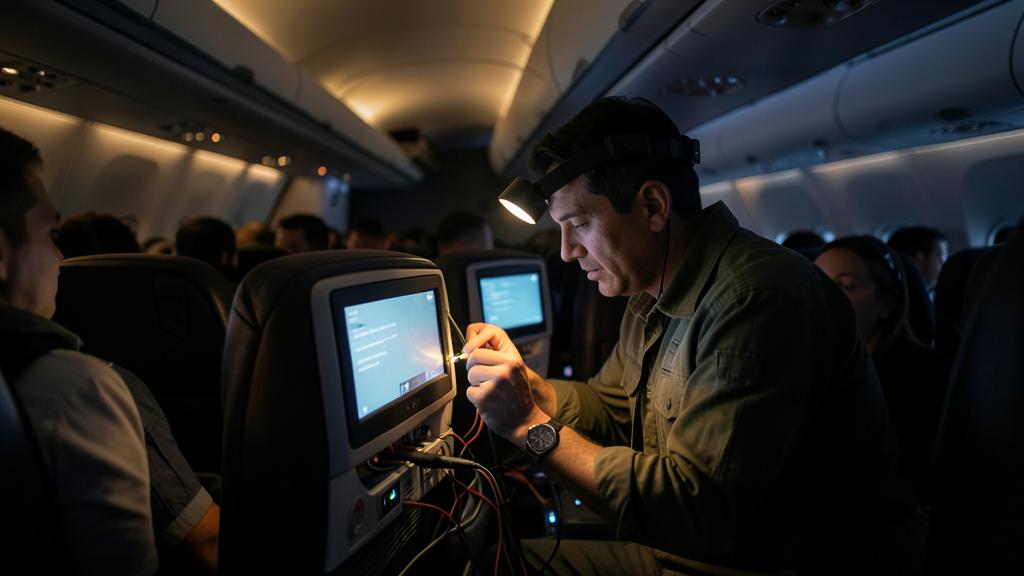
A cabin entertainment retrofit is sold as a catalogue decision: screen size, content platform, connectivity package, a mock-up in a hotel ballroom. It is not. The aeroplane arrives with two budgets already spent by its type certificate — the electrical power its generators can deliver in every configuration, and the heat its air conditioning can carry out of a pressurised tube — and those two numbers, not the supplier’s brochure, decide which architecture is installable. Everything else is negotiable.
Two budgets that were closed before the aeroplane was delivered
Electrical generation on a transport aeroplane is fixed hardware: engine-driven generators sized at certification, an auxiliary power unit generator, transformer-rectifier units feeding the direct-current side. Nobody adds a generator during a cabin refit. The installed capacity is what it is, and the margin available for a new cabin system is what remains after every existing consumer has been counted in the worst credible configuration — which is not cruise with everything working, but the case where one generator has failed and the remaining sources carry the aeroplane.
Environmental control is fixed in the same way. The packs are sized to remove a heat load made of passengers, solar gain through the windows, galley equipment, avionics and the structure itself. That sizing was done with assumptions about cabin electrical load. A retrofit that adds tens of kilowatts of cabin consumption is not adding a feature; it is rewriting an input to the thermal calculation that justified the aeroplane’s cabin temperature performance.
Between them, these two closed budgets explain almost every disappointment in this field. The system that cannot be switched on during a hot-day turnaround, the seat boxes that trip on a full aeroplane in Dubai in July, the in-seat power that quietly delivers half of what the marketing promised — none of these are software problems, and none are fixed by a firmware release.
The plane’s power and cooling systems are already set when it’s built. Adding new entertainment means working within those limits. If the new system uses too much power or makes too much heat, it won’t work well, especially in hot places or when the plane is fully loaded.
Every watt delivered in the cabin comes back as heat in the cabin
This is the sentence that should open every retrofit study, because it closes the loop between the two budgets. A cabin electrical consumer is not a load that disappears somewhere; it is a heater with a useful side effect. A display converts its power into a little light and a lot of warmth. A seat electronics box converts its power into computation and warmth. A power supply that converts aircraft alternating current into low-voltage direct current for a passenger’s device wastes a fraction of what passes through it, and that fraction is heat, released inside the seat, not at the passenger’s telephone.
The heat does not leave the pressurised volume on its own. It joins the metabolic output of the passengers — of the order of a hundred watts each, before anyone moves — and everything else the packs already carry. Air conditioning capacity is finite and was not sized for a cabin that draws like a small office building.
On a Boeing 777 in Dubai at 40°C, a full cabin with seat-back displays and in-seat charging can push the air conditioning to its limit. The system may struggle to keep the cabin cool, especially during boarding when passengers are still entering and the auxiliary power unit is also running the galleys.
| Element | Draws from | Rejects heat into | What that constrains |
|---|---|---|---|
| Head-end server and content storage | Aircraft alternating-current bus | Equipment bay, usually forced-air cooled | Bay cooling capacity and airflow, not cabin comfort |
| Seat-back displays | Seat power distribution | Directly into the cabin, at head height | Passenger-perceived temperature; the load is distributed everywhere |
| Seat electronics boxes | Seat power distribution | Under-seat volume, poorly ventilated by design | Local hot spots; sensitive to baggage blocking airflow |
| In-seat power supplies for passenger devices | Seat power distribution | Under or inside the seat, as conversion losses | Efficiency of the converter becomes a thermal specification |
| Wireless access points | Cabin bus, sometimes powered over the data cabling | Ceiling and sidewall volumes | Modest, but placement is driven by radio coverage, not by cooling |
| Passenger devices being charged | Their own batteries, via your outlets | The cabin, in the passenger’s hands | Invisible in the load analysis, real in the thermal one |
Three architectures, measured against the same two budgets
The architectural choice is usually presented as a question of passenger experience. It is more honestly a question of where the electrical and thermal load is placed, and who owns the mass.
| Full seat-back | Hybrid: wireless plus in-seat power | Streaming to passenger devices only | |
|---|---|---|---|
| Electrical demand | Highest, distributed across every seat | Moderate, concentrated in the power supplies | Lowest, concentrated at the access points and server |
| Heat rejected in the cabin | Highest, and worst where it is least wanted | Moderate, and located under the seats | Low, plus what passenger devices generate anyway |
| Installed mass | Several hundred kilograms on a wide-body, permanently | Intermediate; the power supplies and cabling dominate | Small; a server, access points and their wiring |
| Seat certification impact | Major: the monitor sits in the head-strike zone | Limited, but the seat is still modified | Usually none on the seat structure |
| Where the risk sits | Thermal and mass budgets | Power quality and converter efficiency | Radio coverage, battery endurance, passenger expectation |
The third column deserves an honest note. Streaming to passenger devices does not remove the load, it moves it: passengers who watch for eleven hours on their own devices need charging, and in-seat power is exactly where conversion losses live. An operator who chooses the light architecture and then fits high-power sockets at every seat has re-created most of the electrical problem while giving up the seat-back product. The budgets do not care which box the watts pass through.
The load analysis is the gate — the catalogue is not
A change of this size to the electrical system of a large aeroplane calls for an updated electrical load analysis showing that the sources can carry the demand in every configuration the certification basis considers. That is the actual gate. It is not passed by adding up the supplier’s nominal figures; it is passed by defending assumptions.
The assumption that decides everything is diversity — the simultaneity factor. Nobody sizes a system for every seat drawing its maximum at the same instant, because that has never happened and the aeroplane would be uninstallable if it were required. But diversity is a judgement, and it has moved. A cabin equipped with low-power sockets in an era of small batteries has a very different simultaneity profile from a cabin equipped with modern high-power connectors, where one passenger’s laptop can ask for several times what a legacy socket ever delivered. An analysis inherited from a previous programme, with its old diversity factor, is a load analysis that will be defended once and regretted afterwards.
The rest of the electrical work is architectural discipline: the system belongs on a non-essential bus, it must be sheddable automatically when the generation configuration degrades, and the crew must be able to remove its power deliberately, from the cabin, without a discussion. None of it is a supplier feature to be traded away; each is normally imposed by the approval, as the condition under which a non-required convenience system is allowed to exist on a certified aeroplane.
The trap. Sizing the in-seat power on the socket’s rating rather than on what the connector will negotiate. Modern charging standards let the device ask for far more than a legacy socket ever delivered, and they ask for it on a full aeroplane at the start of a night sector — every passenger at once, which is precisely the diversity case the analysis assumed would never occur.
The ground is the worst case, not the cruise
Studies are written for cruise because cruise is where the aeroplane spends its hours. The system will fail on the ground, because that is where both budgets are simultaneously weakest.
| Phase | Electrical situation | Cooling situation | Consequence for the cabin system |
|---|---|---|---|
| Stand, ground power or auxiliary power unit | Limited source, competing with galleys and preconditioning | Weakest: no ram air, full solar gain, doors opening | The moment boarding heat and system power-up coincide |
| Taxi and take-off | Generators on line, transient reconfigurations | Packs at reduced flow on some configurations | Systems that reboot on transients look broken to the passenger |
| Climb and cruise | Best margin of the flight | Best margin of the flight | Where every demonstration is conveniently performed |
| Descent and turnaround | Reconfiguration, then auxiliary power unit again | Falling, with a full cabin still occupied | Seat boxes that were marginal all sector now saturate |
| Single-generator case, any phase | Load shedding sequence active | Unchanged or degraded | The system must disappear cleanly, without dragging anything with it |
A hot-day turnaround with a full load, the auxiliary power unit carrying galleys and air conditioning, and a system powering up for the next sector is the design point that should be written on the first page of the specification. It rarely is.
Mass is the third budget, and it never comes back
A full seat-back installation on a wide-body is measured in hundreds of kilograms once monitors, seat boxes, brackets, power supplies and wiring looms are counted — and unlike fuel or freight, it is loaded on every sector for the life of the modification. It is a permanent deduction from payload and a permanent addition to fuel burn.
Distribution matters as much as total. Mass added along the whole cabin shifts the empty-aeroplane centre of gravity and changes loading indexes; mass concentrated in one zone can bump against floor loading limits. Both feed back into the weight and balance documentation, which has to be reissued, and into the loading instructions the handling agents actually use.
The good reflex. Ask the supplier for installed mass per seat including brackets, harness and connectors — not equipment mass. The delta between the two, multiplied by the seat count, is frequently larger than the entire mass of the displays, and it is the figure that reaches the weight and balance manual.
The parts of a retrofit that surprise people who have only done new-build
A cabin refit is a design change requiring an approved design and, in most cases, a supplemental type certificate. Around that centre sit several workstreams that consume more calendar time than the entertainment system itself.
- Seats become a certification item again. A monitor in the seat back sits in the head-strike zone. The dynamic testing that qualified that seat was done to a specific configuration; changing what a head can strike means demonstrating the injury criteria again, for the new combination, at the operator’s expense.
- Wiring is governed in its own right. The interconnection requirements in the large-aeroplane codes cover separation, routing, protection and maintainability. A retrofit adds a loom to an aeroplane that already carries the looms of its previous lives, in spaces designed for one of them.
- Environmental and electromagnetic qualification. Equipment is qualified against the recognised environmental standard, and the installation has to show it neither disturbs nor is disturbed by aircraft systems, across the radiated field environment the aeroplane is certified for.
- Flammability and smoke. Anything in the cabin is a cabin interior part, and inherits the flammability requirements of the certification code, monitors and their housings included.
- Continued airworthiness. New instructions, new maintenance programme tasks, new spares, new troubleshooting the line will have to perform at night. The system’s dispatch status under the minimum equipment list has to be settled before the first revenue flight, not after the first defect.
What to establish before the demonstration
The order of questions matters, because the first three answers frequently remove most of the catalogue from consideration.
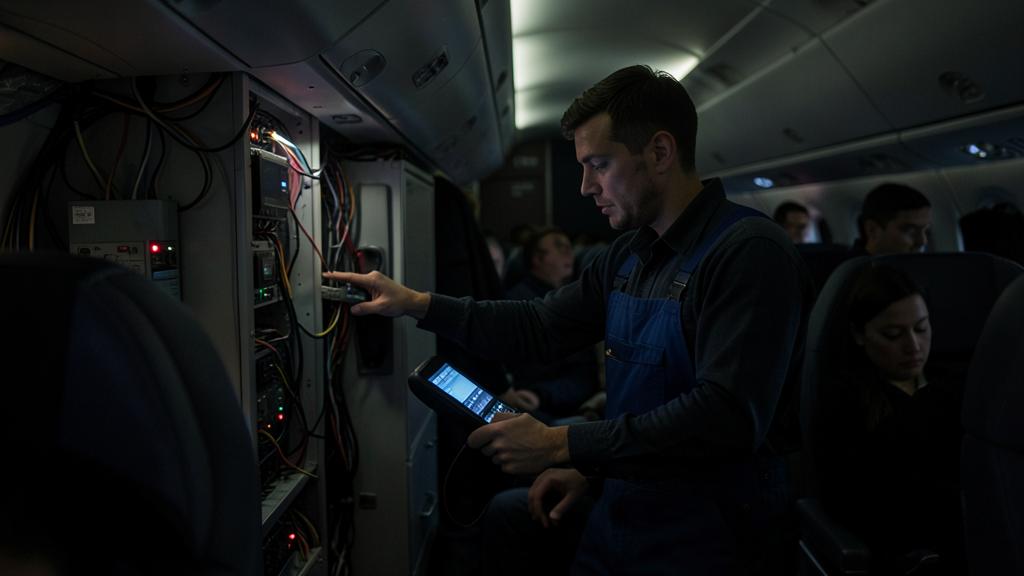
- What electrical margin exists in the degraded generation case, on this registration, with this cabin, today — and who owns the analysis that says so?
- What heat load did the environmental control sizing assume for the cabin, and what does the new architecture add to it?
- What is the design point on the ground: which airfield, which outside temperature, which passenger load, which power source?
- What in-seat power capability is being promised to passengers, and what diversity factor was used to size it?
- What is the installed mass per seat, and where does it sit along the fuselage?
- How does the system shed, and what does the cabin see when it does?
- What does the line maintenance procedure look like at two in the morning, with one technician and no spares?
An architecture chosen against those answers may well be less impressive than the one in the ballroom. It will be the one that still works on the fourth sector of a hot day with a full cabin — which is the only demonstration that counts.


Leave a Reply
You must be logged in to post a comment.