

A type rating that expired eight months ago and one that expired eight years ago sit in the same box on a licence: not valid. What separates them is not the paperwork but the assessment that comes next, because the rule deliberately refuses to say how much training a returning pilot needs. It says the training organisation shall decide. Understanding how that decision is actually built is the difference between a three-session programme and a course that costs as much as the original rating.
Expired is not the same word as lapsed
Under Part-FCL, a type rating has a validity period, and when that period ends the rating stops conferring privileges. Two routes exist back, and they are not variants of each other.
Revalidation applies while the rating is still valid. The proficiency check is taken within the window preceding expiry, the examiner signs, and the new validity is counted from the old expiry date rather than from the day of the check — which is why a check taken inside that window costs nothing in validity. What the rule adds beyond the check is experience rather than a course — recent sectors flown on the type, or a sector flown with an examiner — and any training on top of that comes from the operator or the organisation, not from the licensing rule.
Renewal applies once the rating has expired, and the rule is structurally different: the applicant completes refresher training at an approved training organisation, to the extent necessary to reach the level of proficiency required to operate the type safely, and then passes a proficiency check. The words “to the extent necessary” carry the whole subject. There is no table of hours in the regulation, no sliding scale by months elapsed, and no entitlement to a minimum programme. The ATO assesses, the ATO determines, and the ATO carries the responsibility for that determination in front of its authority.
| Route | Trigger | What it requires | Who sizes it |
|---|---|---|---|
| Revalidation | Rating still valid, check taken in the window before expiry | Proficiency check with an examiner, plus the required recent sectors; training only if the operator requires it | Nobody; the content is set by the check form |
| Renewal | Rating expired, whatever the elapsed time | Refresher training at an ATO as determined necessary, then a proficiency check | The ATO, on the basis of an individual assessment |
| Full type rating course | Never held the rating, or the assessment concludes refresher is not enough | The complete approved course, with its own prerequisites | The approved course syllabus, not the candidate |
The assessment is not a check, and this matters
The single most common misunderstanding among returning pilots is that the first simulator session is an examination they can fail. It is not. It is a calibration exercise, usually flown with an instructor rather than an examiner, and its output is a training plan rather than a pass or a fail. A weak session does not go on a licence, does not have to be declared as a failure, and does not start any of the consequences that follow a failed proficiency check. It simply produces a longer programme.
Treating it as a check produces exactly the wrong behaviour: the candidate over-prepares two or three manoeuvres, hides the areas that have decayed, and buys a programme that is too short for what they actually need. The instructor then discovers the gap two sessions before the check, when there is no room left to fix it. The professional approach is the opposite — fly the assessment honestly, including the parts that feel embarrassing, and let it size the programme correctly.
The trap. Asking an ATO for a quotation before the assessment, then choosing the cheapest fixed-price offer, selects for the organisation that assessed you least carefully. A renewal priced without an assessment is priced on optimism, and the extra sessions get bought later at short notice, at a worse rate, against a slot that may not exist.
The first simulator session is not a test but a way to measure your skills and build a training plan. Hiding weak areas leads to a shorter, ineffective course. Be honest to get the right training.
What the organisation actually weighs
Elapsed time since expiry is the headline variable, but it is rarely the decisive one. What matters is what the pilot has been doing during that time and what the type has done without them.
| Factor | Why it counts | Direction |
|---|---|---|
| Time since the rating expired | Proxy for skill decay, and the trigger for authority interest beyond certain periods | Longer, more |
| Total experience on the type | Deeply embedded procedural skill is recovered faster than it was learned | More, less |
| Recency on anything at all | Instrument scan, automation management and capacity are largely type-independent | Current, less |
| Role during the gap | Simulator instructing, ground school or flight ops keeps knowledge live; a non-flying gap does not | Aviation role, less |
| Variant and standard flown before | A different avionics or engine standard is a differences problem on top of a renewal | Divergent, more |
| Regulatory changes since | Navigation specifications, upset training requirements and new approach types may never have been trained | Many, more |
| Instrument rating status | An expired IR carries its own renewal rule and its own long-stop | Also expired, more |
Note the asymmetry in the second row. A pilot with several thousand hours on the type who has been away four years is often a shorter programme than a pilot with four hundred hours who has been away eighteen months. Skill acquired to the point of automaticity degrades slowly and is retrieved quickly; skill that was still effortful when it stopped being practised tends to disappear.
A pilot with 5,000 hours on an Airbus A320 who has been away for 4 years may need only 3 simulator sessions, while a pilot with 400 hours who has been away for 18 months might need 6 sessions. The more experienced pilot’s skills are more ingrained and return faster.
What decays first, and what does not
Instructors who run these programmes describe a consistent pattern, and it is not the one candidates expect. Systems knowledge — hydraulics, electrics, bleed architecture — holds up reasonably well and is quick to restore with reading, because it is declarative and the pilot knows they have to revise it. What goes first is everything that was never consciously known.
- Capacity. The ability to fly, monitor, communicate and think at once. It is the first thing to disappear and the last to return, and it is invisible in a benign sector.
- Automation mode awareness. Not which button, but what the aeroplane will do next and why, particularly during a reconfiguration or a late runway change.
- Manual handling at the edges. Straight and level comes back within minutes. Raw-data approaches, engine-out asymmetry and manual thrust in turbulence do not.
- Crew coordination habits. Callouts, task-sharing during non-normals, the discipline of not both looking at the same screen. This is the area that shows up in a proficiency check as a failure to manage rather than a failure to fly.
- Speed of recall. The pilot still knows the memory items but takes six seconds to produce them. Under the time pressure of a real drill, six seconds is a different outcome.
The right reflex. Spend the weeks before the assessment on flows and callouts spoken aloud against a paper cockpit or a poster, not on rereading the systems manual. The systems knowledge will return in the classroom; the procedural rhythm has to be rebuilt by repetition and cannot be read.
The aeroplane moved while you were away
A renewal restores a rating on a type, but the type has a current standard and the industry has a current rulebook. Both may have moved. Performance-based navigation privileges became an explicit requirement attached to the instrument rating, so a pilot whose IR predates that change may need the competence demonstrated and recorded. Advanced upset prevention and recovery training became a prerequisite to a first multi-pilot aeroplane type rating course, which is irrelevant to a renewal but decisive if the assessment concludes that a full course is the honest answer.
The type itself will have accumulated modifications, new avionics standards, revised procedures and, frequently, a different flight manual philosophy. Some of that is differences training with its own defined level; some of that is simply a revised standard operating procedure that the candidate will meet for the first time in the simulator. An ATO that does not ask which variant and which standard you last flew has not assessed you.
The licence is the halfway point, not the finish
Passing the proficiency check restores a rating. It does not restore the ability to operate a commercial flight, and candidates funding their own renewal regularly discover this after paying for it.
| Step | Rule family | What it delivers |
|---|---|---|
| Medical certificate valid for the class of privileges | Part-MED | Prerequisite to exercising anything; validity shortens with age and operation type |
| Instrument rating valid | Part-FCL, IR revalidation or renewal | Without it the type rating privileges are largely unusable commercially |
| Operator conversion course | Part-ORO, flight crew training | The operator SOPs, routes, aerodromes and management system |
| Line flying under supervision | Part-ORO | Real sectors with a supervising commander, the number set by the operator programme |
| Line check | Part-ORO | Release to unsupervised line operations |
| Recent experience | Part-FCL recency requirements | Take-offs and landings within the defined preceding period before carrying passengers |
There is also a documentary long-stop that catches pilots who have been away a very long time. Theoretical knowledge credits do not last indefinitely: the airline transport pilot licence theory credit runs from the last validity date of the instrument rating — or, for aeroplanes, of a type rating — entered in the licence, and it can run out entirely, and the instrument rating itself carries an outer limit — seven years under the current text — beyond which the theoretical knowledge examination and the skill test must be taken again. A pilot who assumes only the type rating has expired can find that the licence underneath it has quietly become a much larger project.
Money, simulator slots and the calendar
A renewal is priced in three separate currencies and candidates usually budget for only one of them.
The first is simulator time, which is the visible cost and the one quoted. The second is the instructor and examiner time attached to it, which is not always in the same quotation and is charged differently by organisation. The third, and the one that wrecks plans, is availability. Full flight simulators for in-demand types are commonly booked well in advance, and the night and early morning slots are the ones a renewal candidate is realistically offered. A programme that looks like six sessions can spread over five or six weeks because the slots are not consecutive, and non-consecutive sessions on a decayed skill set are markedly less effective than consecutive ones. If a choice exists between a slightly more expensive block of consecutive sessions and a cheaper scattered one, the consecutive block is usually the better purchase.
Who pays depends entirely on how the return is happening. A pilot recruited by an operator that wants them on a specific type will normally carry the renewal inside the conversion process, often with a training bond attached. A pilot renewing speculatively, to make themselves employable, pays for everything and takes the risk that the rating expires again before it earns anything — which is a real outcome, because a renewed rating carries the same validity period as any other and starts running immediately.
That last point deserves a decision rather than a hope. A speculative renewal with no operator in sight buys a limited window. If the job search is likely to take longer than the validity, the money may be better spent on the assessment alone, on keeping the instrument rating and the medical alive, and on renewing once an operator is genuinely in view.
EASA and the FAA do not lapse the same way
This divergence is structural, not cosmetic, and it confuses pilots moving between systems in both directions.
Under the EASA system, the type rating itself carries a validity period. It expires, and when it does the renewal machinery above applies: refresher training at an ATO, sized by assessment, then a proficiency check.
Under the FAA system, a type rating printed on a pilot certificate does not expire. What lapses is the ability to use it: recent flight experience requirements, the periodic pilot-in-command proficiency check that attaches to aircraft type-certificated for more than one pilot, and the training and checking programme of the certificate holder if the pilot flies for one. A pilot returning after five years in the United States therefore has a rating on their certificate and no legal path to use it until currency and the proficiency check are restored — a different mechanism producing a broadly similar practical outcome, but with different paperwork, different training obligations and no ATO determination step in the middle.
Anyone holding both, or converting, should treat the two as separate projects with separate timelines rather than assuming one satisfies the other. Validation and conversion arrangements exist but are specific, bilateral and slow.
Building the file before you telephone anybody
An ATO can only assess what it can see, and a well-prepared file measurably shortens the programme because it removes the organisation’s need to assume the worst.
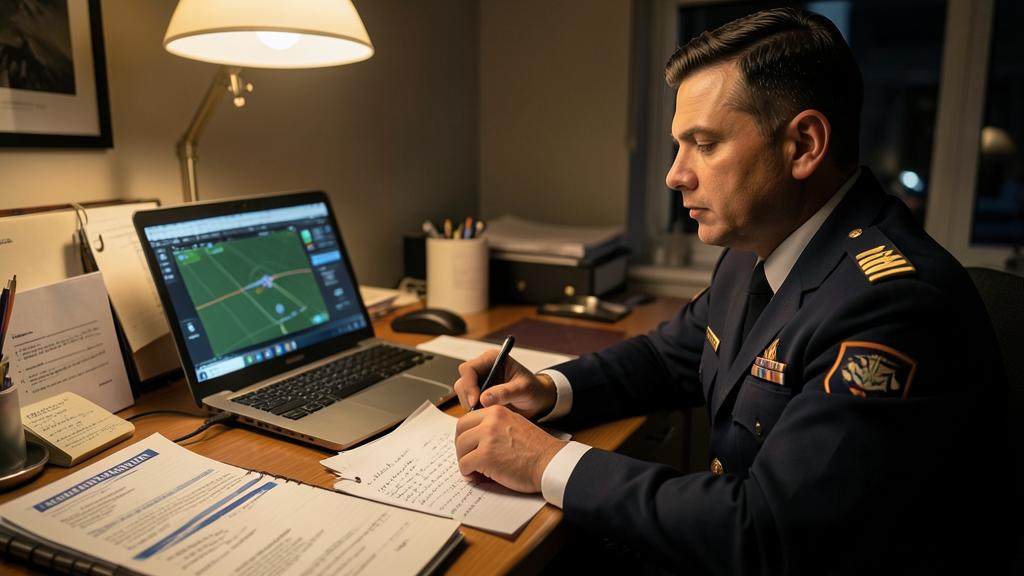
- Logbook totals and the breakdown by type, with the last thirty sectors identified and the last date flown as pilot flying.
- The exact variant and standard last operated, including avionics fit and any differences training already held.
- The last proficiency check and line check records, with the date of expiry rather than the date of the check.
- Instrument rating status, and the date on which the theoretical knowledge credit is anchored.
- Medical certificate class, validity and any limitation.
- An honest written note of what you believe has decayed. Instructors read these carefully, and they save a session.
Approved organisations, their national variations and the current cost of a renewal by type are discussed continuously by pilots who have just been through one; the FL330 training section is a reasonable starting point before committing to a quotation.


Leave a Reply
You must be logged in to post a comment.