
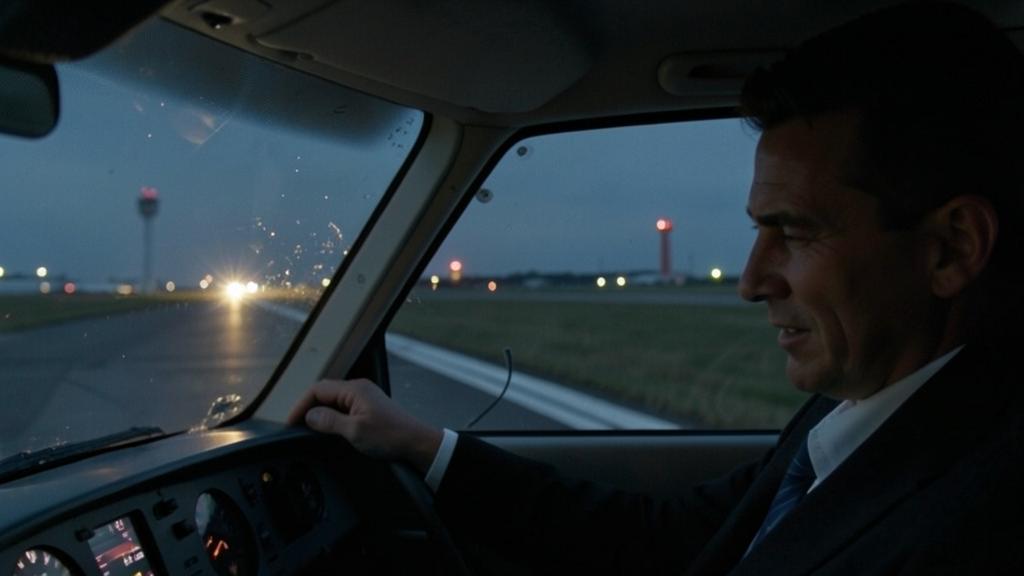
A drone report reaches the tower as a sentence, not a track. Someone saw something, somewhere, at some height, a few seconds ago. Out of that sentence a controller, an airport duty manager and a police officer have to decide whether nothing changes, whether one approach is broken off, or whether the movement rate goes to zero for a length of time nobody can predict. The decision is not made on the rule: by the time anybody picks up a microphone, the rule has already failed to do its work. It is made on how much the report can be trusted and how much of the movement area it touches.
A report is not a detection
Almost every drone event at an aerodrome begins with eyes. A crew on final sees an object for one to three seconds through a windshield, at a closing speed that gives no second look. A ramp agent glimpses something above the fence line. A resident calls the police from a garden. None of these is a measurement, and treating any of them as one is the first mistake in the chain.
The reason is geometric, not about competence. Estimating the range of an unfamiliar object requires a known reference — a wingspan, a building, a terrain feature at a known distance. On approach over open ground there is none, and the visual system falls back on assumptions about size. An object assumed to be a metre across at 300 metres is indistinguishable from one assumed to be ten centimetres across at 3 metres, and only the second one is an immediate hazard. Birds, balloons, plastic sheeting, kites, model aircraft operating lawfully several kilometres away and other traffic seen against an unhelpful background have all been reported in good faith as unmanned aircraft and later resolved as something else.
The inverse error is just as real. A small multirotor holding station is close to invisible from a moving cockpit, and the absence of a report proves nothing at all. So what a sighting actually establishes is narrow and worth stating precisely: a trained observer, in a position to see, believed they saw an unmanned aircraft, at a stated time, in a stated direction. It does not establish presence, position, height or persistence. The professional response is neither to treat that as a radar track nor to discard it because it came from one person.
A drone sighting is just someone’s best guess. It doesn’t prove a drone is there, how high it is, or how long it’s been there. The key is to treat it as a clue, not as a fact.
At London Heathrow, a pilot reports a drone near Runway 27L. The report says it was 100m away, at the same height as the aircraft (about 1000ft). But without a reference point, it could be a plastic bag or a bird. The tower holds departures for 15 minutes while checking, then resumes when nothing is found.
Who hears it first, and who decides
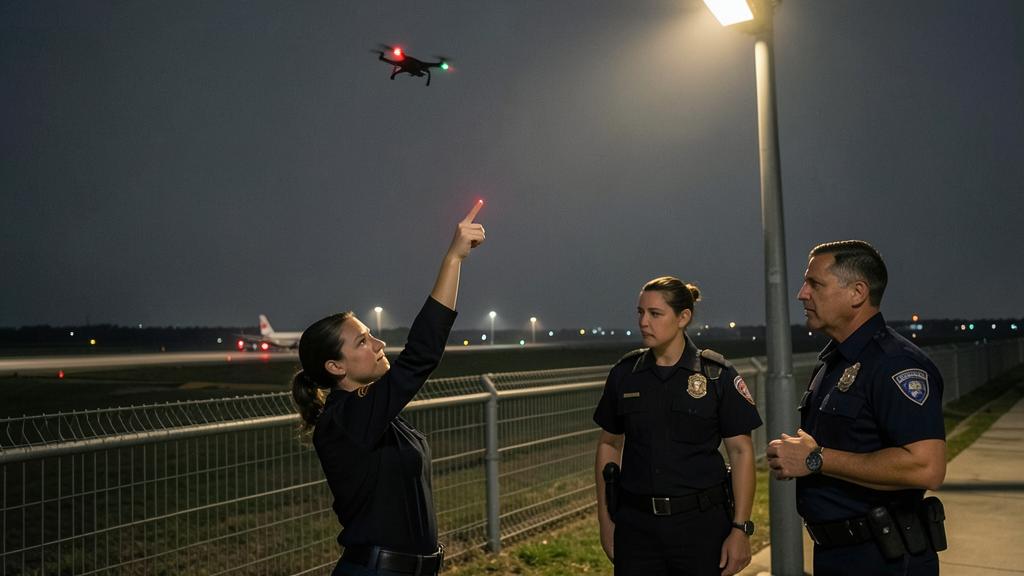
Reports enter the system through several doors that rarely open the same way. Flight crew through the air traffic services unit; aerodrome staff through operations; police through their own control room; the public through an emergency number; a detection system through an alarm on a console; occasionally the drone operator, calling to coordinate a flight that should have been coordinated a week earlier.
The confusion worth naming is that no one body owns the whole response. The air traffic services unit owns the traffic and can act on it immediately. The aerodrome operator owns the aerodrome and its safety management system. The police own the offence, the ground search and the identification of the operator. The State authority owns any airspace restriction. A workable local procedure therefore does one thing above all others: it names, in advance, the single person who may suspend movements and the single person who may resume them. Most of the value of the procedure lies in the fact that this name was chosen on a quiet afternoon rather than at nineteen hundred with aircraft holding.
Two failure modes recur. In the first, every party waits for another to take the decision, and the traffic continues while the report ages into uselessness. In the second, several parties can stop the traffic and none of them can start it again, so the aerodrome stays closed long after the reason has evaporated.
| Source | What it establishes | What it does not establish |
|---|---|---|
| Single flight crew report | A credible observer saw an unidentified object near a defined point of the approach or departure path | Height, range, size, whether the object is still there |
| Two independent crews, minutes apart, consistent position | Persistent presence of something at a stable location; near-conclusive in practice | The type of aircraft, its intent, the operator’s position |
| Ground observer on the aerodrome | A better range estimate against known references, and a direction to search | Whether the object is inside or outside the perimeter |
| Member of the public off-field | A location worth searching and a possible operator position | Any relationship to the approach path; timing is often hours old |
| Radio-frequency detection alarm | A control link or an identification broadcast is present in the area | That the aircraft is airborne, or where it is; silence proves nothing |
| Radar track | A radar return with a position and a track history | That the object is an unmanned aircraft rather than a bird or clutter |
| Recovered airframe | That a flight took place; evidence for the investigation | Anything about the present state of the airspace |
The ladder between noted and stopped
The decision is often framed as a binary — carry on or close — and it is not one. Between the two sits a ladder of responses whose rungs cost very different amounts, and the skill lies in climbing it at the right speed rather than jumping to the top.
One asymmetry drives more real decisions than any other: holding departures is cheap and reversible, holding arrivals starts a fuel clock. An aircraft on the ground can wait, burn nothing and be resequenced. An aircraft in the hold is consuming its reserves, and within a predictable number of minutes its commander has to choose a diversion. That is why a mature procedure very often begins by stopping departures on the affected runway while the report is corroborated, and treats the interruption of arrivals as a separate, later and much more consequential step.
| Response | Typical trigger | Operational cost |
|---|---|---|
| Log the report, no operational change | Single uncorroborated sighting, well clear of the protected surfaces, aged | None beyond the reporting workload |
| Traffic information to aircraft on the affected path | Single credible sighting on or near an approach or departure track | Frequency time; crews adapt their scan |
| Stop departures on the affected runway | Sighting on the departure path, awaiting corroboration | Sequence delay, reversible in minutes |
| Runway change, or a different approach procedure | Sighting concentrated on one final approach segment, alternative available | Capacity reduction, tailwind or crosswind limits, noise routing |
| Break off approaches, hold arrivals | Corroborated presence on final, close to the threshold | Go-arounds, fuel clock, diversion decisions within minutes |
| Full suspension of movements | Confirmed persistent activity over the movement area | Diversions, stand saturation, crew duty limits, several hours of recovery |
The right reflex. A crew report is worth far more when it is structured. Time and position relative to a named point, height relative to your own aircraft rather than an absolute guess, apparent size compared with a known object, direction and speed of movement, how long you had it in sight, and whether a second crew member saw it. Those six items turn a sentence into something a duty manager can act on; without them the report can only be filed.
What detection equipment actually delivers
Airports increasingly hold some form of detection, and the marketing metric is detection range while the operational metric is the false alarm rate. A system that raises two alarms a night for a passing delivery drone or a maintenance van’s telemetry will be muted by the third week, and a muted system is worse than no system because it creates a documented expectation that was not met.
Each sensing principle has a specific blind spot. Radio-frequency detection listens for control links and identification broadcasts; it is excellent against consumer aircraft flown normally and blind against one flying a pre-loaded route with its transmitter off. Radar sees an object but must separate a very small return from birds and ground clutter, which is exactly the discrimination problem that makes bird radar hard. Electro-optical and infrared cameras give the identification that everything else lacks, but generally need a cue from another sensor and degrade in the weather that makes drone flying unattractive anyway. Acoustic sensing works at short range and struggles beside a runway. Fusion of several principles is the only configuration that reliably converts an alarm into a decision.
Countermeasures are a different subject with a different legal footing. Jamming and spoofing are deliberate radio emissions near an aerodrome, constrained by telecommunications law and by the obvious risk to navigation and surveillance systems, and in most States they are reserved to designated authorities rather than to the airport. Kinetic effectors solve one problem by creating another: uncontrolled debris over a movement area.
There is also a security dimension that belongs in the procedure rather than in the equipment specification. A detection feed is data, and a decision process that hands automatic authority to a sensor can be attacked through that sensor — by fabricated broadcasts, by a cheap aircraft flown deliberately at the edge of coverage, or simply by a run of anonymous telephone reports. Closing an airport for an afternoon is an attractive result for very little outlay. Keeping the suspension decision with a named human who weighs several independent sources is not bureaucratic caution; it is the countermeasure.
The trap. Reading a silent detection system as proof of absence. The sensors that are quiet are quiet about the aircraft they were designed to hear. A crew report and a silent console are not a contradiction to be resolved in favour of the console — they are two partial views, and the human one saw something the machine was never built to see.
Detection systems are not perfect. They can miss drones or give false alarms. The key is to use them as one tool among many, not as the final word.
At Gatwick Airport in 2018, multiple drone sightings led to a 36-hour closure. Later investigations found no evidence of drones, but the reports caused major disruptions. The issue was not the drones, but how the reports were handled.
Resuming is the harder decision
Stopping has a trigger. Restarting has only an absence, and absence is not observable. This is where procedures are thin and where commercial pressure is at its highest, because by then every stakeholder in the airport is on the telephone.
What a defensible resumption looks like is a written set of conditions rather than a judgement call: a defined quiet period with no further sighting and no detection alarm, the completion of the ground search of the sectors that matter, confirmation from the police that they are content, and the resumption decision taken by the same authority that ordered the suspension. The length of the quiet period is a local choice and there is no universal figure; what matters is that the figure was fixed in advance and is not negotiated downwards while the delay accumulates.
Recovery is not the reverse of the suspension either. Reopening a runway does not reopen the airport. Diverted aircraft have to come back or be released, stands are occupied by aircraft that should have left hours ago, crews are approaching duty limits, ground handling has been rescheduled twice, and the slot picture is broken. A twenty-minute closure at the wrong hour can cost the rest of the operating day, which is precisely why the ladder in the previous section exists.
What the report becomes afterwards
Every one of these events is an occurrence and belongs in the reporting system, whether or not the traffic stopped. In the European framework mandatory occurrence reporting is a legal obligation on organisations and on certain individuals, and the report travels to the national authority and into the pooled European data. Elsewhere the equivalent national scheme applies. The point of filing is not the individual event, which is usually inconclusive by nature.
The value appears in aggregate. One unconfirmed sighting near a threshold means almost nothing. Twenty reports across a year, clustered at the same point, at the same time of day, in the same season, describe something concrete: a habitual operator flying from an accessible viewpoint, or a location from which a particular misidentification keeps recurring. Those two conclusions call for opposite responses — enforcement and identification in the first case, a change in the sensor coverage or in what crews are briefed to expect in the second. Neither is available from a single report, and neither becomes available if the reports are handled as incidents to be closed rather than as data to be accumulated.
Where the rule sits, and where it differs
It is worth being blunt about what the regulation contributes here. It defines the offence and the legitimate operation; it does not stop an aircraft that is already airborne. And it is not global. In the European system, Regulation (EU) 2019/947 organises unmanned operations into the open, specific and certified categories, sets a height ceiling of 120 metres above the surface for the open category, and gives Member States the power to define geographical zones in which operation is prohibited, restricted or subject to authorisation — which is how the surroundings of an aerodrome are normally protected. Most of the class marks, though not all of them, also carry a direct remote identification requirement.
The United States arrives at comparable protection through a different structure: small unmanned operations under Part 107 with a ceiling of 400 feet above ground level, airspace authorisations for controlled airspace obtained through the automated system rather than by a blanket prohibition, and a separate remote identification rule. The categories, the authorisation mechanism, the height reference and the enforcement authority all differ. The practical consequence for an airport is that a visiting operator’s honest belief about what is permitted may be imported from another system, and that awareness campaigns written for one framework do not transfer intact to another.
Above the national rules sit the international obligations that give the aerodrome its safety framework in the first place: the aerodrome certification and safety management obligations in ICAO Annex 14, the air traffic services provisions of Annex 11 with the procedures in PANS-ATM, and the aviation security framework of Annex 17. None of them contains a threshold that tells a duty manager when to stop the traffic. That threshold is written locally, and the quality of the local writing is what separates an aerodrome that loses twenty minutes from one that loses a day. Practitioners comparing how different fields have written theirs will find the discussion recurring on the FL330 forums.


Leave a Reply
You must be logged in to post a comment.