
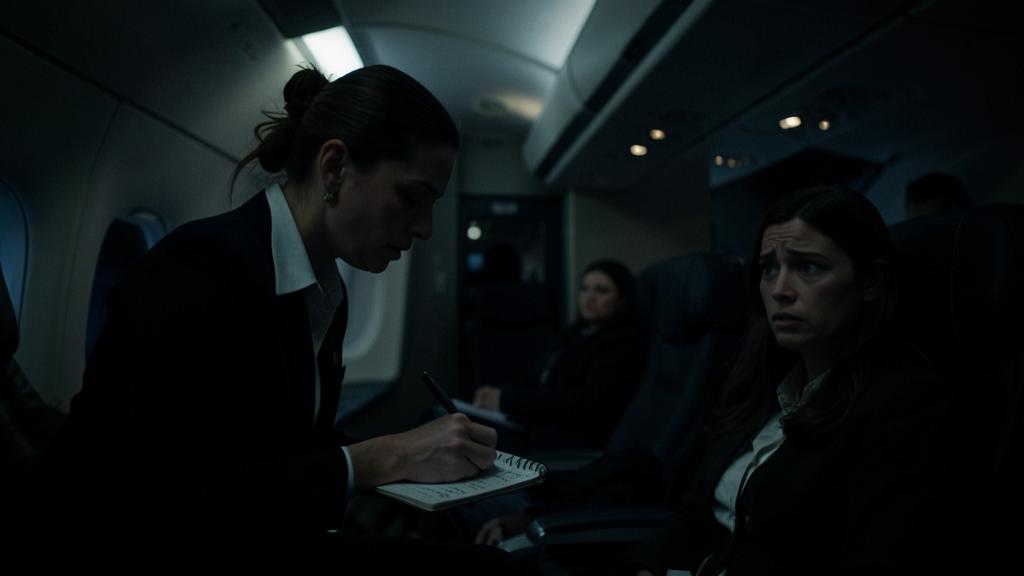
During a night rotation, a passenger reports being touched in her sleep by her neighbor. The crew does what’s needed for the flight: the two individuals are separated, tensions subside, and the door opens on time. Six weeks later, nothing is left to work with—none of the four accounts were written separately, no one noted the two seat numbers, and the passenger took a connection without anyone on the ground knowing who he was. The facts didn’t disappear: it’s the material that carried them that was destroyed, act by act, by gestures all justified in isolation.
On the ground, what’s missing is almost never the fault
Cases collapse due to four consistent absences: no one can link the account to an identity, no one can pinpoint the time, the testimonies are too similar to stand on their own, and the chain of what was done on board isn’t documented anywhere. None of these gaps can be recovered after disembarkation.
The issue stems from a conflict of objectives that goes unnoticed at the time. In flight, the mission is complete when nothing else happens; on the ground, something must remain. Yet what stops the disturbance fastest—relocating the affected person, not disturbing the cabin, debriefing as a group upon arrival to ensure consensus—is precisely what erases the evidence. The two objectives only align during the first minute.
A competent crew that handles the incident well can still produce an empty file: it’s not a behavioral fault, it’s a procedural flaw.
Les cas s’effondrent parce que les détails importants ne sont pas notés assez tôt. Si on ne note pas les sièges ou les témoignages séparément, il n’y a plus rien à utiliser après l’atterrissage. C’est comme si on effaçait les preuves sans le vouloir.
Sur un vol Paris-New York, une passagère signale un contact non désiré à 2h14 UTC. L’équipage sépare les deux personnes mais ne note pas les numéros de sièges avant de déplacer le passager. À l’arrivée, l’opérateur ne peut pas identifier le passager concerné dans les données de réservation, car le lien entre le siège et l’identité a été perdu.
Three objects that aren’t handled at the same time
A report of this type opens three distinct files, with different recipients and timelines. First, flight safety: a passenger who assaults may also disobey, resist, or move, and standard classifications of disruptive behavior place physical assault far beyond verbal disturbance. Second, care for the affected person: removing them from harm, listening without interrogating, not exposing them to the rest of the cabin, and telling them what will happen. Finally, the evidentiary material: what will be readable by a third party who wasn’t there.
The recurring mistake is treating the third object as a follow-up to the first two, once the flight is over. It must be handled simultaneously, with gestures taking seconds: noting a time, noting two seats, and preventing two witnesses from speaking before writing. None of this delays response, and all of it becomes impossible ten minutes later.
A point is often misunderstood on board: the fact that the affected person doesn’t want—or isn’t ready—to pursue legal action doesn’t exempt the operator from any of its obligations. The event report, notification to the commander, and company information don’t depend on this choice. The person is informed of what will be possible upon arrival; they aren’t asked to decide in ten minutes, in their current state, what they’ll do with a complaint.
The right reflex. As soon as the report is received, note three things on any medium: the UTC time, the two seat numbers, and the flight phase. Thirty seconds. It’s the only element no later reconstruction can produce, and it’s the most frequently missing.
Separating people is already investigating
Separation fixes positions and prevents version contamination. Three principles govern it, and the first is counterintuitive for many crews.
The presumed perpetrator is moved, not the affected person. Moving the one who reported treats them as the problem, under the cabin’s gaze, and makes them lose their belongings, seating, and bearings—the moment they need them most. It also deprives the file of an anchor: their original seat becomes debatable. If cabin constraints require the opposite, it’s justified and documented.
Seats are noted before any movement. The seat number is the only link between a witness’s account and a passenger’s identity in the reservation data. Once the passenger is moved, then disembarked, this link no longer exists: the ground team is left with a description of a man in his forties and nothing else.
Contact is prevented, not just proximity: the lavatory line, galley, and disembarkation queue undo everything separation achieved. The same rule applies to spontaneous mediation—the passenger who wants to “work it out,” or the crew member who organizes a face-to-face discussion, destroy independent versions in two minutes. No confrontation occurs on board.
The trap. Physically restraining a passenger whose behavior has stopped. Restraint measures are justified by an ongoing threat, not by the severity of what just happened. Excessive restraint shifts the file: the procedure will no longer focus on the reported facts, but on the conditions of restraint—and the operator will be on the defensive.
Writing while the account is still theirs
This is where the most material is lost, and the remedy costs nothing: everyone writes alone, before any exchange with others. The reason isn’t distrust of colleagues, but a documented effect of witness memory. As soon as two people recount together, each incorporates the other’s details and later restates them as their own, in good faith. Accounts converge, gain apparent coherence, and lose all cross-verification value—a savvy reader immediately sees that four identical testimonies are worth one.
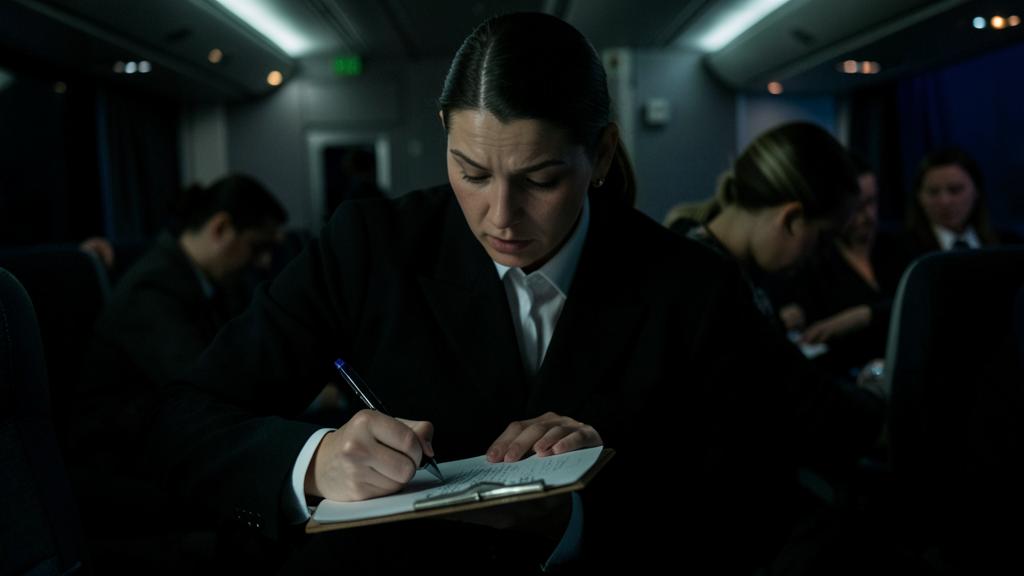
Si les témoins parlent entre eux avant d’écrire, leurs récits deviennent trop similaires et perdent toute valeur. C’est comme si quatre personnes disaient la même chose : ça ne prouve rien. Il faut écrire seul, tout de suite, pour garder des versions indépendantes.
Sur un vol Londres-Dubaï, deux passagers signalent un incident. L’équipage les fait écrire ensemble pour “clarifier”. Leurs témoignages deviennent identiques, ce qui les rend inutilisables en justice. L’enquête au sol n’a plus que des versions alignées sans valeur probante.
The crew debriefing retains its full utility for emotional load and safety analysis: it comes after the writings, never before.
The manner of writing remains. A useful account describes without qualifying: legal qualification belongs to a law the crew doesn’t know, and an erroneous qualification written by a professional becomes an attack point. The table below lists the most frequent formulations in cabin reports.
| What gets written spontaneously | What a reader makes of it | What holds up |
|---|---|---|
| “The passenger sexually assaulted the woman next to him.” | A legal characterisation made by a witness who is not entitled to make it, and which does not say what was seen. | “At 02:14 UTC, the passenger in 24C told me she had been touched on the thigh by the passenger in 24B while she was asleep.” |
| “He admitted it.” | A confession reported without context or exact words, easily contested, and which weakens the rest of the account. | “When asked about his seat, he replied: ‘I must have moved in my sleep.’ Words reported in quotation marks, spoken in front of me.” |
| “She was visibly distressed, so it happened.” | An inference presented as an observation: the state described remains useful, the causal link weakens the whole statement. | “She was shaking and crying; she stayed standing in the galley until the descent. I did not witness the incident.” |
Three rules complement the table. What wasn’t seen must be written as such: “I wasn’t in the aisle at that moment” is more valuable than a reconstructed account. What comes from a third party is flagged as reported, with the name or seat of that third party. And crew actions are written with their time, even the trivial ones: this chronology will show that the response was conducted, if later contested.
The ground link is built in cruise
The difference between a passenger handed over to authorities at the gate and one who took a connection doesn’t depend on the severity of the facts: it depends on when the commander was informed. The team must have time to relay a message to operations, which then contacts the relevant authorities. If informed during taxi, no one has time for anything.
Si l’équipage ne prévient pas le sol pendant le vol, il n’y a plus de temps pour organiser l’accueil des autorités à l’arrivée. Le passager peut alors prendre une correspondance et disparaître sans laisser de trace.
Sur un vol Francfort-Singapour, un incident est signalé pendant la descente. L’équipage n’a pas le temps d’informer le sol. À l’arrivée, le passager concerné prend une correspondance sans que les autorités puissent l’intercepter, car son identité n’a pas été transmise à temps.
Four method points frame this phase. The crew has no authority to verify identity, search belongings, or seize anything—and doesn’t need to, since the seat number provides access to reservation data. No public announcement is made: the cabin isn’t an audience, and exposing the affected person is itself a harm. The disembarkation order is prepared, so the two individuals aren’t in the same line or airbridge. Finally, the affected person is accompanied upon arrival by a designated crew member: leaving them alone in a transit corridor is when most actions stop.
When the stopover has no support and the ground doesn’t respond, the crew remains the only channel—and this is documented: a file showing the request was made without success is better than a silent file.
Two writings, two regimes that don’t replace each other
Many crews produce a single document and believe they’ve covered everything. Two are needed, with unrelated purposes, and their confusion is costly.
| Criterion | Occurrence report | Factual statement handed to the authorities |
|---|---|---|
| Purpose | Alimenter le système de gestion de la sécurité, mesurer un phénomène, corriger des procédures | Establish facts admissible in criminal or disciplinary proceedings |
| Trigger | Obligation of the operator and the crew member, independent of the wishes of the person targeted | Referral to the authorities, complaint, requisition |
| Author | Each crew member concerned, using the operator’s forms | Each witness, in their own name, signed and dated |
| Handling of identity | Protection of the reporter, downstream de-identification under the applicable rules | Named by design, identity is the very subject of the statement |
| What it does not do | It does not establish liability and does not constitute a complaint | It does not feed the operator’s safety analysis |
The protection attached to the event report covers its author within the safety system; it doesn’t turn the account into a shield and doesn’t exempt from any declaration to authorities. Conversely, giving authorities a poorly calibrated safety form copy is giving them a text designed for another purpose. Best practice is to write once, factually, then feed both circuits from the same material—never producing two divergent versions, which would discredit both.
The third, often forgotten, register is the operator’s own: refusal of future boarding, internal blacklist, contractual consequences. It follows its own rules and doesn’t wait for judicial outcomes, but relies on the same writings. All the more reason for them to be descriptive.
The law that will qualify the facts isn’t known on board
The point seems theoretical in flight; yet it dictates the manner of writing, and is the fundamental reason to describe rather than qualify. The convention on offenses committed on board aircraft first gave jurisdiction to the aircraft’s state of registration, creating absurd situations: acts committed over one country, in an aircraft registered in a second, landing in a third, fell under no available authority. The subsequent modification protocol extends jurisdiction to the landing state and the operator’s state, for ratifying states.
Two practical consequences. The qualification of facts, age thresholds, and even the definition of consent vary by country, and the crew doesn’t know, at the time of writing, which law will apply: a descriptive account crosses these variations, a qualification doesn’t. And the effective availability of authorities upon arrival depends on the stopover, not the severity of the facts—which doesn’t change what the crew must produce, but prohibits making any promises to the affected person.
The commander’s powers, however, are stable: they can take reasonable measures necessary to protect persons on board and hand the individual over to authorities upon landing. This is the basis for separation, possible restraint, and handover; no further justification is needed to act.
Areas that nothing clarifies, and how to handle them anyway
Certain configurations repeatedly arise and find no answer in procedures. They’re handled by method, not rule.
- Night flight, dimmed cabin. Noting the lighting isn’t a detail: it’s what will make it credible—or not—that a crew member distinguished a gesture from the aisle.
- Sleeping person, blanket. The report arrives upon waking, sometimes long after the facts. Separation remains possible, as does noting seats; the time of the facts becomes an estimate and must be written as such, with the reporting time, which is certain.
- Alcohol. Intoxication is described by observed behavior, never by judgment: no stated level, but what was served noted if the information exists.
- Report after landing. It isn’t refused: the report remains due, and the seat number still allows the operator to act on its own register.
- Fact implicating a crew member. The hierarchical channel is no longer neutral: this is the case where a distinct internal channel must exist, and be known before needed.
- The affected person recants or wants nothing. It’s recorded, not insisted upon, not argued. The operator’s report remains due, and the preserved trace serves if the person returns later—which is frequent.
What to verify in your own documentation
This article describes a mechanism; the application lives in your operator’s manuals, and that’s where discrepancies are found. Five concrete checks are worth doing before the next flight rather than during.
Does the cabin report form have fields for UTC time, flight phase, and seat numbers, or must they be slipped into a free field? Does the passenger discipline section of the operations manual have explicit instructions on separate account writing—and if not, does the cabin team know the group debriefing happens after? Who decides on the request for authority reception, and by what channel, when the stopover is outside working hours? Is there a designated contact for the affected person post-flight, with a way to reach them, or does the handover stop at the gate? Finally, is a reporting channel distinct from the hierarchical path provided for facts implicating a crew member?
A missing answer isn’t an operator’s fault: it’s a point to raise in a safety meeting or to work on in periodic training. The FL330 training courses treat this sequence as a standalone cabin exercise, including timed writing, because such an order isn’t improvised.
A gray area no one closes remains: the boundary between accidental contact and deliberate gesture, in a space where people constantly touch. The crew isn’t to decide it, and mustn’t. Its role is to enable someone else to decide it, with material—which is exactly the purpose of everything preceding.
The applicable texts, the concerned state’s regulations, and your operator’s approved documentation take precedence over this article, which has only an explanatory value and doesn’t replace a procedure or legal advice.


Leave a Reply
You must be logged in to post a comment.