
An operator receives six additional aircraft. Same manufacturer, same type rating on the licence, but one avionics generation apart and a braking architecture that differs from the fleet already in service. The question lands at the very first programme meeting: how many hours, on which device, checked or not? It is settled neither at the operations desk nor in the manufacturer’s training centre brochure. The answer was written during type certification, in a file that few operators ever open in full.
What the operational evaluation deposits in the certification file
For a long time, type certification and the evaluation of its operation lived apart. On one side, the demonstration of compliance with airworthiness specifications; on the other, an operational evaluation board that published a report: useful, consulted, largely followed, but with no force of its own. Authorities referred to it, operators drew on it, and no one could really say what happened when a training programme departed from it.
The operational suitability data regime closed that door. This data is produced by the type certificate applicant, approved by the agency, and belongs to the certification file on the same footing as the flight manual. It is no longer advice: it is binding. Its revision even follows the design-change route — same office, same formalism, same traceability. A manufacturer that changes a system therefore touches, in the same act, airworthiness and the training content that flows from it.
The package covers five items whose only common trait is being approved together. They are not addressed to the same operator departments, and that is precisely why they travel poorly: whoever writes the type rating course does not read the simulator data, whoever writes the minimum equipment list does not read the cabin part.
| Approved item | What it fixes | Who cannot go below it |
|---|---|---|
| Flight crew data | Type rating designation, minimum course content, master differences tables, points of special emphasis | Training organisation, operator, examiner |
| Simulator data | Validation source data enabling objective qualification of a device | Device manufacturer, qualification authority, buyer of hours |
| Cabin crew data | Type and variant split on the cabin side, minimum content of the associated training | Operator, cabin training organisation |
| Maintenance certifying staff data | Minimum content of type training, split between theory and practice | Maintenance training organisation, workshop |
| Master minimum equipment list | Dispatch conditions with inoperative equipment, associated procedures and limitations | Operator, in its own minimum equipment list |
The operational suitability data sets the minimum training requirements for an aircraft type. If the manufacturer changes something, the data changes too, and the operator must adjust their training. The operator can add more training, but never less than what the data says.
An airline adds an Airbus A320neo to its fleet, which has a different avionics system than the existing A320ceo. The operational suitability data specifies that crews must complete a simulator session (level D) to transition between these variants. If the airline doesn’t have a simulator qualified for the neo, it must either rent one or delay the aircraft’s entry into service.
Type designation, the heaviest decision in the file
The first line of the flight crew data is also the costliest: the name carried on the licence. Deciding that a new model falls within an existing rating, or that it opens a new one, commits far more than a writing convention. A common rating allows crews to be mixed on a single roster, lowers the entry cost of a new sub-fleet, and lets fleet growth be built without going back through a full course. A separate rating imposes a full course, a full check, its own recurrent training, and closes the door on operating across several types.
This decision is made in light of system-by-system comparisons, flight control logic, alerting philosophies, workload and the machine’s handling behaviour. It is never free: when two very different models nonetheless share a rating, whatever was not paid for in the initial course shows up in full in the differences package. Nothing disappears, everything moves. That is also what makes a rating worth what it is worth on the job market, a factor that crews on short-term assignments read before anything else on a job posting.
Master differences tables set a floor, not a programme
For each pair of models or variants attached to the file, the data carries a table that assigns a level, across three distinct columns: training, checking, recurrent training. These three columns do not follow from one another. A difference may call for a simulator session in training and no dedicated check, or the reverse: a mere briefing but a periodic verification of recurrent competence on both configurations.
The level scale carries letters. It rises from a document handout up to the aircraft, passing through assisted instruction and devices. The exact letter for each pair is assigned by the approved file: it cannot be inferred from a reading of the flight manual, and it is not negotiable on the grounds that crews already know the machine.
| Rung | Expected instructional means | What the evidence covers | Consequence for the workload plan |
|---|---|---|---|
| A | Document handout, self-instruction | Recorded briefing | No dedicated session, but a distribution to prove |
| B | Assisted instruction: interactive media, presentation, classroom | Guided understanding, with follow-up | Crew time, no device |
| C | Part-task device, procedures trainer | Correct execution of the procedure | Booking of a device and an instructor |
| D | Full flight simulator | Handling in situation, complete manoeuvres | Simulator slot: the deciding cost item |
| E | Aircraft or higher-level representative device | Real behaviour of the machine | Aircraft taken out of service, slot and fuel |
The trap: believing that a common type rating removes differences training. It is exactly the opposite. A single rating means no full course is required to move from one model to the other, not that there is nothing to do. Pairs housed under the same rating may well require a simulator session, a check, and recurrent-competence follow-up on each configuration. A schedule built on the opposite assumption collapses at the first audit, and the crews concerned find themselves retroactively unqualified on half the fleet.
From the master tables to the operator’s tables
The master tables reason in terms of models and variants as declared by the manufacturer. The operator, for its part, does not operate models: it operates configurations. Two aircraft of the same model number can differ by a computer standard, a guidance option, a terrain alerting device, a cabin fit-out, a post-delivery modification. That is why the work does not stop at reading the file: one must build one’s own tables, system by system, comparing what crews actually find in front of them.
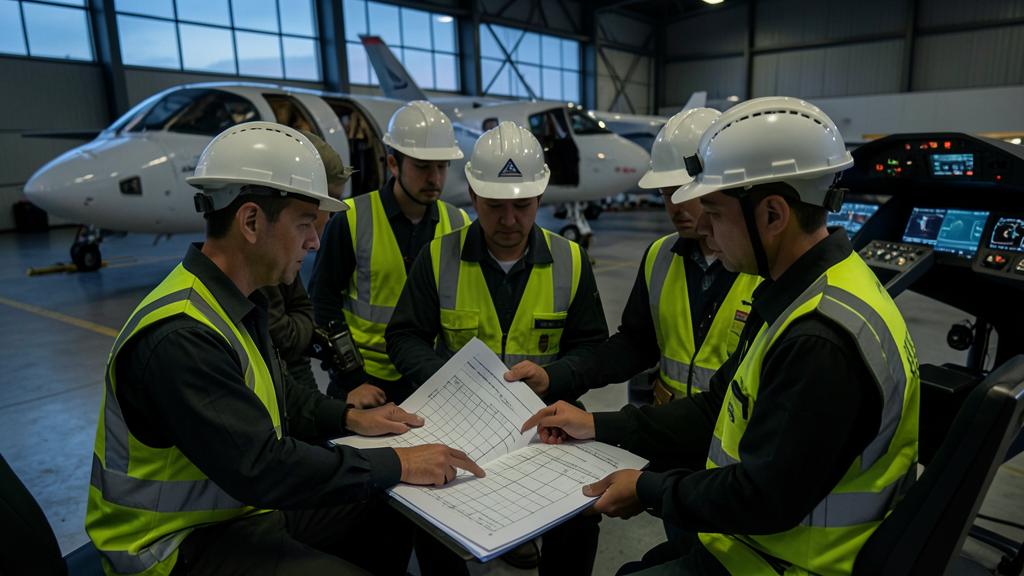
This comparison is conducted pair by pair, and in a given direction. Moving from the older aircraft to the newer one is not the same event as the reverse path: discovering an additional automation does not cost the same as doing without it, and regression to an older configuration generally holds the bad surprises. The result of this work is a living, revisable document, which must remain consistent with the master tables — above, never below — and which becomes the reference for the approved programme.
The difficulty is that the configuration moves without anyone triggering a training review. A modification project, a computer replacement, a placard fitted after an airworthiness directive, an aircraft taken on short-term lease with an instrument panel found nowhere else in the fleet: each of these events creates a pair that has never been analysed. Technical mastery of the fleet and mastery of training are then two departments that fail to speak to each other at the right moment.
The right reflex: tie the differences review to the modification process, not to the training calendar. Concretely, any modification touching a system listed in your tables triggers an analysis before return to service, even if it changes nothing about airworthiness. And record in the training manual the precise reference — revision index included — of the data your programme is built on: that number is what will let you know, long afterward, immediately whether the floor has moved under your feet.
Simulator data, the link that gets forgotten
A training device is not qualified against instructors’ impressions, but against reference data drawn from flight tests: aircraft responses, performance, system behaviour. This validation source data is precisely what the simulator element of the file provides. Qualification tests then compare the device to these recordings, within tolerance bands, point by point.
The practical consequence often goes unnoticed until it blocks a project. A device is qualified for a given configuration, the one used to validate it. If the tables require a simulator session for a difference, there must still be a device representing the configuration concerned, or a file justifying the use of a neighbouring device with the restrictions that come with it. An operator can thus find itself with a perfectly clear requirement and no way to satisfy it within a reasonable timeframe, because the only device representative of its area is booked out months in advance. The fleet growth schedule is therefore negotiated with the device provider before it is negotiated with the operations department.
Cabin, maintenance and the minimum list: three more clocks
The split into types and variants is not the same on each side of the flight deck door. What matters on the cabin side is the exits, their opening mode, emergency equipment, layout, means of communication and evacuation procedures. Two aircraft under the same pilot type rating can constitute two distinct entities for cabin crew, and two aircraft requiring two pilot ratings can converge on the cabin side. An operator who mechanically aligns the two splits builds a programme that is wrong both ways at once.
On the maintenance side, the file fixes the minimum content of type training for certifying staff and how it is split between theory and practice. This is what determines whether a mechanic already qualified on one variant must take a full course or a differences course for the neighbouring variant — a question that governs a workshop’s capacity far more than the number of workstations.
The master minimum equipment list, finally, plays the same floor role for the operator’s list: the latter may be more restrictive, never more permissive, and must be updated when the reference changes. It also generates training: every operating procedure associated with an inoperative item is something the crew must know and apply under time pressure at the gate.
What the operator genuinely keeps control of
The floor is not the programme, and a considerable margin remains. The order of sessions, how they link with in-house procedures, the choice of scenarios, the level of standardisation required of instructors, integration with the rest of recurrent training: all of this belongs to the operator and is negotiated with its authority within its manual. Nothing prevents going beyond the minimum, and an operator running a heterogeneous fleet often has an interest in doing so.
This is even where the real organisational decision is made: train everyone on the most demanding device in the fleet, or manage individual restrictions configuration by configuration. The first option costs hours; the second costs planning, a reliable qualification database and an assignment discipline that holds up on a disrupted night. No text settles it: it is an operator’s call, and it must be documented. Organisations that deliver type rating courses apply the same reasoning when building their type rating pathways around a common floor.
Credits, on the other hand, are not invented. When the file provides for an abridged course for a candidate already holding a neighbouring rating, the reduction is carried by an approved text and stands on its own. Any other reduction is a proposal from the operator, which must be substantiated, submitted, and approved before being applied — not after. Crew experience, instructor quality and a fleet’s reputation are not admissible arguments: they are reasons to run the programme well, not to shorten it.
The floor moves, and no one calls you
What remains is the grey zone, the one that produces the most unpleasant findings because it results from no visible fault. The data is revised at the pace of design changes, and a revision can raise a requirement for a fleet already trained. No mechanism spontaneously warns the training manager: the new index arrives in the technical circuit, not in their own. Three checks are worth running in one’s own documentation, and they require only reading.
- Is the data index on which the approved programme is built written down anywhere, and does it match the index currently in force?
- Is the date of the operator’s tables’ last review later than the last modification project and the last aircraft entry, including on lease?
- For an older type, is a complete set of elements available, or does the programme still rest on evaluation reports predating the current regime, with the uncertainties that implies?
For someone preparing a type rating, the same reading pays off differently. The special requirements section and the points of special emphasis announce what the instruction will actually bear down on, and what the examiner will look for: these are not pedagogical recommendations, they are the areas where the operational evaluation found something. Entry conditions, for their part, tell the candidate whether they will need to justify prior experience before being accepted onto the course, which is checked before signing a quote, not after.
The foregoing describes a general mechanism. In every case, the applicable text, the approved data for the type concerned and the operator’s approved documentation prevail over this article, and are authoritative before the authority.
Questions fréquentes
Does operational suitability data apply to the operator or only to the training organisation?
It applies to both, through different channels. The organisation that delivers the type rating course has its programme approved by reference to this data. The operator, for its part, inherits it for its differences training, cabin training, minimum equipment list and maintenance training. An operator who outsources all of its training remains responsible for the compliance of the result.
Can two aircraft sharing the same type rating still require differences training?
Yes, and this is the most common situation. A common rating means no full course is required to move from one to the other, not that there is nothing to do. The differences tables may impose a device session, a simulator session, a dedicated check or recurrent-competence follow-up on each configuration. This level is read in the approved file, it is not inferred.
What happens when a data revision raises the requirement for a fleet already trained?
The revision creates a gap between the approved floor and the programme in force, which must be analysed and then closed on a schedule agreed with the authority. The sensitive point is detection: the new index circulates in the technical channel and does not spontaneously reach the training manager. Recording the reference index in the training manual is the simplest way to make the gap visible.
Can a differences session be run on a simulator qualified for another variant?
Not freely. A device is qualified against the validation source data of a specific configuration, and its certificate says so. Using a neighbouring device requires a file that identifies the gaps, the tasks that remain validly trained and those that do not, with the authority’s agreement. It is feasible, but it must be prepared before booking the slots.
Is the split into types and variants the same for cabin crew?
No, and this is a recurring source of programme errors. The cabin split is based on exits, emergency equipment, layout and evacuation procedures. Two aircraft under the same pilot rating can constitute two distinct entities on the cabin side, and the reverse is also observed. The two splits must be read separately, in their respective elements.
Can an operator shorten a course by invoking its crews' experience?
Only the credits provided for by the approved data apply as of right, for example an abridged course for a candidate already holding a neighbouring rating. Any other reduction is a proposal that must be substantiated by a file and approved before application. Crew experience is an argument for the quality of the outcome, not an argument for reducing the content.


Leave a Reply
You must be logged in to post a comment.