
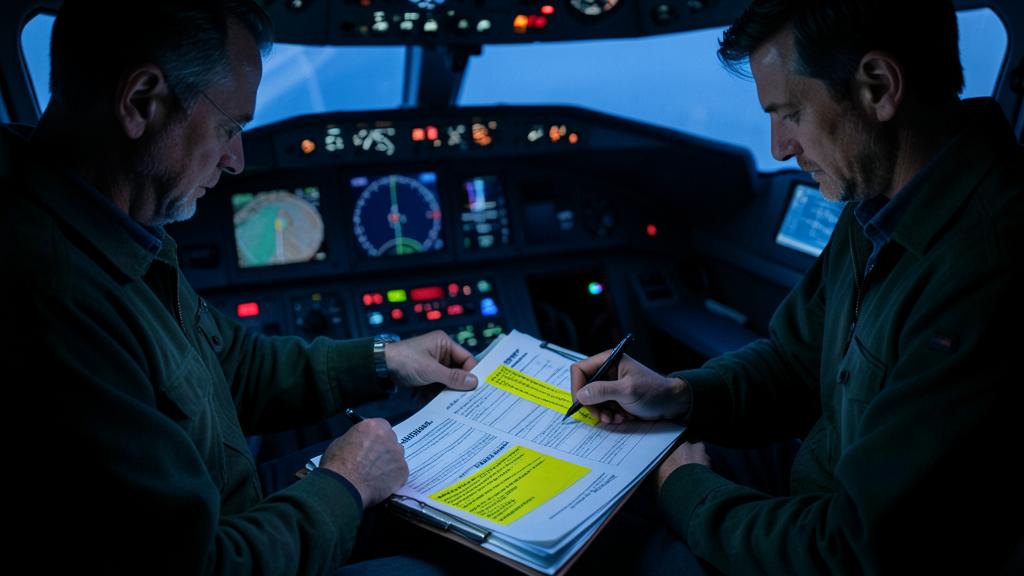
Most of the notices that matter are not missed because they were unreadable. They were read, then filed in the wrong urgency category, and the crew arrived at the runway with an item they had technically seen and operationally forgotten. The volume argument — too many notices, too little time — is real but it is not the mechanism. The mechanism is a briefing package sorted by aerodrome and series rather than by the decision each item changes, and a small set of validity conventions that fail quietly when nobody reads them closely. Both are fixable in the way a crew works, without waiting for the format to improve.
A notice that was read is not a notice that was used
The obligation is old and unambiguous: the ICAO rules of the air require the pilot-in-command, before beginning a flight, to become familiar with all available information appropriate to that flight. EASA Part-CAT carries the same duty into the pre-flight preparation of a commercial flight, and no operator’s dispatch arrangement transfers it. What neither text says is how a human being is supposed to convert forty pages of notices into a handful of decisions, and that gap is where the failures live.
The instructive case is not obscure. In its investigation of the Air Canada 759 overflight of a taxiway at San Francisco in July 2017, the United States National Transportation Safety Board examined how the closure of the parallel runway — the reason the expected pattern of lights was not there — had been presented in the crew’s briefing material. The item was in the package. It was not, in any useful sense, in the crew’s model of the aerodrome. That distinction is the whole subject of this article.
Sort by the decision, not by the order of arrival
A briefing package arrives sorted by aerodrome, then by series, then by number. None of those orderings correspond to anything a crew has to decide. The first move, before reading a single item in detail, is to assign each one to a tier defined by the decision it can change.

| Tier | Question it answers | Typical subjects | When it must be known |
|---|---|---|---|
| 1 — Feasibility | Can this flight legally and physically be made at all? | Aerodrome closed, runway closed, airspace closed or reserved, curfew, prior permission required, customs or handling withdrawn, alternate unavailable | Before the fuel figure is agreed — it changes the plan, not the execution |
| 2 — Numbers | Does a figure in my performance or approach calculation change? | Work in progress shortening declared distances, displaced threshold, obstacle in the climb-out, navigation aid or approach unserviceable, lighting unserviceable, rescue and firefighting category reduced | Before performance and minima are computed — a recomputation, not a briefing note |
| 3 — Execution | What will surprise me between the stand and the runway, or on the day? | Taxiway closures, stand and apron restrictions, non-standard procedures, bird activity, GNSS interference, laser and drone activity, temporary frequency changes | At the taxi and approach briefings, in the specific place it applies |
| 4 — Awareness | Nothing I do changes; do I need to recognise it if I see it? | Lit cranes clear of the flight path, work outside the movement area, administrative and reference items | Read once, no action |
The value of the tiering is not tidiness. It is that tier 1 and tier 2 items have to reach a different person at a different moment. A runway closure that arrives in the crew’s hands at the gate has already missed the fuel decision it should have driven. An operator whose dispatch process cannot separate those two tiers before releasing the flight is relying on the crew to catch late what the system should have caught early.
The right reflex. Read the package twice with different eyes. The first pass is a triage that touches nothing but the qualifier line and the subject: tiers assigned, nothing read in detail. The second pass reads tier 1 and 2 items in full, and only those. Attempting both at once is what produces a package that has been read through and understood in patches.
The qualifier line does the triage for you
The Q line exists precisely to make the first pass fast, and it is routinely skipped as noise. Its structure, set out in ICAO Annex 15 and detailed in the associated ICAO procedures for aeronautical information management, encodes in a few characters what the plain-language item takes a paragraph to say: the flight information region concerned, a five-letter subject and condition code, the traffic it affects, its purpose, its scope, the vertical band, and a centre point with a radius.
Two parts of that repay learning properly. The five-letter code decomposes: after the leading Q, two letters name the subject and two name the condition. The subject group MR designates a runway, so a code beginning QMR concerns a runway; the condition group LC means closed. Read that way, the code alone puts an item in tier 1 before the text has been opened. The other part is the purpose group, which tells you whether the originator considered the item to warrant the immediate attention of aircrew, to be of operational significance for inclusion in a pre-flight bulletin, or merely miscellaneous. Those are the originator’s judgements, not yours, and they are sometimes wrong — but they are a reasonable prior for a first pass, and using them costs seconds.
The vertical band and radius matter for the en-route items, which are where over-inclusion does the most damage. A briefing package assembled with a generous corridor width returns navigation warnings for airspace nowhere near the track. Knowing that the qualifier line carries the geometry lets a crew discard those without reading them, which is the only honest way to reduce the volume problem from the cockpit.
The qualifier line is a shorthand code at the start of each notice. It tells you quickly what the notice is about (like a runway closure) and how urgent it is. Skipping it means you might miss important details without even reading the full notice.
A NOTAM for Paris Charles de Gaulle (LFPG) reads: “QMR LC 01/01/24 1200-1800 UTC RWY 27L CLOSED.” The “QMR” tells you it’s about a runway (MR) and it’s closed (LC). The “01/01/24 1200-1800 UTC” gives the time window. The crew can quickly see this is a tier 1 notice and must adjust their flight plan before fueling.
The fields where the information actually hides
| Item | What it carries | The trap |
|---|---|---|
| Q line | Region, subject and condition code, traffic, purpose, scope, vertical band, centre and radius | Skipped as noise, so the triage that it enables never happens |
| A) | The location concerned | An en-route item filed under a region rather than an aerodrome is easy to lose in an aerodrome-sorted package |
| B) and C) | Start and end of validity, in UTC | C) marked as an estimate does not expire on its own; C) marked permanent means the change is heading for the published documentation |
| D) | The schedule inside the B–C window | The single most expensive omission: a window of several weeks that in fact applies only on certain days and hours |
| E) | The plain-language text | Read first and often read alone, which is how the schedule in D) is missed |
| F) and G) | Lower and upper limits for the item | Absent on aerodrome items; on en-route items they are what makes most of the package irrelevant to your level band |
The D field deserves its reputation. An item announcing work on a taxiway from the first of the month to the end of it, with a D field restricting it to nights between specified hours, is a tier 3 item on most days and a non-item on the rest. Read without D, it becomes a month-long closure that the crew plans around unnecessarily — or, worse, it trains the crew to discount a whole class of items as exaggerated, which is precisely the habit that lets a real closure pass.
Time is where the reading goes wrong
Everything in the package is in Coordinated Universal Time, and almost every operational conversation around it is in local time. That conversion is trivial and it is still a routine source of error, because it is performed under time pressure, at the moment of least attention, and it is performed twice — once for the start of the window and once for the end.
| Trap | Mechanism | Defence |
|---|---|---|
| Summer time changes at the destination | The UTC window does not move; the local working hours it describes do. Notices written around a local schedule can shift relative to your arrival | Convert the window to local time for the destination on the day of arrival, not on the day of planning |
| Estimated end of validity | An estimated end does not cancel anything. The condition remains in force until a replacement or cancellation is issued, whatever the printed date suggests | Treat an estimated end as no end at all, and check for a replacement rather than for expiry |
| Schedule inside the window | The D field narrows a long window to specific days and hours; the E text rarely repeats it | Never accept a validity from B and C alone when a D field is present |
| Replacement chains | A replacement supersedes an earlier item and renumbers it. Notes taken against the old number no longer refer to anything | Annotate by subject and location, never by number |
| Crossing midnight or the date line | A window quoted by its hours alone becomes ambiguous the moment it spans a date change, and long sectors are briefed on one date and flown into another | State the full date and time in UTC when briefing, never the time alone |
| Trigger items for a documentation cycle | A trigger announces a change to the published aeronautical information at a cycle date and carries little text of its own | Check the cycle date against the flight date; the substance is in the amendment, not the notice |
The trap. An estimated end of validity looks like an expiry and behaves like an open commitment. Crews read the printed date, conclude the work finished last week, and plan on a runway that is still shut. The rule to hold is simple: nothing ends because its printed end date has passed — it ends when someone issues the cancellation.
Replacement, cancellation and the checklist
Three lifecycle states exist and they behave differently. A new item stands on its own. A replacement supersedes an identified predecessor, which is why the running commentary on a long runway rehabilitation appears as a chain of renumbered items rather than as an edit. A cancellation ends one. The practical consequence for a crew is that any note, any highlight, any annotation made against a number is worthless as soon as the chain advances — annotate by what the item is about and where, and the note survives.
Separately, States issue a periodic checklist listing the numbers currently in force for each series. It is not there to be read; it is there to be used when something does not add up — when an item that plainly should exist is absent from the package, or when a filtered feed is suspected of dropping a series. Knowing the checklist exists converts a vague unease about a briefing package into a check that takes a minute.
The specialised formats, which follow different rules
Not everything that arrives in the package is a general notice. Runway surface condition is reported through the runway condition report format that ICAO’s Global Reporting Format brought into effect in November 2021, with a condition code assigned per third of the runway and a plain-language description of the contaminant, depth and coverage. It has its own validity behaviour — it describes an assessment made at a stated time, not a period during which a condition is guaranteed — and it feeds directly into landing performance rather than into situational awareness. Reading it as though it were a general notice, valid until superseded, is a serious error: it is a snapshot, it ages fast, and the recency of the assessment is part of the information.
Volcanic ash and interference with global navigation satellite systems have likewise acquired their own reporting habits. Interference items are now routine over several regions, and their operational content is not the fact of the interference but its consequence: which approaches remain available, whether area navigation capability can be assumed, and what the aerodrome’s conventional navigation aids still offer. That is a tier 2 item disguised as a tier 4 one, and it is regularly filed under awareness.
Filters help, and they also delete
Every serious flight planning system filters. It has to: an unfiltered en-route package for a long sector is unusable. The question a crew should be able to answer is what the filter in front of them removes — corridor width, level band, series, subject classes — because a filter is a decision made in advance by someone who did not know today’s routing, today’s diversion, or the alternate that got chosen at the last minute.
Two habits cover most of the exposure. First, when the plan changes after the package was built — a new alternate, a re-route, a level far from the planned one — the package is stale in a specific way, and the items concerning the new element were never requested. Second, when something on the day contradicts expectation, the honest response is to check whether the item exists rather than to conclude it does not; a filtered feed is evidence of absence only within the filter. Crews comparing notes on how different operators build and prune these packages will find the topic argued at length on the FL330 professional forums.
A routine that fits in the time available
None of this requires more reading time. It requires the reading to happen in a different order. Triage first on the qualifier line and subject alone, assigning tiers without opening the text. Read tier 1 and 2 in full, and compute what they change before the fuel and performance figures are fixed. Convert every window that matters into local time at the location concerned, for the date of the operation. Carry tier 3 items into the briefing where they apply — the taxiway closure into the taxi briefing, the unserviceable approach aid into the approach briefing — rather than into a general recollection that something was closed somewhere.
The measure of whether this works is not how much of the package was read. It is whether, standing at the holding point, the crew can say what is different today about this aerodrome and this runway, and where that difference came from. A crew that can do that has used the notices. A crew that has read every page and cannot has not.


Leave a Reply
You must be logged in to post a comment.