
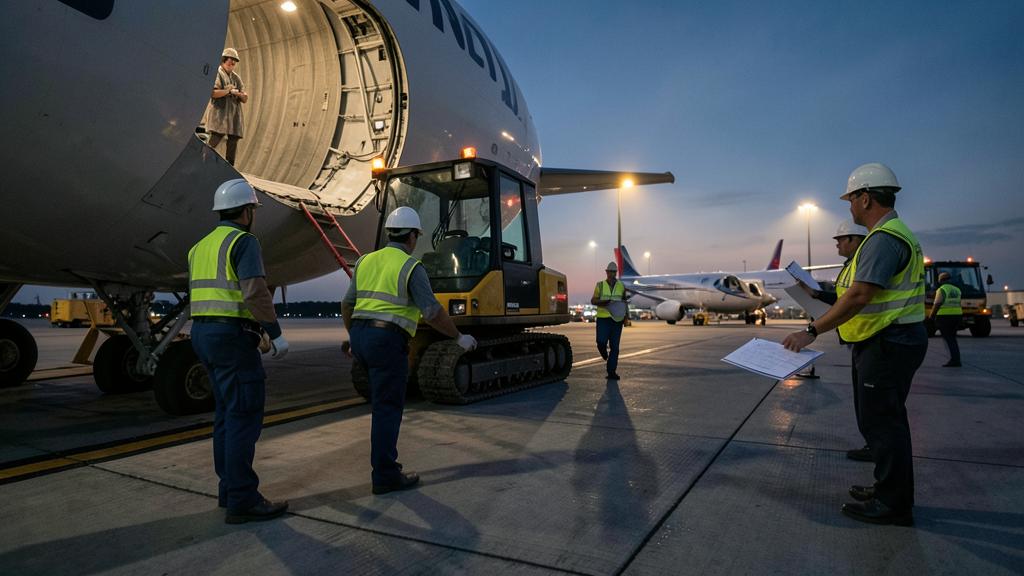
An operator may outsource almost any ground activity it performs, but not the responsibilities that come with it. This single asymmetry is the whole point. What follows is how the obligation actually works, which supplier indicators carry information and which are just decoration, and what a service contract must contain before physical supervision is possible.
What outsourcing transfers and what it does not
The rule is short and unusually clear. According to European organizational requirements for airlines, an operator that outsources part of its activities remains responsible for compliance with the applicable requirements by the outsourced activity. The same principle applies under ICAO’s safety management, which treats interfaces between a supplier and the organizations it depends on as part of its own system and not as someone else’s problem.
Read it carefully, as the wording is intentional. It does not say that the operator must choose a competent supplier. It does not say that the operator must have a contract. It says that the operator remains responsible for compliance — a continuous result, at every step, including those that no one at headquarters has visited.
The practical translation is that a handling contract is a delivery mechanism, never a transfer of responsibility. If a loading manifest is incorrect, if a cargo hold is loaded against instructions, if a deicing treatment is recorded with the wrong code, the certificate that is checked is that of the operator. The handling agent may be contractually responsible; that’s another conversation, led by other people, and it does not change who responsibility must be attributed to before the authority.
The trap. « We audited them last year and they are ISAGO certified » is a description of two past events. Responsibility is a present commitment. Between the audit and today, there may have been a new station manager, a change in subcontractor, a fleet of new equipment, seasonal hiring of temporary workers, and a change in scheduling — none of this has generated a document that has reached the operator.
Even if you outsource ground services, you’re still responsible for everything that happens. Just because a supplier is certified doesn’t mean they’re perfect today. You need to keep checking.
An airline outsources ground handling at an airport where it operates twice a week. The supplier is ISAGO certified, but during a random audit, the airline finds that the station manager was recently replaced, and the new team hasn’t been fully trained on the airline’s specific procedures. The airline is still responsible for any errors, even if the supplier is certified.
Why ground handling is the most difficult activity to supervise
Every outsourced activity has its difficulties, but ground handling has a structure that resists conventional supervision, and it is worth naming the reasons.
It is geographically dispersed. Maintenance is outsourced to certain organizations at certain sites; handling is outsourced at every station in the network, including those served twice a week.
It is shared. A specific ground team at a given airport serves a dozen airlines during the same shift, each with its own manual, its own loading instruction format, its own damage reporting threshold, and its own idea of what a walk-around covers. The person driving the baggage loader applies the procedure most recently imprinted in their head.
Its personnel change rapidly, and a significant portion is seasonal or temporary. Training tests are therefore not a stable asset, but a flow, and a picture taken in February describes a different population from the one working in July.
And it is commercially compressed. Ground handling in Europe has been deliberately opened to competition, which has driven down prices and, consequently, also the margin for equipment renewal, supervision ratios, or training beyond the minimum. Supervision that ignores the commercial reality of the supplier will be surprised.
Selection of meaningful indicators
Most supplier dashboards measure punctuality and damage rates. Punctuality is a commercial metric that can evolve in the wrong direction for safety reasons and in the right direction for dangerous reasons. Damage rates are real, but retrospective, low-frequency, and heavily influenced by the fact that reporting is safe for the person reporting.
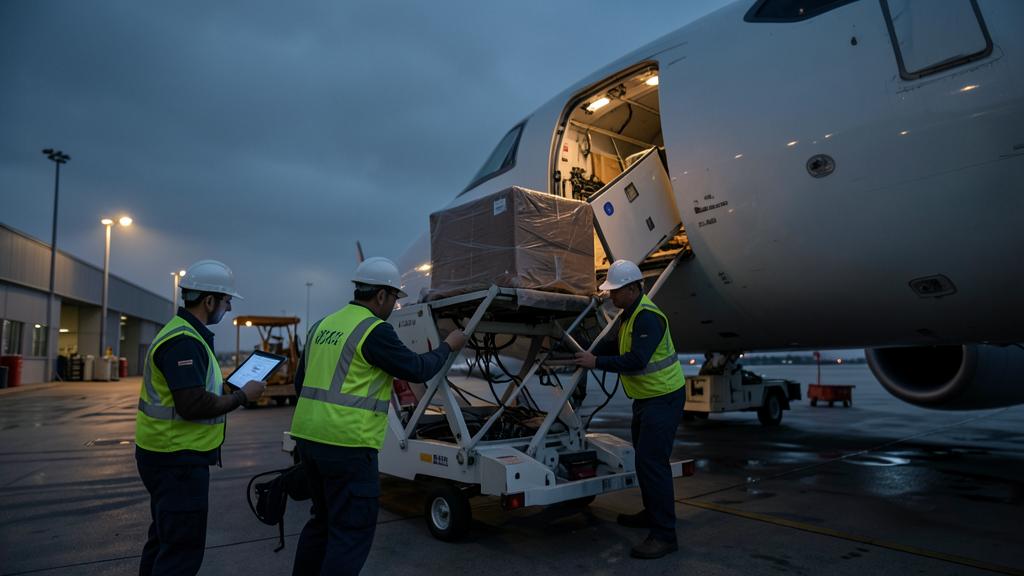
A useful set of indicators mixes both classes deliberately and indicates what is what.
| Indicator | Class | What it reveals — and its blind spot |
|---|---|---|
| Ground damage events per thousand rotations | Retrospective | Actual results data; too rare in a single station to show a trend before a damage |
| Reports per thousand rotations | Prospective | The health of the reporting culture; a drop is much more often silence than safety |
| Percentage of loading instructions returned with a discrepancy | Prospective | Direct reading of the mass and balance chain; requires data sharing |
| Currency of training and qualification coverage by task | Prospective | Whether qualified people are in the team; must be read by station, not by company |
| Percentage of temporary or seasonal personnel on duty | Prospective | The best single predictor of variability; almost never voluntarily reported |
| Supervision staff ratio per team during peaks | Prospective | Whether someone is actually watching; the ratio at 06:00 is not the ratio in the contract |
| Audit finding closure time | Prospective | Whether the corrective action system works; easy to manipulate with paper closures |
| Equipment availability and fleet age | Prospective | Predicts contact damage; requires verification on the ramp, not in a table |
| Punctuality performance | Neither | A commercial metric; improvement can come from reducing the steps that matter |
The hardest pair to observe is the second and the first set. A station whose reporting index drops while its damage index remains stable is not improving — it is staying silent. The most frequent cause of a silent station is that reporting has become personally costly for the reporter, which is a contractual and cultural problem, long before it is a safety problem.
The right reflex. Ask a supplier to give you the denominator and not just the numerator. « Six damage events » means nothing without the number of rotations, the mix of aircraft types, the parking geometry, and the weather season. A supplier who can provide the denominator without preparation has a system; a supplier who cannot do it creates reports for you.
What the contract must contain for supervision to be possible
Most supervision failures are not failures of will. They are failures of access, and access is decided when the contract is signed — usually by people who are not in the safety department and who negotiate on price.
The industry’s ground handling agreement is a reasonable basis: a master agreement, an annex listing the services, and station-specific annexes. It is deliberately generic, and its liability clauses are written to protect the handling industry’s economy, not to enable an operator’s supervision. Everything else must be added, and each point exists because its absence has created a blind spot somewhere.
| Clause | The blind spot it eliminates |
|---|---|
| Right of access and audit, without notice, at each station, during operations | Scheduled audits with enough notice to be a performance and not an observation |
| Obligation to report incidents related to its flights, with an established deadline | Events known by the supplier and the airport, but never by you |
| Designated safety contact at the station level, not just at headquarters | A reporting chain that must go through a commercial department |
| Provision of the agreed set of indicators at a fixed frequency, with denominators | Numerators without volume, which cannot be separated |
| No subcontracting without prior written agreement | A third party performs the work under a contract you have never seen |
| Notification of essential changes: management, equipment fleet, subcontractors, work practices | A system you have approved is silently replaced by a system you have not approved |
| Access to training and qualification tests for personnel serving your flights | Company-wide training percentages, which hide an un-trained station |
| Agreement on which manual applies, explicitly, service by service | Ten competing carrier procedures on the same ramp |
| Just culture obligation that also covers the supplier’s own personnel | Reporting is stifled at the source by fear of individual consequences |
| Defined escalation and, as a last resort, an exit path | A supervision process with findings, but no consequences |
The last point is more important than it seems. A supervision system that has never been able to escalate is not a supervision system; it is a reporting habit. If the only available reaction to persistent failure is another corrective action plan, the supplier learns this quickly and integrates it accordingly.
The problem of the ten manuals
The structural danger of shared handling deserves separate treatment, as it does not resolve with stricter audits.
A ramp agent serving ten airlines cannot have ten regulations in mind. In practice, they keep one — a mix built from the briefings that have been the most recent and insistent — and apply it to all. The airline whose procedures diverge from this mix is the airline whose procedures are not followed, no matter what the training test says.
The industry’s response is harmonization: a common manual for ground operations that airlines adopt as a basis, so that the ramp executes one procedure, not ten. It works, to the extent that airlines actually adopt it and do not adopt it with a list of exceptions, which reintroduces the problem in a more refined form. Every exception that an operator imposes is a real cost, paid by a real person on the ramp, and should be justified by a real danger, not by an institutional habit.
The practical test is unpleasant and worth it: for every exception that your manual imposes during shared handling, can you name the danger it controls? If the answer is that it has always been that way, the exception protects nothing and undermines compliance with all the others.
An audit is a sample, and a sample must be designed
A station audit sees a few hours of a shift, most of the time on a day when the supplier knew someone was coming. It is a useful and overloaded tool, and its value depends almost entirely on what surrounds it.
The design questions are simple to formulate. Which shift — the auditor arriving during lunch break has not seen the operation. Which shift — night shifts are often more scattered and younger. Which season — a summer station and a winter station can only share a name. And what was observed instead of read: a walk-around actually performed, a loading instruction actually balanced, a taxi actually briefed.
Between audits, the tools that work are continuous. Cabin and flight crew reports on ground events. Damage reports and their denominators. Discrepancies in loading manifests. Fuel figure deficits. Ground handling delay codes attributed, read by reasons and not by responsibility attributions. Results of third-party audit programs, understood as input and not as conclusion. And the local station manager, who is the only permanent presence of the operator and often the last person consulted.
| Risk factor in the station | Impact on supervision effort |
|---|---|
| New supplier or new contract in an existing station | The highest; check before the first season, not after |
| Recent change in management or ownership at the supplier | Increase; procedures do not survive personnel changes well |
| New aircraft type for this station | Increase; equipment adaptations and authorizations change |
| Declining reporting rate with stable damage rate | Increase; treat silence as a finding |
| High percentage of seasonal or temporary personnel | Increase, synchronized with recruitment and not with the calendar |
| Deicing season in a station that rarely deices | Increase; low frequency, high consequence, procedure-dependent |
| Stable supplier, stable data, findings closed with evidence | Reduce, but never to zero and never without indicating the basis |
Activities that deserve disproportionate attention
Not all managed tasks have the same weight. Three systematically justify more supervision than their share in the contract would suggest.
- Load control and loading. The chain from loading instruction to loading manifest to cargo hold is the only outsourced activity that can take an aircraft out of its certified range without anyone noticing before takeoff. Check the balance, not just the documents.
- Deicing and anti-icing. The decision and the holdover time belong to the operator and its crew; the supplier applies the fluid and declares the code. A misreported code is an aerodynamic problem that the crew cannot see.
- Acceptance and loading of dangerous goods. Separation, notification to the commander, and correct stowage are in a chain that crosses at least three organizations and is only as strong as its least trained link.
Refueling, aircraft maintenance, cabin cleaning, and baggage handling are also important, but the three previous ones are those where a single silent failure directly turns into an in-flight failure. Operators who build or rebuild a station supervision program will find the practical structures discussed in the operational management materials on the FL330 training platform.
The honest summary
Supervising a handling supplier is not a document, an annual audit, or a certificate owned by someone else. It is a continuous claim that the operator can defend: that it knows what is done in its name at each station, that it receives data with denominators and not just assurances, that its contract gives it access to verification, and that it has escalated at least once and can say so.
The supplier is not the adversary in all this. A good handling agent wants the same things, often with more urgency, and is often the most frustrated party when ten airlines give twenty people twenty sets of instructions. The operator’s task is to be one of the airlines that makes this easier to comply with — and to keep looking, because responsibility has never left the building.


Leave a Reply
You must be logged in to post a comment.