
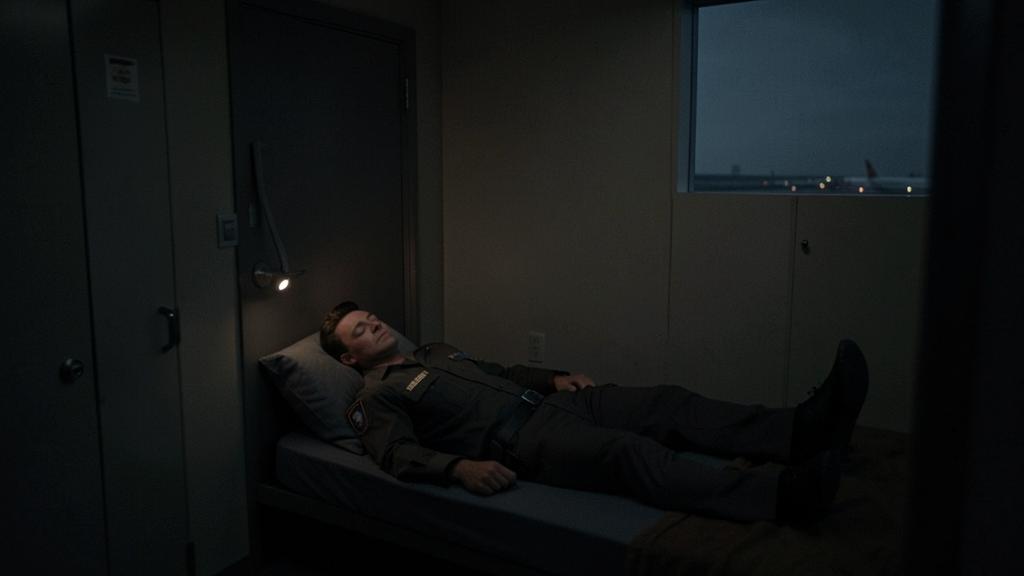
A wait between two sectors is not a break. Left to itself it changes nothing: the flight duty period keeps running, and the crew reach the second departure with exactly the clock they would have had if they had spent the interval sitting on the aeroplane. What turns that wait into something a roster may credit is not its length alone but a short list of very material conditions — a door, a bed, control of the light, and a duration counted from the moment the crew actually get into the room. This is what split duty asks for, and why so much of the argument ends up being about furniture.
The clock split duty is trying to buy back
Everything here hangs on one idea: the flight duty period is a single continuous span, and it does not pause. It starts when the crew report for the first sector and it ends when the last engine is shut down, whatever happened in between. A three-hour turnaround in the middle does not create two short duties. It creates one long one with a hole in it.
That is deliberate. The limit exists because performance degrades with time awake and time on task, and an interval spent in a crew room with a coffee machine and a television does very little to reverse either. Someone who has been awake since four in the morning is still someone who has been awake since four in the morning at two in the afternoon, whether or not they were flying for the middle part of it.
Split duty is the narrow, conditional exception to that rule. It says: if the operator provides a break that genuinely offers the possibility of sleep, the maximum flight duty period may be extended by part of that break. The word doing the work in that sentence is genuinely. The regulation does not measure intent, and it cannot measure whether anyone actually slept. So it does the only thing a rule can do — it specifies the physical conditions under which sleep is possible, and it credits those.
Split duty is about giving crews a real chance to sleep during a long workday. The rules don’t care if you actually slept, just that the conditions (like a dark room and a bed) made it possible. If those conditions aren’t met, the break doesn’t count toward extending your duty time.
An A320 crew has a 4-hour break between flights. The facility has beds, controlled lighting, and is away from public areas. The crew enters at 14:00 and leaves at 18:00. The operator’s scheme credits 2 hours of that break toward the duty period, allowing a longer flight day. But if the facility’s blinds were broken, the credit would be lost.
Why the credit exists at all — the physiology, not the goodwill
The scientific basis for split duty is the nap: a sleep opportunity taken inside the working day, often at a point in the circadian cycle when sleep is possible but not easy. A nap of an hour or two, even a poor one, measurably restores alertness for several hours afterwards. That is the effect being purchased.
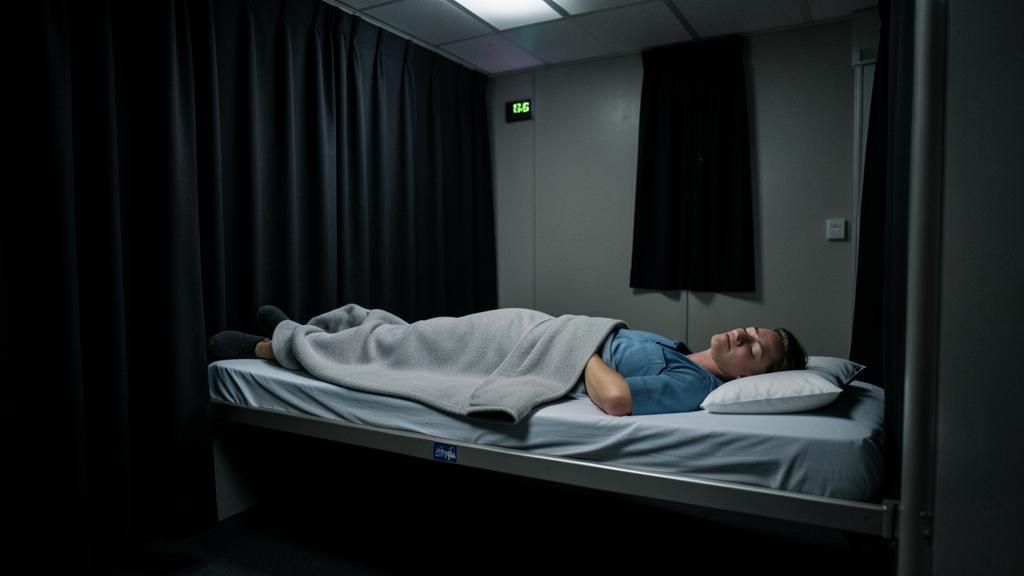
Three consequences follow, and they explain nearly every condition attached to the provision.
- First, a nap has to be long enough to include real sleep, not just the descent into it. A break that ends before sleep can consolidate returns very little, which is why schemes set a floor below which nothing at all is credited — and why that floor is counted in hours rather than in minutes. The precise figure belongs to your operator’s approved scheme and is written in Part A of the operations manual, not deduced from the flight time.
- Second, sleep needs darkness, quiet and a horizontal surface. This is not comfort language. Sleep onset in a lit room, in a chair, with public address announcements every few minutes, is slow and shallow, and the alertness benefit collapses accordingly. A rule that credited any three hours of sitting somewhere would be crediting nothing.
- Third, there is a cost on the way out. Waking from consolidated sleep produces sleep inertia — a period of degraded performance that can last from a few minutes to something considerably longer, depending on sleep depth and time of day. A crew that wakes and walks straight to the aircraft is worse for a while, not better. Schemes handle this by requiring the break to end a stated interval before duty resumes, and good operators handle it by rostering enough slack for a wash and a coffee. If your break ends at the aircraft door, someone has designed the roster and not the rest.
| Condition | What it means on the ground | Who holds the answer |
|---|---|---|
| Minimum duration | A floor below which no credit exists at all, and a clock that starts when the crew are actually in the facility. | The operator’s approved flight time specification scheme, reproduced in the operations manual. |
| Quality of the facility | The difference between a quiet room away from the public and a room with a bed in it. Both are defined terms. | Regulation, through defined vocabulary the operator cannot reinterpret. |
| What is excluded from the break | Post-flight duties at the front, pre-flight duties at the back, and the travelling time at both ends. | The scheme, plus the crew report that records the real times. |
| Planning in advance | Split duty is a planned construction, not a label applied afterwards to a delay. | Crew planning, and the commander’s discretion rules if the day departs from the plan. |
The break is what remains, not what appears on the roster
This is the single most common source of friction, and it is arithmetical rather than legal. The interval printed between the two sectors is gross. The break is net.
From the gross figure, subtract the post-flight duties on the inbound: securing the aircraft, the technical log, the handover, the walk through the terminal. Subtract the travel to wherever the accommodation is — a hotel ten minutes away costs twenty minutes of break, and an airside facility at the far end of a satellite pier is not free either. Then subtract the same again at the other end, plus the pre-flight duties and the briefing. What is left is the number that must clear the minimum, and it is routinely an hour or more shorter than the number on the roster.
The trap. A break that clears the minimum on paper and fails it in practice does not merely lose the credit — it invalidates the extended flight duty period that was built on it. The extension was the justification for the day’s length. If the break was not what the scheme requires, the crew are being asked to fly beyond the unextended limit, and the correct response is a report, not a shrug. Record the real times: reached the facility at, left the facility at. Nothing else can reconstruct it afterwards.
Accommodation is a defined word, and the definition is the rule
European flight time limitation rules define two levels of facility, and the difference between them is the difference between a chair and a bed. The vocabulary is not decorative: an operator cannot argue that its crew room is comfortable enough, because comfort is not the test. The defined characteristics are the test.
| Characteristic | The lower defined level | The higher defined level |
|---|---|---|
| Privacy | A quiet, comfortable place not open to the public, with capacity for all the crew present at the same time. | A separate room for each crew member, in a quiet environment. |
| Sleeping surface | Furniture that gives a crew member the possibility of sleeping. | A bed. |
| Environment | The ability to control light and temperature. | Sufficient ventilation, with a means of regulating temperature and light intensity. |
| Food and drink | Access to it. | Access to it. |
Read the second row again, because it is where most disputes live. The lower level does not say a bed; it says furniture that allows sleep — which a properly reclining lounger in a dark room satisfies and an upright chair in a crew room does not. The higher level says a bed, and a separate room, which no amount of screening off a corner will produce.
Which of the two levels applies to a given break normally turns on how long the break is and when it falls, as set out in the applicable certification specifications and in the operator’s approved scheme. It can still differ from one operator to another, because schemes are approved individually. What does not differ is that the level is defined, that the definition is objective, and that a facility either meets it or does not. « Not open to the public » is checkable. « Ability to control light » is checkable. A blind that does not close is a finding, not a preference.
What the credit is actually worth
The extension is only part of the break, never the whole of it — a stated proportion of it in some schemes, a fixed maximum number of hours in others. This surprises people the first time they see it, and it is the right design: the crew are not being given the break back as duty, they are being credited with the part of it that plausibly converts into recovered alertness. Sleep does not repay time one for one, and the arithmetic reflects that.
Further limits sit on top of it. Schemes commonly cap the credit itself, so that a very long break does not produce an unlimited day. And the credit interacts with the rest of the scheme rather than sitting outside it — the reduced rest that may follow, the cumulative duty limits over the week and the month, and the number of sectors flown all continue to apply. A day that is legal as a single extended duty may still be the third such day in a row, which the cumulative limits will catch even though the split duty calculation did not.
The consequence for planning is worth stating plainly: split duty is not free capacity. It converts an expensive facility and a long day into a small number of extra hours of flight duty. Operators that treat it as a routine tool rather than an occasional one tend to discover the cost on the fatigue reporting side rather than the rostering side.
Europe and the United States do not do the same arithmetic
Split duty exists in both systems and is built on the same physiology, but it is not the same rule, and crews moving between regulatory environments should not carry assumptions across.
| Aspect | European approach | United States approach |
|---|---|---|
| Where the rule lives | Subpart FTL of Part-ORO, applied through a flight time specification scheme approved for each operator. | Part 117 for the operations it covers, applied directly as a rule of general application. |
| Scope | Commercial air transport by aeroplane, with separate arrangements for other operations. | Notably excludes all-cargo operations, which continue under the older duty and rest rules. |
| Variation between operators | Substantial: the scheme is approved individually, so two airlines in the same state can differ. | Limited: the numbers are in the rule, though fatigue risk management plans add to it. |
| Facility standard | Two defined levels of accommodation, the applicable level following the break itself and the approved scheme. | Suitable accommodation as defined in the rule, with its own scheduling conditions attached. |
Beyond these two systems, the international framework is thinner than people assume. The ICAO Annex 6 provisions require the state of the operator to prescribe limits and require the operator to manage fatigue — either through a prescriptive scheme or through an approved fatigue risk management system — but they do not prescribe a split duty formula. Outside Europe and the United States, therefore, the answer to « does this break count? » is genuinely a national one, and the operations manual is the only document that answers it.
Fatigue risk management does not replace the conditions
Operators running a fatigue risk management system sometimes present it as a way around prescriptive detail. It is not. An approved system allows an operator to depart from prescriptive limits where it can demonstrate an equivalent or better safety outcome with data — reported fatigue levels, sleep measurement, biomathematical modelling, incident and observation data. That demonstration is expensive and continuous, and it is approved by the authority in advance.
What such a system cannot do is make a windowless room with plastic chairs into a rest facility. The physiology is not negotiable by process. Where fatigue risk management genuinely earns its place in split duty is in the questions the prescriptive rule cannot see: whether the break falls in a part of the circadian cycle when sleep is achievable at all, whether the crew’s commute before report already consumed the sleep opportunity, and whether the same pairing repeated four times in a week accumulates a debt that each individual day appears to avoid.
What to check before you accept it
The right reflex. Before the day, find three numbers in the operations manual: the minimum break your scheme requires, the level of facility it requires, and the interval that must separate the end of the break from the resumption of duty. On the day, record two times in the report — when you entered the facility and when you left it. Those two timestamps are the entire evidential basis of everything that follows, and nobody can reconstruct them a week later.
If the facility does not meet the defined level, say so at the time, in writing, and file it. This is not confrontation; it is the only mechanism by which a facility ever gets fixed. Rostering departments generally cannot see that the airside rest room’s blinds have been broken for two months. Safety reports can.
And if the break has evaporated — the inbound was late, the transport did not come, the room was occupied — the calculation has changed and the extended duty no longer has a basis. That is a commander’s decision, made before the extension is relied upon rather than at the end of a long day. Crews comparing how different operators’ schemes handle this in practice will find it a recurring subject on the FL330 forums, and the differences between schemes are larger than most people expect.
The one-line version
Split duty credits the possibility of sleep, not the passage of time. Everything the regulation says about duration, doors, beds, blinds and travelling time is a proxy for that single question — could a reasonable person actually have slept? If the honest answer is no, the credit was never earned, whatever the roster says.


Leave a Reply
You must be logged in to post a comment.