
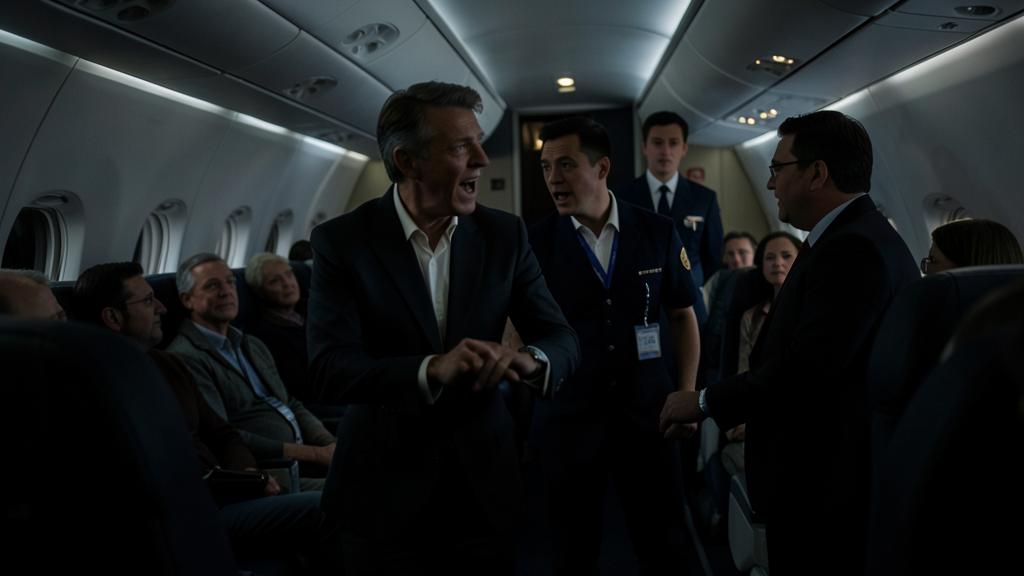
Every operations manual contains a scale of unruly passenger behaviour, and almost every crew can recite it. What the scale does not say, and what decides the outcome of the event, is where the boundaries actually sit. A passenger who is offensive is not necessarily a security matter; a passenger who is perfectly polite can be one. The threshold is not rudeness, and it is not volume — it is whether the crew still controls the cabin, and whether the aeroplane itself has become the target.
Two different questions hiding behind one word
The phrase “unruly passenger” compresses two problems that have different owners, different legal machinery and different consequences on the ground.
The first is a safety problem. The behaviour interferes with the crew’s ability to conduct the flight safely: instructions are not followed, a required item is not stowed, a smoke detector is tampered with, the cabin cannot be secured for landing. Here the aeroplane is not the objective; it is the setting.
The second is a security problem — in the language of the international texts, an act of unlawful interference. The aeroplane, its occupants or its operation have become the object of the act. That is a different category entirely, and it triggers a different response chain: not just the operator’s procedures but the State’s, including air traffic and law enforcement.
Almost all inflight events are the first kind. What crews need is a reliable way to notice the small number that are becoming the second kind, early enough for the response to still be a choice.
An unruly passenger can be a safety issue if they disrupt the flight. But if they target the plane itself, like trying to break into the cockpit, it becomes a security issue. The crew must spot the difference fast.
On a flight from Paris to New York, a passenger becomes aggressive after drinking too much. The crew restrains them and lands safely. This is a safety issue. But if another passenger tries to force the cockpit door mid-flight, that’s a security issue, and the plane may need to divert immediately.
The four levels, and what the scale is actually for
The classification used across the industry, derived from ICAO guidance and adopted in most operators’ manuals, has four levels. Its purpose is often misunderstood. It is not a legal instrument — what the courts punish is defined by national criminal law, not by a level number. The scale exists to make the crew’s response, the captain’s decision and the subsequent report comparable: it gives everyone on board the same vocabulary under pressure, and it lets the operator and the authority read the same event the same way afterwards.
| Level | Defining behaviour | What changes in the cabin | What changes on the ground |
|---|---|---|---|
| 1 — Disruptive | Verbal: argument, refusal to comply, intimidation without physical action | Verbal management, senior cabin crew member involved, captain informed | Internal report; the operator may act commercially |
| 2 — Physically abusive | Physical contact with a person or object: pushing, striking, damaging equipment | Written warning where used, seat reallocation, preparation of restraint, captain decides | Police meeting the aircraft; a prosecutable offence in many States |
| 3 — Life-threatening | Behaviour that endangers life, or the display of a weapon | Restraint expected, flight deck secured, cabin resources committed | Security response; diversion frequently justified |
| 4 — Attempted or actual flight deck breach | Any attempt to enter or force the flight crew compartment | Treated as unlawful interference, not as a discipline matter | State security procedures; air traffic notified as such |
Two properties of the scale are worth stating explicitly. It is not a ladder that must be climbed step by step — an event can begin at level 3. And it describes behaviour, not persons: the same passenger can drop back down, and the level should be re-assessed rather than assumed to be sticky.
The escalation criterion is control, not offence
The practical error is to grade the event on how objectionable it feels. Abuse directed at a crew member is unacceptable and is an offence in many States, but by itself it does not change what the crew must do next. The question that decides escalation is narrower and colder:
- Can the cabin still be secured on command — seats occupied, belts fastened, aisles clear — for the remainder of the flight?
- Is the behaviour spreading, or drawing in other passengers?
- Does managing this person consume crew who would be needed for anything else?
- Is there any indication of intent directed at the aeroplane, the crew as crew, or the flight deck?
A single “no” to any of the first three is a reason to move the event up. A “yes” to the fourth moves it out of the safety category altogether.
The right reflex. Say the level out loud and say it to the flight deck. A level spoken becomes shared; a level held privately by one crew member becomes a surprise for everybody else twenty minutes later. The captain cannot weigh a diversion against an assessment that has not reached the flight deck.
What each level actually authorises
The authority to act does not come from the level. It comes from the aircraft commander’s powers, which in international law rest on the Tokyo Convention of 1963 and, for the States that have ratified it, on the Montréal Protocol of 2014 that modernised it. Those texts give the commander the power to impose reasonable measures — including restraint — on a person he or she has reasonable grounds to believe has committed, or is about to commit, an act that jeopardises safety, good order or discipline on board. They also allow crew members to take reasonable preventive measures without the commander’s prior authorisation when immediate action is necessary.
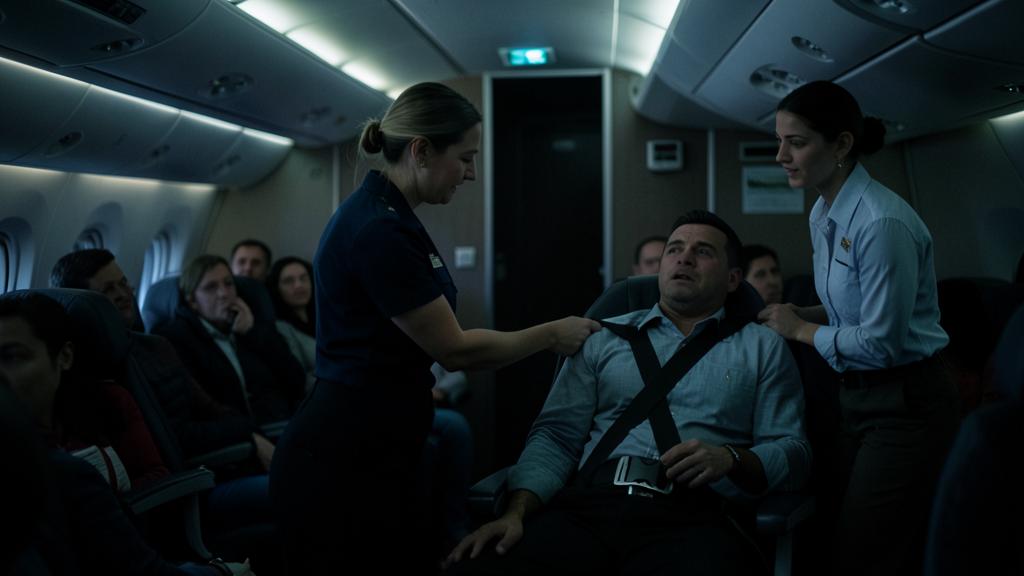
That last provision is the legal basis for one of the very few measures cabin crew may take without the commander, and it is deliberately narrow: immediate necessity, reasonable measures, and an obligation to inform the commander as soon as possible.
| Measure | Who decides | Basis and limits |
|---|---|---|
| Verbal management, de-escalation, seat change | Cabin crew, senior cabin crew member informed | Operator procedures; no special authority needed |
| Withdrawal of alcohol service | Cabin crew | Operator procedures and conditions of carriage |
| Written warning notice, where the operator uses one | Senior cabin crew member, captain informed | Operator procedure; evidentially useful, not itself a sanction |
| Physical restraint | Commander; crew may act first if immediately necessary | Must be reasonable and proportionate; ends at landing save in narrowly drawn cases, chiefly delivery to the authorities or the person’s agreement |
| Diversion | Commander alone | Command authority; assessed against the ability to hold the cabin for the remaining flight time |
| Declaring unlawful interference to air traffic | Commander | Standard international procedures; changes the entire ground response |
The moment it becomes an act of unlawful interference
Three markers move an event out of the safety category and into the security one, and none of them depends on how loud the passenger is.
The flight deck becomes the objective. Any attempt to enter the compartment, any sustained interest in the door, its lock, the crew rest access or the movements of the crew through it. This is the reason the door discipline is procedural and unnegotiable, and the reason a crew member’s account of “he kept watching the door” is a material fact, not an impression.
A weapon, a device, or a credible claim of one. A claim that cannot be disproved in the cabin must be treated as true until the ground can establish otherwise. The correct handling of a claimed device is a search-and-isolate problem with published procedures — not an argument with the person making the claim.
Coordinated or purposeful behaviour. Two or more passengers acting together, behaviour timed to a phase of flight, probing of crew responses, or an interest in aircraft systems, exits or equipment that has no innocent reading.
The trap. Intoxication makes an event feel less serious and can make it more so. A passenger who is drunk and abusive is a safety problem; a passenger who is drunk and repeatedly moving toward the flight deck is a security problem, and the intoxication does not downgrade it. Assess the direction of the behaviour, not the state of the person.
Restraint: a narrow legal window and a real physiological risk
Restraint is the measure crews train for and least often use, and it carries two constraints that are easy to lose in the moment.
The legal one: restraint is permitted while it is necessary and proportionate, and it does not automatically survive the landing. Under the Tokyo Convention, measures of restraint may not be continued beyond the point at which the aircraft lands, save in narrowly drawn cases — in substance, delivery of the person to the competent authorities, a forced landing that prevents that delivery, or the person’s own agreement to onward carriage under restraint. A restrained passenger is therefore a commitment to a handover, and that handover has to be arranged before the aeroplane arrives, not discovered at the gate.
The physiological one is more urgent. A restrained person who is agitated, intoxicated or in a medical crisis is at genuine risk from the restraint itself. The recognised dangers are positional asphyxia — restraint face-down, or with weight on the back or chest, compromising breathing — and the failure to monitor a person who then deteriorates quietly. The person must be restrained in a position that leaves the airway clear, must be under continuous observation by a named crew member, and must be re-assessed at intervals. A restrained passenger who becomes calm and quiet may be improving, or may be deteriorating; the two look identical from three rows away.
Behaviour that is not misconduct at all
Some events that begin as “unruly” are medical rather than deliberate. Hypoxia, hypoglycaemia, stroke, seizure and the post-seizure state, alcohol or drug withdrawal, head injury, and reactions to medication all produce confusion, aggression, disinhibition and refusal to cooperate. So does acute psychiatric crisis, which is a medical event and not a discipline problem.
The differentiators are usable in the cabin: an abrupt onset in a passenger who was previously unremarkable, confusion about place or time, incoherent rather than merely angry speech, sweating, pallor, unequal pupils, weakness on one side, or a person who does not appear to hear the crew at all. None of these is diagnostic, and cabin crew are not being asked to diagnose. They are being asked to consider a medical cause before the event is framed as misconduct — because the framing determines everything that follows, including whether a doctor is called and what is written down.
Landing, handover, and why cases fall apart
Jurisdiction over offences committed on board historically followed the State of registration of the aircraft, which produced the familiar and demoralising outcome: an aeroplane lands in a third State, the local authorities have no jurisdiction, and the passenger walks. The 2014 Montréal Protocol addressed precisely this by extending jurisdiction to the State of the operator and the State of landing — but only between the States that have ratified it. Whether a given event will be prosecuted therefore depends on the route as much as on the behaviour, and crews are entitled to know that the answer is sometimes “nowhere”.
Where prosecution is possible, cases are usually lost on evidence rather than on law. What survives legal scrutiny is specific and contemporaneous: times, the exact words used rather than a characterisation of them, what was said to the passenger and by whom, which warnings were given, who witnessed what, and what the passenger did after each intervention. What does not survive is a narrative written three days later in the language of the report form.
The report is the product
By the time the passenger is off the aeroplane, the crew’s remaining output is the report — and it serves at least four different readers. The operator needs it to decide on refusal of carriage. The police need a statement that can support a charge. The safety management system needs it as an occurrence record, which in the European system falls under the mandatory occurrence reporting regime. And the security function needs to know whether this was an act of unlawful interference, because that determination is not the crew’s to make alone but cannot be made at all without their account.
Writing one document that serves all four means separating fact from assessment: what was observed, then what was concluded, then what was done, in that order and visibly distinct. Operators that train report writing as a skill in its own right, alongside the cabin techniques, are the ones whose accounts still stand up months later. Crews comparing operator practice on this will find the subject discussed on the FL330 forums.
Three questions, in that order
The level scale tells you how to talk about the event. Control of the cabin tells you whether it is escalating. Direction of intent — toward a person, or toward the aeroplane — tells you whether it has stopped being a safety matter and become a security one. Those are three different questions, and answering them in that order is what turns a bad flight into a manageable one.


Leave a Reply
You must be logged in to post a comment.