
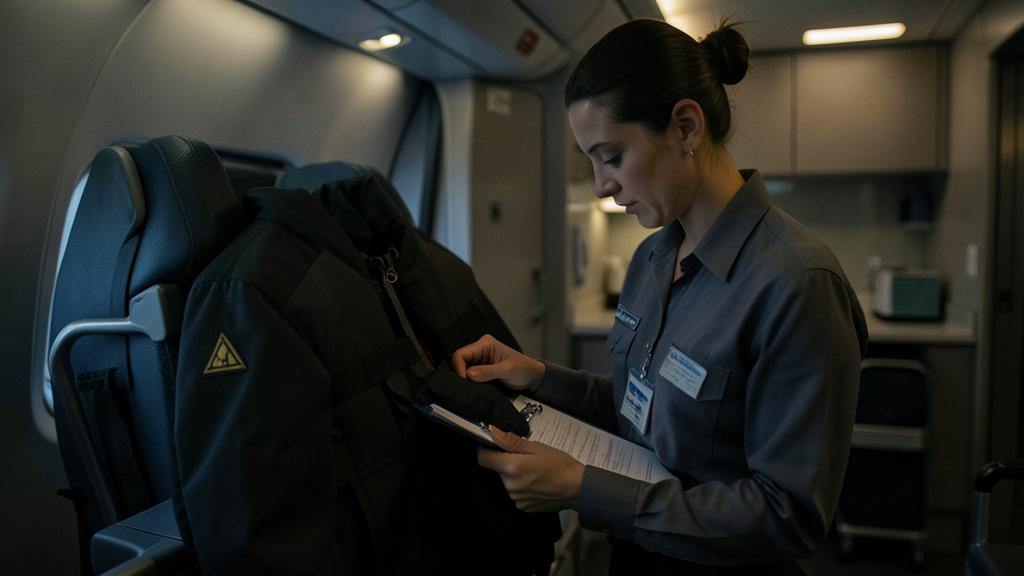
A report reaches the safety office: “trolley ran away on its own during a go-around, caught a few rows further down”. Three lines. The analyst codes the occurrence as a procedural deviation, brake not set, and closes the file. A few months later, the same sequence recurs on another aircraft, without anyone connecting the two files or the shift in the service schedule imposed that day on the sector. What the first handling lacked was not rigour: it was someone who knows what “getting ahead with the service” means on a short rotation, and which question to ask while the answer still exists.
What a report loses between the jump seat and the desk
A cabin report is almost always written after the fact, in the crew room or at the hotel, by someone who leaves again the next day. What survives is the general impression, the one still recounted months later and which cannot be coded. What the writing loses first is not the narrative, it is precisely the material the analysis needs: the exact positions, the order of the actions, the timing of the service, the state of the stowages, who was holding what.
The consequence is mechanical: a file opened late contains a great deal of judgement and few verifiable facts, and the analyst who takes it up has no resource other than to fill the gaps with hypotheses. This is where the presence of a cabin crew member in the safety office changes the outcome: they know which question recovers the fact before it fades, and they know how to ask it without leaving the writer feeling accused.
When cabin crew write reports after a flight, they often forget small but important details like exact positions or timing. This makes it hard for safety analysts to understand what really happened. Having a cabin crew member in the safety team helps because they know the right questions to ask right after the incident, before those details are forgotten.
On a short 90-minute flight between Paris and Brussels, a flight attendant reports that a beverage trolley rolled away during turbulence. The report written later only mentions “trolley not secured.” A cabin crew analyst would ask: Was the service in progress or finished? Were all trolleys stowed before turbulence? Was the crew short-staffed? These details would show if this was a simple oversight or a workload issue on short flights.
The useful questions are disarmingly ordinary for anyone who has done the job, and invisible to anyone who has not. Was the service under way or finished? Were the trolleys stowed or waiting in front of the galleys? How many crew members on duty on that sector, and at what time of day? None of them is spectacular. All of them determine whether what you have is an error of execution or a workload constraint.
A second contribution, less visible and more lasting: the description of the equipment. A report that says “life jacket missing” says nothing as long as it is not known whether the pouch was open, whether the fastening still held, whether the life jacket was found two rows further along or never seen again. These three cases call for three treatments unrelated to one another — pre-flight check, wear, passenger behaviour — and a single code swallows them all.
The processing chain, and the precise place where the cabin is missing
A report only becomes data after several transformations, most of which remain invisible from the line. It is received, de-identified, filed within a taxonomy, risk-rated, analysed if the rating crosses a threshold, then converted — or not — into an action whose effectiveness is supposed to be measured later. Feedback to the reporter closes the loop, and it is the link most often sacrificed: a crew that hears nothing back about its reports ends up writing shorter and shorter ones, then none at all beyond what is mandatory.
The place where the cabin is missed most is not the analysis: it is the coding. Occurrence taxonomies were built around the flight deck, with fine-grained headings for the flight path, the configuration and the systems. Cabin occurrences, for their part, fall into catch-all categories: injury, equipment, behaviour, other. Yet a badly coded occurrence joins no series, a series that does not form produces no trend, and a missing trend never triggers any action. The mechanism is arithmetical and invisible, since the system appears to work: every file is processed and closed on time.
The most lasting contribution of a seconded crew member therefore rarely lies in a spectacular file. It lies in opening the coding dictionary, proposing headings within it that finally distinguish what needs distinguishing — a stowage that was impossible is not a stowage that was omitted — and accepting the thankless work of recoding the historical record so that comparison over time remains possible.
Three analytical skills that cannot be improvised
Code without narrating
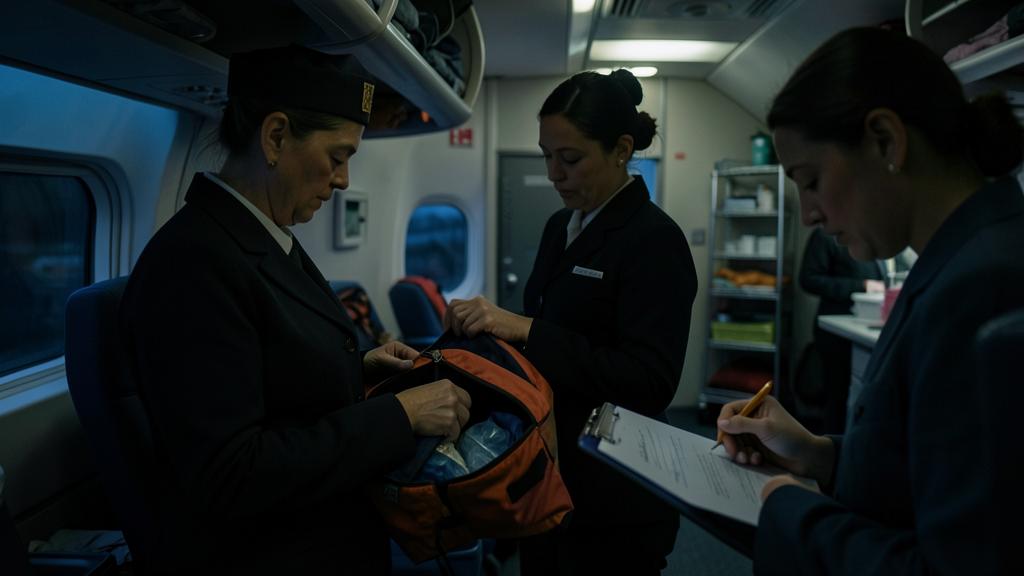
The first discipline consists in separating what was observed from what is inferred. “The trolley crossed the galley threshold” is a fact. “The brake was not set” is a conclusion, often correct, sometimes wrong, and one which, written in the facts box, closes the investigation before it has begun. A trained analyst writes both, in two separate fields, and leaves the second line open to refutation until it is verified.
Rate the risk, not the consequences
This is the point most systematically misunderstood. The rating does not bear on what happened, but on the worst credible outcome of the same sequence and on the probability that it will recur. A trolley that was caught and a trolley that strikes a passenger occupy, as long as the conditions have not changed, the same cell of the matrix. This is not dramatisation: it is the only way to prevent luck from deciding the order of priorities.
Trace back to conditions, not to people
Causal analysis looks for the conditions that made the error likely: a procedure written for a cabin the fleet no longer has, a service sequence that cannot be sustained on a short sector, a piece of equipment whose behaviour varies from one version to another, a crew complement calculated to the bare minimum. The question is never “who got it wrong” but “what made that action reasonable at the time”. The wording changes the nature of the answer, and therefore that of the action decided upon.
| Family | What points to it | Question to ask | Lasting action |
|---|---|---|---|
| Individual action | A single crew involved, procedure known and applicable that day | Was the prescribed action feasible in the time available? | Individual support, with no disciplinary record |
| Procedure | Several crews, same deviation, ambiguous wording or unsustainable sequence | What does a crew do that follows the text to the letter? | Rewriting of the operating procedure, then verification on the line |
| Equipment and cabin layout | The deviation tracks an aircraft type, a cabin version or a batch | Does the item behave the same way across the whole fleet? | Technical escalation and modification follow-up |
| Organisation | The deviation clusters on certain rosters, crew complements or time bands | What actual workload was bearing on the galley at that moment? | Review of the crew sizing or of the service sequencing |
The barrier model seen from the jump seat
An operator’s defences are stacked: design of the cabin layout, written procedure, briefing, then crew action. The cabin almost always occupies the last place. It is the cabin that stops things, and that is why its occurrences look from a distance like human performance problems when they are the visible end of a chain whose preceding links were already open.
This is the main service a seconded crew member renders to their safety office: recalling, file after file, that the absence of consequences says nothing about the robustness of the defence that came into play.
The recovery trap. An occurrence stopped by the crew has, by construction, no consequence; it ends up rated at the lowest level, closed with no action, invisible in the trends. Correct rating retains the worst credible outcome of the same sequence and the probability that the recovery fails the next time: a trolley grabbed by hand before the first row is rated like a trolley that no one would have grabbed. Failing that, the department only ever works on its accidents.
Characterising the deviation without judging the person
The same description leads to three treatments unrelated to one another, and the routing hinges on a single question: was the prescribed action executable under the conditions of the day? Answered honestly, it sends the file towards individual support, towards a rewriting of the procedure or towards a technical escalation. Answered the wrong way round — starting from the intention attributed to the writer — it produces reminders of instructions that change nothing and that dry up the flow of reports.
The habit that prevents a routing error. Before characterising a deviation, reconstruct the timed sequence of the service — take-off time, start of the service, position of the trolleys, crew on duty — and ask a single question: under those precise conditions, was the prescribed action executable? Write the answer in the file, including when it is yes. That is the line which protects the writer of the report, and the one which will make the analysis defensible in a safety review months later.
What the secondment changes once you are back on the line
The clearest effect is not on the curriculum vitae: it is on the next flight. You become the person people ask, in the crew room, whether or not to write it up — and the volume of reports tends to rise again wherever someone can say what they are for, more lastingly than after a poster campaign. You also bring back into the cabin a vocabulary that is sorely lacking: distinguishing a fact from a conclusion, saying “worst credible outcome” rather than “nothing happened”, knowing that lessons learned live on a loop and not on a form. That vocabulary circulates well beyond a single operator, in the spaces where practitioners compare their methods.
The downside is more delicate. You know things you cannot say, including about people you fly with the next day. The only tenable line is drawn once and never moves: no comment on an individual file, ever, to anyone, not even to reassure. It costs a few uncomfortable silences, and then it becomes the reason why you go on receiving information.
| Criterion | Time shared with the line | Full-time secondment |
|---|---|---|
| Recent experience | Retained effortlessly: you fly what you analyse | Erodes quickly; observation flights have to be organised |
| Depth of analysis | Limited to short files; trend studies fit poorly | Allows the recoding of a historical record and effectiveness follow-up |
| Credibility with the crews | High as long as you are subject to the same rosters | To be rebuilt constantly |
| Exposure to role conflict | High: you analyse colleagues you meet again the next day | Lower day to day, sharper on confidentiality |
| Return to the line | Without a break | Refresher training and readjustment time required |
Before applying: what to open in your own documentation
A few pages of the management system manual settle half the misunderstandings, and almost no one has read them before applying. Who codes the occurrences, with which dictionary, revised when? Who rates them, according to which matrix? Who decides on the action, and within what time limit is feedback to the reporter due? Finally, who has access to the identifiable content of a report, and for how long does it remain identifiable? The answer to that last question is the one your colleagues will ask you on the first day.
There remains a grey area that the secondment does not close. The cabin representative in the safety office does not, in the general case, correspond to a function defined by the regulations: their legitimacy rests on the internal mandate that appointed them and on the quality of their analyses. Demand that mandate in writing, with the reporting line, the guaranteed time, access to the data — and above all the list of what does not fall within the function, starting with any participation in a disciplinary decision. The boundary between flight safety, security and quality varies from one operator to another; if no one writes it down, it will be drawn by the first difficult arbitration, and rarely in favour of the analysis. For anyone preparing for management or instruction, it is that written trace that carries weight in a file, more than the job title — and a training course in occurrence analysis carries more weight there than an assignment with no substance.
The applicable regulation, the authority’s documents and the operator’s approved documentation prevail in all circumstances over this article, whose sole purpose is to explain the mechanism.
Questions fréquentes
Do you have to be a purser to be seconded to flight safety?
The regulations do not define this function: its criteria fall within the operator’s internal organisation, which sets them itself. In practice, what is required is line experience sufficient to know several aircraft types and several rosters, solid written expression and a demonstrated ability to maintain confidentiality. The management system manual sets out the conditions adopted at your operator.
Does a spell in the safety office count towards a qualification or a promotion?
It is not a credit recognised by the regulations and it does not replace flying experience. What the spell brings is of a different nature: an analytical vocabulary, a practice of causal reasoning and verifiable written traces. Selection boards and training managers read in it an ability to work up a file, which carries weight on a path towards management or instruction.
What becomes of a signed report, and who reads the name on it?
The report is received and then de-identified according to a procedure described in the operator’s documentation, and protection of the source is an explicit principle of the European occurrence reporting scheme. What varies from one operator to another is the period during which the file remains identifiable and the named list of the people who have access to it. Both points appear in the management system manual and must be able to be shown to you.
How should an occurrence recovered by the crew, with no consequence, be rated?
What is rated is not the outcome obtained but the worst credible outcome of the same sequence, combined with the probability that it will recur under current conditions. The recovery is a barrier whose reliability has to be assessed, not a reason to lower the rating. A department that systematically lowers the rating of recovered occurrences no longer detects anything before the accident.
Can you analyse files concerning colleagues you fly with?
Yes, provided the rules are laid down in advance and in writing: no comment on an individual file, no participation in a disciplinary decision, and immediate withdrawal from the file when you are personally involved in it. The secondment mandate must state these limits explicitly. Announced once, clearly, they cease to be an issue and become the reason why information keeps circulating.


Leave a Reply
You must be logged in to post a comment.