

Operating rules express a reserve in minutes because, with fuel, minutes are honest: the tank holds a measurable quantity, energy per kilogramme is effectively fixed, and full power is available down to the last usable litre. A battery breaks all three assumptions at once. Converting a required reserve time into kilowatt-hours you can genuinely commit is not a multiplication — it is a chain of derations, and the last link in that chain is the one that catches crews out, because the power disappears well before the energy does.
Why the rule speaks in minutes and the pack speaks in kilowatt-hours
The requirement is written in time for a good reason. A diversion takes minutes, a hold takes minutes, an approach and a go-around take minutes. Whatever the energy source, what has to be survived is a duration, so commercial aeroplane rules set the final reserve as a period of flight at holding speed at a stated height above the aerodrome where the aeroplane is planned to land — thirty minutes for turbine-engined aeroplanes, a longer period where the engines are reciprocating. The number describes the operation, not the tank.
With fuel, converting that period into a quantity is trivial. Read the holding fuel flow off the performance data, multiply by the time, and you have a mass that a gauge will show you and that a dipstick can confirm. The relation is linear, the energy per unit mass barely varies between uplifts, and the aeroplane will deliver take-off power from a nearly empty tank as readily as from a full one.
With a battery, none of that survives contact. Nothing on board measures energy directly. The energy the pack can deliver depends on how fast you ask for it, how cold it is, how old the pack is and which cell is weakest. And the aeroplane’s ability to produce the power for a go-around collapses long before the pack is empty. The conversion therefore has to run in the opposite direction from the fuel case: start from the power demanded in the worst reserve segment, and work back through the pack’s actual condition to a state of charge you are willing to arrive with.
Batteries don’t give power the same way fuel does. With fuel, you can always get full power until the tank is empty. With batteries, power drops sharply before the energy runs out, so you can’t just count on the remaining charge for a go-around.
On a cold winter day, an EASA-certified electric aircraft with a 200 kWh battery might show 30% state of charge, suggesting 60 kWh left. But due to temperature derating and power loss, the actual usable energy for a go-around could be just 30 kWh—half of what the display suggests.
A fuel probe measures; a state-of-charge indicator estimates
This distinction deserves more respect than it usually gets. A capacitance probe responds to the fuel that is physically there. A state-of-charge display responds to a computation. The three quantities a battery management system can actually measure are terminal voltage, current and temperature; state of charge is inferred from them, and the inference has two classical methods, both imperfect.
Coulomb counting integrates current over time. It is accurate over short horizons and it drifts, because any offset in the current sensor is integrated along with the signal. It has to be re-anchored at a known point — typically a full charge — and the longer since the last anchor, the wider the error.
Voltage-based estimation looks the open-circuit voltage up against a characterisation curve. It requires a cell at rest, which an aeroplane in flight never provides, and it is at its worst precisely where you spend most of the flight: across the middle of the range, many chemistries have a very flat voltage plateau, so a few millivolts of measurement error translate into a wide band of state of charge. Lithium iron phosphate is the textbook case of a chemistry whose curve tells you almost nothing between the ends.
Real systems blend the two with a model and a filter, and the result is better than either alone — but it remains an estimate with an uncertainty band, and the band is not constant. It is widest in mid-range, widens with time since the last full charge, and widens again as the pack ages away from the characterisation it was modelled on. That band has to be paid for out of the reserve, because you cannot dip a battery.
| Fuel | Battery | |
|---|---|---|
| What the sensor responds to | Quantity physically present | Voltage, current, temperature — energy is computed |
| Independent check available | Yes: dipstick, uplift record, mass and balance | No equivalent; the record of the last charge is the closest thing |
| Error behaviour | Bounded, largely known, does not accumulate in flight | Accumulates with coulomb counting; widest in mid-range |
| Mass during the flight | Falls as the fuel burns | Constant; landing mass equals take-off mass |
| Full power near empty | Available down to the last usable quantity | Falls away before the energy does |
| Adding more before departure | A decision the commander can take | No such decision exists above a full charge |
The nameplate is a laboratory number
A cell’s rated capacity and rated energy are quoted at a stated discharge rate, a stated temperature and a stated end-of-discharge voltage. Change any of the three and the number changes, which means the figure printed on the datasheet is a measurement of a condition you will not be flying in.
Discharge rate is the first correction. Terminal voltage under load is approximately V = OCV(SoC) - I x R_int. Draw more current and the internal resistance eats a larger share of the voltage, so you reach the minimum permitted cell voltage with charge still chemically present. Delivered energy falls as the rate rises, and the loss is heat.
Temperature is the second. Cold raises internal resistance sharply, cutting both the energy you can extract and the power you can draw. Heat is tolerated better in the short term but triggers protective derating and accelerates ageing. Neither effect is small enough to ignore on a winter morning.
State of health is the third, and it is the one that quietly invalidates a year-old flight plan. A pack loses usable capacity through cycling and through calendar time, and the figure you must plan on is the current one from the maintenance record, not the one in the brochure. Cell-to-cell imbalance adds a fourth correction in the same direction: a series string stops when the weakest cell reaches its floor, so usable pack energy is governed by the worst cell rather than by the average.
Finally, part of the pack is not yours at all. Manufacturers keep a protective buffer below the displayed zero for cell longevity and safety margin. The display reaching zero does not mean the chemistry has. It means you have arrived at the bottom of the region the designer is prepared to let you use, and planning to enter the buffer is planning to fly outside the approved envelope.
The knee: power disappears before the energy does
This is the mechanism that has no analogue in a fuel system. As discharge proceeds, two things happen simultaneously: open-circuit voltage falls, gently at first and then steeply, and internal resistance rises. Terminal voltage under load is the difference between them, so near the end of discharge it drops much faster than the remaining energy figure suggests.
Power available is bounded by the minimum cell voltage the system will permit. Since P = V x I and V is collapsing, the maximum power the pack can deliver without violating that floor falls away rapidly in the last part of the discharge. The consequence is blunt: a state of charge that still shows several minutes of cruise may not support a go-around. The energy is nominally there and the aeroplane cannot use it at the rate a balked landing demands.
The trap. Reading a state-of-charge percentage the way you read a fuel gauge. The last ten per cent of a battery is not equivalent to the first ten per cent, and on a cold day it may support level flight while being unable to support a climb. Any reserve expressed only as an energy quantity has failed to describe the case that actually matters.
A reserve is a power promise before it is a quantity
The reserve therefore has to be sized by the most demanding segment it must cover, and that segment is almost never the hold. It is the approach flown to minima, followed by a full go-around, a circuit and a second approach — the sequence in which peak power is required at the lowest state of charge of the flight.
Sizing it means enumerating the power actually drawn from the pack, not the power at the propeller. Shaft power from the aeroplane flight manual has to be divided by the efficiency of everything between the terminals and the propeller: wiring and contactors, the inverter, the motor, any reduction gearing, and the propeller itself. Those efficiencies multiply, and none of them is a constant — inverters and motors are designed for a working point and are measurably worse at low load, which is exactly the loiter condition.
Hotel loads belong in the same sum, and they are not the rounding error they are on a conventional aeroplane. Avionics, pumps and lighting come off the same pack, and in cold conditions so does cabin heating, since an electric powertrain sheds far less waste heat, and at far lower temperatures, than a combustion engine gives away for free. On a cold diversion, the heating is not a comfort item; it is a load competing with the go-around.
The conversion, in the order that keeps it honest
Run the arithmetic in one direction and you get a number that flatters the aeroplane. Run it in the order below and you get one you can commit to. Each step is a multiplication or a subtraction whose coefficient comes from the flight manual, the manufacturer’s data or the maintenance record — never from a general figure quoted in an article.
| Step | Operation | Where the coefficient comes from |
|---|---|---|
| 1. Nameplate energy | Start from rated pack energy at the rated conditions | Manufacturer’s data sheet |
| 2. State of health | Multiply by the current capacity retention of this pack | Maintenance record, not the display |
| 3. Temperature | Multiply by the correction for the pack temperature expected in the reserve segment | Flight manual or manufacturer’s curves |
| 4. Discharge rate | Multiply by the correction for the rate the reserve segment actually demands | Discharge characterisation at the relevant current |
| 5. Protective buffer | Subtract the reserved region below the displayed zero | System design; it is not available energy |
| 6. Estimation uncertainty | Subtract the state-of-charge error band at the expected point in the discharge | System specification, widened by time since last full charge |
| 7. Cell imbalance | Subtract the margin imposed by the weakest cell in the string | Balancing data from the management system |
What comes out of step seven is compared against two separate requirements, and both must pass. The energy test asks whether committable energy exceeds the sum of battery-side power times duration across every reserve segment. The power test asks whether the state of charge at the start of the approach is above the level at which the pack can still deliver go-around power at the day’s temperature. They are different questions, they bind under different conditions, and in the cold it is often the power test that binds first.
The right reflex. Write both limits on the plan, not one. Note the minimum committable energy for the reserve segments and the minimum state of charge that still guarantees go-around power at the forecast temperature — then note which of the two is binding today. A crew that knows which limit is active knows what a ten-minute delay in the hold will cost.
There is no discretionary energy
The commander of a fuel-burning aeroplane holds a lever that has no electric equivalent. Faced with a marginal forecast, a congested destination or a suspicion about the tankering figures, they can ask for more fuel and pay for it in payload and performance. There is no way to put more than a full charge into a fixed pack. The energy on board at brakes-off is a hard ceiling set at the design office.
What remains are three weaker levers, and they should be planned rather than improvised. Payload can be reduced, which lowers the power required rather than raising the energy available. Speed and profile can be chosen for endurance instead of for time. And the route can be shortened, or the alternate brought closer, which is the lever that most often does the real work — the entire reserve calculation is far more sensitive to the distance to the alternate than to anything the crew can do once airborne.
Which is why, on an electric aeroplane, the alternate selection is a performance decision rather than an administrative one. Choosing an alternate ten minutes further away does not consume a small extra margin; it consumes it in the region of the discharge where the power test is already tightening.
What this changes on the ground
Two ground realities feed straight back into the airborne numbers. The first is preconditioning. A pack that is cold at start-up will still be cold in the descent, and warming it costs energy that comes either from the ground supply or from the pack itself. Which of the two, and how much, belongs in the pre-flight calculation and not in a hopeful assumption.
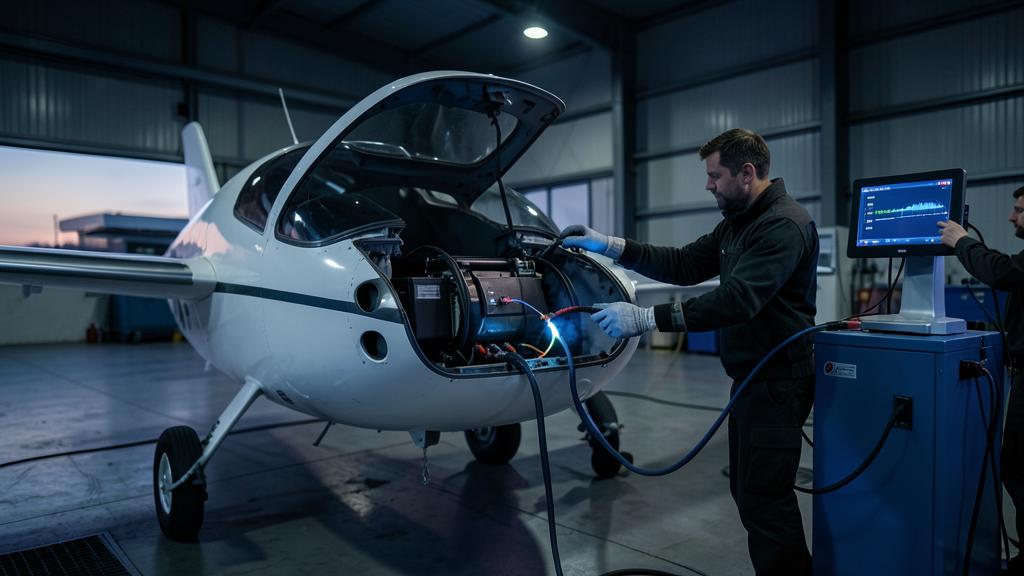
The second is the turn-round. Rapid charging heats a pack, and a hot pack is derated. The reserve available on the second sector therefore depends on how the aircraft was charged after the first, which makes the charging decision an operational one rather than a handling-agent one. Schedules built on fuel-era turn-round times quietly assume a thermal recovery nobody has budgeted for.
The regulatory picture is still forming around all of this. The first fully electric aeroplane to hold an EASA type certificate was approved in 2020 on a light-aeroplane certification basis supplemented by special conditions written for electric propulsion, and further special conditions cover hybrid and vertical take-off configurations. That means the governing document for reserves on these aircraft is the flight manual, with the operating rules applied on top of it — and where the manual expresses a limitation in state of charge while the rule expresses a reserve in minutes, it is the manual’s limitation that stops the aeroplane. Operators building their first procedures around this are working largely from manufacturer data; the collected practice is thin, and worth comparing with others through the FL330 forums before it hardens into habit.


Leave a Reply
You must be logged in to post a comment.