
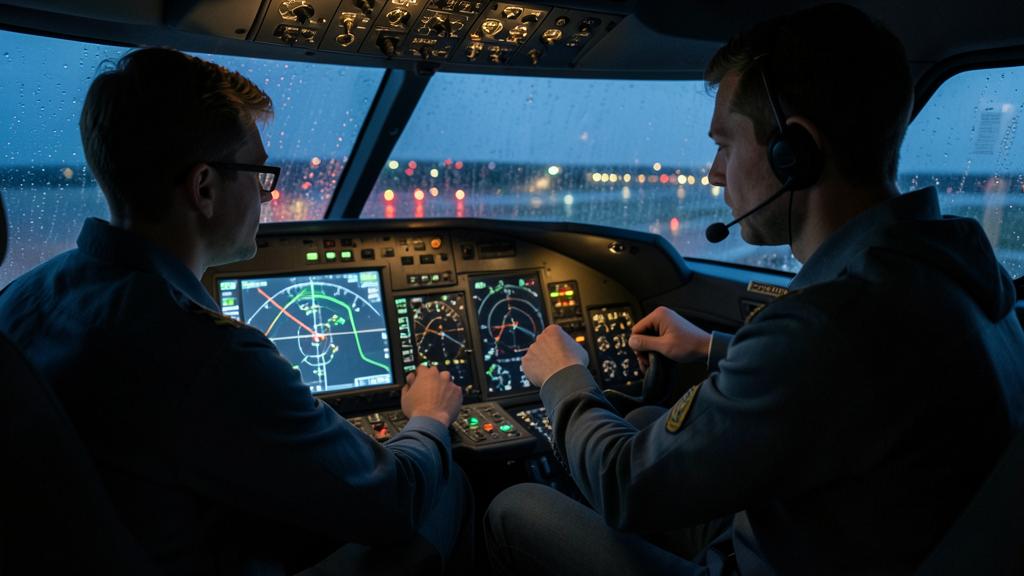
Two folders on the same table, two total hours of the same order of magnitude, and the temptation to conclude that the careers are equivalent within a few dozen hours. Yet, the hours count is the easiest to compare and the least informative. The multi-crew pilot license does not certify the same thing as the standard professional license, is not established by the same proofs, and does not open the same doors when the partner operator changes its mind.
Two licenses, two certified objects
The professional license with an instrument rating certifies a defined capability in relation to the aircraft and the airspace: to conduct a solo instrument flight on a given class or type, to decide on a diversion alone, and to manage a failure alone until landing. The reference is the aircraft. The multi-crew license certifies something else: the ability to hold the co-pilot position in a constituted crew, on a specific type, within a precise set of procedures. The reference is the crew.
The distinction is not rhetorical, and all certifying personnel notice it as soon as they observe the same maneuver in both contexts. An instrument approach passed in a standard practical test is judged on deviations: trajectory, speed, stabilization, and decision at the decision height. The same approach, in a multi-crew curriculum, is first judged on task distribution, compliance with announcements, and how the monitoring pilot intervenes. A candidate may fly a technically flawless approach and fail the milestone because the evaluated competence was not maintaining the plan but managing workload in a team.
This license includes from the outset what a standard curriculum only assembles at the end. The multi-engine instrument rating, crew cooperation, and type rating are all part of the same approved course, and the transport-level theory is included. No additional qualifications are added to the license: an indivisible set is delivered, with the type rating granting all privileges.
Four phases, only one resembling the standard curriculum
The course consists of four phases, the sequence of which reveals the logic. The core flying phase establishes fundamentals on a light aircraft, with solo flights, maneuvering work, and basic navigation: this is the only segment where the trainee truly flies alone, and the only segment resembling the start of a standard training. The basic phase introduces instrument flying and teamwork, largely in synthetic training devices. The intermediate phase transfers these skills to a high-performance multi-engine turbine aircraft environment, using a representative simulator. The advanced phase is conducted on the partner operator’s type, following its procedures, with line-oriented exercises built around its network.
The total volume is around 240 hours, split between pilot flying and pilot monitoring, combining real and simulated time. The flight time is concentrated in the first phase, supplemented by a limited number of takeoffs and landings on the aircraft, around a dozen, often conducted during basic sessions on the type. Reading this total as equivalent to the same number of flight hours in a standard curriculum is a fundamental error, not just a matter of scale: the two columns measure different units.
This license trains pilots to work as part of a team, not to fly solo. The hours spent in simulators count just as much as real flight hours, and the training focuses on following procedures rather than handling emergencies alone.
A trainee on an Airbus A320 multi-crew course might spend 100 hours in a simulator and 50 hours in the actual aircraft. During the core phase, they’ll do solo flights in a Cessna 172, but the rest of the training focuses on teamwork in the A320 simulator and aircraft, with only a dozen takeoffs and landings in the real plane.
Continuous assessment is another form of proof
In a modular or integrated curriculum, proof is event-based. An examiner, a day, a report, a signature. Competence is presumed from the result obtained at that moment, and the file retains nothing else. In the multi-crew pathway, proof is cumulative: instructors note, session after session, observable behaviors linked to competence units, and progression to the next phase is conditional on achieving a level in each.
The shift is deeper than it appears. It transfers the burden of proof from the examiner to the instructional body, and thus to the standardization of that body. Two instructors who assess the same situation differently produce an unusable record, and the organization has nothing to present to the authority during an audit. Monitoring therefore focuses, in this type of course, as much on the calibration of evaluators as on the pedagogical content.
The benefit is symmetrical: remediation is integrated into the system rather than being a catch-up. A weakness identified in the basic phase is addressed before the intermediate phase, whereas a standard curriculum sometimes discovers it at the final exam, when budget and schedule constraints allow little room for correction.
The restriction, read exactly
The privileges are those of a co-pilot on an aircraft requiring a co-pilot. Nothing else. No single-pilot operations, no aerial work, no instruction, not even a circuit on a single-engine aircraft on a Sunday, if the holder does not hold any other license. The restriction does not apply to a flight domain or weather conditions, but to the operating regime itself.
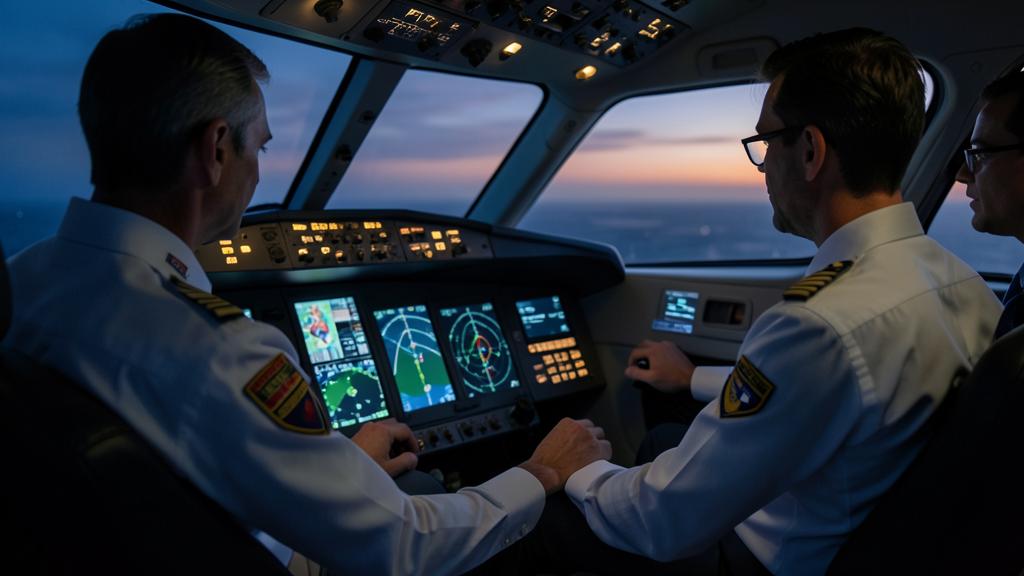
The regulation provides for a progressive lifting: the holder must have completed, on the aircraft and in real operations, a volume of supervised line sectors set by the applicable text, before being able to extend the exercise of their privileges beyond the initial strict framework. The count is in sectors, not hours, which changes everything for a long-haul network: a ten-hour rotation may only count as one sector where a day of short-haul operations counts as four. This lifting is not earned through an exam: it is earned by flying in line, and thus requires an employer. A holder who does not find one remains technically licensed but practically grounded.
| Criterion | Modulaire | Integrated commercial | Équipage multiple |
|---|---|---|---|
| What is certified | single-pilot flight management, brick by brick | single-pilot flight management, in a continuous syllabus | performing the co-pilot role in a constituted crew |
| Preuve retenue | skill test before an examiner at each stage | skill tests at the syllabus milestones | continuous assessment of observable behaviours, milestone at each phase |
| Share of the real aircraft | majority from start to finish | majority from start to finish | concentrated in the first phase, residual thereafter |
| Type rating | obtained after the licence, separately | obtained after the licence, separately | integrated into the course, inseparable from the licence |
| Privileges on issue | commercial, single-pilot flight included | commercial, single-pilot flight included | co-pilot in multi-crew operations, on the course type |
| Course approval | training organisation alone | training organisation alone | organisation and partner operator, jointly |
| Fallback if the job disappears | aerial work, instruction, towing, single-pilot flight | same as modular | none, until the conversion is done |
The trap. The multi-crew license carries no privileges usable without a valid type rating, and its holder is not allowed to maintain recent experience on a light aircraft as a professional license holder would. An expired qualification during a long break is not regained through personal flight hours or VFR flying: it requires a type simulator, an organization, and a type examiner, and thus an operator willing to pay for them.
The partner operator is a single point of failure
The course is only approved in association with a commercial air transport operator. This partnership is not a commercial ornament: it provides the type, the standardized operating procedures, the network on which line-oriented exercises are built, and the line adaptation following delivery. All the employment value of the license is tied to this relationship.
The corollary is verified with every cycle reversal. A hiring freeze, a fleet restructuring, a failure in line adaptation, and the trainee is left with a title whose only outlet has just disappeared. The standard curriculum then offers mediocre but real alternatives: instruction, aerial work, ferry flying, single-pilot operations under contract. The multi-crew pathway offers none without prior conversion, and this conversion requires precisely what the curriculum had eliminated: training in single-pilot operations, validated by a practical test.
What the pathway changes for the rest of a career
In the long term, both paths converge. The airline transport pilot license is issued on 1,500 hours of flight experience, and the hours flown in line count the same regardless of the entry point; since the theory is already acquired in the multi-crew course, the deadline is not further away. The divergence occurs in the first five years, and in the freedom of movement during those years.
Changing operators while keeping the type is simple: the license follows, and the adaptation is redone with the new operator. Changing types is less straightforward as long as the restriction is not lifted, since the required supervised sectors must be accumulated. Moving to instruction is not possible with this license alone: instructor authorizations are linked to licenses that the holder does not possess. Changing the issuing state requires verifying that the receiving state recognizes a license it does not necessarily issue: this is what expatriation candidates discover too late. A training path is also chosen based on this criterion.
Reading a file without misjudging the measure
For a recruiter or certifying personnel, comparing experience from this pathway to a standard experience requires abandoning the sole column of total hours. Four elements provide more insight. The first is the ratio between flight time and simulator time: it indicates the nature of the experience, not its quantity. The second is the number of line sectors actually completed, the only measure of exposure to weather, diversions, and real-time management. The third is the competence record, which does not exist elsewhere. The fourth is the type of the advanced phase, which determines the cost of integration into a fleet.
One point deserves verification and not assumption: how the operator handles the pairing of two inexperienced crew members. A co-pilot from this pathway, at the start of adaptation, falls into this category, and the operations manual draws programming consequences that a planning service sometimes discovers too late.
The right reflex. Upon completion of the course, have three documents issued and kept: the nominative record of evaluated competencies with their achieved level, the details of the supervised sectors completed, and the exact breakdown between flight hours and simulator hours. These are the only transferable documents from such a file: they survive a change of operator, whereas internal seniority is not recognized anywhere.
What remains to be verified in your own documentation
Three areas remain unclear and are resolved in the operator’s documents, never in a general comment. The first is the operational definition of the supervised sector: what counts, what does not, who certifies it, and on which form. Two operators do not interpret it the same way, and the gap is paid for at the time of restriction lifting. The second is the qualification required of the captain flying with a co-pilot from this pathway during their initial period: some manuals require a line instructor, others a designated captain, others nothing. The third is the handling of a long interruption, leave or stop, during the period when the restriction has not yet been lifted.
For those preparing for a qualification or retraining, the useful question is not whether the pathway trains well or poorly, but what the resale value of the license is when the original plan no longer holds. This is a matter of personal risk management, and it arises before signing, when it can still be arbitrated by the choice of a complementary license held in parallel. Experiences shared among practitioners on this point are often more valuable than a brochure, and the professional forum preserves the record.
This article outlines mechanisms, not enforceable obligations: the applicable text, the decision of the issuing authority, and the operator’s approved documentation take precedence over everything that precedes.


Leave a Reply
You must be logged in to post a comment.