
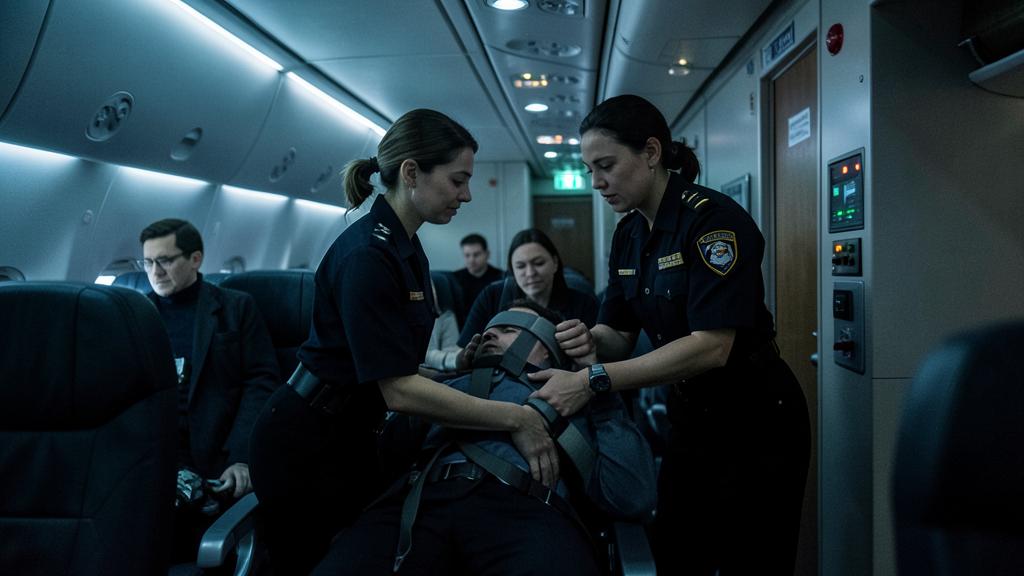
Four hours of Atlantic remain to be flown when a passenger, already warned twice, strikes a crew member in front of the rear galley. The decision to restrain him is no longer up for debate; what is up for debate is everything else: the intensity of the act, its legal basis, and above all the surveillance obligation it triggers. Because restraint is not the end of an incident—it’s the beginning of a phase that engages the crew until the aircraft lands.
Authority of the captain, not a diffuse right of the crew
The foundation is old: the Convention on Offences and Certain Other Acts Committed on Board Aircraft, signed in Tokyo in 1963, grants the pilot in command the power to impose reasonable measures, including restraint, on any person he has reasonable grounds to believe is endangering the safety of the aircraft, persons, or property, or the order and discipline on board. The same adjective twice: the grounds must be reasonable, the measure too—entirely the regime hinges on this double safeguard.
The counterpart is immunity: neither the captain, nor the crew members, nor the passengers who assist at his request can be held liable for reasonable measures taken in this context. The protection is not tied to status but to the nature of the measure—a disproportionate act falls outside, and so does its author: proportionality is not a lawyer’s nicety, it is the condition of coverage.
The text covers the case where the hierarchy has no time to function: any crew member may take reasonable preventive measures without authorization when they have reasonable grounds to believe they are immediately necessary for safety. The protocol signed in Montreal in 2014 filled the gap that rendered the mechanism toothless: criminal jurisdiction, long reserved for the most part to the state of registration, now extends to the state of landing and the operator’s state—the perpetrator no longer disembarks into a legal vacuum.
The captain has the sole authority to restrain a passenger, but only if the action is strictly necessary and proportionate. Crew members can act immediately in emergencies, but must report to the captain right away. Everyone involved is protected from legal consequences as long as they follow these rules.
On a Paris-New York flight, an intoxicated passenger becomes violent after refusing to comply with seatbelt instructions. The crew attempts de-escalation but the passenger strikes a flight attendant. The captain authorizes restraint using approved wrist restraints, places the passenger in a window seat away from exits, and assigns a crew member to monitor them every 15 minutes. The passenger is calm after 30 minutes but remains restrained until landing in New York, where authorities take custody.
Four levels of threat, a response that escalates step by step
Almost all operations manuals adopt the same four-level classification, derived from international guidelines on unruly passengers: verbal disruptive behavior, physically abusive behavior, behavior threatening to persons, and an attempt to intrude into the flight deck. This scale is the tool that makes proportionality practicable in the moment. Each level corresponds to a standard response, and one only skips a step if the behavior did so first.
Proportionality is assessed at three points. At the outset: is restraint necessary now, or would a lesser measure—seat change, change of interlocutor, formal warning—still suffice? In intensity: are the means the lightest that achieve the result? In duration: is the measure reassessed, or continued by inertia? Restraint justified at the first moment becomes questionable if no one asks, two hours later, whether it still is.
Restraint prevents, it never punishes. The passenger restrained because he posed a danger and the one left tied “to teach him a lesson” fall under two different regimes—the first act is covered, the second exposes the crew. The line is drawn by the question the captain must be able to ask at any time: if this passenger has been calm for an hour, what justifies maintaining the restraint?
| Niveau | Comportement type | Graduated response | Who decides | Trace attendue |
|---|---|---|---|---|
| 1 | Verbal disruption, repeated refusal to follow instructions | De-escalation, change of crew member, change of seat | Cabin crew, senior cabin crew member informed | Entry in the flight report |
| 2 | Physically abusive behaviour | Formal warning, final reminder before restraint | Senior cabin crew member, captain informed | Warning logged, witnesses identified |
| 3 | Outright violence, threat to people | Restraint with the equipment provided, continuous monitoring | Captain — crew initiative in immediate danger | Time stamp of the action and of each check |
| 4 | Attempted intrusion into the flight deck | Flight deck defence, immediate restraint, diversion considered | Whole crew, emergency procedure | Full report, handover to the authorities |
The decision loop: who acts, who authorizes, who reports
In normal mode, the loop is short but it exists: cabin crew observes, attempts de-escalation, informs the purser, who informs the captain; the formal warning—with many operators a written card, handed over in the presence of witnesses—comes from the captain or is delivered in his name; restraint is decided by him. This loop creates the traceability the ground file will need, and it ensures that the person who decides is not the one who was just struck or insulted—proportionality is poorly assessed under adrenaline.
Immediate danger reverses the order, not the obligation: one acts, then reports, immediately. A passenger who stands up to strike does not leave time for an interphone call. The convention covers this initiative under the same two conditions, and the captain’s immediate notification is not a courtesy: it reintegrates the act into the framework.
As for passengers, the captain may request or authorize their assistance, and the conventional immunity extends to them. The crew has an interest in choosing its reinforcements: a volunteer briefed in ten seconds—where to hold, what not to do, who is in charge—is better than three spontaneous volunteers, one of whom applies pressure to the chest of the passenger on the ground without anyone asking him to.
Onboard means and the passenger’s installation
Nothing on board is left to chance: the operations manual designates the restraint means, their location, and their conditions of use. Depending on the operators, these are dedicated devices—textile straps, single-use ties—or expressly listed makeshift means, such as extension seatbelts. The distinction matters: using the means provided in the approved documentation is to inscribe one’s act in a validated procedure; improvising with whatever is at hand is to have to justify each technical choice alone, later.
The installation follows a simple logic: reduce what the passenger can reach, preserve what the crew must be able to do. Seat away from emergency exit rows, as far from doors as possible, window side to interpose a seat between him and the aisle; seatbelt fastened; hands in front of the body rather than behind, which allows checking circulation and limits dangerous postures. And a rule with no exceptions: restraint must be able to be released quickly. An emergency evacuation does not warn, and a restrained passenger who cannot be untied becomes everyone’s problem.
The imposed surveillance: the obligation that begins when the act ends
This is the point that written procedures handle best and oral culture handles worst: once the passenger is immobilized, the crew becomes responsible for his condition. Restraint effects a transfer: the restrained person can no longer protect himself, nor change position, nor always express himself clearly. Everything that happens to him from that moment on occurs under the crew’s custody and will be examined as such—including what stems from a health condition that no one on board knows.
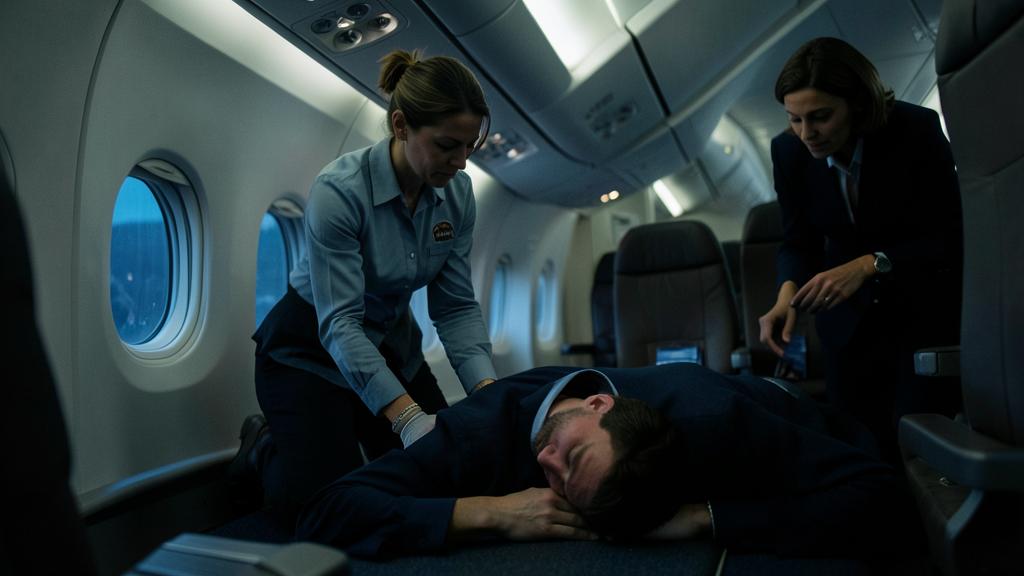
Surveillance is organized as a separate flight task, not as a floating attention. A crew member specifically designated, relieved if the flight is long; a passenger never left without visual contact; checks at close and constant intervals, on defined points: state of consciousness, breathing, facial color, circulation at pressure points, body position. The most documented danger of restraint is positional asphyxia, and it alone justifies the discipline of these checks.
The trap: the prone position. A passenger held face down on the floor, a fortiori with weight on his back or hands restrained behind his body, can stop breathing effectively in a few minutes, even if young, even without known pathology—and the agitation preceding distress looks exactly like a resumption of the struggle, when it is exactly the opposite. As soon as control is achieved, the passenger is raised, seated, and never left on his stomach.
Reassessment is part of surveillance, it is not an option. Many operators prescribe maintaining restraint until arrival once it has been necessary—a defensible position: the passenger has demonstrated his dangerousness, and a second restraint would be riskier than the first. Still, it must be documented: the captain who has recorded “behavior still threatening, maintenance decided” at regular intervals builds the proof of proportionality over time; the one who writes nothing suggests that no one reassessed.
The right reflex: one guardian, one watch, one pencil. Specifically designate the crew member responsible for surveillance, then timestamp each check, each notable word, each adjustment of the restraints. Three lines noted in flight weigh more heavily, six months later, than a page reconstructed from memory—and it is this log that will demonstrate that surveillance actually took place.
Landing: the quality of the file decides the follow-up
Landing is prepared from the cabin. The captain has the destination informed—the arrival is not improvised with a restrained passenger on board—and decides on the follow-up that the convention opens to him: disembark the person, or hand him over to the competent authorities with the elements he has. Since the extension of jurisdiction to the state of landing, this choice has regained meaning: the authority receiving the aircraft can now prosecute itself, where it often had to settle for escorting the individual to the terminal door.
The file makes the difference between a landing with consequences and a routine entry: captain’s report, timestamped surveillance log, identity of witnesses, preservation of items in question, precise description of words and gestures—facts, not qualifications like “aggressive” or “dangerous.” A diversion, when the threat required it, is accompanied in many operators by a cost recovery procedure against the passenger: this procedure lives or dies with the quality of the file compiled in flight.
What your documentation should tell you—and what it often omits
Six answers are to be found in your own documentation, not in an article:
- what restraint means are on board, where they are, and who on board knows how to apply them;
- the exact wording of the formal warning and its medium—card, journal entry, required witnesses;
- the imposed installation position and the excluded seats;
- the frequency of surveillance checks and the points to verify;
- the report template and the post-flight transmission circuit;
- the procedure in intermediate stops, when the restrained passenger remains on board.
A gray area persists in most manuals: the release of restraint in flight. The texts say when to restrain, rarely when to untie—and yet it is the decision where proportionality is most directly exercised, the one a challenger will examine first. For those preparing for a purser role or a ground safety responsibility, it is an excellent case study; the modules dedicated to managing difficult passengers on formations.fl330.com address it from this angle.
These lines describe a mechanism, not your procedure: the applicable convention, operational regulations, and your operator’s approved documentation prevail over this article, and it is the operations manual, in its current version, that is authoritative for any act performed on board.


Leave a Reply
You must be logged in to post a comment.