
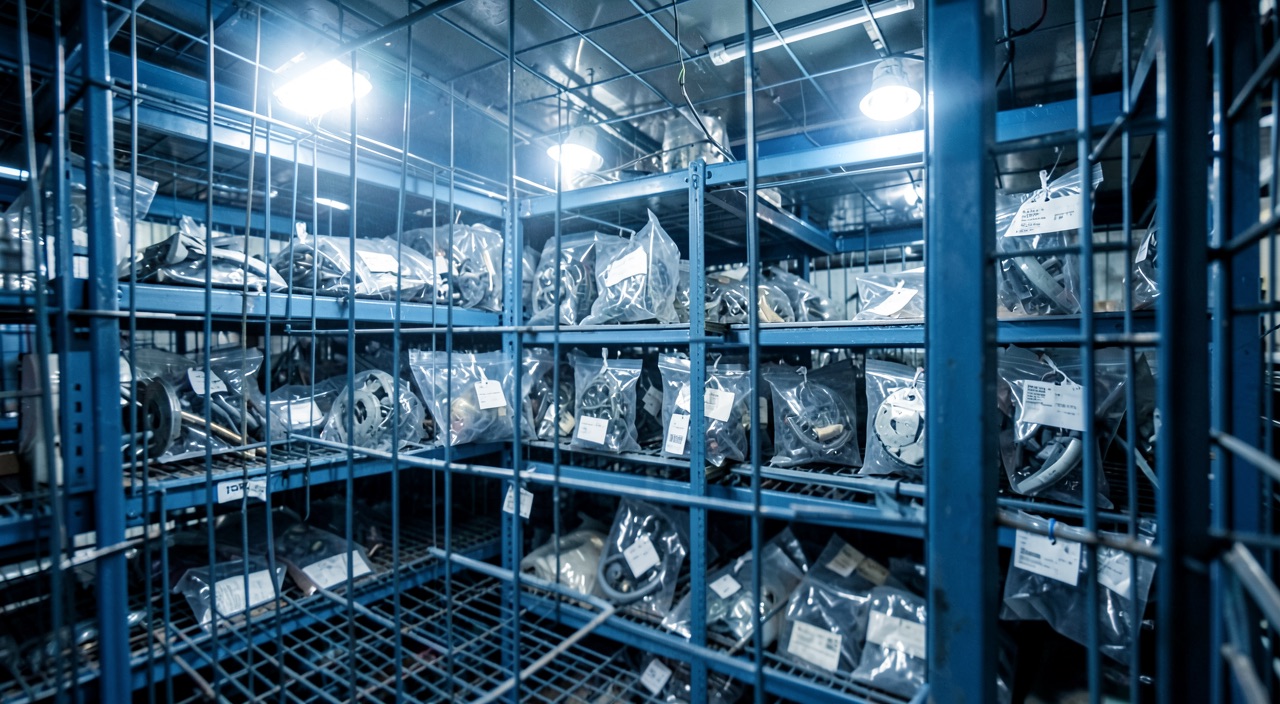
A box arrives in stores: twelve hinge bushings in sealed bags, a broker’s delivery note, and a photocopy of an authorised release certificate which, for its part, covers a batch of forty-eight. Everything looks normal and nothing is. A part with no history almost never enters a fleet through a crude forgery: it enters through a receiving signature given too quickly, on a genuine document made to say what it does not say.
What an authorised release certificate actually proves
An authorised release certificate is a dated statement, made by an approved organisation, covering an identified item in a defined condition. It says: on this date, this item, in this condition, left my quality system. It says nothing about what came afterwards. It does not state that the part suits your aircraft, that its modification standard covers your effectivity, that storage complied with the prescribed conditions, nor — above all — that the object sitting on the counter is indeed the one the document designates.
The form carries two distinct and mutually exclusive statements. One commits a production organisation: the item conforms to approved design data and is new. The other commits a maintenance organisation: identified work has been carried out and the component is released to service. Knowing which of the two has been completed is not an administrative subtlety, it is what determines the chain you must be able to trace back. And the remarks block is not decorative: that is where the reference to non-approved data sits, the particular repair, the reference to a set of rules other than the one you believe you are buying under, or the mention of work limited to a functional test.
Third point, the one most often glossed over: a distributor releases nothing. It holds, preserves and passes on. The document it issues attests to a chain of custody, to storage conditions and to a batch identity; it attests to no conformity with approved design data, because it has neither the means nor the privilege to do so. The only document that counts goes back to the approved organisation, and the distributor’s role is precisely to hand it over to you intact. A supplier who produces its own certificate in place of the issuer’s has not made an error of form: it has substituted its signature for the one that commits.
An authorised release certificate only proves that a part left a quality-controlled system at a certain time. It doesn’t guarantee the part is right for your aircraft or that it hasn’t been damaged since. Distributors can’t certify parts – only the original approved organisation can do that.
A Boeing 737 operator receives a batch of 100 fuel pump seals from a distributor. The certificate says it covers serial numbers 1001-1100, but the box contains serial numbers 1101-1200. The certificate is valid, but doesn’t match the parts. The distributor can’t issue a new certificate – only the original manufacturer can.
The five places where the history breaks
The physical flow of a part is never interrupted: at every moment, someone holds it. The documentary flow, by contrast, breaks at each change of hands, and the breaks are always the same.
- Batch splitting. One certificate covers a batch; the batch is divided into shipments, and the original can follow only one of them.
- The degradation of the evidence. The original becomes a copy, the copy becomes a copy of a copy, and nobody knows any longer who holds the original document or whether it still exists.
- The re-classification of condition. A removal tag, which states only the provenance, becomes a serviceable tag after a simple visual inspection, in a workshop whose scope of approval does not cover the item.
- Mixing in stock. Two neighbouring part numbers, two modification standards, a single bin: traceability becomes statistical.
- Salvage. Items taken from crashed, burnt, submerged or scrapped aircraft come back into circulation through intermediaries, often with a plausible file and an absent history.
To these five breaks a sixth must be added, insidious because it does not concern mechanical parts: the extension of expiry dates on elastomers, adhesives, sealants, seals and batteries. A batch whose shelf life is exhausted is visually indistinguishable from a fresh batch; it is distinguished only by its date of manufacture, which appears on a document.
Read the document like an investigator, not like a storeman
A compliance document is read backwards: you start from the part and its requirement and work back to the issuer, instead of starting from the document and seeking to be satisfied by it. The question is not “do I have a piece of paper?” but “who is committing, to what, and did that party have the right to commit?”. Depending on the item’s provenance, it is not the same documents that carry the proof.
| Provenance | Document that commits | What it attests | Immediate warning sign |
|---|---|---|---|
| New item from a production organisation | Release certificate, production block | Conformity with approved design data at the date of issue | Maintenance block completed instead, or reference to non-approved data in the remarks |
| Component maintained by an approved organisation | Release certificate, return-to-service block | Performance of the work described and fitness for service for that work | Work described narrower than the order: functional test sold as an overhaul |
| Component removed with no subsequent work | Removal tag and life record of the aircraft of origin | Origin, time and cycles at removal, reason for removal | Condition “serviceable” entered with no authorised organisation behind it |
| Standard part, material, consumable | Declaration of conformity with the specification called up by the design data | Conformity with a standard, with heat or batch number and date of manufacture | Specification quoted without its revision, or no date on a shelf-life product |
| Item bought from a distributor or a broker | The original document passed on, not the seller’s own | Nothing more than what the original issuer attests | Certificate issued by the seller itself, in place of the original |
The trap: the genuine document that does not cover your part. A valid certificate, signed by a genuinely approved organisation, may designate a batch of forty-eight items or a range of serial numbers that does not include the one you are holding. Nobody has falsified anything: the batch was simply split further down the line. Verification therefore never consists in noting the presence of a document, but in checking that it designates by name, by serial or by batch, the item received.
Receiving inspection: four cross-checks before signing
A proper receiving inspection is not a tick-off exercise, it is cross-checking work. Four cross-checks, in this order, stop the most common doubtful files before they reach the workshop. First cross-check: the issuer. Does the organisation that signs exist, was its approval in force at the date of issue, and does its scope cover the class of items concerned? An airframe maintenance approval does not release an avionics unit. Second cross-check: the nature of the document. Original, or a copy whose chain of custody is established and verifiable? A copy with no identifiable issuer of that copy has no probative value.
Third cross-check: the identities. The physical marking of the part, the designation carried on the document and the part number required by your approved documentation must coincide, modification standard included. This is the stage at which items eligible for a different effectivity, and part numbers one character apart, are spotted. Fourth cross-check: physical consistency. The declared condition must be consistent with what you see: an item announced as new in opened packaging, a missing connector cap, installation marks on a part said never to have been fitted, retouched identification paint. Disagreement between the paper and the object remains one of the most reliable signals available to you.
The right reflex: photograph the label, the sealed packaging and the marking of the item before opening the bag and separating the accompanying documents from the package, then archive those images with the receiving file. It is the only evidence left when a doubt arises six months later, and it is also what makes it possible to reconstitute a batch when the other items that left in the same box have to be traced.
Batch splitting, the quietest flaw in stores
Batch splitting deserves separate treatment because it presupposes no bad faith. A stores department receives a batch with its certificate, consumes part of it, passes another part to a partner workshop and sells the balance. Each destination receives a fraction of the batch, and the proof of origin, for its part, does not divide. Sound practice consists in issuing, for each fraction, a split-batch certificate identifying the parent certificate, its issuer, its date, the number of items drawn and the holder of the original; all of it under the responsibility of an identifiable and traceable organisation.
A part “with no history” is almost always a part whose history stopped at an undocumented batch split, three links upstream. That is why the question to put to the supplier is not “do you have the paperwork?” but “who holds the original, and can you name them for me?”. A contact who cannot answer that question does not know the provenance of what they are selling, and that is already an answer.
Life-limited parts: the file is worth as much as the part
For a life-limited component, the traceability question ceases to be documentary and becomes arithmetical. Remaining life is calculated; it is not estimated. A continuous count since manufacture is therefore required: every period of operation, every visit to a workshop, every spell in storage must be covered by a document establishing the cumulative total at its end. Continuity counts for more than detail: an overall statement per period, signed by the organisation that held the component, is worth more than a thick but discontinuous bundle.
A gap is filled neither by a fleet average, nor by a seller’s declaration, nor by reasoning about probable usage. It leaves two ways out: reconstituting the missing count with the previous holder, by means of a document that commits that organisation; or adopting the most unfavourable assumption, that is, the maximum life consumable during the unknown period. The second way out very often leads to scrapping, which explains why the temptation to rewrite history is strong, and why life records are among the documents most exposed to rewriting.
The price of a late detection
The reason receiving inspection deserves time lies entirely in the shape of two curves. Detectability by documentary examination is at its maximum the moment the package is opened: the accompanying documents are there, the packaging is intact, the supplier is reachable and the order is fresh. It then collapses. Once the item is in stock under an internal number, it is no more than a line; once installed, it is no more than a part number in a work report.
The cost, for its part, follows the opposite trajectory and very quickly ceases to be proportional. At the counter, rework is counted in minutes on the telephone. In stores, it requires an audit of the batch and the blocking of a part number. On the line, it adds a removal, a grounding and an emergency replacement. In service, it becomes a fleet-wide search: finding all the parts from the same batch, on every aircraft, at every customer of the workshop, with the question that always accompanies such work — how long have they been flying? It is this scale factor, and not the price of the part, that justifies the apparent slowness of a serious receiving inspection.
When the doubt is established
A doubt is not an opinion: it is an administrative state that triggers actions. The first is quarantine, and it is twofold. Physical quarantine, in a closed area with restricted access, separate from the everyday stores, so that no hurried hand can take the item back during a night stop. Then system quarantine, by blocking the part number and the serial number in the system, failing which physical stock and theoretical stock diverge and the item “reappears” at the first inventory.
Then come three actions that are regularly forgotten. Escalation to the quality function, which alone decides on release or scrapping: stores observes, it does not rule. Reporting to the competent authority when the item is suspected of being unapproved, because a doubtful batch is never held by a single operator and the value of the report lies in the cross-referencing. Finally, the actual destruction of scrapped items, by mutilation making any refitting impossible: a part merely thrown away can come back into circulation, and that is one of the routes by which scrapped items reappear for sale. Traceability does not stop at the door of the stores; it ends at the skip.
What to go and check in your own organisation
Three points deserve a read in your own documentation, this week rather than at the next audit. First, who is authorised by name to sign for the receipt of a component, and does their training cover the reading of a release certificate — not merely the handling of the management system? Next, how a supplier gets onto your list and how quickly they come off it: the question is particularly severe for brokers, who hold neither a production approval nor a maintenance approval, and whose assessment can bear only on documentary quality demonstrated order after order. Finally, your emergency purchasing procedure: it is at AOG that the safeguards get bypassed, and the fact that the derogation exists in writing is better than an improvised workaround at two in the morning.

One grey area remains that nobody has completely resolved: standard parts, fasteners and consumables, whose unit cost is trifling and whose criticality is sometimes at its highest. These are the least well traced items in the whole chain, the ones bought in enormous batches and consumed without anyone reopening a file. For anyone preparing an organisation approval or taking up a continuing-airworthiness management post, this is the subject to work on first: the examination asks who may release, the job asks what you do when nobody can. Feedback on doubtful suppliers circulates mainly between peers, on the FL330 professional forum, long before it appears in any official publication.
These pointers describe a mechanism, not a procedure to be applied as it stands: the regulations in force, the specifications of the design approval holder and your organisation’s approved documentation prevail in all circumstances over this article.
Questions fréquentes
Can a distributor issue an authorised release certificate itself?
No. That privilege belongs to approved production organisations, for new items, and to approved maintenance organisations, for components returned to service after work. A distributor passes on the original document and may attach its own statement of storage and chain of custody. If the only document supplied bears the seller’s letterhead while the item is presented as new or overhauled, the part must be treated as undocumented.
Is a photocopy of a certificate acceptable at receiving inspection?
A copy is usable only if you know who produced it, from which original and who holds that original. This is the principle of the split-batch certificate, which identifies the parent document and its holder. An anonymous copy, with no established chain of custody, does not prove that the item received belongs to the batch described.
What should be done with a life-limited component whose file has a period with no record?
Only two routes. Reconstitute the missing count with the organisation that held the component over that period, by means of a document that commits that organisation. Failing that, adopt the most unfavourable assumption, that is, the maximum consumption possible during the unknown period, which most often leads to scrapping. No fleet average or commercial declaration replaces a signed statement.
Must standard parts and consumables be accompanied by a release certificate?
No, they are accepted against a declaration of conformity with the specification called up by the approved design data. That declaration must carry the revision of the specification, the heat or batch identification and, for age-sensitive products, the date of manufacture and the shelf life. It is precisely on this family of items that traceability is weakest in practice.
What should be done when a suspected unapproved part has already been fitted?
The matter leaves stores for the quality function and continuing-airworthiness management. The effect of the item on airworthiness must be determined, removal and its deadline decided, the suspicion reported to the competent authority, and the search launched for all items from the same batch. It is this fleet-wide search, and not the replacement, that makes up the bulk of the workload.
How can an emergency purchase from an unknown intermediary be made safe?
By providing for the situation in writing before it arises: a derogation procedure that names the decision-maker, requires the documents to be sent before shipment and imposes a reinforced receiving inspection on arrival. Demanding a scan of the complete certificate, remarks included, and the naming of the holder of the original costs a few minutes and eliminates most fragile files.


Leave a Reply
You must be logged in to post a comment.