
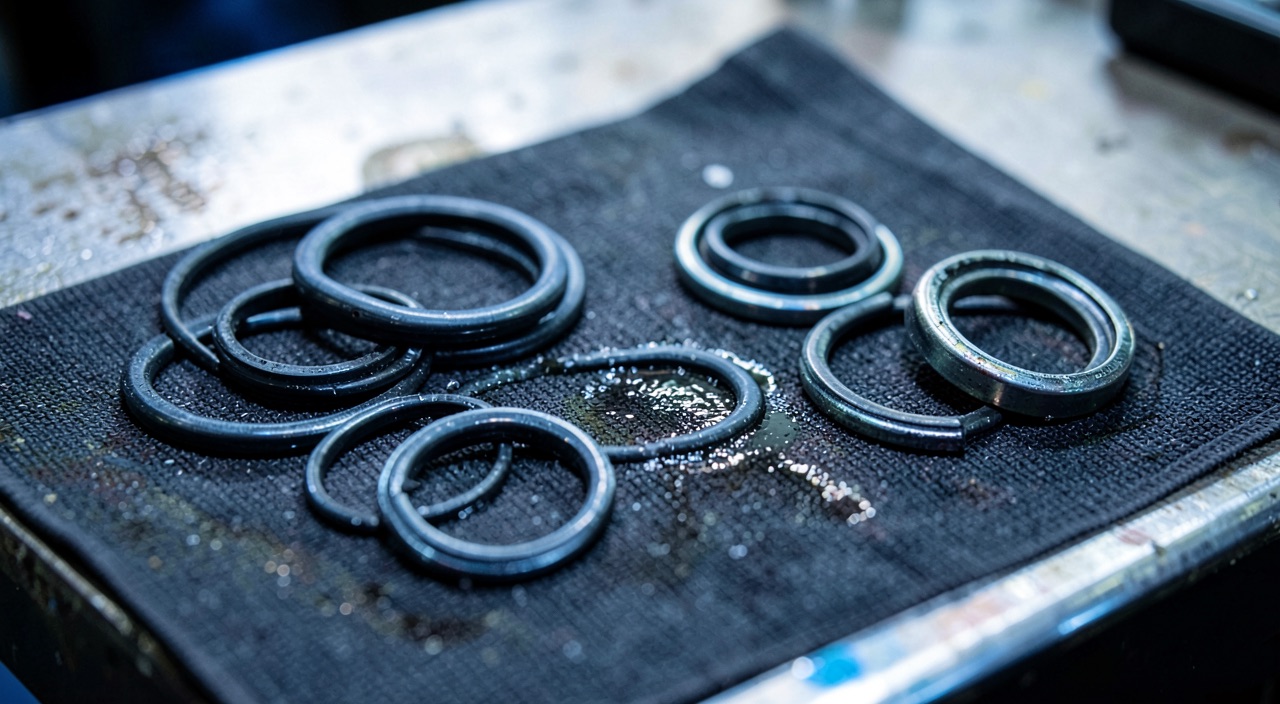
A drain fitting weeping on a buffer tank, two weeks after the first receipt of a batch with a high proportion of synthetic kerosene: the seal has not aged in two weeks, and the fuel has not attacked anything. It has simply stopped swelling it. Aromatics perform a mechanical function in jet fuel that nobody ever wrote down, because it was taken for granted as long as every kerosene contained them. Here is what happens when that function is removed.
What aromatics actually do in a kerosene
A conventional jet fuel blends linear and branched paraffins, naphthenes and aromatics. The latter, mostly alkylbenzenes with a supplement of naphthalenes, contribute three things: a density higher than paraffins of the same cut, hence slightly more energy per litre; a solvent power that keeps polar traces and additives in solution; and a benzene ring whose combustion proceeds through soot precursors. It is this last point that set the upper limit.
Specifications cap the total content and, separately, the di-aromatic fraction, because naphthalenes are, among aromatics, the ones that weigh most heavily on particle formation, flame radiation on combustor walls, and the soot loading available to nucleate a contrail. Synthetic paraffinic kerosenes — hydroprocessed esters and fatty acids, Fischer-Tropsch conversion, alcohol-to-jet route — are practically devoid of them. Hence the volumetric blending cap and the aromatics floor imposed on the final blend. That floor was not written for combustion, but for seals.
Aromatics in jet fuel help keep seals swollen, which maintains their sealing ability. Without them, seals can shrink and start leaking. This is why fuel specifications set minimum levels of aromatics, not just for combustion but to protect the aircraft’s fuel system.
On an A320 using a fuel blend with 15% synthetic paraffinic kerosene (SPK) and 85% conventional jet fuel, a nitrile seal in a static application might swell by 5% in conventional fuel but only 1% in the SPK blend. After two years, when the fuel switches to a fully synthetic blend, the seal may shrink by 4%, leading to weeping at a low-point drain fitting.
Elastomer swelling is a design parameter, not a defect
An elastomer immersed in a hydrocarbon absorbs some of it and swells. The extent of the phenomenon reads on the gap between the polymer’s solubility parameter and the fluid’s: the closer they are, the stronger the absorption. Of all the constituents of a kerosene, aromatics are the ones that come closest to nitrile rubbers, linear paraffins the ones that are furthest from them. The same seal therefore swells by several percent in volume in a fuel rich in aromatics, and barely at all in a purely paraffinic fluid. The balance can even reverse: a fluid with very little solvent power extracts plasticisers and processing oils from the compound faster than it penetrates it, and the specimen comes out smaller than it was dry. This is the limiting case that a paraffinic immersion reveals on heavily plasticised formulations, and it is not visible on a lightly plasticised grade.
This swelling is not merely endured, it is put to use. A static O-ring is fitted with a squeeze counted in tens of percent of its cross-section — typically around a quarter in a static application, noticeably less as soon as a face moves, on pain of heating and wear; it is this squeeze that creates the contact stress, to which pressure energisation by the fluid is added. In-service swelling adds a reserve that offsets wear of the mating faces and slow relaxation of the material. The downside explains the cap: excessive swelling softens the elastomer, drops its modulus and tear resistance, and promotes its extrusion into the diametral clearance.
| Family | Swelling in aromatic kerosene | Shrinkage in paraffinic fuel | Common use | Point of vigilance |
|---|---|---|---|---|
| Nitrile | Strong | Marked | Ground support equipment, hoses, flange gaskets | The most exposed family, and the one where the oldest seals lie dormant |
| Fluorosilicone | Moderate | Sensitive, especially in cold conditions | Aircraft fuel systems | High compression set after prolonged hot exposure |
| Fluorocarbon | Low to moderate | Limited | Hot zones, engine environment | Mediocre cold performance depending on the grade |
| Perfluoroelastomer and polytetrafluoroethylene | Very low | Negligible | Critical rings and packings | Cost, and irreversible creep of the non-elastomeric polymer |
| Tank polysulfide sealant | Low but real | Stresses adhesion | Structural fuel tanks | The failure mode is disbonding, not shrinkage |
Why the leak appears at shrinkage, not at swelling
A new seal copes very well with a switch to a fuel low in aromatics: it loses a little volume, its contact stress drops and stays well above the sealing threshold. The problem goes by a different name: compression set. An elastomer kept crushed for years, at temperature, reorganises itself: the chains relax, the material takes the shape of its housing, its elastic recovery capacity is consumed.
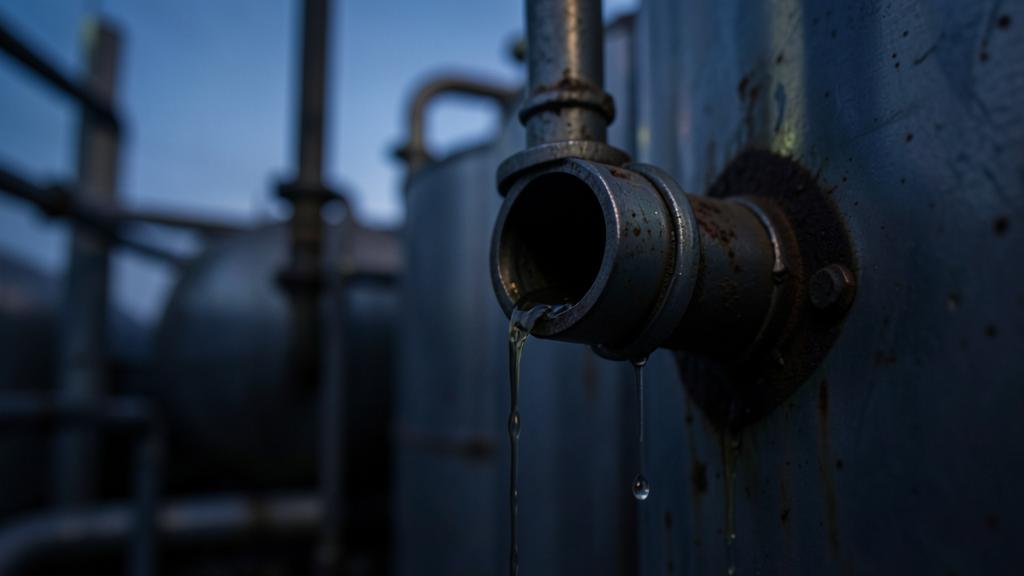
As long as the fluid keeps swelling it, nothing is visible: the absorbed volume offsets the loss of recovery. The system thus silently accumulates a population of seals that no longer hold by their elasticity but by what they have absorbed. Remove the swelling agent and the seal gives back the absorbed liquid. A new seal would follow the movement by relaxing; a deformed seal cannot, it has no recovery left to give. The mating face moves away, the stress drops below the threshold, weeping appears.
The time lag blurs the diagnosis: desorption of a bulky cross-section takes days to weeks depending on thickness and temperature, so the leak is reported long after the batch change. Cold makes everything worse, since the modulus rises again and the elastic shrink-back capacity collapses. This is what the low-temperature retraction test measures, and it becomes far more discriminating once the fluid no longer swells the seal.
The trap: validating compatibility on new seals. An immersion campaign on virgin specimens will rightly conclude that the material holds up. It will say nothing about the installed population, whose risk lies entirely in its history: years of compression, thermal cycles, acquired swelling. The question is not « is this material compatible », but « will that particular seal, after fifteen years in its housing, be able to follow a receding face ».
Lubricity: a related property, a different cause
The second complaint levelled at paraffinic fuel is loss of lubricity. It is well founded, but blaming it on aromatics is a common reasoning error. What lubricates a fuel pump is not the aromatic molecule: it is the polar species present in trace amounts — naphthenic acids, sulphur and nitrogen compounds, oxygenates — that adsorb onto metal surfaces and form there a molecular-thickness boundary film, the only defence when the hydrodynamic lift of such a low-viscosity fluid collapses.
The confusion arises because the two disappear together: hydroprocessing that saturates the aromatic rings also removes, and earlier on the severity scale, the polarity-bearing heteroatoms. Excellent correlation, zero causation. The consequence is unpleasant — restoring aromatics with a synthetic component does not restore lubricity, and a fuel that meets the aromatics floor can still be poor on the bench. Hence the two must be treated separately, by ball-on-cylinder lubricity test and, if needed, an improver additive whose surfactant nature in turn degrades water separation.
What the pump and the fuel control system make of it
On a high-pressure system, the positive-displacement pump is lubricated by the fluid it delivers, and by nothing else. Three zones there operate in boundary or mixed regime: the gear tooth flanks at mesh, the plain bearings fed by a bypass, and the carbon-face shaft seal. This last one deserves a clarification: what tracks the wear of the faces is not the carbon face itself but the elastomeric secondary seal that carries it, and which must slide freely on its shoulder. Deflated and deformed, it sticks to its housing, the face loses contact, and the leak passes through the shaft — the flange mechanism, transposed to a rotating part. As the film thins, the wear regime changes nature, shifting from a mild regime to an adhesive one: micro-welding, tearing, particles that go on to score downstream components.
The control system is more insidious. A hydromechanical metering unit, a servo-valve, a distribution spool work with clearances of a few microns, calculated for an internal leakage that is part of the design. A worn spool does not break: its leakage increases, the loop gain shifts, the response lengthens. The symptom is a slow drift of an operating parameter, never an outright failure. Add to this the internal seals of the unit, whose shrinkage does not produce a puddle under the aircraft but a drop in volumetric efficiency.
| Criterion | Seal shrinkage | Loss of lubricity |
|---|---|---|
| Actual cause | Loss of the swelling agent, the aromatics | Loss of polar traces, through hydroprocessing |
| Time lag | Days to weeks, the time it takes to desorb | Hundreds of hours, through cumulative wear |
| Signature | Weeping at cold static points, internal leakage of the units | Slow drift of the control system, particles, scored gear teeth and seal |
| What corrects it | Replace the seals, sometimes the elastomer family | Lubricity additive, verified by standardised test |
| What fixes nothing | Adding a lubricity additive | Reintroducing synthetic aromatics |
Ground equipment is more exposed than aircraft
One naturally reasons about the aircraft. It is the best-protected link: its elastomers are qualified material by material, tracked by part reference, replaced on schedule or when equipment goes through the shop. The refuelling chain benefits from none of these protections. Sump valves, couplers, filter cover seals, meter packings, hoses and their liners: many have been in place for decades, often in nitrile because it was the obvious choice in a fluid that swelled it, and they are never removed as long as they do not leak.
This is exactly the population whose compression set is at a maximum. The first manifestation of a change in solvency power will therefore not appear in flight, but under a refuelling truck, at a filter-separator cover or a hose coupling. Filtration components deserve their own attention: a very clean fuel, devoid of natural surfactants, does not behave like a conventional kerosene towards coalescers and water-absorbing monitors, and the lubricity additive further shifts the interfacial tension.
The right reflex: treat the arrival of a batch with a high proportion of synthetic fuel as a fluid change, not as a delivery. Record the baseline sealing condition before the first receipt, starting with the cold static points — low-point drains, filter flanges, couplers, hose fittings — then repeat the same round at two, four and eight weeks. Without a zero point, nothing will distinguish a new leak from a weep that was already there.
All-synthetic fuel shifts the question
As long as blending remains capped, the aromatics floor of the blend protects the fleet and the issue only arises at the margins. A fully synthetic fuel raises it head-on. First path: reintroduce aromatics of synthetic origin, produced by the pathway itself or added as a dedicated component. This preserves solvency but reintroduces some of what one wanted to remove, with an arbitration that becomes explicit between the sealing integrity of the existing fleet and the reduction of soot and non-CO2 effects.
Second path: demonstrate that an aromatics-free fuel suits a given fleet. This requires tests far more demanding than immersion of virgin specimens — artificially aged or in-service seals, shrinkage measurement after complete desorption, endurance testing on a full-circuit rig, instrumented flight campaigns. It is worth noting in passing that solvency is not reducible to aromatics alone: naphthenes also contribute to it, aniline point accounts for it better, and certain cuts rich in cycloalkanes swell noticeably more than a linear paraffin without carrying a single benzene ring.
What to go and check at home
Three checks pay off more than any general briefing note. The list of approved fuels in the aircraft and engine documentation, which names the admitted pathways and the cap specific to each — they are not all identical. The actual nomenclature of the installed seals: a part reference does not designate a material, and successive substitutions may have changed the elastomer family without changing the number. Finally, on the ground side, an inventory of static sealing points classified by installation age.
A grey area remains, and it is better to say so. There is no way to know a seal’s compression set without removing it, no standardised criterion today covers the recovery capacity of an aged seal after desorption, and the history of batches received into storage is rarely traceable finely enough to date a change in solvency. For anyone preparing a type qualification or an approval extension, the subject shifts from the fuel domain into that of materials and processes. The discussions devoted to fuel systems give a fairly faithful picture of it.
This article describes a mechanism and replaces nothing: the applicable fuel specifications, the approved aircraft and engine limitations, and the operator’s maintenance documentation prevail in all circumstances over what is written here.
Questions fréquentes
Can a fuel that fully complies with the specification still make a seal leak?
Yes, and it is the most frequent case. The specification bounds the fluid, not the response of the installed seal: two equally compliant batches can have very different aromatics contents, one close to the cap, the other close to the floor. An aged seal equilibrated on the first one shrinks when the fuel switches to the second, and its compression set prevents it from following the mating face. Fuel compliance is therefore not an acceptable argument for ruling out this hypothesis.
Should seals be preventively replaced before receiving a batch with a high proportion of synthetic fuel?
Not everywhere, but yes for a targeted population. The cold, old static points of the refuelling chain concentrate almost all the risk, because they combine a material highly sensitive to swelling with years of continuous compression. On the aircraft, renewal already follows the maintenance programme and calls for no general pre-emptive action. A baseline sealing survey before the first receipt is worth far more than a blind mass replacement.
Does a lubricity-improver additive also protect the seals?
No, the two problems do not share the same cause. The additive restores the boundary film that protects the metal surfaces of the pump and control system; it brings no solvent power capable of re-swelling an elastomer. Conversely, reintroducing synthetic aromatics re-swells the seals without restoring lubricity. The two properties are treated separately and verified by their respective tests.
Why does the blending of synthetic kerosene remain capped by volume?
The cap does not stem from the aromatics criterion alone: each production pathway is approved with its own limit, based on the full set of properties of the cut it produces. The practical effect is indeed that one, however: the final blend retains a solvent power comparable to that of conventional kerosene, which makes it substitutable without modifying the existing fleet, aircraft and ground infrastructure alike. This is also why the caps differ from one pathway to another, since the cuts produced have neither the same composition nor the same behaviour. It is therefore better to read the value applicable to the pathway concerned than to retain a single figure.
How can a leak due to seal shrinkage be distinguished from an ordinary ageing leak?
The pattern of clues is both temporal and geographic. Shrinkage affects several points with no functional link between them, within a window of a few weeks after a batch change, and strikes the oldest seals and cold zones first. Ordinary ageing shows up sporadically and progressively. On removal, a shrunk seal presents a flattened, hard, glossy cross-section, without the cracking of chemical degradation.
Is ground equipment really more exposed than the aircraft?
Yes, for a management reason rather than a design one. On-board elastomers are qualified, tracked and renewed under a maintenance programme, which naturally limits their average age. The seals of valves, filters, meters and hoses in the refuelling chain are only replaced when they leak, and many are nitrile, the family most sensitive to swelling. The probability of encountering a heavily deformed seal there is therefore much higher.


Leave a Reply
You must be logged in to post a comment.