
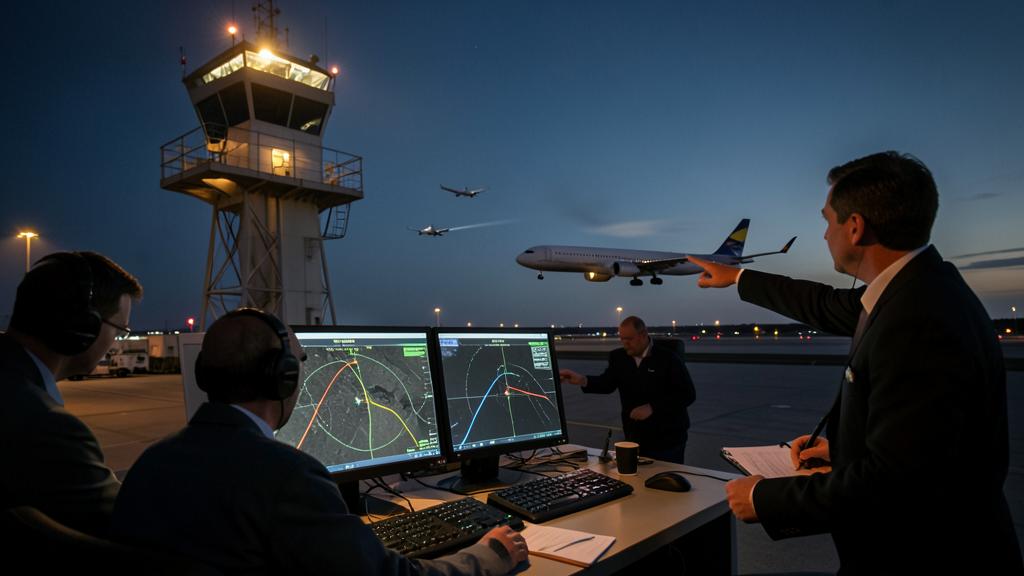
A reclassification of wake is announced as a reduction: same runway, same lighting, more movements per hour. It is not. Nothing is reduced uniformly: some pairs adapt, several relax, and the rate of movements per hour only changes because the most restrictive constraint was modified. Here is where the additional movements truly come from and where they disappear silently before anyone notices.
A wake category has always been a substitute
The scheme the world knew classifies airports according to the maximum certified takeoff mass into three bands: Heavy from 136,000 kg, Medium between this value and 7,000 kg, Light below, with a separate treatment for the largest type in operation. From these bands, the radar separation minima known in the final approach phase are derived, four, five, and six nautical miles depending on the pair, with the exact values being those the State publishes in its AIP, not those a controller from another country has in mind.
Mass has never been the physical quantity of interest. The strength of a wake vortex pair is determined by the circulation shed at the wing tips, which for a stabilized flight is close to the weight divided by the product of air density, true airspeed, and effective wingspan. Written this way, three things are immediately evident. Weight counts, but so does wingspan, and a proportional change in wingspan shifts the response exactly as an identical proportional change in mass. Speed counts, which explains why a heavy aircraft on final approach at a slow approach speed generates a stronger wake than the same aircraft fast and clean at high altitude. And density counts, which explains why a warm high-altitude airport does not offer the same wake environment as a cold sea-level airport.
Clear. Wake categories are not based solely on the aircraft’s weight, but also on its wingspan, speed, and air density. A heavy and slow aircraft can generate a more dangerous wake than a lighter but faster one.
An Airbus A380 (maximum weight 575,000 kg, wingspan 79.8 m) and a Boeing 737 (maximum weight 85,000 kg, wingspan 35.8 m) can have very different wakes, despite a large mass difference. An A380 in a slow approach at 140 knots on a warm runway (low air density) generates a stronger wake than a 737 in fast cruise at 500 knots.
Two aircraft with the same mass and very different wingspans leave very different wakes, and the three-band scheme could not express this. If a type misbehaved in its band, the solution was a special rule added, rather than a better taxonomy: the industry has spent decades patching this for a famous narrow-body twinjet passenger aircraft whose wake refused to respect the assigned weight class.
Generating and finding are two different questions
The second thing the old bands could not express is that an aircraft in a separation matrix is two different objects. As a leader, it is a generator, characterized by mass, wingspan, and approach speed. As a follower, it is a victim, and what matters then is not its mass, but the roll moment that a given wake induces in it, and the roll control authority it has to respond. A short wingspan aircraft can be completely inside a wake core and be rolled over; a long wingspan aircraft spans it and feels it less.
Every recategorization scheme in operation is based on this distinction. Categories are not a single classification of aircraft from largest to smallest; they are a double-indexed table, once for the leader’s generation characteristics and once for the follower’s resistance. That is why the result is by pairs rather than uniform, and that is the complete explanation of why a recategorization can shorten some pairs and lengthen others at the same time.
| Scheme | How aircraft are grouped | What can be expressed |
|---|---|---|
| Classic ICAO bands | Three mass bands plus a special case | Coarse classification by mass only; wingspan and approach speed are invisible; special cases are handled via exceptions |
| RECAT-EU | Six categories, from the largest twin-aisle to small aircraft | Leader and follower are evaluated separately; wingspan and approach speed are incorporated in the classification; many pairs return to the radar minimum |
| FAA consolidated categories | A national set of categories replacing previous local trials | Same logic in pairs, different letters and limits: the two systems are not interchangeable |
| Static separation by pairs | No category: a distance for each ordered pair of types | The finest resolution available without real-time wind data; requires a much larger dataset in the flight data system |
The matrix grows before accelerating
The change from three categories to six multiplies the number of ordered pairs by four. Some of these new cells carry a lower number than the band they come from; some carry a higher number because the old band hid a pair that was underseparated by averaging. A scheme that never increased values would be a safety case no one could write. A scheme that redistributes is acceptable, and that is what is approved.
- Some pairs see their separations decrease
- Others see their separations increase
- The result depends on the traffic distribution on the runway
Whether the redistribution generates movements depends entirely on the traffic distribution on the runway in question. An airport operating a flow of narrow-body aircraft behind narrow-body aircraft was already at the radar minimum for most of its pairs and not at the wake minimum. Reclassifying these pairs does not bring anything in the final approach phase because the wake was not what kept them separated. An airport with a truly mixed flow of long- and short-haul flights, where a large part of the pairs was based on a wake value, has a real margin. Two airports can adopt the same scheme on the same day and show completely different results, and neither of them is doing anything wrong.
The rate of movements per hour is a maximum, not a wake number
The time between two consecutive threshold crossings on a single runway is not determined by the wake minimum. It is determined by the most restrictive constraint at that moment. The recategorization reduces exactly one of them.
| Constraint | What it depends on | What it relieves |
|---|---|---|
| Wake turbulence minimum | The leader and follower types and the applicable scheme | Recategorization, separation by pairs, time separation |
| Radar separation minimum | Surveillance performance and authorized minimum in the final approach phase | Surveillance upgrade and a reduced authorized minimum in the final approach phase; nothing more |
| Leader’s runway occupancy time | Exit geometry, braking strategy, aircraft type, surface conditions | Fast exits, exit assignment, crew briefing on expected exit |
| Takeoffs between landings | Mixed mode policy, takeoff wake intervals, alignment time | Runway usage strategy, runway design, sequencing tools |
| Delivery precision and controller buffer | Distance tool support, final compression, wind forecast quality | Arrival management and distance tools, no regulation |
Here is the sentence that explains the entire topic: the recategorization reduces one column of this table, and the runway does not become faster unless this column is the highest. If the runway occupancy time is the highest, a wake change brings nothing more than a tighter final approach phase and more go-arounds. If the buffer is the highest — and that is true in many airports — the money is in the distance tools, not in the categories.
The trap. Reading a recategorization gain as a uniform reduction. Several pairs lengthen, not shorten, and a controller who has internalized the old scale and assumes the new one is uniformly tighter will underseparate exactly the pairs the scheme is supposed to protect.
From nautical miles to seconds, and why wind changes the response
A separation minimum, expressed in distance, only becomes a time interval after dividing it by the ground speed. In calm conditions, both are almost interchangeable. With strong headwinds, they are not: the same distance takes materially longer, so the runway delivers fewer movements per hour on the days the network can least absorb the loss.
The physical irony is that headwinds help. A wake dissipates and descends in the air in which it is found, so the danger behind the leader has a duration measured in time, not nautical miles. Maintaining a fixed distance with strong headwinds, and the follower reaches the leader’s position much later than it would in calm conditions, at the moment when the wake has had more time to dissipate and descend below the approach path. Therefore, the fixed distance minimum buys a much larger time interval than justified by the danger. This observation is the complete basis for time separation, where minima are expressed in seconds and converted into a distance the controller can use with the measured wind profile on the approach. The gain is not free: it requires a wind measurement chain, an indicator on the controller’s screen, and a complete safety file, and is implemented in a small number of airports, rather than published as a global rule.
Compression works in reverse and never stops. The leader reduces its speed to its final approach speed, while the follower is still faster; the interval the controller has set at the application point is not the interval at the threshold. Every operational separation scheme includes a buffer for this, plus a buffer for delivery error, and these buffers are where a large part of a theoretical gain disappears when nothing on the ground helps the controller place the aircraft with precision.
Strong headwinds make the same distance take longer, but they also give the wake more time to dissipate. This means that fixed distance rules can sometimes be too strict, and time-based rules are more accurate but require extra tools.
At an airport with a 2,500-meter runway and a 15-knot headwind, a separation of 4 nautical miles (7.4 km) between an Airbus A350 and a Boeing 737 might take 90 seconds instead of 60 seconds in calm conditions. However, the wake from the A350 would have dissipated more by the time the 737 arrives, making the longer time interval safer.
Takeoffs follow the clock
On takeoff, there is generally no surveillance-derived spacing that can be used at the time of the takeoff clearance, so the wake constraint is expressed as a time interval: the classic construction is a two-minute interval behind a heavier aircraft, extended if the following aircraft takes off from an intermediate point on the same runway and, therefore, will be in the air beyond the leader’s takeoff point, within the already established wake. The applicable values are those the State publishes, and the recategorization schemes contain their own table of takeoff intervals, indexed by pairs like those for arrivals.
On a mixed-mode runway, the takeoff interval and the arrival interval compete for the same seconds. A recategorization that shortens the takeoff intervals can increase total movements, even if it does nothing for arrivals, and vice versa is equally true. Evaluating the effect based on the arrival matrix is one of the most common ways to be surprised by the result.
What must be true on the ground before any of this counts
A pair scheme only works if every position that requires the category has it correctly for each aircraft. This means the flight data system maps types to the new categories, the radar label or the strip shows them where the controller looks, the wake indicator on the flight plan and the radio call are consistent with what the tool believes, and the airport’s entry in the AIP was changed before the first day, not after. A single type mapped to the wrong category is not a rounding error; it is a systematic underseparation applied to every movement of that type until someone notices.
The second truth on the ground is commercial, not technical. The declared capacity used for slot coordination is not the physical flow of the runway; it is a number agreed through the slot coordination process, and is reviewed based on evidence after a season of measured performance, not the day the new matrix comes into force. The runway may be faster for months before the schedule allows it to reflect this.
The correct reflex. Before discussing categories, measure which constraint on your runway is limiting, hour by hour. Count the pairs that were actually separated by a wake value, not by the radar minimum, runway occupancy time, or buffer. If this number is low, the recategorization will be an exercise on paper with an excellent press release and no additional movements.
What absolutely does not change
None of this affects the crew’s own responsibility. If visual separation is applied, the responsibility to avoid the wake lies with the crew that has accepted it, and a crew that wants more than the applied minimum has the right to demand it and must do so. Nothing in a recategorization forces anyone to accept a separation they consider insufficient for the day’s wind, the leader’s configuration, or their own aircraft.
It also does not address encounters that occur far from the final approach: wakes slightly carried over parallel runways by a crosswind, a wake found while stabilizing below and behind a preceding aircraft in cruise, or the low-altitude encounter during a takeoff turn. These are managed by completely different means: lateral displacements, level assignments, procedure design, and through reports. A wake encounter is a reportable event according to reporting procedures, and the dataset that initially allowed the recategorization was built from these reports. Procedures only improve if crews continue to report.
The honest summary for anyone reporting to a management team is brief. Recategorization does not reduce separations; it stops averaging them. Where the average hid additional capacity, the flow increases. Where the runway was restricted by something else, it does not. Both results are the scheme working as designed, and knowing which one is yours before the project begins is worth more than the project. The FL330 forums carry reports from controllers who have experienced both.


Leave a Reply
You must be logged in to post a comment.