
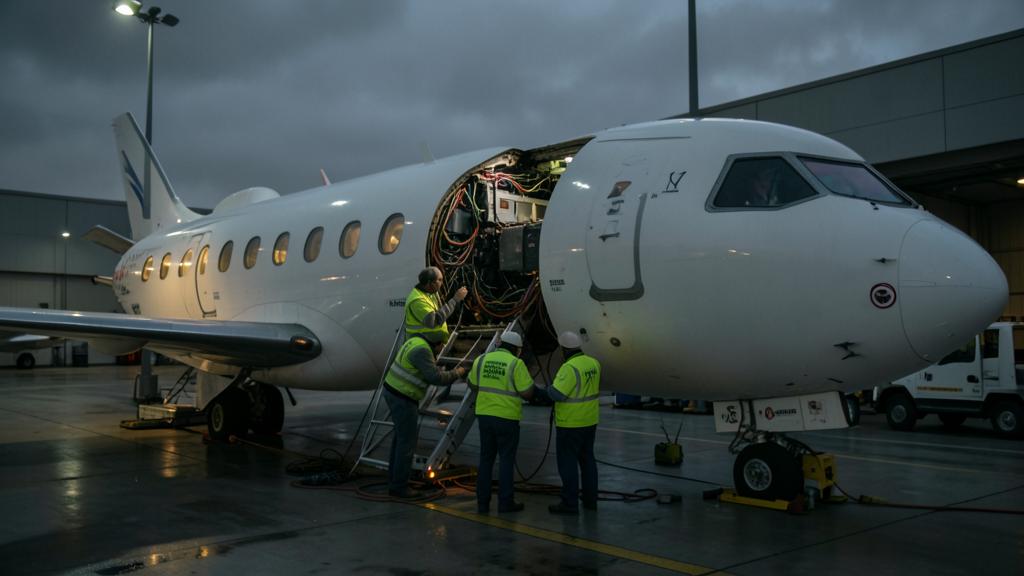
A lease ends twice. Once on the date printed in the agreement, and once — weeks or months later — when the lessor signs the acceptance certificate. Everything that happens between those two dates is paid for by the operator, at the daily rate, on top of the work itself. The clauses that generate that gap are known from the first day of the lease, they are readable years in advance, and they are almost always addressed too late to be cheap.
The final bill is written at signature, not at redelivery
A dry operating lease is a document about two moments: the technical condition in which the aircraft is delivered, and the technical condition in which it must come back. The rent covers the interval. Between those two descriptions sits a set of return conditions that operate as an obligation to restore a defined state, and restoring a state is not the same exercise as keeping an aircraft airworthy. An aircraft can be perfectly serviceable, fully compliant with its approved maintenance programme and legal to fly a revenue sector on the morning of redelivery, and still be a heavy check and an engine shop visit away from meeting its return conditions.
That gap is the whole subject. It exists because the two documents answer different questions. The maintenance programme answers « may this aircraft fly ». The lease answers « is this asset worth what the next lessee will pay for it ». A lessor selling remarketing time wants an aircraft that can be delivered onward with minimal investment, and every return condition is a transfer of that investment back onto the outgoing operator.
The lease cares about the aircraft’s value, not just its airworthiness. If the plane meets safety rules but doesn’t match the lease’s return conditions, the operator still has to pay to fix it.
An A320 with 1,000 flight hours left on its heavy check (required every 6,000 hours) is legally airworthy. But if the lease demands 2,000 hours remaining, the operator must either perform the check early (losing revenue) or pay compensation.
Reserves or end-of-lease compensation: two ways to pay, one to overpay
Most leases handle maintenance cost through one of two structures, and the choice changes the redelivery negotiation completely.
Maintenance reserves — supplemental rent — are paid monthly into notional accounts by event type: airframe checks, engine performance restoration, engine life-limited parts, landing gear, APU, sometimes thrust reversers and wheels. When the operator performs a qualifying event, it submits the invoices and draws the corresponding account down. The traps are all in the definition of « qualifying »: the scope of work that counts, the minimum interval since the last claim, the requirement to use an approved shop, the exclusion of work performed for reasons other than the scheduled task, and the treatment of a partial or « hospital » shop visit that restores serviceability without restoring the interval. Amounts left in the accounts at the end of the lease are frequently not returned.
End-of-lease compensation replaces monthly payments with a settlement computed at redelivery on the difference between the delivery condition and the return condition, component by component. It preserves cash during the lease and concentrates the entire exposure into a single negotiation at the worst possible moment — when the operator has already decided to give the aircraft back and has no leverage left.
| Point | Maintenance reserves | End-of-lease compensation |
|---|---|---|
| Cash profile | Monthly, predictable, non-recoverable if unused | Zero during the lease, single settlement at exit |
| Main risk | Claims rejected on scope or shop approval | Valuation dispute with no remaining leverage |
| Effect of early exit | Balances often forfeited | Full shortfall crystallises immediately |
| Records dependence | High — every claim is a documentary file | Total — the condition must be proven, not asserted |
| Where to act | File claims continuously, never in a batch at the end | Build the condition model from year one |
The clause families that actually move the number
Return conditions vary by lessor and by asset, but they cluster into a small number of families, and the money is very unevenly distributed among them.
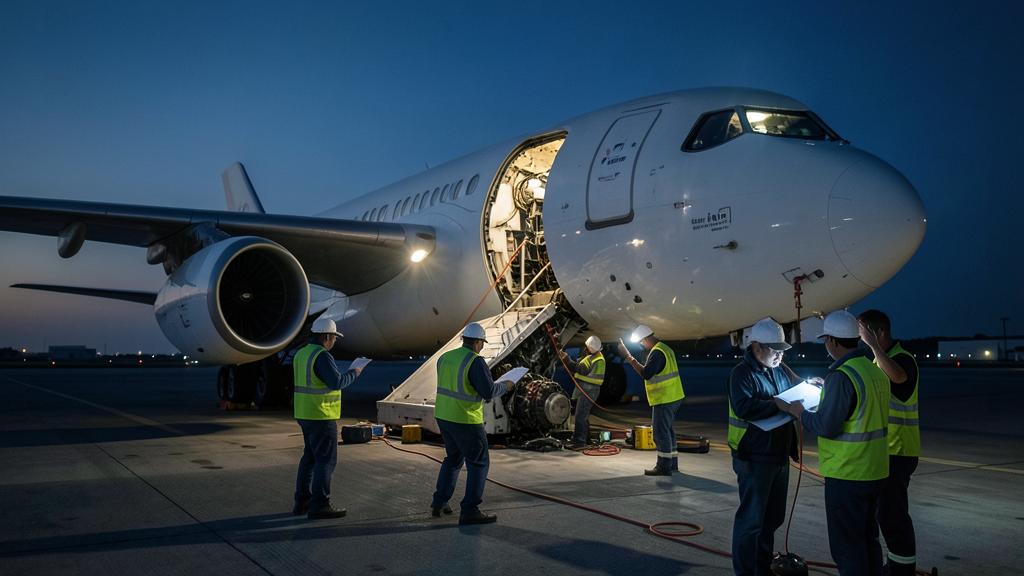
- Engines. On most redeliveries this is the largest single item, and on wide-bodies it dominates the rest. Conditions are typically expressed as a minimum remaining interval to the next shop visit, a minimum remaining life on the life-limited parts, and a minimum exhaust gas temperature margin, with a cash adjustment when the aircraft is handed back below those thresholds. Life-limited parts are the cruel part: they are consumed by cycles, they cannot be restored, and a set whose remaining life falls just short of the threshold forces either a shop visit whose only purpose is to change parts, or a compensation payment computed under the formula in the lease, which commonly starts from the manufacturer’s list prices.
- Airframe checks. A typical clause requires a fresh heavy check, or a defined minimum interval remaining before the next one, at redelivery. The economic damage here is not the check itself but its timing: a heavy check performed to satisfy a return condition delivers its entire interval to the next operator. The same check performed early enough to be flown against generates revenue over most of its life.
- Landing gear, APU and time-controlled components. Usually a minimum remaining calendar or cyclic life on each. Individually small; collectively, a long tail of components each requiring either an overhaul, a swap, or a line in the settlement.
- Damage, repairs and modifications. Repairs must generally be permanent and within the published structural repair manual limits; anything approved as a repair design outside the manual requires the approval data to be handed over, and a lessor may simply refuse to accept it. Temporary repairs must be made permanent. Installed modifications are the mirror image: operator-specific equipment often has to be removed and the aircraft restored to its original configuration, unless the lessor agrees to keep the modification, in which case the underlying approval data has to travel with the aircraft.
- Cabin and paint. The clause reads « fair wear and tear », which is not a specification, and that is precisely why it costs money. Seat covers, carpets, sidewall panels, galley inserts, placards, lavatory fittings and paint condition are all inspected against a subjective standard by someone whose employer benefits from a strict reading. Livery removal is a separate item, and the lease normally puts it on the outgoing operator.
The trap. « Fair wear and tear » and « in as good condition as at delivery, ordinary wear excepted » are not the same clause and do not cost the same. The second one only means anything if the delivery condition was properly recorded — with photographs, a signed condition report and a snag list — on the day the aircraft arrived. Operators who skipped that step at delivery lose every argument at redelivery by default.
Records are the item that stops the aircraft leaving
Technical work can be planned, quoted and scheduled. Missing records cannot, because reconstructing a document that was never created is often impossible at any price. Records failures are among the things that most reliably push a redelivery weeks past its date, and the extension rent they generate can exceed the cost of the maintenance itself.
What is being verified is a chain: continuous traceability of the airframe’s maintenance history, complete back-to-birth documentation for every life-limited part with its accumulated cycles, release documentation of the accepted form for every installed component, evidence of compliance with every applicable airworthiness directive with the method of compliance stated, the modification status, the current status of repairs with their approval data, and a clean statement that the aircraft has not been involved in an accident or incident requiring major repair.
Three recurring problems account for most of the pain. Components installed with release paperwork valid in one regulatory system but not accepted by the receiving authority — the dual-release question, which is decided long before redelivery, at the moment the part is bought. Life-limited parts whose history has a gap, typically inherited from a previous operator and never challenged at delivery. And an aircraft going to a new state of registry whose authority applies a different standard of evidence to the same file, so that records accepted for years by one regulator are rejected by the next.
| Clause family | Cost driver | Last useful moment to act |
|---|---|---|
| Engines | Remaining interval, life-limited part life, temperature margin | At the last shop visit decision, years out |
| Airframe check | Interval handed to the next operator for nothing | When the check slot is booked |
| Time-controlled components | Long tail of overhauls and swaps | 12 months out, at the component forecast |
| Repairs and modifications | Approval data, removals, restoration to original build | When each repair or modification is embodied |
| Cabin and paint | Subjective standard, no delivery baseline | On the delivery day of the lease itself |
| Records | Gaps that cannot be reconstructed, release form mismatch | When the part is purchased and installed |
| Extension rent | Rent runs until the acceptance certificate is signed | Once the aircraft is in the redelivery check |
Why the last twelve months are the expensive ones
There is a structural conflict at the end of a lease and everyone involved knows it. The operator’s rational behaviour is to consume the asset: fly the remaining green time, defer everything deferrable, avoid buying an interval it will never use. The lease’s requirement is the opposite: hand back an asset with intervals in front of it. The two positions meet in the final months, when every remaining option is expensive.
The specific mechanism worth naming is the shop visit decision. An engine removed for an unscheduled reason two years before redelivery raises a choice: a minimum-scope repair that returns it to service without restoring the interval, or a full workscope that costs more now and satisfies the return condition later. The minimum-scope option is almost always chosen, because the redelivery is somebody else’s problem in two years. It is the same organisation’s problem, and the invoice arrives with extension rent attached.
The same logic applies to the airframe check, to landing gear overhaul intervals, and to any component whose life can be juggled between aircraft in the fleet. An operator running several airframes of the same type has a genuine lever here: components and even engines can be rotated so that the aircraft leaving the fleet carries the compliant hardware and the aircraft staying carries the green time. That arbitrage only works if it is planned far enough ahead for the paperwork to follow — a swap performed in the redelivery check, with release documents chased afterwards, creates a records problem on top of the technical one.
The right reflex. Build a return-condition model at the start of the lease and re-run it at every maintenance decision, not at the end. The question at each shop visit, each check and each component change is not only « what does this cost now » but « what does this do to the redelivery position ». Most of the avoidable expense is created by decisions taken two to four years before the aircraft leaves.
A countdown that starts long before the date
The redelivery itself is a project with a critical path, and the critical path is documentary. Physical work can be surged with extra manpower and extra hangar slots; a missing back-to-birth trace cannot.
| Horizon | Action |
|---|---|
| 24 months | Re-read the return conditions against the current technical status; model engine, gear and component positions at the return date |
| 18 months | Internal records audit, life-limited part traceability first; identify gaps while sellers and previous operators are still reachable |
| 12 months | Fix the maintenance plan for the remaining period; decide the check and shop visit strategy; book the slot and the hangar |
| 9 months | Close outstanding reserve claims; agree the inspection protocol, acceptance criteria and dispute mechanism with the lessor in writing |
| 6 months | Mock redelivery inspection with the lessor’s technical representative; convert findings into a costed work package |
| 3 months | Complete records rectification; start deregistration, export certificate and, where applicable, the deregistration authorisation formalities |
| Redelivery | Ground inspection, demonstration flight, snag closure, acceptance certificate — rent stops at signature, not at the calendar date |
What is actually negotiable, and when
Two moments carry nearly all the negotiating power, and neither of them is the redelivery week.
The first is lease signature. Return conditions are drafted, and the items worth arguing for are the ones that convert absolutes into money: a cash adjustment mechanism instead of a mandatory shop visit, a defined and objective cabin standard instead of « fair wear and tear », a stated formula for the engine settlement, an obligation on the lessor to inspect within a fixed number of days, and a cap on extension rent once the aircraft has been presented. Delivery condition documentation belongs to the same moment.
The second is the extension conversation, typically eighteen to twenty-four months out. A lessor deciding whether to extend, remarket or part out is holding the aircraft’s future, and an operator willing to extend has a real trade: extension terms against relaxed return conditions, or a purchase of the remaining position at an agreed value. Once the operator has stated that the aircraft is definitely going back, that leverage is gone and the negotiation becomes purely defensive. Fleet-exit experience and shop workscope decisions are discussed in detail on forums.fl330.com, where the same clause families come up under different lessor names.


Leave a Reply
You must be logged in to post a comment.