
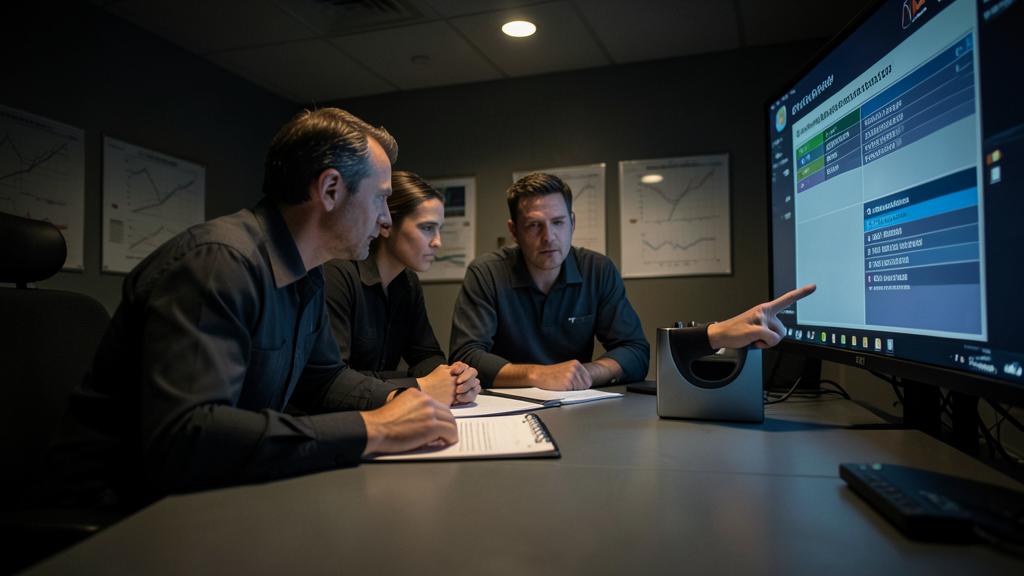
Two crews fly the same simulator detail, in the same device, with the same instructor and the same scenario. One comes out with something that will still be there in six months on a wet night; the other comes out having successfully completed a series of exercises they will never think about again. The difference is decided before anybody sits down, in a room with a table and no motion system. Here is what a briefing has to fix, and why a session that is not framed teaches almost nothing transferable.
A briefing is not a reading of the schedule
The commonest failure in type-rating and recurrent training is a briefing that consists of announcing the running order: engine failure after V1, then a hydraulic problem, then an approach with a system degraded, then a rejected landing. That is a table of contents. It tells the crew what will happen and nothing about what is being trained, so the crew rationally optimises for what they have been told — surviving the list.
A briefing does three things and only three. It states what will be trained; it states the standard against which performance will be judged; and it states the conditions under which the training will happen. Everything else — the device, the aircraft state, the weather, the failure catalogue — is detail in service of those three. A crew that leaves the briefing room unable to say what the session is for will fly the session for the instructor rather than for themselves.
Objectives are written in behaviour, not in events
The shift that competency-based training brought to the industry was not a new set of manoeuvres; it was a new way of naming the target. The competency framework published by ICAO, and carried into EASA training rules, describes observable behaviour rather than events: the application of knowledge and of procedures, communication, flight path management by hand and through automation, leadership and teamwork, problem solving and decision making, situation awareness and the management of information, workload management. The wording of that list has been revised more than once, and the version that counts in a briefing room is the one written into your own operator’s training manual.
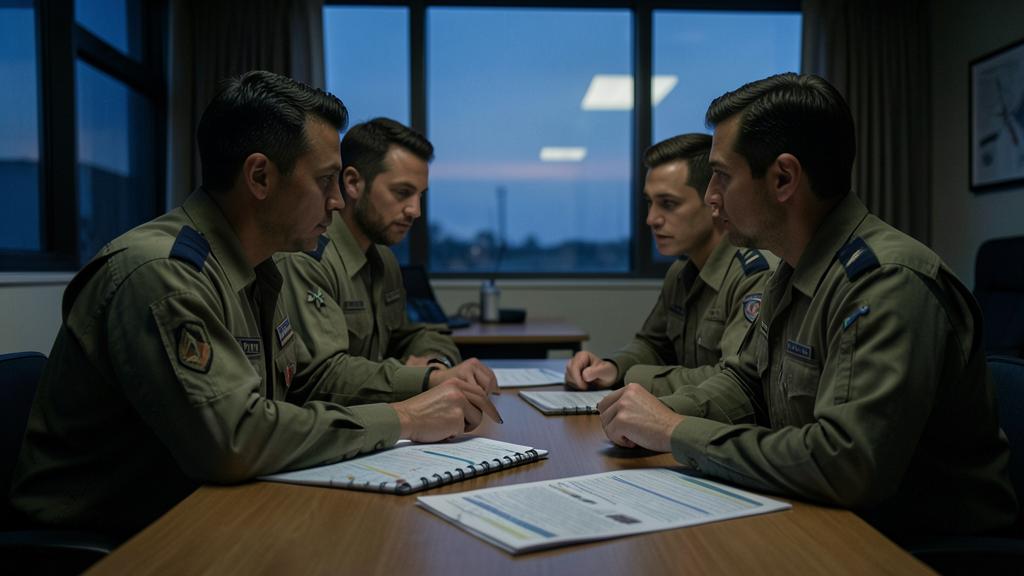
Written that way, an objective stops being « do a single-engine ILS » and becomes something like « manage the flight path and the workload of an asymmetric approach while the pilot monitoring completes a procedure that competes for the same attention ». The manoeuvre is still flown. But the crew now knows what is being observed, which is exactly the information they need to make the session about learning rather than about performance.
The goal isn’t just to perform a task, but to practice specific skills like teamwork, decision-making, and managing workload. A good briefing tells you what behaviors to focus on, not just what steps to follow.
On an A320 simulator, the briefing might state: “We’re practicing workload management during an engine failure at V1. The non-flying pilot must complete the checklist while the flying pilot maintains the flight path. We’ll evaluate how you divide tasks and communicate under pressure.” This frames the exercise around skills, not just completing the manoeuvre.
| Event framing | Behaviour framing | |
|---|---|---|
| What the crew hears | « We will do an engine failure after V1, then a return » | « We are working on task-sharing and decision quality when the flight path demands attention » |
| What the crew optimises | Getting through the event without a mistake | How they divide the work and how they decide |
| What the instructor can observe | Whether the manoeuvre was flown within tolerance | Behaviour, in this and in every later exercise |
| What the debrief can say | « That was within limits » or « That was not » | « Here is what produced the result, and here is where it will show up again » |
| What transfers to the line | The specific event, on the specific day | A way of working that applies to events never trained |
The condition is half the objective
An objective without conditions is untestable. « Manage a diversion decision » means nothing until you add whether the crew has time or not, whether the information is complete or contradictory, whether the cabin is calling, whether the destination weather is deteriorating or already below minima. Those conditions are the training. Remove them and you have a procedural walkthrough.
This is where instructors most often under-specify. The scenario is designed in detail, the conditions are left implicit, and two instructors running the same syllabus item deliver two different sessions. Writing conditions down — what information is available, what pressure exists, what will and will not be offered by the simulated environment — is also what makes a training programme repeatable across a fleet.
The trap. Announcing the failure destroys the only condition that cannot be recreated later: not knowing. Startle and surprise are legitimate training content and are trained deliberately, in the right phase, with the crew briefed that unannounced events are part of the session — not by ambushing a crew who were told the running order and then handed something else. Both extremes waste the device: the fully announced list trains nothing, and the ambush without a framing produces a defensive crew who learn to distrust the instructor.
Training and checking are not the same conversation
A licence or operator proficiency check is an assessment against a defined standard, and the crew should be told exactly that before it starts: what is being checked, to what tolerance, what happens if an item is not met, and what repetition is permitted. A training phase is the opposite — it is where an exercise may be stopped, repositioned, discussed and flown again, because the objective is learning, not proof.
Sessions that mix both without saying so are the ones crews describe as unfair. If the crew cannot tell whether they are being taught or measured at any given moment, they will assume they are being measured, and they will stop experimenting. Experimentation is where the value of a full flight simulator lies: it is the only place where a crew may deliberately try an approach that might not work.
| Phase | Purpose | What the briefing must state |
|---|
The workload contract nobody writes down
Part of the briefing is unglamorous and skipped precisely because it is obvious. Who is pilot flying for which sector. Who handles the radio when the workload rises. How the instructor will indicate a freeze, and what the crew should do during one. How a reposition works and what state the aircraft will be in when it resumes. What phrase transfers control between the two pilots, and what happens if the instructor takes it.
These conventions cost two minutes to state and prevent the single most common source of wasted simulator time: an exercise abandoned because nobody was sure whether it had started. They also matter for a crew who have never flown together, which in recurrent training is common.
The device is not the aeroplane, and the briefing should say so
Synthetic training devices are qualified at defined levels — full flight simulators, flight training devices and the lower-level procedural trainers — and each level carries only the training and checking credit its qualification allows, which the authority defines and not the device manufacturer. Every one of them reproduces some cues faithfully and others not at all. Motion cueing is a washout approximation, not sustained acceleration; the visual system has its own limits in low visibility and at night; and some aerodynamic regimes are modelled well inside the validated envelope and much less well outside it.
This has a training consequence, not just an engineering one. Where a device does not reproduce a cue, the crew can learn a response calibrated to the device rather than to the aircraft — negative transfer, and it is invisible unless it is named. The remedy is cheap: state in the briefing which cues are being used as training content and which are known device artefacts to be ignored. A crew told that a particular sensation is a limitation of the platform will not build a habit around it.
The right reflex. Before each session, name one cue the device does well and one it does not, relevant to the day’s objectives. It takes thirty seconds, it prevents negative transfer, and it teaches crews to interrogate their own training rather than accept it whole.
The debrief is written during the briefing
A debrief can only measure against something. If the objective was stated in observable behaviour, the debrief has a subject; if it was not, the debrief collapses into an inventory of moments the instructor happened to remember, which is why so many end as a list of small technical corrections with no theme.
The structure that works is unremarkable and hard to do well. The crew speaks first, on the objectives that were named, not on whatever they feel guilty about. The instructor then adds what the crew could not see — data replay, instrument traces, the timing of a call — and the conversation moves from what happened to what produced it. A cause identified as « we were behind the aeroplane » is a symptom; a cause identified as « the checklist was started before the flight path was stable, and neither of us said so » is something a crew can act on next Tuesday.
Time is the constraint. A debrief that tries to cover everything covers nothing, and crews leave with a diffuse sense of having done adequately. Two or three points, tied to the objectives announced at the start, tied to a specific moment that both pilots remember, outlast a comprehensive list every time.
How a badly framed session fails without looking like a failure
The uncomfortable characteristic of a poor simulator session is that it produces no visible defect. The exercises are completed. The tolerances are met. The paperwork closes. The crew is legal and the training record is clean. Nothing signals that the four hours produced no durable change.
The signals exist, but they are indirect: crews who cannot state what the session was about an hour afterwards; recurrent programmes where the same weakness reappears cycle after cycle in different clothing; instructors whose debriefs sound identical regardless of the crew in front of them. Any training department that measures only completion rates will see none of these.
The fix is not a new syllabus. It is the discipline of writing, for each session, three objectives in observable behaviour, the conditions attached to them, and the standard expected — and then debriefing those three and nothing else. It costs a training department nothing but that discipline, and it is the single change that turns a debrief into a conversation about causes rather than an inventory of events. Instructor development programmes covering objective writing and facilitation technique are among the topics discussed on the FL330 training platform.
What to carry into the next briefing
Ask what will be trained, in behaviour. Ask under what conditions, explicitly. Ask against what standard, and whether this is training or checking. Fix the workload conventions in two minutes. Name one device limitation. Then fly the session and debrief exactly what was announced.
None of this requires a better simulator, a longer detail or a new regulation. It requires the room before the room — and the willingness of an instructor to spend twenty minutes on something that produces no visible output, in order to make the four expensive hours that follow do what they were bought to do.


Leave a Reply
You must be logged in to post a comment.