
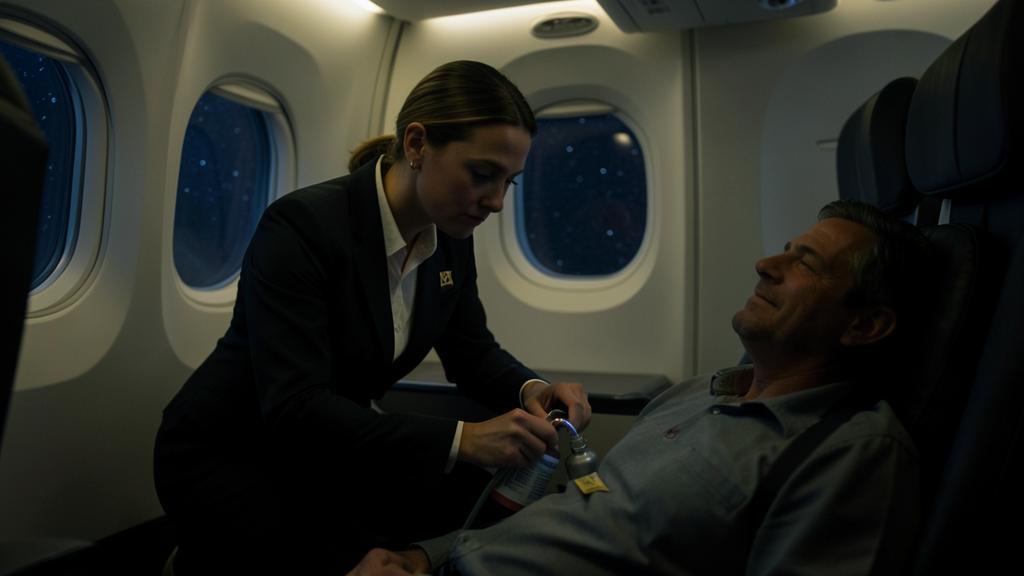
Two oxygen reserves are located in the same cabin and are still commonly referred to as if they were one. One exists to keep everyone conscious during the few minutes needed to bring the aircraft down to a breathable level; the other exists to supply a sick person for the time needed to get them to the ground. They differ in purpose, flow, control and duration, and the difference is not academic: the reserve sized for a decompression runs for a fixed period and then simply stops, whereas the set of therapeutic bottles carried on board could never cover an entire cabin. Confusing them costs endurance at the exact moment when endurance decides a diversion.
Three provisions, not two
A pressurized transport aircraft carries oxygen in at least three separate devices, and the reason they are separate is that no single design satisfies the three missions.
| Oxygen for the flight crew | Emergency oxygen for passengers | First aid oxygen | |
|---|---|---|---|
| Purpose | Keep the crew operational in case of decompression, descent, and the subsequent flight; also in case of smoke and fumes | Keep the occupants conscious during the descent to a breathable level | Treat a person who needs oxygen for a physiological reason, on the ground or in flight |
| Source | High-pressure cylinder, fixed system | Chemical generators in the overhead passenger service units in most types; gaseous in some | Portable cylinders with a regulator, stored in the cabin |
| Flow regulation | Demand regulator, selectable dilution, 100% and emergency pressure settings | None. Continuous flow at a fixed rate by design | Calibrated outlets, normally a high and a low setting, selected by the user |
| Duration | Long, and calculable from the cylinder pressure | Fixed at manufacture; nothing extends it | Content divided by the selected flow |
| Can it be stopped? | Yes | Not by the occupant; in a chemical installation, not at all once started | Yes, by the valve |
| Who uses it? | Flight crew | The occupant, by pulling the mask | Cabin crew, according to the operator’s procedure, with medical advice from the ground if such a service exists |
Reread the line « flow regulation » twice. It contains the entire argument. A supply that cannot be reduced, stopped, or measured is a supply that can only be used for one thing: a short, universal, worst-case event that affects everyone at the same time. A supply that can be measured is the only one that can be used for care.
What the emergency reserve is actually sized for
The passenger emergency system answers a question: Can everyone on board remain conscious while the aircraft descends from the cruise level to a level where the atmosphere is breathable? The answer must be yes for the worst credible decompression, from the highest certified level, with the fastest tolerable descent profile. Once the aircraft levels off at a safe altitude, the requirement is satisfied, and the system has fulfilled its function.
Everything in the design derives from this. The implementation in most types is automatic above a cabin altitude threshold, with manual control available on the flight deck. The mask must be pulled to start the generator, because the lanyard triggers it. The flow is continuous and unregulated, so the reservoir bag does not need to inflate for the mask to work — a point that cabin crew spend a surprising amount of time explaining during a decompression. In a chemical installation, the unit heats up and may give off a burning smell, which is normal and which the crew must be ready to explain before someone reports a fire.
Two consequences matter operationally. First, the duration is fixed by the installed capacity and is stated in the operator’s documentation for the type; it is a short, fixed period, and nothing anyone does extends it. Second, one generator usually serves all the masks of a single overhead unit, so moving to an adjacent seat and pulling another mask does not buy a fresh supply from an intact reserve — it starts a second clock that will also run out, and it consumes a supply intended for another seat.
The trap. The emergency system cannot be used as therapeutic oxygen. It cannot be slowed, stopped, restarted, its duration is fixed, and in a chemical installation, it is single-use. A passenger who is still sick once the aircraft levels off at a safe altitude must be transferred to the first aid reserve. Leaving them on an exhausted overhead mask, or attempting to move them from one deployed unit to the next, wastes the remaining emergency reserve of the aircraft without curing anyone.
The emergency oxygen is for everyone in case of sudden cabin pressure loss. It works for a set time and can’t be adjusted. First aid oxygen is for one sick passenger and can be controlled to last as long as needed. Mixing them up can leave people without the right help when they need it most.
On an Airbus A320 at FL350, a rapid decompression triggers the chemical oxygen generators. Each unit provides 15 minutes of oxygen per mask. If a passenger moves to another seat and pulls a second mask, that seat’s 15-minute supply starts too, wasting oxygen meant for others. Meanwhile, a passenger with a medical issue needs the portable first aid bottle, which can be set to low flow for 60 minutes or high flow for 30 minutes, depending on their condition.
What first aid oxygen is actually sized for
The first aid reserve exists for the person for whom levelling off at a safe altitude is not enough. Its regulatory justification is post-decompression: a proportion of occupants may need supplemental oxygen for a physiological reason for the rest of the flight, and the aircraft must carry enough for them. In daily operations, the same bottles serve the far more frequent case — a medical event in a cabin that never lost pressure.
The sizing basis is an amount for a declared proportion of passengers, for a declared portion of the flight time, at a declared flow. The numbers themselves come from the applicable operating standards and the operator’s approved documentation, and they are not the same on both sides of the Atlantic: the European and U.S. frameworks achieve comparable protection through different calculations, so a number learned in one fleet does not transfer to another. What does transfer is the structure of the requirement — an amount, a duration, and a flow, all three declared.
Duration = content divided by flow
The most useful thing a cabin crew member can know about portable oxygen is not a memorized number, but an equation. The bottle contains a known volume of gas at its nominal pressure. The regulator delivers at a calibrated flow. The duration is the usable content divided by this flow, and the needle of the pressure gauge indicates what fraction of the content remains.
| Appearance | High flow | Low flow |
|---|---|---|
| Typical marking | HI, or the higher of the two numbers engraved on the outlet | LO, or the lower |
| Effect on endurance | The shortest. Reduces the available time to approximately half compared to the low setting on a two-setting regulator | The longest, for the same bottle |
| Indicated for | Acute distress, suspected hypoxia, cases in which saturation must be raised quickly | Prolonged support of a stable patient on a long flight or a diversion |
| Risk of the wrong choice | Emptying the bottle before landing when the patient is stable | Undersupplying a patient who needs a high concentration now |
| What decides it? | The operator’s procedure and the patient’s condition, not the crew’s impression | The same procedure, plus the ground-based medical advisory service whenever available |
Two practical points follow. The bottle’s endurance is a hard fact for the diversion decision, and must be communicated to the cockpit in terms of time, not pressure: « We have approximately forty minutes of oxygen remaining at the current setting » is actionable, « The gauge indicates two-thirds » is not. And the total endurance available is the sum of the bottles serviceable on board, so their number and location are part of the pre-flight verification, not a detail.
The right reflex. As soon as a portable bottle is opened, note the time and the flow setting. From these two facts and the bottle’s nominal content, any crew member can indicate the remaining endurance at any time without guessing from a gauge needle. Report this figure to the cockpit in the form of the time at which the supply will be exhausted — it is the form in which the commander needs it to weigh a diversion against continuation.
Recurring errors
The errors that appear in reports and in recurrent training fall into a short list, and none is exotic.
- Treatment in the emergency system. Covered earlier, and the most serious. This consumes a shared provision and delivers care that cannot be adjusted.
- High flow by default. Selecting the high setting for every case, because it seems to do more, and discovering ninety minutes before a suitable airport that the bottle is empty. In a two-setting regulator, the choice doubles or halves the available endurance.
- Leaving the valve open between uses. A bottle left flowing when the mask is not on the patient’s face empties at its set flow, silently. The valve is closed every time oxygen is not being delivered.
- Not accounting for what remains. After a long medical event, the remaining first aid provision on board may not match what was dispatched on the flight. It is information for the commander and for the next sector, not a detail that must be discovered by the next crew.
- Oxygen near a fire. Oxygen does not burn, but it makes everything else burn much more easily. A portable bottle is kept away from any fire or smouldering object, and is never used with grease or oil on the fittings.
Two things that are not therapeutic oxygen
Protective breathing equipment is a closed-circuit or oxygen-generating hood for the crew, designed to let a crew member work in smoke and fumes for a short, fixed period. It protects the eyes and airways of the person fighting a fire. It is not a means of giving oxygen to a passenger, its duration is short, and using it for a medical case removes a firefighting capability from the aircraft.
A passenger’s portable oxygen concentrator is different. It does not store oxygen: it concentrates the oxygen that is in the cabin air, and its endurance is a matter of battery rather than pressure. Operators require an approved model and a battery capacity that exceeds the planned flight time by a declared margin, precisely because a depleted battery turns an autonomous passenger into a demand on the aircraft’s first aid reserve. When a concentrator fails in flight, the previous arithmetic becomes the crew’s problem, and it is useful to know which passengers carry one before it happens.
The pre-flight verification that really counts
The verification of the safety equipment in portable oxygen is short, and each element exists because of a specific failure.
| Element | Failure it detects |
|---|---|
| Pressure within the range indicated in the operator’s procedure | A bottle that will not deliver its nominal endurance, or a bottle already partially used and not replaced |
| Bottle present, in its correct stowage, properly secured | An unsecured cylinder in turbulence, and a bottle that nobody can find under time pressure |
| Mask and tubing present and sealed | A serviceable bottle with no means of delivering it |
| Regulator outlets identifiable, flow numbers legible | An endurance calculation made on an incorrect hypothesis |
| Number and location of all bottles known to all crew | Underestimating the total endurance during a medical event or a diversion |
The pressure gauge reading varies with temperature, so a bottle cooled by the cold indicates a lower pressure than the same bottle after an hour in a warm cabin. This is why the acceptance criterion belongs to the operator’s documentation and the minimum equipment list rather than to a rule of thumb, and why a marginal reading is escalated rather than debated at the door.
Why the separation exists
It would be simpler to carry a single large reserve and draw from it for everything. The reason no one does is that the two missions have incompatible failure modes. The decompression case is universal, instantaneous, and short; it needs a supply that activates itself, asks nothing of an occupant beyond pulling a mask, and cannot be defeated by someone manipulating a valve. The therapeutic case is for a single patient, unpredictable, and long; it needs a supply that can be measured, stopped, moved to where the patient is, and made to last the length of a diversion.
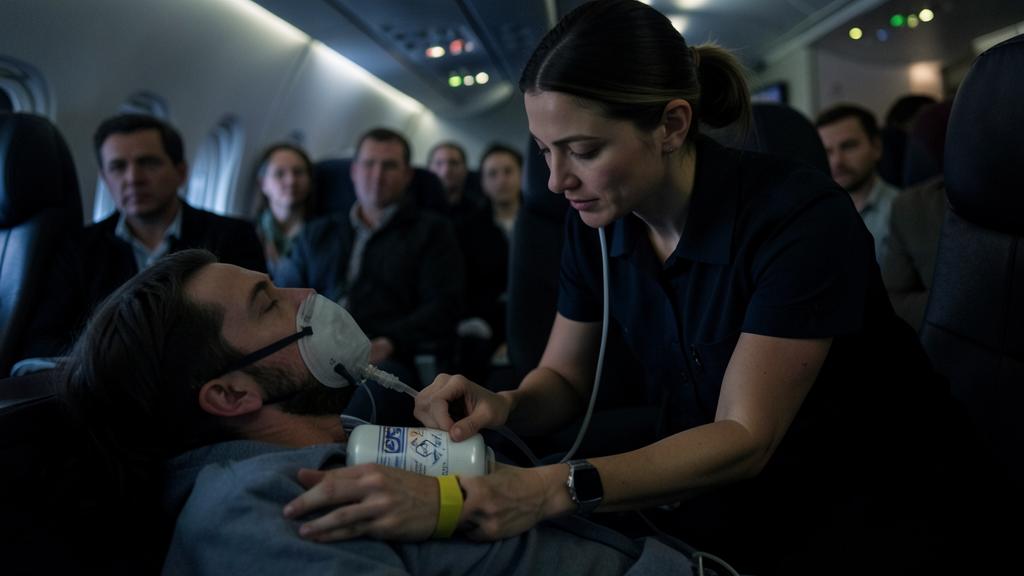
A shared reserve would mean that a medical event in cruise could consume the supply needed for a decompression an hour later, and that a decompression would leave nothing for the sick passenger. Keeping the reserves separate is what ensures that neither event can consume the other’s margin — which is exactly why using one for the other’s job silently removes a protection the design was built to provide. The distinction is worth repeating in recurrent cabin safety training in these terms, rather than as two lists of equipment to memorize.


Leave a Reply
You must be logged in to post a comment.