
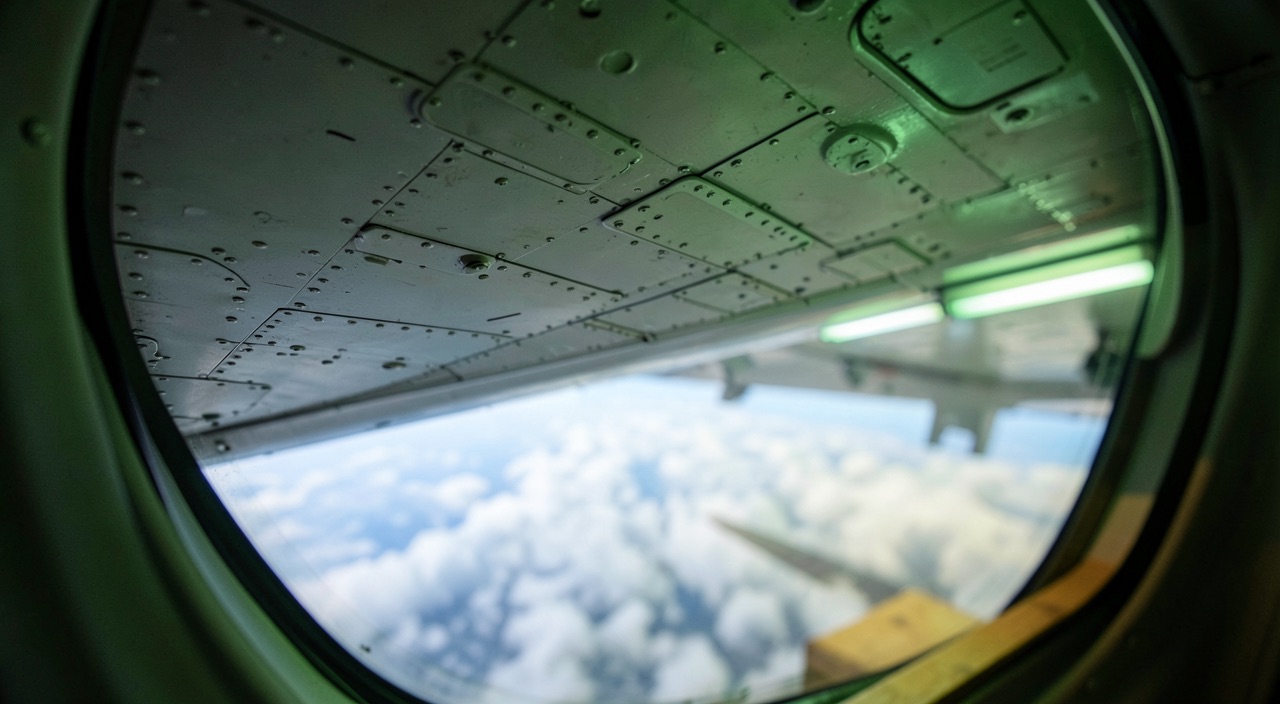
Four hours of cruise behind you, the flight management computer shows an optimum altitude two thousand feet above the level being flown, and ATC has just announced that the level is free. The step is therefore available: is it worth taking? The answer is not to be read on the screen displaying the optimum, because it is settled between three quantities that this display never puts side by side — the specific range gain at the new level, the change in wind between the two levels, and the cruise time remaining to amortise the transition.
Why the optimum climbs as the mass comes down
In level flight, lift equals weight: W = CL · q · S. And dynamic pressure, in air, is written q = 0.7 · p · M² — the speed of sound is already contained in the Mach number, so that temperature has disappeared from the equation. Fix the cruise Mach, fix the lift coefficient that maximises the product of Mach and lift-to-drag ratio: only one unknown remains, static pressure. It is proportional to mass.
The whole mechanism lies there, and it has three consequences that the flight deck lives with without always naming them. First, the optimum altitude is a pressure altitude: it does not depend on outside air temperature. A day fifteen degrees above standard does not move the aerodynamic optimum — it moves the thrust ceiling, which is not the same thing. Second, the optimum does not depend on the wind either: the wind changes the distance covered over the ground per kilogram, not the operating point of the wing. Third, since pressure decreases by around four to five per cent per thousand feet in the vicinity of the tropopause, burning four to five per cent of the mass raises the optimum by about one thousand feet.
This last order of magnitude sets the step size of the whole mechanism. On a long-haul flight, the mass loses a large fraction of its value between the beginning and the end of the cruise: the optimum climbs by several thousand feet, continuously. Continuous climb, however, does not exist in real airspace. The levels usable in a given direction of flight are spaced two thousand feet apart where the reduced vertical separation minimum applies, and twice that in volumes not approved for it. Each step therefore requires having burnt something like a tenth of the mass — that is, on most sectors, something like one to three hours of flight.
The plane’s best altitude for fuel efficiency rises as it burns fuel. This is because the wing works best at a certain pressure, which changes as the plane gets lighter. But real airspace only allows climbing in big jumps, not smoothly. So you climb in steps, not continuously.
A Boeing 777 flying from Paris to Tokyo at 30,000 feet may see its optimum altitude rise to 34,000 feet after burning 10% of its fuel. If ATC allows it, climbing to 34,000 feet could save fuel—but only if the wind and remaining flight time make it worthwhile.
The peak is flat, and that is what makes the step optional
Plot specific range — the miles covered per kilogram of fuel — against altitude, at a given mass and Mach number. The result is a bell curve, but a very flat one: near the peak the derivative is zero by construction, and it stays close to zero over a wide band. Two thousand feet away from the optimum typically costs a fraction of a per cent; you have to move several thousand feet away before the penalty becomes plainly measurable on the operational flight plan.
This flatness is what allows discretisation into steps without squandering fuel — which is why nobody has ever fought to obtain continuous cruise climb. It is also what makes the decision non-trivial, since it puts the expected gain in the same order of magnitude as the error on the assumed mass, the difference between forecast wind and actual wind, or the precision with which Mach is held.
The bell is roughly symmetrical; operationally, it is not symmetrical at all. Below the optimum, thrust reserve, buffet margin and comfort are preserved. Above it, those three reserves are consumed together, and the gap between cruise Mach and minimum-drag Mach narrows: a loss of speed no longer recovers by itself, and recovering it takes thrust that is no longer available, or altitude that has just been paid for. For an equal gain, it is therefore preferable to be slightly below the optimum than slightly above it.
What the step really costs
The temptation is to count the fuel used in the climb. That is wrong, and by a factor that is not small: the potential energy acquired is not lost, it is stored. For a widebody, two thousand feet of altitude represent, including the efficiency of the propulsion chain, something like a hundred kilograms of fuel — but those hundred kilograms will be given back to you, in the form of a more distant top of descent.
The real cost lies elsewhere: it is the excess drag during the transition. For a few minutes the aircraft flies at climb thrust, at an angle of attack and often at a Mach number that are not those of best efficiency, and it covers less ground per kilogram burnt than it would have done in level flight. It is that excess which has to be amortised, and it is only amortised over the distance that remains.
The calculation is short. The break-even threshold is the ratio of the extra cost of the transition to the fuel saving per unit of distance at the new level. The numerator is roughly constant for a given type and a given step; the denominator depends entirely on where you start from. Far below the optimum, the gain is clear-cut and the threshold falls to a few tens of minutes of cruise. Already very close to the optimum, the gain is slight and the threshold recedes beyond the cruise time remaining: the step is then not worth taking, whatever the screen displays.
Hence a sorting rule, as an order of magnitude and to be checked against your own type: a step requested less than half an hour from top of descent practically never pays for itself, and a step requested when already within one thousand feet of the optimum is only worth the effort if the wind pays for it.
The wind decides more often than aerodynamics
What counts is not the distance covered through the air per kilogram, but the distance covered over the ground. And the order of magnitude of the wind dwarfs that of aerodynamics. At a cruise true airspeed of around four hundred and fifty to five hundred knots, ten extra knots of headwind remove something like two per cent of ground specific range — that is, several times the gain of a step taken close to the optimum. The consequence is clear: in the band where the difference from the optimum is modest, it is not aerodynamics that arbitrates, it is the vertical wind gradient.
That gradient is anything but trivial at cruise levels. In the vicinity of a jet stream, wind speed varies strongly with altitude, and the sign of that variation changes according to whether you are below the core or above it. One and the same higher level can therefore be a gift or a trap depending on which side of the core you are on and on the direction of the route: in one case you climb into a strengthened headwind and lose on both counts, in the other you gain far more than the wing would ever have given.
That leaves the question of what the computer knows. Many installations calculate the optimum altitude on a model that does not take into account, or takes only crudely into account, the wind at levels adjacent to the one being flown: the displayed optimum is then an aerodynamic optimum, not a trajectory optimum. The wind at adjacent levels, for its part, appears on the operational flight plan and can be requested en route. Comparing it before formulating the request costs two minutes, and it is the only element of the decision whose order of magnitude is genuinely decisive.
| Difference from optimum altitude | More favourable wind above | Wind unchanged | Less favourable wind above |
|---|---|---|---|
| More than two thousand feet below the optimum | Step clearly worth taking, request early | Worth taking as soon as the remaining cruise exceeds the break-even distance | To be calculated: the wind may cancel the aerodynamic gain |
| One to two thousand feet below the optimum | Worth taking, but it is the wind that pays | Slight gain, decide on the cruise time remaining | Stay at the level flown |
| Less than one thousand feet below the optimum | Conceivable for the wind alone, not for the wing | Not applicable, let the mass do the work | Stay at the level flown |
| Already above the optimum | Do not climb, consider the lower level | Do not climb | Do not climb |
The ceilings that close off the step
Two ceilings bound the step, and they do not obey the same variables. The first is aerodynamic: it is the altitude at which the manoeuvre margin before buffet onset falls to the minimum adopted by the operator — commonly a load factor margin of the order of 1.3 g, corresponding to a sustained bank angle in level flight of about forty degrees. This ceiling rises as the mass comes down, like the optimum, and for the same reason: it is again the lift coefficient that governs, hence again a pressure altitude.

The second is propulsive: it is the altitude at which no usable residual rate of climb remains at maximum climb thrust — typically a few hundred feet per minute, often of the order of three hundred. That one depends on temperature, and strongly: a warm layer at the upper levels reduces the thrust available without moving the aerodynamic optimum by a single foot. That is the asymmetry to keep in mind, because it produces a counter-intuitive situation: with a large positive deviation from standard, the optimum can lie above the ceiling actually attainable, and the display then invites you to climb where the aircraft will not hold.
| Altitude | What sets it | Sensitive to mass | Sensitive to temperature |
|---|---|---|---|
| Optimum | Lift coefficient of best efficiency at the selected Mach number | Yes, pressure varies with mass | No, it is a pressure altitude |
| Buffet ceiling | Load factor margin before buffet onset | Yes, by the same mechanism | No, for the same reason |
| Thrust ceiling | Residual rate of climb at maximum climb thrust | Yes | Yes, and it is the dominant parameter |
The trap. The step you cannot hold. The level is granted, the mass allows it on paper, but the layer is warmer than forecast: the aircraft arrives at the top with no residual rate of climb, the Mach number decays, and since you have moved above the optimum, drag increases instead of decreasing. Speed is then traded for altitude, and the lower level is requested again — after paying for the transition twice and spending the whole interval with a degraded buffet margin. The parameter that decides this outcome is not mass, it is the temperature at the target level.
The right reflex. Three thirty-second checks before requesting. The temperature observed at the level being flown, compared with the forecast, which gives the deviation to expect higher up. The wind forecast at the target level, compared with the wind observed at the level being flown. The cruise time remaining, compared with the order of magnitude of the amortisation threshold for the type. If the thrust margin at the target level does not leave a comfortable residual rate of climb at cruise Mach, the step is not ripe: wait until enough has been burnt to make it clear-cut. The optimum, for its part, keeps rising — it will not get away from you.
The step in real traffic
Physics gives the moment, air traffic gives the opportunity, and the two rarely coincide. In dense radar airspace, the request goes through voice or datalink, with a delay that is not zero, and the level may be refused for a reason that has nothing to do with your mass. On transoceanic organised track systems, the step is a matter of reclearance, with a procedure and a notice period specific to the region being crossed: the request is prepared before the point at which it becomes useful, not after.
There is also what the step does to the rest of the aircraft. A cruise climb is not free for the cabin: service is interrupted, and if the target layer is turbulent, you will have traded a fraction of a per cent of fuel for an hour of fastened seatbelts. Some operators settle the matter for the crew, by imposing a fixed step increment or a policy of cruising one level below the optimum. That second option is not a surrender: it is a choice of robustness, buying buffet margin and thrust at a cost that the flatness of the curve makes modest.
One last point, often overlooked: a step taken late changes the descent profile. You climb, then descend again almost immediately — which is neutral in energy terms but not in management terms. Top of descent moves back, the arrival constraint tightens, and you find yourself having to give back the stored energy at a moment when ATC does not want it. The right question is therefore not only “is the step worth taking?”, but “at what point in the flight does it become unmanageable?”.
What remains to be checked in your documentation
Three questions to put to the type documentation, because the answers vary from one manufacturer and one operator to another and they change the decision. For which cost index, and therefore for which Mach number, is the displayed optimum altitude calculated — and what becomes of it if the crew changes speed en route? Does the maximum recommended ceiling combine buffet margin, residual rate of climb, or both, and with what margin relative to the flight test values? Does the optimum calculation include the forecast wind, or does it reason in still air?
The grey area, for its part, will not close. The gain from a step cannot be measured in flight: neither a reliable instantaneous specific range nor a counterfactual is available. The decision is therefore made on wind and temperature forecasts whose error is of the same order of magnitude as the gain being sought. That is precisely why operators with a homogeneous fleet end up writing a simple rule rather than leaving optimisation case by case: the variance of judgement costs more than the badly chosen step.
For anyone preparing a type rating, the subject is a classic oral examination trap, because it forces you to separate three quantities that the display places side by side. Reciting that the optimum rises as the mass comes down is not enough; you are expected to say why it is a pressure altitude, why the thrust ceiling is not one, and which of the two is disturbed by temperature. The performance modules work through the demonstration in that order.
The values, margins and procedures discussed here describe mechanisms, not applicable limits: the regulatory text in force, the approved flight manual for the type and the approved operating documentation prevail in all circumstances over this article, and it is the version in force on board that is authoritative.
Questions fréquentes
At what difference from optimum altitude is a step worth requesting?
In practice, as long as you remain within one thousand feet below the optimum, the aerodynamic gain is smaller than the uncertainty on wind and on mass: on its own it does not justify the request. Beyond two thousand feet below the optimum, the gain becomes clear-cut and the step is taken as soon as the wind at the higher level does not work against it. Between the two, the decision turns on the cruise time remaining and on the vertical wind gradient.
Why does optimum altitude not depend on temperature, while maximum altitude does?
The optimum is set by the lift coefficient: the lift required depends only on static pressure and on Mach number, temperature being already contained in the speed of sound. The optimum is therefore a pressure altitude, insensitive to deviation from the standard atmosphere. The thrust ceiling, on the other hand, depends on the thrust available, which falls when the temperature of the intake air rises. That is why a warm layer can place the displayed optimum above the ceiling actually attainable.
How much cruise time is needed to amortise a two-thousand-foot step?
The threshold is the ratio of the extra cost of the transition to the fuel saving per unit of distance at the new level, which makes it highly variable. Far below the optimum, it falls to a few tens of minutes of cruise; close to the optimum, it can exceed all the flight time remaining. As an order of magnitude, and subject to verification on the type, a step requested less than half an hour from top of descent practically never pays for itself. The exact figure is to be found in the performance documentation for the type.
Should a higher level be accepted if ATC offers one when already at the optimum?
Climbing above the optimum simultaneously degrades fuel consumption, buffet margin and thrust available, and narrows the gap between cruise Mach and minimum-drag Mach. The only valid reason is external to aerodynamics: a markedly more favourable wind above, or a turbulent layer to be left behind. Without such a reason, it is better to decline and keep the margins.
Why are cruise steps spaced two thousand feet apart and not one thousand?
In airspace with reduced vertical separation minimum, vertical separation is one thousand feet, but levels are allocated alternately according to the direction of flight: two consecutive levels usable in the same direction are therefore two thousand feet apart. Above volumes not approved for that reduced minimum, the interval doubles. The granularity of the step climb is thus imposed by the sharing of airspace, not by the aircraft.
Does the computer take the wind into account in the optimum altitude it displays?
Depending on the installation and the software version, many computers display an essentially aerodynamic optimum, without including the wind at levels adjacent to the one being flown. The display then indicates where the wing works best, not where the trajectory burns least. This indication must therefore be cross-referenced with the wind forecast on the operational flight plan for the adjacent levels, and what the type documentation says exactly about this calculation must be checked.


Leave a Reply
You must be logged in to post a comment.