
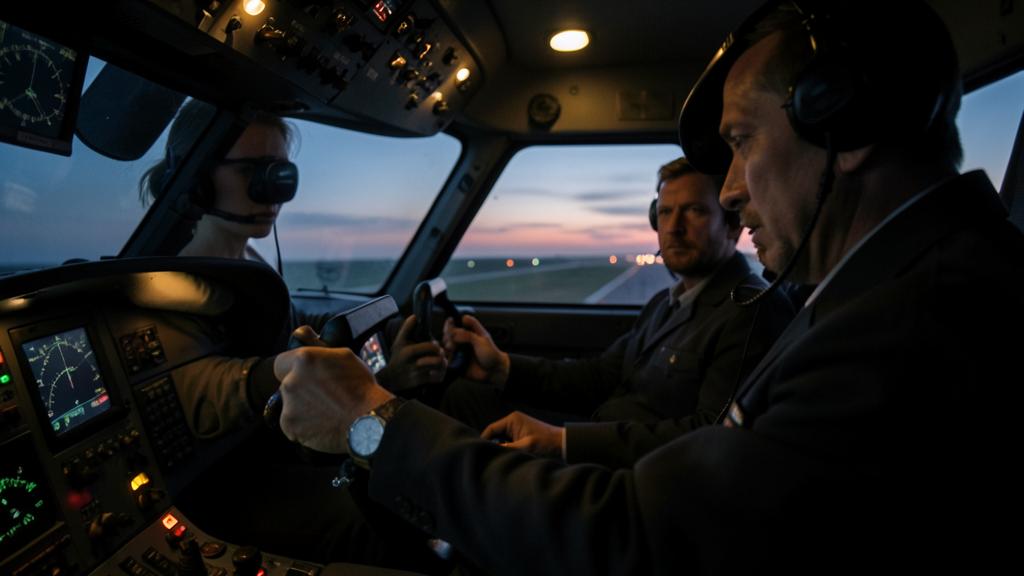
No exercise is repeated as often in the career of a professional pilot as the engine failure immediately after decision speed. It is part of the type rating, it returns during proficiency checks, and it takes up a large part of the recurrent training sessions. So often repeated, it stops being a failure and becomes an cue: the crew notices nothing, they wait. It is a deficiency in training that has a name, and the solution does not lie in flying the exercise less often – but in no longer informing the crew that it is forthcoming.
Why the engine failure on takeoff dominates the program
The place of the exercise is no tradition. It derives directly from the way a takeoff of a jet-powered airliner is certified. The entire performance calculation – runway length, obstacle clearance, net-state flight path – is based on the assumption that a critical engine fails at a defined speed during the roll, with an explicit margin for the interval between the failure and the first discernible action of the pilot. Every performance figure for takeoff used by an operator assumes that a crew can perform the maneuvers that the exercise trains.
The regulatory chain follows the same logic. According to EASA Part-FCL, both the skill test and the proficiency check for a multi-engine type include the asymmetric takeoff and the associated go-around, as well as the approach with a single engine. The operator’s conversion training adds its own repetitions. A pilot on a twin-engine type performs the exercise year after year, throughout a career, in a device where motion, sounds, and instructor are near-constant.
Thus, the exercise is not optional, and to claim it is trained too often misses the point. The problem is narrower and more interesting: the exercise is trained under conditions that gradually eliminate most of what makes an engine failure dangerous.
Pilots practice engine failures so often that they stop reacting like it’s an emergency. The training is designed to teach them how to fly with one engine, but it doesn’t prepare them for the surprise or confusion of a real failure.
An Airbus A320 with a 1,000-meter runway at 30°C. In training, the crew knows an engine will fail at V1. In reality, the failure could happen at any speed, and they might not notice until the aircraft starts veering. The training doesn’t teach them how to react when they don’t expect it.
What repetition actually builds
It would be wrong to consider repetition a waste. The asymmetric takeoff is a psychomotor task with real content: a rudder input that must be large, fast, and then adjusted; a pitch attitude that must be captured and held against a changed thrust line; a flight path that must be tracked at a certain speed; a configuration sequence that must not be rushed. These are skill-based behaviours in the classic sense, and they measurably deteriorate without practice.
Repetition also builds what makes a single-engine circuit survivable: low variance. A crew that has flown the profile forty times produces a tighter and more predictable result than a crew that has flown it four times, and the predictability of the crew’s own production is exactly what you want when one of the engines is missing and the aircraft is close to the ground.
Nothing that follows argues against training the handling. The argument is that handling is only one of several skills for which the exercise is credited, and it is the only one that predictability leaves intact.
What predictability quietly erodes
Compared to an unexpected engine failure during a real takeoff, the simulator version is deprived of four elements.
Detection. In the simulator, the crew already knows that an engine will fail. No one has to notice anything. During a line takeoff, the first evidence may be a yaw that the pilot feels at the controls before an instrument moves, or a noise, or nothing, until a parameter deviates. Detection is a skill; a staged exercise cannot train it, for there is nothing to detect.
Diagnosis. Which engine, and what type of failure. The staged version delivers the answer with the question: the failure is clean, complete, without doubt, and announced. Real failures are often partial, sometimes ambiguous, and occasionally indicated on the wrong side of the cockpit. Misidentification remains one of the recurring contributors to asymmetric accidents, and that is exactly the step the exercise eliminates.
The decision. A control places the failure after decision speed, and the crew knows this. The answer is therefore always “continue,” and the decision to abort – the one with the short fuse and the really bad consequences at the wrong end – is never really made. A crew can be perfect on the asymmetric takeoff and completely untrained in deciding whether to perform one.
Surprise. The physiological reaction to an unexpected event – the surprise, the narrowing of attention, the phase of impaired processing – cannot be trained if nothing is unexpected. Whatever a crew has learned about managing surprise, they have not learned it here.
| Skill | Effect of repetition | Effect of predictability |
|---|---|---|
| Control of the aircraft’s flight path, manual control | Strongly positive – variance decreases with practice | Neutral: handling is trained in both cases |
| Problem-solving and decision-making | Weak – the problem is pre-solved | Negative: the answer is known before the event |
| Situational awareness and information management | Weak | Negative: attention is pre-assigned to an engine |
| Application of procedures | Positive for the flow and sequence of the checklist | Negative for the selection of procedures, which is never in question |
| Workload management | Positive for known workload | Negative: the maximum workload is expected, therefore never really maximal |
| Communication and leadership | Moderate | Negative: the role distribution is repeated, not negotiated |
Expectation is a failure mode, not a comment on training
The mechanism has a name in the work on human factors: expectation bias, the tendency to perceive what one is prepared to perceive, and to act on the prepared interpretation before evidence is available. The literature on training calls the result negative learning or negative transfer – a behavior acquired in the device and of little use or actively harmful outside of it.
The channels through which the secret leaks are banal and numerous, and most of them lie outside scenario design. The pre-briefing, which lists the events. The chosen runway, which is the long one without obstacles. The takeoff weight, which is suspiciously close to the limit. The instructor’s attitude at the console. The pause while a page loads. The fact that the previous crew left the room talking about it. Any one of these elements turns a scenario into an indicator.
The consequence is not that the crew performs poorly – but that the crew performs well, for reasons that will not be present on the day. A perfect asymmetric takeoff, performed by a crew that expected it, is proof of handling and nothing else. It is entirely possible that an entire fleet is well trained and simultaneously poorly prepared.
The trap. Evaluating the exercise on tolerances – speed held, roll angle, flight path tracked, height at capture – measures only the skill that predictability leaves intact. A scenario that has become a ritual will deliver the best results in the session before it stops making sense.
What the training system has done about it
The regulatory response in the last two decades has been to shift assessment from maneuver tolerances to observable competencies and to construct part of the session from unscripted line operations.
The ICAO procedures for training set the competency framework against which most operators now assess – flight path management, application of procedures, communication, leadership and teamwork, problem-solving and decision-making, situational awareness, workload management. The ICAO handbook on evidence-based training then reorganizes the recurrent session around the evidence of what actually happens on the type, rather than around a fixed list of maneuvers inherited from previous aircraft generations.
In Europe, an operator can conduct an approved, evidence-based training program according to the operator’s training regulations in Part-ORO, in which the session is built in phases: a phase of evaluation, flown like a line-oriented scenario, a phase of maneuvers in which repetition is intentional and the exercise is announced, and a phase based on scenarios in which events are managed, rather than executed. This structure is the direct response to the problem described – it does not remove the trained engine failure, but limits the training to the phase in which the training is the goal.
The United States has reached comparable terrain by another path. The FAA’s Advanced Qualification Program, an alternative to the traditional checking regime established in its own subpart of the air carrier operating rules, has enabled data-based training programs and scenario-based curricula as a replacement for the prescribed maneuver lists for many years. The two systems are not interchangeable, and an operator cannot simply claim one under the supervision of the other, but the underlying diagnosis is the same on both sides.
Techniques that break the expectation
Below the regulatory level, the practical work lies in scenario development. The goal is not to be mean – an unfair session teaches nothing and damages trust – but to restore the parts of the event that the script has removed.
| Technique | What it restores | Practical effort |
|---|---|---|
| Distribute the trigger over the roll, rotation, gear retraction, and acceleration altitude | Detection, and the decision to abort if the trigger falls early | Low; requires instructor standardization so that the scatter is intentional, not a matter of personal taste |
| Use partial and ambiguous failures: thrust feedback, overspeed, vibration, a parameter that deviates | Diagnosis, and the discipline to fly first | Moderate; the device’s capability varies, and evaluation is more difficult |
| Include null tests – takeoffs where nothing happens | The value of detection itself; eliminates the certainty that an event is due | Simulator time spent on an uneventful takeoff, which is politically difficult to defend |
| Brief the objective, never the events | Surprise, and genuine workload | Low, but requires the entire training department to stay on message |
| Integrate the failure into a line-oriented segment, rather than into an “engine failure exercise” | Situational awareness, communication, decision-making under real pressure | High instructor competence; the session is harder to conduct and evaluate |
| Vary the environment: contaminated runway, crosswind, obstacle-limited takeoff, low visibility, unknown airport | Workload management and selection of procedures | Moderate; time for scenario preparation |
| Vary the state of the aircraft: weight, reduced or shut-down thrust, a deferred defect | The link between performance assumptions and the maneuver | Low, and it also updates the performance knowledge that deteriorates the fastest |
Of these, the null test does the most work for the least effort. If in a simulator over fifteen years every takeoff has had an engine failure, the training system has without doubt and by demonstration taught that takeoffs contain engine failures. Removing the certainty costs nothing, except a few minutes and the will to invest them.
The right reflex. When designing or debriefing a takeoff exercise, ask what the crew would have done differently if nothing had failed. If the honest answer is “nothing observable,” the exercise has trained a reflex and must be evaluated as such – not credited as evidence of decision-making.
Where are the limits, and the tension that no one removes
Two constraints prevent this from being a simple question of creating better scenarios.
- The first is the facility. A full-flight simulator reproduces the onset of yaw through motion cueing, which, by design, is an approximation; the control forces, seat asymmetry, and acoustic signature of a failure are all represented, not real. The certification specifications for flight simulators define what must be reproduced and with what fidelity, and a crew trained only in the device has learned the device’s cue set. That is unavoidable, and it is another argument for varying everything that can be varied.
- The second is the tension between checking and training, which is structural and will not be designed away. A check must be comparable – the same event, evaluated in the same way, for every pilot in the fleet, defensible before a licensing authority. Comparability requires a script. Training, on the other hand, needs unpredictability, and unpredictability destroys comparability. The viable position is not to resolve the tension, but to stop claiming that it does not exist: leave the scripted, repeated, announced maneuvers where they belong, and stop treating a good evaluation of them as evidence of anything other than handling.
| What is observed | What that suggests | What must be changed first |
|---|---|---|
| The crews configure or prepare before anything happens | The indicator has leaked; the event is expected | Introduce null tests and scatter the trigger |
| The calls are made before the corresponding indication appears | The response is remembered, not driven by evidence | Use partial or ambiguous failures |
| The evaluations rise from year to year while the line events remain the same | The population learns the session, not the task | Rebuild the scenario from operational evidence |
| The debriefing consists only of tolerances and timing of calls | The evaluation has collapsed to handling skill | Evaluate according to the full competency framework |
| No one has aborted a takeoff in the device for years | The decision to abort is untrained in the entire fleet | Place failures before decision speed, without announcement |
The objective of the exercise, repeated
The engine failure on takeoff is trained because the takeoff is certified on the assumption that it can be managed. This assumption concerns a crew that did not know it was coming, on a day organized by no one, on the runway given to them. A program that demonstrates handling under conditions of full knowledge has checked one link in this chain and silently assumed the other three.
The remedy is neither more sessions nor stricter evaluation. It is the conscious separation of the two things for which the exercise is responsible – training asymmetric handling until variance is low, and separately, in another part of the session and without a word of warning, finding out whether the crew can notice, diagnose, and decide. Operators transitioning to competency-based recurrent programs generally find that the second half is where the value of training was hidden, and the practical details of their implementation are a recurring topic in the training resources of FL330.


Leave a Reply
You must be logged in to post a comment.