

Every departure carries one, and most of what is said in it was already known by everyone in the room before anybody spoke. That is the whole problem. A pre-departure briefing earns its four minutes only where it transfers something that is true of today and not of yesterday, attaches a task to a name, or settles how the crew will speak to each other when the flight stops being routine. The rest is recitation — and recitation is exactly the part that survives when the turnaround shortens, because it is the part that can be delivered without thinking.
What the rule actually asks for
The obligation is universal and the content is not. ICAO Annex 6, Part I puts the duty on the operator: the operations manual must contain the procedures the crew follows, and the commander is responsible for the crew being briefed for the flight. In the European system the same duty is split across Part-ORO, which governs cabin crew composition, the designation of the senior cabin crew member and their training, and Part-CAT, which carries the operating procedures the briefing has to reach. The FAA arrives at the same place through the operator’s approved manual and its crewmember duty rules.
What none of these texts do is list the items. There is no regulatory briefing script. The content lives in the operations manual, Part A for the company-wide items and Part B for what is specific to the aircraft. That has a consequence people rarely draw out loud: the quality of the briefing is an operator’s choice, not a legal minimum, and an inspector who finds it thin will write the finding against the manual and the way it is applied, not against a missing paragraph in the regulation.
The verb these regimes reach for is worth reading closely. The commander must be satisfied that each crew member is fit for the flight and briefed for it. Satisfaction is a verification, and verification runs in the opposite direction from delivery: it is something the commander obtains from the crew, not something the commander pushes at them. A briefing built as a broadcast cannot produce it.
One more point changes the shape of the exercise. Because the rules do not prescribe the content, they do not prescribe the cadence either: whether one briefing may cover several sectors flown by the same crew, and what has to be briefed again when something changes, is settled by the operations manual and nowhere else. Where the manual allows it, the identical per-sector recital is a company habit rather than a legal obligation, and knowing which of the two you are dealing with frees the crew to spend the time where it earns something.
The rules say a briefing must happen, but they don’t say exactly what must be said. It’s up to each airline to decide what’s important enough to mention. The commander’s job is to make sure everyone understands their role, not just to read from a script.
The test that sorts the items
One question sorts a briefing faster than any checklist: if this item were left out, would anybody act differently on this flight? An item passes if it satisfies at least one of three conditions.
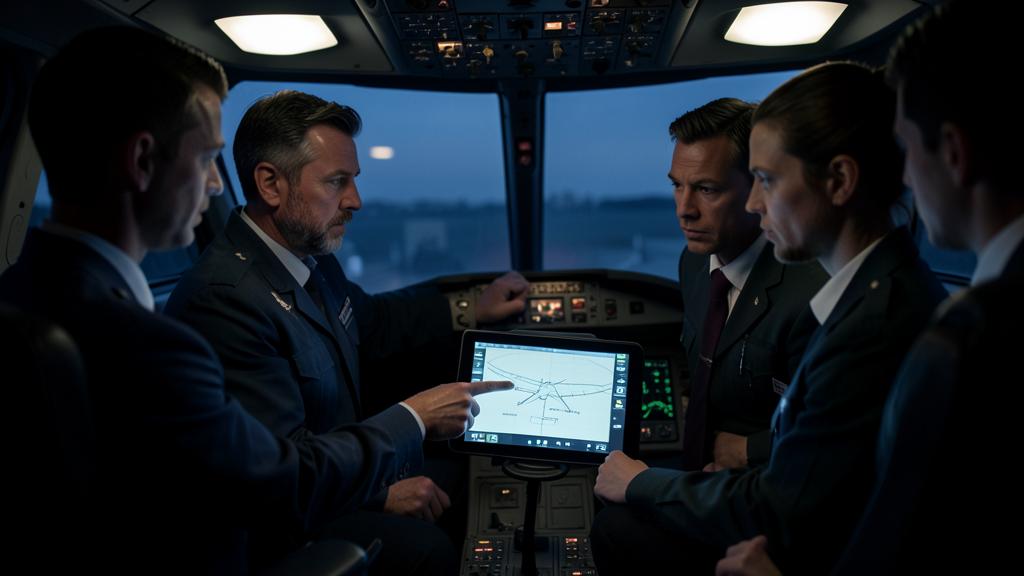
- It is specific to today. Something about this aircraft, this load, this route or this crew differs from the last time, and the difference reaches into somebody’s job.
- It binds a task to a name. A duty that belongs to a station rather than to a person is a duty that has to be worked out under load, at the worst possible moment.
- It sets a protocol. It fixes the words, the codes or the thresholds the crew will use to talk to each other when the situation stops being normal.
An item that meets none of the three is permanent knowledge. Permanent knowledge belongs in the manual, in recurrent training and on the crew’s own reference cards. Reciting it in the briefing does not reinforce it — it dilutes the items around it, because attention is finite and the crew learns very quickly that most of what is said does not need to be heard.
There is one nuance that catches mixed-fleet operators. On a single-type fleet, the position of the first-aid oxygen bottle is permanent knowledge. On a fleet with two cabin configurations, or a wet-leased airframe, or a variant with a different door mechanism, the same item becomes today-specific and moves straight into the first category. The test is about the item’s status on this flight, not about its subject.
On an Airbus A320 with a standard cabin layout, the location of the first-aid kit is permanent knowledge. But if the same airline also operates an A320neo with a different galley configuration, the kit’s location becomes flight-specific for that aircraft type. The crew must be briefed on it for that flight.
| Item | What it actually changes in flight | Why it fails if left out |
|---|---|---|
| Station and door assignment by name | Who commands which exit, who takes the assist space, who covers a crew member who is incapacitated | An evacuation is the one moment with no time to negotiate a role |
| Deferred defects visible in the cabin (slide, exit, interphone, public address, galley) | Redistribution of duties, an exit that will not be used, a communication path that has to be replaced | The crew discovers it when it tries to use the item |
| Special-category passengers carried today | Seating restrictions, the assistance plan, who is not counted as an assisting passenger | Reduced-mobility seating and exit-row rules are decided on the ground or not at all |
| Dangerous goods on board and their position | Where a fire in the hold or in the cabin has to be assumed to behave differently, and what the commander is told | The notification to the commander exists; the cabin’s part of it often does not |
| Expected flight time, expected turbulence, planned service window | Whether the service is compressed, when the crew expects to be seated, what a late seatbelt call means | A crew standing in the aisle at the wrong minute is the routine injury case |
| The emergency communication format and the evacuation signal | The words used in both directions, and what a given signal commits everybody to | Two crews trained at different operators do not share a vocabulary by default |
The items that only fill the time
The recitable half of a typical briefing is made of regulatory background everyone has been examined on, equipment locations that have not moved in three years, and questions asked as a formality. None of it is wrong. All of it is inert.
The question ritual deserves a paragraph of its own, because it is the item most often defended. Asking one crew member to describe a door operation while the others watch is an examination, not a briefing. It produces a defensive answer aimed at the person asking, it consumes the time of everyone not being asked, and it tells the crew that the briefing is a place where you can be caught out — which is precisely the wrong lesson for a room in which somebody may need to raise an awkward point in the next thirty seconds.
Compare it with a question that is answerable only today: the forward slide is deferred, so walk me through what changes at your station. That question has no correct answer waiting in a manual, it obliges the crew to reason about the actual aircraft, and it produces a shared conclusion instead of an individual score.
The joint briefing, and what the flight deck owes the cabin
The weakest part of most operations is not the cabin crew briefing but the joint one. It is short, it happens under time pressure, it is often reduced to an introduction and a flight time, and it is the only occasion on which the two halves of the crew agree how they will communicate in the events that require them to act together.
| Topic | Usable | Not usable |
|---|---|---|
| Turbulence | « Moderate expected in the climb through the first twenty minutes; I will call for you to be seated before it, and the service starts after » | « Might be a bit bumpy » |
| Emergency communication | The agreed format, stated: nature, intentions, time available, special instructions — and who reads it back | « I’ll let you know » |
| Critical phases | The threshold this operator uses, and what the cabin does with it — including how an urgent call still gets through | A number quoted from another airline |
| Flight deck access | Today’s procedure, today’s crew complement, and who is not available to cover it | Assumed to be common knowledge |
| Evacuation | Who gives the order, by what signal, and what the cabin does if the signal never comes | The command only, with no silent case |
The threshold for a sterile flight deck is a genuine divergence and worth stating precisely, because crews move between systems. The FAA fixes it by rule at a defined altitude below which non-essential communication is prohibited. The European definition works differently: critical phases of flight are defined by the phases themselves — the take-off run and take-off flight path, the final approach, the missed approach, the landing and landing roll — plus anything else the commander designates. There is no altitude in that definition. If your crew believes there is one, it comes from your operations manual, and it is worth saying which.
The traffic runs both ways. The flight deck needs to hear the cabin’s minimum crew position, any defect that constrains what the cabin can do, and anything about the load that would change an evacuation. A commander who briefs for five minutes and asks for nothing has held a meeting, not a briefing.
What a short turnaround really removes
Under time pressure, a briefing is not skipped. It is compressed — and it compresses in exactly the wrong direction. The recitable part is fluent, requires no preparation and can be delivered while walking; the today-specific part requires someone to have read the load sheet, the deferred defect list and the special-category list first. So the part that survives compression is the part that changes nothing, and the part that gets dropped is the part that was the entire justification for the exercise.
The structural fix is dull and effective: put the today-specific items first, name the stations second, and let the permanent material be the tail that gets cut. A briefing that runs out of time then loses only what the crew already knew.
The right reflex Open with the differences, not with the introductions. One sentence — what is different about this aeroplane, this load and this crew today — forces the person briefing to have read the paperwork, and it tells the crew within ten seconds whether this briefing is worth listening to.
When the briefing has to be run again
A briefing describes a state of affairs. When the state of affairs changes, the briefing expires, and the trigger is not always the obvious one.
| Change | Why the briefing no longer holds | Minimum re-brief |
|---|---|---|
| A crew member is replaced | A station is now assigned to somebody who was not in the room | Full station assignment plus today-specific items |
| Aircraft change, including a same-type variant | Equipment position, door mechanism and cabin configuration are no longer known quantities | Everything that the previous fleet made permanent knowledge |
| A new deferred defect is raised before departure | A duty distribution built on working equipment | The defect, the redistribution, the affected station by name |
| A long delay during which the crew disperses | Protocol agreements decay; the load and the passenger list may have changed | Differences since the first briefing, and the load |
| Change of commander | The emergency communication format and the evacuation command are the commander’s | The joint briefing, in full |
What the briefing leaves behind
A briefing produces two kinds of trace. The first is administrative and easy: an entry showing it was held, the designation of assisting passengers where the operator requires it, a note in the cabin log against a defect that was discussed. The second matters more and is almost never measured — whether a point raised in the briefing went anywhere.
A crew member who reports a doubtful item in the briefing and sees nothing happen learns, in one flight, that the briefing is a place where issues are absorbed rather than moved. That lesson is durable and it is expensive: it removes the operator’s cheapest source of information about its own cabin. The safety-management value of a briefing is not in the words said but in the loop that closes afterwards — which is why the items raised in briefings and the defects reported at the end of the day belong to the same conversation, one that continues in the professional exchanges on the FL330 forums long after the sector has been flown.
The trap A briefing that produces no question is usually read as a good briefing. It is more often a briefing that transferred nothing: it stated what everyone already knew, in an order that gave nobody a reason to interrupt. The absence of questions is data, and it points at the briefing, not at the crew.
The measure to apply is simple enough to use on the next sector. Count the items that would have made somebody act differently today. If the answer is fewer than three, the four minutes bought a record of compliance and nothing else — and the crew, who are professionals, worked that out before the briefing was over.


Leave a Reply
You must be logged in to post a comment.