
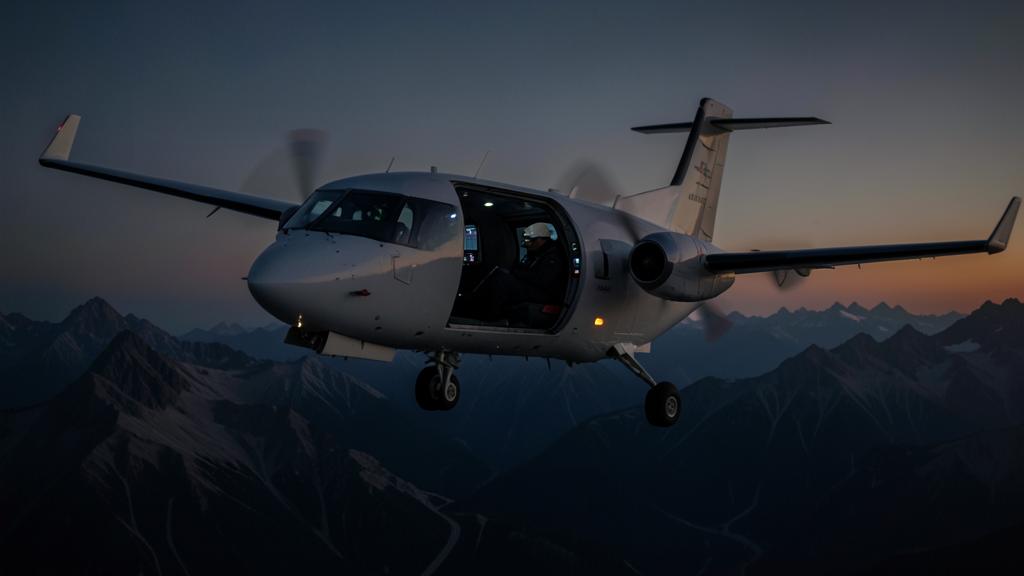
The right engine quits at FL370, heading east, and the first line of ridges on the route lies forty minutes ahead. Knowing how to descend on one engine presents no difficulty at all: the procedure fits in three lines. The real question lies elsewhere — at what altitude the aircraft will stop descending, where it will be at that moment, and whether that altitude clears what lies beneath. The drift-down profile is not a descent manoeuvre: it is a problem of geometry, half of whose answer was written on the ground.
What the failure takes away, and why the ceiling collapses
In cruise, a twin has no thrust reserve: at optimum altitude both engines are working close to their maximum cruise rating and the aircraft drag exactly equals the thrust delivered. Losing an engine removes half the installed thrust at a stroke without removing any drag — on the contrary, the drag of the windmilling engine and that of the asymmetry trim have to be added to the balance. Advancing the remaining engine to maximum continuous thrust gives back only a part of what is missing, and that part thins out as altitude increases. The deficit can be made up only by drawing on potential energy: the aircraft descends.
The altitude at which the descent stops is in no way arbitrary. The minimum drag of a clean aircraft equals its weight divided by its maximum lift-to-drag ratio: it depends hardly at all on altitude, but directly on weight. The thrust available from one engine at maximum continuous rating, for its part, decreases with altitude and with temperature. The two curves cross at a single point, and that point is the ceiling with one engine inoperative. There is therefore no single-engine ceiling belonging to the type: there is a ceiling for a given weight, a given temperature deviation and a given bleed configuration.
When an engine fails, the plane can’t maintain altitude because it loses half its thrust but keeps all its drag. The plane must descend until the remaining engine can provide enough thrust to balance the drag. The exact altitude where this happens depends on the plane’s weight, outside temperature, and whether systems like anti-ice are running.
A Boeing 737-800 at FL370 with a weight of 150,000 lbs and standard temperature would level off at around 18,000 ft on one engine. If the temperature is 10°C warmer, the ceiling drops to 16,000 ft. If anti-ice is turned on, the ceiling drops further to 14,000 ft.
The three quantities that move this ceiling are exactly those one omits to say out loud: the weight of the moment — and not the take-off weight —, the deviation from the standard atmosphere, and the state of the bleeds. Engine and airframe anti-ice selected on draws thrust and adds drag: it lowers the ceiling, and the penalty is not symbolic. The table giving the level-off altitude always carries, in small print, the configuration in which it was established.
Handling the asymmetry counts too, and counts for a great deal. Published performance assumes flight at zero sideslip, wing slightly low on the live-engine side, correct rudder trim. A residual sideslip maintained throughout the drift-down is paid for not in comfort but in feet: trim drag rises quickly and the aircraft stops descending lower than the book says. Fine handling of the yaw axis is here a performance manoeuvre, not a matter of style.
Three drift-down strategies, a single trade-off
Manufacturers documentation describes, under varying names, three families of profile. They differ in one thing only: the speed at which one accepts to descend, hence the trade-off between altitude retained and transit time.
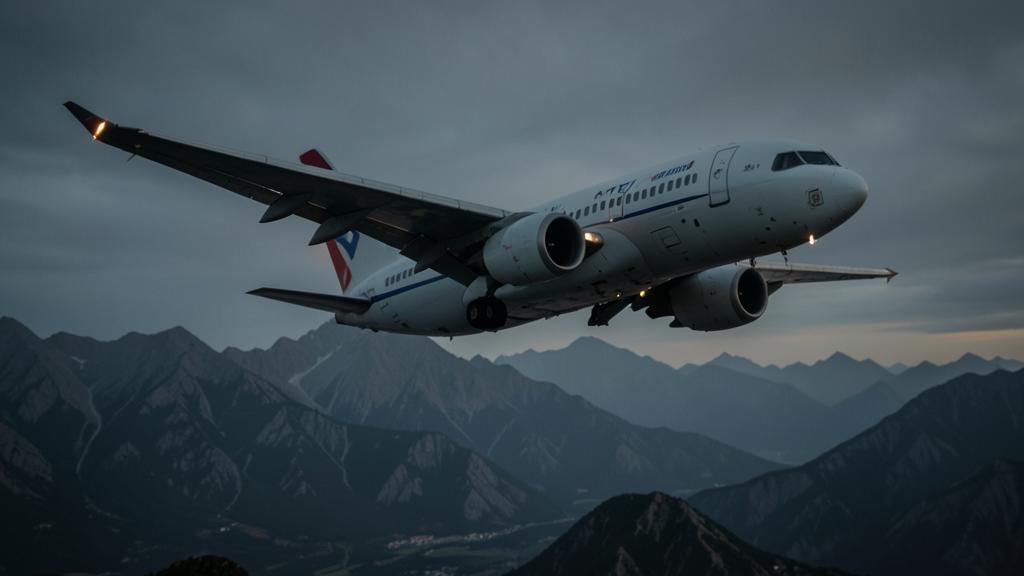
The first aims at overall efficiency. The aircraft is decelerated towards the best lift-to-drag speed, descends at that speed to the single-engine ceiling, then accelerates towards a long-range single-engine cruise. It is the profile that burns the least and goes the furthest; it is the one most flight plans adopt by default, because in the absence of constraining terrain the only constraint is fuel.
The second aims at altitude. The same drift-down at best lift-to-drag speed, but after the level-off that low speed is retained instead of accelerating, so as to hold the highest altitude the remaining engine allows, until the obstacle is behind. What is gained in vertical margin is paid for in time and in fuel per mile.
The third aims at time. A higher speed is imposed, because the alternate is far away, because a diversion time is capped, or because the situation on board will not tolerate waiting. Beyond the best lift-to-drag speed, drag rises quickly with speed: the ceiling drops markedly. A legitimate choice, provided it has been verified that this lower ceiling remains compatible with what lies beneath the flight path.
| Criterion | Efficiency profile | Obstacle profile | Fixed-speed profile |
|---|---|---|---|
| Priority objective | Distance achievable and fuel | Vertical margin over the terrain | Time to the airfield |
| Speed during the drift-down | Close to the best lift-to-drag speed | Close to the best lift-to-drag speed | Higher, set by the operator |
| Descent gradient | The shallowest | The shallowest | Steeper, level-off reached sooner |
| Level-off altitude | Ceiling of the moment, then altitude given up on acceleration | Ceiling of the moment, held as long as the obstacle has not been passed | Appreciably lower |
| After the level-off | Acceleration towards the single-engine cruise | Best lift-to-drag speed maintained | Imposed speed maintained |
| Main cost | Vertical margin not maximised | Time and fuel per mile | Degraded ceiling, fuel |
| Typical use | Route with no constraining terrain | Crossing a mountain range, escape corridor | Distant diversion or constrained time limit |
The reasoning changes in nature as soon as the number of engines changes. On a four-engined aircraft, the loss of one engine removes only a fraction of the thrust and the resulting ceiling often remains close to a usable cruise level: the subject becomes fuel management and asymmetry, rarely terrain. On a twin turboprop, the starting ceiling is low but the lift-to-drag ratio is good and the anti-ice penalty, relative to the thrust available, weighs more heavily. Finally, the same aircraft does not pose the same problem depending on the operation: a short-haul flight over a plain has airfields everywhere and needs nothing more than a clean descent, whereas a flight over a high plateau or over a sea without islands has neither a nearby airfield nor terrain it can clear, and it is the en-route analysis that fixes the mass and the route there.
Gross flight path, net flight path: two numbers that do not serve the same purpose
The gross flight path is the one the aircraft actually achieves: flight tests, corrections, flight manual tables. The net flight path is that same path degraded by a gradient decrement fixed by certification. This decrement has nothing to do with the state of the remaining engine: it statistically buys the difference between a test aircraft flown at its best and a production example on an ordinary day. It is more severe for three- and four-engined aircraft than for twins, and for the latter it is of the order of one percentage point.
En-route terrain clearance is assessed on the net flight path, never on the gross. The regulatory mechanism offers two formulations of equivalent intent. Either the net flight path clears the terrain and obstacles with a vertical margin — of the order of two thousand feet — within a lateral corridor on either side of the intended route, of the order of five nautical miles, and does so as far as an aerodrome where a landing is possible with the required margins. Or the gradient of the net flight path remains positive at a height defined above the terrain, which amounts to saying that the aircraft can hold level flight there. The width of the corridor increases when navigation accuracy does not guarantee the lateral position.
The practical consequence is brutal: a ceiling figure obtained in flight is not the regulatory figure. Flight management system predictions reason on the conditions of the moment and on the performance of the aircraft, not on a degraded flight path. They answer the question “where is the aircraft going to level off”, not the question “is the terrain cleared within the meaning of the en-route criterion”.
The trap. Comparing the level-off altitude announced on board with a minimum sector altitude or with a grid MORA value, and concluding that the terrain is cleared. These numbers do not belong to the same frame of reference: one is an expected performance, the other a safety altitude that already includes its own margins, and the clearance criterion applies to a net flight path that the machine does not display. The margin one believes one has may be entirely consumed by the decrement.
Terrain is dealt with laterally first
When the net single-engine ceiling of the moment falls below the terrain of the corridor, no vertical strategy saves the situation: there is nothing to be gained by descending better. The answer is lateral, and it is prepared in advance. A mountain escape corridor is a coherent whole: a flight path that follows the valleys or moves away perpendicular to the range, one or more critical points along the route that decide between turning back and continuing, a usable aerodrome at the end, and a level-off altitude that remains above the terrain of this new corridor — not of the old one.
These critical points are not comfort markers. They express the fact that beyond a certain position, going back costs more than continuing, in time as in fuel, and that the choice must be settled before reaching them, not at the moment of the failure. A crew that discovers the existence of the corridor after having begun to drift down has already spent half its decision margin.
The turn itself is not free. Banking increases the load factor, hence the lift required, hence the induced drag: the gradient steepens and the ceiling drops. A steeply banked turn in the middle of a drift-down is therefore paid for in level-off altitude, and not symbolically. The right geometry is to start early, at moderate bank, while there is still altitude and speed to spend — even if that means beginning the heading change before the deceleration is complete. Finally, a corridor that exists only in an annex to the flight preparation is not an operational route: if it cannot be entered into the navigation system or read on a chart the crew can find again at night, it will not be flown as it was calculated.
Engine failure and depressurisation do not call for the same altitude
The two classic cruise emergencies have opposite vertical targets. Engine failure wants the highest altitude the remaining engine permits. Depressurisation wants a descent to a breathable altitude, bounded by the oxygen endurance of the occupants. Above a mountain range, that breathable altitude may lie below the terrain: the only way out is then a corridor that descends while moving away, and it is often this case — not the engine failure alone — that sizes the clearance documentation.
The combined scenario, simultaneous engine failure and depressurisation, is the one that the planning of extended diversion time operations adopts for the critical fuel calculation. It is not adopted because it would be likely, but because it is enveloping: it imposes both a low altitude, hence a degraded fuel consumption per mile, and a long diversion time. A crew that sticks to the efficiency profile in a corridor sized by this scenario is correctly applying a procedure to the wrong problem.
The first minutes, in order
Once the failure has been identified and the aircraft secured in accordance with the type procedure, the order of the actions is not a matter of indifference. Setting maximum continuous thrust on the live engine makes available everything that is left. Holding altitude and letting the Mach number decay towards the drift-down value converts speed into time: with altitude retained, the excess kinetic energy pays for a few minutes of thought, and above all it leaves the turn possible high up, where it costs the least.
The automation must then be taken in hand deliberately. Left to itself, the autopilot will hold the selected altitude while thrust stays at the cruise setting, the speed collapsing until the low-speed protections take over. The speed target must become that of the chosen profile, and the vertical mode must correspond to a descent at a held speed, not to an imposed rate that no longer respects anything.
The real decision point is the lateral choice, and it precedes the vertical commitment: one descends towards a place, not merely towards an altitude. The number to be spoken out loud is not the rate of descent, it is the level-off altitude expected at the weight and temperature of the moment, compared with the highest terrain of the corridor ahead.
The right reflex. Announce three things before starting the descent: the level-off altitude estimated at the current weight, the approximate position where that level-off will be reached, and the maximum terrain of the corridor between here and there. If one of the three is missing, the descent waits — a few tens of seconds, which the altitude retained amply finances. A drift-down begun without these three numbers is a blind descent towards an unknown floor.
The level-off is not, moreover, a definitive floor. As fuel burns, weight decreases, minimum drag with it, and the single-engine ceiling rises again. A slow climb back up in cruise is the normal behaviour after stabilisation: it is planned and announced to air traffic control rather than discovered. Conversely, if the descent passes through an icing layer and anti-ice has to be selected on, the ceiling calculated without bleeds becomes optimistic and the announced level-off will not be held.
What flight preparation has already decided
On a mountain route, it is not always the runway that limits the take-off mass: the en-route analysis with one engine inoperative may be the sizing case, because the mass at the crossing of the range determines the net ceiling, hence the margin over the terrain. Taking off lighter is then not a precaution, it is the condition for clearing the terrain.
The drift-down strategy adopted by the operator is also a fuel commitment. The critical fuel of a diversion, the diversion time of an extended-time operation, the position of the critical points: all of this is calculated for a given profile speed. A crew that decides in flight to fly a strategy other than the one on which the numbers were established may well retain a more comfortable vertical margin, but the fuel and time figures in front of it no longer describe its flight.
Finally, an en-route alternate aerodrome is of use only if it is one at the moment of the diversion: compatible weather conditions at the estimated time, approach aids available, an adequate rescue and fire-fighting service category, a usable length at the actual weight after a drift-down that has not allowed much to be burnt off. An airfield named at departure and closed six hours later has never got anyone over a mountain range.
What remains to be checked in your own documentation
Four questions are settled on the ground, before the flight, and change the way things are handled on the day the event occurs. Which drift-down strategy does your operator adopt by default, and where is that written — general policy, type documentation, route documentation? Are the level-off altitudes in your charts gross or net values, and for what temperature deviation and what bleed configuration? Can your mountain escape corridors be entered into the navigation system, or are they only described in text? Are your critical points expressed in position, in time or in fuel, bearing in mind that these three expressions coincide only at the planned weight?
There remains a grey area that documentation handles badly: the sequence from an emergency descent for depressurisation to a stabilised single-engine cruise. Each half is trained separately; the transition — regaining vertical control, choosing the level-off, managing the residual oxygen, reassessing the terrain — is most often improvised. That is what should be asked for in a simulator session when the programme leaves some room, and it is also what examiners are trying to hear from those preparing a type rating: not the recitation of the list, but the level-off altitude, the position where it will be reached, and what lies beneath.
This article sets out mechanisms, not enforceable values. The applicable regulatory text, the aircraft flight manual and the approved documentation of the operator prevail in all circumstances over what is written here; in the event of a discrepancy, it is the on-board documentation that is authoritative.
Questions fréquentes
At what speed is a single-engine drift-down descent flown?
The reference speed is close to the best lift-to-drag speed of the clean aircraft, because it minimises drag and therefore maximises the altitude at which the descent stops. The flight manual and the documentation of the operator publish it as a Mach target and then as an indicated airspeed, varying with weight. A higher speed is sometimes imposed in order to shorten the diversion, at the cost of an appreciably lower level-off.
Is the ceiling with one engine inoperative a characteristic of the aircraft type?
No. It corresponds to the altitude at which the thrust of one engine at maximum continuous rating equals the minimum drag of the airframe, so that it varies with the weight of the moment, the deviation from the standard atmosphere and the state of the bleeds. Anti-ice selected on lowers it. It is read from the charts for the actual conditions of the moment and is not something to be memorised.
Why does the regulation reason on a net flight path rather than on actual performance?
The net flight path is the achievable flight path degraded by a gradient decrement fixed by certification. That decrement covers the difference between a test aircraft flown at its best and a production example on an ordinary day. En-route terrain clearance is assessed on this degraded flight path, which explains why a margin that appears comfortable in gross performance may prove insufficient.
Can the aircraft climb again after reaching the single-engine level-off?
Yes, and that is the normal behaviour. Weight decreases as fuel is burnt, minimum drag decreases with it, and the ceiling slowly rises. This climb back up is planned and announced to air traffic control rather than merely endured, bearing in mind that it disappears if anti-ice has to be selected on.
What should be done if the single-engine ceiling lies below the terrain of the route?
No vertical strategy solves this case: the answer is lateral and is prepared before the flight. The route documentation provides escape corridors that move away from the range or follow valleys, with critical points that decide between turning back and continuing. The choice is made before reaching those points, not at the moment of the failure.
Why does the scenario combining engine failure and depressurisation serve as the reference in planning?
Because it is enveloping: it imposes simultaneously a low altitude, a degraded fuel consumption per mile and a long diversion time. The critical fuel calculations for extended diversion time operations are based on this case. It does not express a probability but a sizing bound.


Leave a Reply
You must be logged in to post a comment.