
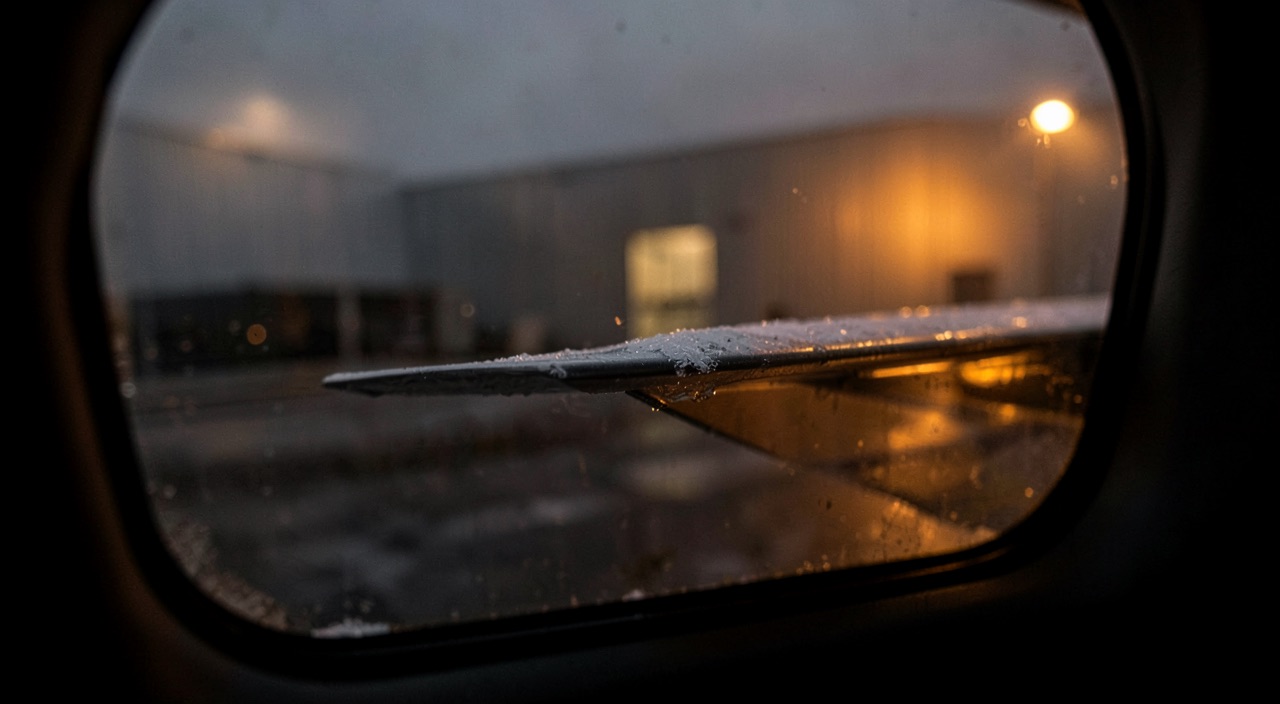
Descent toward an airfield under an overcast layer, anti-icing systems running for about twenty minutes, flaps extended at an intermediate setting: at the instant of selection, the nose pitches down without anyone having commanded it, the elevator lightens and then runs away forward, and the stall warning stays silent. The airspeed is not low — if anything, it is high. Nothing the crew has rehearsed in the simulator applies, because the surface that has just let go is not the wing, and because its stall margin does not move in the same direction as the wing’s. Pushing the wrong way is exactly what finishes off the other.
Two lifting surfaces, two angles of attack that vary in opposite directions
The horizontal tailplane is a lifting surface, with its own polar, its own critical angle of attack, and its own boundary layer. On a conventional transport aircraft, it operates in download most of the time: the wing’s nose-down pitching moment — that of a cambered airfoil, worsened by the aft shift of the center of pressure when the flaps extend — together with a center of gravity forward of the wing-fuselage neutral point, require a downward force at the tail. The tailplane’s low-pressure face is therefore its lower surface. Everything the crew knows about flow separation applies, but inverted.
The angle of attack this surface actually sees is not that of the aircraft. It equals the wing’s angle of attack, corrected for the tailplane’s rigging incidence, minus the downwash the wing imparts to the flow ahead of the tailplane. Since this downwash grows more slowly than the wing’s angle of attack, the tailplane’s algebraic angle of attack varies in the same direction as the wing’s; but it is negative in trimmed flight, so that any reduction in the wing’s angle of attack makes it still more negative and further loads the low-pressure face, the lower surface. The two margins therefore vary in opposite directions: the wing stalls at low speed, the tailplane at high speed. Accelerating moves the wing away from its limit and moves the tailplane closer to its own. This single sentence is enough to reconstruct everything that follows, including the recovery actions, without memorizing them.
The tailplane works opposite to the wing. When you slow down, the wing is in more danger of stalling, but the tailplane is safer. When you speed up, the opposite happens. This is why the recovery actions are completely different.
Flap selection acts in both directions at once, which is what makes it the canonical trigger. It increases the downwash seen by the tailplane, and therefore its local angle of attack; and it increases the wing’s nose-down pitching moment, and therefore the download that must be supplied. With a forward center of gravity and a light weight — the full landing configuration at the end of a short sector — the required trim download is typically among the highest of the flight. The weight-and-balance sheet has, on that day, a direct aerodynamic consequence.
| Parameter | Wing margin | Tailplane margin |
|---|---|---|
| Speed increase at constant weight | Improved: angle of attack decreases | Degraded: local angle of attack increases on the suction side |
| Speed reduction | Degraded | Improved |
| Selection to a larger flap setting | Improved in speed terms: maximum lift increases and the stall speed decreases, even though the stall angle of attack decreases | Degraded twice over: more downwash, more download to supply |
| Retracting to the previous setting | Degraded in speed terms: the stall speed rises again | Improved |
| Forward center of gravity | Little effect | Degraded: greater trim download |
| Entering a turn, pull-up | Degraded | Degraded during the maneuver: the elevator must produce extra load |
| Thrust increase on a propeller type | Improved: the slipstream sweeps the wing and flaps | Degraded: that same slipstream increases the downwash |
| Leading-edge contamination | Reduction of the stall angle of attack | Reduction of the critical angle of attack and loss of elevator effectiveness |
Why the tailplane ices up before the wing, and why no one sees it
A supercooled droplet has inertia: it follows the streamlines only imperfectly. The larger the body and the blunter its nose, the earlier and more gradually it deflects the flow, and the more time the droplet has to be carried aside without striking it. A leading edge of small radius, carried on a short chord, deflects the air late and abruptly: a much larger fraction of the droplets in the swept tube strikes the surface, and the impingement limits extend further aft as a fraction of chord. Over the same time in the same cloud, the tailplane therefore collects more ice per unit area than the wing, and over a larger proportion of its chord. The same absolute thickness also represents a far greater relative deformation there: what is a mere ridge on a wing chord is a change of shape on a tailplane chord.
This collection efficiency is compounded by a total asymmetry of information. From the flight deck or the cabin, one can see a wing leading edge, sometimes illuminated; one can never see the tailplane’s. Some types offer a small unprotected reference probe or mast: that is an indicator of the presence of accretion, not a measurement of what is happening at the tail. Ice detectors detect at their own location. The statement ‘the wing is clean’ therefore carries no information about the tailplane, and the wing anti-ice cycle is not necessarily that of the tailplane protection, where the latter even exists.
The trap: inferring the tailplane’s condition from what one observes. A visibly clean wing, a de-icing cycle that has just run, a silent detector: none of this says anything about a surface that collects ice faster and that no one is looking at. The trap also applies on the ground. On a T-tail, the horizontal surface is high up, hard to inspect visually from the ramp and sometimes poorly reached by the de-icing rig. An aircraft whose wing has been made visibly clean can depart with a contaminated tailplane, and the clean-aircraft rule is not verified where the eye naturally lands.
On an Airbus A320 in icing conditions, a crew extended flaps from 2 to 3 at 1,500 feet AGL. The tailplane, already lightly contaminated, immediately stalled. The aircraft pitched down 15 degrees before the crew recognized the situation and retracted flaps to 2. The recovery was successful, but only after a 500-foot altitude loss. This case highlights how quickly a tailplane stall can develop when flaps are extended in icing.
What separation does to the elevator
The elevator lives in the flow that the fixed tail surface delivers to it. When that surface’s leading edge separates, two things happen, and the first precedes the second. Effectiveness drops: the elevator acts by modifying the load over the whole surface, and placed in a separated wake, every degree of deflection buys less pitching moment. Pitch authority therefore degrades before the surface stalls outright, which reads as a duller response than the deflection would lead one to expect — a weak sign, easy to attribute to turbulence.
Then comes the hinge moment. On a mechanically reversible control, that is what the pilot holds in his hand. The upstream separation redistributes the pressures on the elevator and can flip the sign of the force gradient: instead of opposing the deflection, the flow sustains it. The control runs by itself toward the deflection that reduces the download, that is, forward. The crew, who had been holding a normal force, suddenly have nothing left to hold, and then find themselves with a control pulling the wrong way.
With the download collapsing, the wing’s nose-down moment is no longer balanced and the nose drops uncommanded. The excursion is symmetric: there is no roll-off characteristic of the event, and that absence is itself a diagnostic element. The buffet, for its part, is not felt in the same place as that of a stalling wing. In the wing’s case, the separated wake sweeps the tailplane and shakes the structure: it is felt in the seat and in the floor. In the tailplane’s case, the excitation originates in the pitch axis and travels back through the control, while the structure may remain relatively quiet.
Finally, nothing on board announces it. The angle-of-attack vanes measure the local flow at the front of the fuselage, and the warning schedule is built on the wing’s angle of attack, corrected for configuration and, on some types, offset when icing mode is armed. Production installations do not include a tailplane angle-of-attack measurement. The aircraft stays silent, and its silence will be read as the absence of a problem when it is only the absence of a sensor.
Recognizing which of the two surfaces has let go
The diagnosis does not rest on a feeling but on three quantities the crew already has in front of them: the airspeed, what has just been done, and what the aircraft’s alerting does or does not say. Everything else confirms.
| Criterion | Wing stall | Tailplane stall |
|---|---|---|
| Airspeed at the moment of the event | Low, decreasing | High or increasing, often above the target approach speed |
| Wing angle of attack | High, near the maximum | Low, far from the maximum |
| Aircraft alerting | Stick shaker, aural alarm, protections possibly active | None |
| Usual trigger | Deceleration, turn, pull-up, retraction of high-lift devices, wind shear | Flap selection, acceleration, entering a descent, thrust increase on a propeller type, elevator movement |
| Buffet | Structure and seats, increasing with angle of attack | Pitch axis, felt in the control, structure often quiet |
| Control column force | Normal, with a sluggish pitch response | Lightening, a gradient that flattens or reverses, control running forward |
| Lateral axis | Possible roll-off, asymmetry | Symmetric event, no characteristic roll |
| What worsens it | Pulling up, increasing angle of attack, tightening the turn | Pushing, accelerating, continuing the flap selection, adding thrust on a propeller type |
| Direction of correction on wing angle of attack | Decrease it | Increase it |
| Configuration | Do not extend the flaps further | Retract to the previous setting and hold it |
The reverse recovery, and the reflexes that work against it
The quantity that governs both cases is the same: the local angle of attack of the surface that has separated. For the wing, it is reduced — release back pressure, wings level, thrust as needed. For the tailplane, it must be increased, and since it varies in the opposite direction to the wing’s, that means increasing the wing’s angle of attack: slowing down. This translates into three actions that go together. Retract to the previous flap setting, which removes downwash and part of the pitching moment. Reduce speed toward the value appropriate to the recovered configuration. Counter the nose-down excursion, accepting that this must be done against a degraded, absent, or even reversed force gradient — which presupposes having decided in advance that one will pull, because the movement cannot be improvised once the control runs away on its own.
Thrust, for its part, has no general rule. On a propeller type, a thrust increase strengthens the slipstream over the wing and flaps, and hence the downwash and the download that must be supplied: the go-around reflex can deepen the event. On other architectures, the position of the thrust line relative to the center of gravity produces a moment that works the other way. That is precisely why the order of actions must be read in the type’s documentation and not in general aerodynamics, and why two operators of different aircraft do not have the same correct response.
The real problem is not the difficulty of the movement, it is that several solidly trained reflexes all converge on the harmful action. An uncommanded nose-down excursion on approach first reads as a low-energy event or wind shear: thrust is added. A pitch upset reads as the onset of an unusual attitude: back pressure is released, the stick is pushed, the wings are leveled. The approach-to-stall exercise, repeated dozens of times in the simulator, begins with reducing angle of attack and continues with reconfiguring. And continuity bias does the rest: the crew was engaged in a flap-extension sequence with a landing to complete, the hand is already on the flap lever, and the natural action is to finish the sequence already begun.
The discriminator costs nothing and reads in one second: the airspeed. A wing stall does not occur at high speed, in approach configuration and without load factor, with nothing having sounded or shaken; the exception, the accelerated stall, requires a maneuver the crew has just commanded. If the nose drops while the speed is high and the aircraft is silent, the surface at fault is not the wing, and pushing amounts to driving the tailplane further into its separation.
The right reflex: in icing conditions, extend the flaps in stages and give each stage time to say something — a lightening of the control, a vibration in the pitch axis, a need to counter a nose-down tendency. At the slightest of these anomalies during a selection, retract to the previous setting before opening any debate, and keep that setting down to the ground. And before any decision about a pitch excursion, someone calls out the airspeed aloud: high and no stick shaker, it is not the wing.
Irreversible controls: the symptom the aircraft cannot give
The canonical list of symptoms — the control torn from the hands, the reversed force gradient — was established on aircraft whose elevator is mechanically reversible: the hinge moment travels all the way back to the hands. On a type with a fully powered, irreversible elevator, fitted with artificial feel, that moment never reaches the crew. The feel unit manufactures a force from airspeed and deflection, indifferent to what the flow is doing on the surface. The mechanism is not abolished for all that: the tailplane still collects ice faster than the wing, its critical angle of attack still recedes under the effect of roughness, and the downwash still increases with the flaps. It is the cue that disappears, not the physics.
What remains observable then changes in nature: pitch authority weaker than the deflection would lead one to expect, an uncommanded nose-down excursion, a discrepancy between the pitch rate demanded and the one obtained, an autopilot that drives the horizontal stabilizer trim toward an unusual position to hold the flight path, and, depending on the architecture, an alert relating to trim or to the pitch axis. That is where the training risk lies: a crew trained on the classic list looks for a cue their aircraft cannot produce, does not find it, and names the event something else — turbulence, a gust, autopilot drift.
This is also one of the reasons why some flight manuals restrict autopilot use in icing conditions. The autopilot holds the flight path by trimming, and therefore silently absorbs a growing download demand; it removes the only usable cue and can leave, at the moment of disconnection, a trim state far removed from neutral, which the crew will inherit at the worst possible moment.
What to check in one’s own documentation, and the closing window
Seven points can be checked once and for all in the type’s documentation, and then retained for good. Does the type publish a separate tailplane stall procedure, or a single approach-to-stall exercise — the absence is information in itself, and it changes what one is entitled to improvise. Is flap deflection limited in icing conditions for landing, and does that limitation protect the wing or the tail: the manual rarely says, but a flap limitation in icing is very often a tailplane limitation. What is the icing speed regime, with its entry and exit criteria, bearing in mind that its increments protect the wing and are not neutral for the tailplane. What protects the tailplane: a heated leading edge, a pneumatic boot and its cycle, or nothing at all, and what does the minimum equipment list say about a departure with that protection unavailable. Is the elevator reversible. Is the autopilot restricted. Is there a visual accretion reference, and how reliable is it really.

What remains is the gray zone, and no reasoning will close it. A contaminated wing calls for speed; a contaminated tailplane calls for taking it away. The published increments and flap limitations are the trade-off the manufacturer made between the two, based on test data corresponding to the critical accretion adopted at certification. Improvising outside that band means arbitrating without the data. And in severe conditions, the band can close to the point where the only correct response is to leave the conditions — a decision that belongs to descent preparation, not to the instant the nose drops. For anyone preparing a type rating or a technical interview, the answer that sets a candidate apart is never the list of actions: it is the sentence about the opposite variation, the ability to name the observable that separates the two events at the moment a decision must be made, and the honesty to add that on a machine with irreversible controls the classic cue does not exist. This reasoning is best built in training rather than by rereading a procedure, and the practice of staged flap selection in icing, very uneven from one operator to another, is usefully compared on the FL330 professional forums.
The applicable regulations and the operator’s approved documentation — flight manual, operations manual, type limitations and procedures — prevail in all circumstances over this article, whose purpose is to explain a mechanism and not to serve as a procedure.
Questions fréquentes
How can a wing stall be distinguished from a tailplane stall within a few seconds?
Three readings suffice and all three are immediately available: airspeed, low and decreasing for the wing, high or increasing for the tailplane; the alerting, stick shaker and aural warning for the wing, complete silence for the tailplane since nothing on board measures the tailplane’s angle of attack; the trigger, a deceleration or a turn for the wing, a flap selection or an acceleration for the tailplane. A roll-off points to the wing, a purely longitudinal event to the tail. The feel then confirms what these three readings have already settled: structural buffet on one side, lightening and vibration in the pitch axis on the other. None of these signs should be read in isolation, but their combination is unambiguous.
Why is it necessary to slow down when the icing speed regime specifically calls for flying faster?
Because the icing speed increments protect the wing, whose stall angle of attack has receded, and they are not neutral for the tailplane. The tailplane’s local angle of attack varies in the opposite direction to the wing’s: accelerating reduces the wing’s angle of attack and correspondingly increases the tailplane’s local angle of attack on its suction side. The published speeds and flap limitations are the manufacturer’s trade-off between these two opposing requirements, based on their tests with the critical accretion. Reducing speed is therefore a recovery action only within the framework and limits the type’s documentation defines.
On a type with irreversible elevator controls, does tailplane stall remain a risk?
The mechanism remains entirely intact, only the cue disappears. The tailplane collects ice faster than the wing, its critical angle of attack recedes under the effect of roughness, and the downwash still increases when the flaps are selected. However, the hinge moment does not reach the crew, since the force is manufactured by a feel unit: neither lightening nor reversal will be seen. What remains observable is pitch authority weaker than expected, an uncommanded nose-down excursion, and a horizontal stabilizer trim that drifts to hold the flight path.
Why does the tailplane accumulate ice faster than the wing?
It is a matter of collection efficiency. A supercooled droplet has inertia and does not exactly follow the streamlines; a leading edge of large radius deflects the flow early and lets most droplets go around the obstacle. A tailplane’s leading edge, of smaller radius and shorter chord, deflects the air late and abruptly, so that a larger fraction of the droplets strikes it and the impingement limits extend further as a fraction of chord. At the same absolute thickness, the relative deformation is also markedly greater there than on a wing.
Can the stall warning give advance notice of a tailplane stall?
No, and its silence must never be interpreted as an absence of danger. The vanes measure the local flow at the front of the fuselage, and the warning schedule is built on the wing’s angle of attack, corrected for configuration and sometimes offset when icing mode is armed. Production installations do not include a horizontal tailplane angle-of-attack measurement. The only warning available is behavioral: control column force, pitch authority, and attitude control at the moment of a flap selection.
The anomaly appears exactly at flap selection on final: what should be done?
The previous flap setting is restored immediately and held, without trying to complete the planned configuration. Do not push: counter the nose-down excursion and bring the speed back to the value appropriate to the recovered configuration, bearing in mind that the force gradient may be degraded or reversed on a reversible control. Thrust is handled with restraint, since on a propeller type increasing it raises the downwash seen by the tailplane. A landing with a reduced flap setting is then a matter for the published performance data and limitations, which set the procedure to follow.


Leave a Reply
You must be logged in to post a comment.