

A call at four in the afternoon: departure the next day at six-thirty from a Paris business airfield, three passengers, a meeting in Milan, return the same evening. The aircraft is free, the slots exist, the sale looks done. What is missing is neither the machine nor the runway: it is the end of the crew’s day, and no one in the sales conversation has yet worked out what time that falls.
Two clocks that do not start together
The client buys flight time: a block-to-block duration, sometimes a fixed-price mission. The operator, for its part, spends duty time. The two quantities do not start at the same instant, do not stop at the same instant, and do not share the same economic unit. The whole misunderstanding of on-demand flying lies in this gap of definition, never in a planner’s ill will.
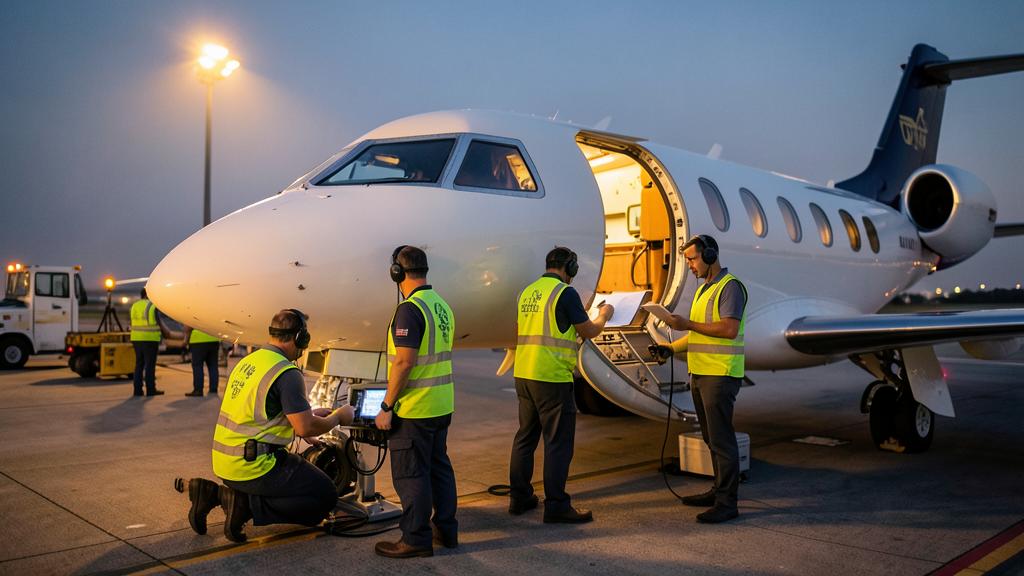
The flight duty period begins at the reporting time set by the operations manual — not at door closure, not at first movement. In on-demand transport, this reporting is structurally longer than on scheduled airline flights: the crew prepares the aircraft itself, receives the fuel, checks the catering order, sometimes handles customs formalities and welcomes the passengers at the foot of the stairs. It ends when the engines stop on the last sector; duty, meanwhile, continues until the aircraft is secured and the reports have been filed.
The window that is actually sellable is therefore not the regulatory maximum for the day. It is that maximum minus reporting, positioning legs and ground waiting — that is, everything that does not produce a single kilometre. On a there-and-back mission within the day, it is not unusual for the paid portion to be less than half the time committed.
The client pays for the time the plane is in the air, but the crew’s workday includes much more: preparing the plane, waiting on the ground, and paperwork. This extra time cuts into how many flights the crew can legally do in a day.
A crew flies a Falcon 2000 from Paris to Milan (1h 30m flight) and back (1h 30m), with a 4-hour ground wait. The total flight time billed is 3h 00, but the crew’s duty time is 9h 15 (including 1h 00 prep, 45m positioning, and 30m post-flight tasks). The paid flight is only 33% of the crew’s actual workday.
| Sequence | Duration used | Billed to client | Counted as duty |
|---|---|---|---|
| Reporting and aircraft preparation | 1 h 00 | no | yes, opens the flight duty period |
| Empty positioning leg, flown by the crew | 0 h 45 | generally yes, depending on the contract | yes, and counts as a sector |
| Outbound sector with passengers | 1 h 30 | yes | yes |
| Ground wait, passengers in meeting | 4 h 00 | no, excluding parking fees | yes, unless split duty is validated |
| Return sector with passengers | 1 h 30 | yes | yes |
| Securing the aircraft and reports | 0 h 30 | no | yes, outside the flight duty period |
| Total | 9 h 15 | 3 h 45 of flight | 9 h 15 of duty |
The durations shown here are those of a textbook case: they vary considerably from one operator, airfield and aircraft type to another, and none has the value of a scale. What does not vary is the structure of the last two columns — a billed column full of gaps, a duty column that is solid — and the fact that the second decides feasibility while the first decides the price.
Positioning: the flight that is not billed and still counts
In on-demand transport, the aircraft is rarely where the client is. Positioning — the empty leg to the pick-up airfield — is the first line on the quote and the first drain on the day. It is visible on the invoice and invisible in the conversation about feasibility.
Two cases behave in opposite ways. If the crew ferries the aircraft itself, the empty leg is a sector in its own right: it consumes duty time and it enters the sector count, so it lowers the maximum applicable to the day. If the crew joins the aircraft by road or on a commercial flight, that journey is duty time, and it never counts as a sector. Depending on how the operator’s documentation sets the reporting time, it may in addition be absorbed into the flight duty period that follows: the day is then shortened without anything given back in exchange, since the scale applied remains that of the number of sectors actually operated. Checking this exact point in the manual is worth more than assuming it, because both treatments exist.
The mirror case is nastier, because it does not show up on the same day. A positioning leg placed after the last sector does not lengthen the flight duty period — it is not part of it — but it does lengthen duty, and it is duty that governs rest. A crew dropped off at destination at ten in the evening, then ferried two hours by road to its base, has ended its day at midnight for the purpose of the rest calculation, and therefore for the next day’s reporting time. The following morning’s mission, sold as independent, was already compromised the moment it was accepted.
The trap. Two missions sold separately to two different clients are independent only in the sales software. As soon as an end-of-day ferry flight links the two, the second inherits the first through rest. The check to make is not « is the crew free tomorrow morning, » but « at what time did its duty actually end yesterday evening, ferry flight included. »
The ground wait decides everything
The most common request from a business client is also the most costly: wait on site and leave again the same evening. Four to six hours on an apron, engines off, produce not a single kilometre and consume duty time exactly like a flight. It is the only line in the day that is both entirely unproductive and entirely charged.
The regulations offer one mechanism, and only one, to recover part of it: split duty. A sufficiently long break, spent in a suitable facility, allows a fraction of the break to be added to the day’s maximum. The word that carries the whole mechanism is not « long, » it is « suitable »: it designates a place that can be darkened, quiet, temperature-controlled, with somewhere to lie down. A business terminal lounge, a sofa behind a reception desk, or an office lent by ground handling do not qualify, however good the handler’s intentions.
The calculation is therefore made in two versions as early as planning: the day with split duty, the day without. Only the second can be promised to the client, the first being contingent on a facility that a provider must supply and that no text obliges anyone to reserve.
The trap. The extension for split duty is decided on paper before departure and is only verified on the ground, on arrival. If the promised facility is occupied, noisy, or simply closed on a Sunday, the break turns back into duty: the latest permissible time for engines-off moves back several hours, exactly when the passengers are boarding again. That discussion does not happen on the apron, facing an impatient client.
The right reflex. Have the facility confirmed in writing when placing the handling order, with its access hours, and put two cut-off times on the mission sheet: the one that applies if split duty holds, the one that applies if it does not. It is the second that is announced to the client, the first being only a margin that must never be sold.
Sector count and reporting time
Two parameters set the day’s maximum before it even begins: the number of sectors planned and the time at which the crew reports. Both work against on-demand transport, and both are known as soon as the order is taken.
The maximum decreases with the number of sectors, because each landing and each take-off concentrate workload. Yet a business mission accumulates short sectors: positioning, pick-up, an intermediate drop-off, pick-up again late afternoon. Four forty-minute sectors weigh little in billed flight time and heavily on the scale. In on-demand flying, it is the number of sectors, not the distance, that decides feasibility.
Reporting time plays an even stronger role. The maximum is set from the local reporting time, and it is markedly lower when the day starts within the window of the night when alertness is at its lowest. That is precisely what the client asks for: leaving before dawn to be in a meeting at nine. The day that is easiest to sell is therefore the most constrained to build.
The combination is common in business aviation: reporting before dawn, positioning, two commercial sectors and sometimes an intermediate drop-off. The resulting window often closes in the early evening. The « end of the day » return that the client imagines as elastic has a hard cut-off, known the evening before by anyone who has taken the trouble to calculate it.
Two resources, two sets of books
The availability displayed by an on-demand operator rests on two resources whose management rules have nothing in common. The aircraft is managed by potentials: hours, cycles, calendar deadlines. These are predictable quantities, plannable months ahead, and transferable, since another aircraft in the fleet can take over the mission. The crew is managed by duty counters, which reset only with rest actually taken, and which are not transferable.
This asymmetry explains why a technical issue costs twice. The first cost is visible: the aircraft drops out of the schedule. The second is far less visible: while the part is being sourced, while awaiting the workshop’s opinion or the technical department’s decision, the crew that has already reported is also waiting, and its counter is running. A three-hour groundstop resolved at noon can leave a day too short for the mission, even though the aircraft has become airworthy again.
Hence a rule of conduct specific to on-demand operations: as soon as an issue exceeds the decision deadline set in advance, the crew is put back into rest or sent home, rather than left to burn its day in a waiting room hoping for good news. An hour of duty spent early in the morning is paid for in hours of delay that evening, and often in a turn-back.
Five levers, and what each one costs
When the requested mission does not fit within the day, five responses exist. They are not equivalent, and above all they are not decided at the same moment.
| Lever | What it requires | What it gives back | What it costs |
|---|---|---|---|
| Split duty | a ground break long enough and a suitable rest facility, provided for in the manual | a fraction of the break added to the day’s maximum | nothing in money, everything in dependence on a third party; collapses if the facility is not compliant |
| Augmented crew | an onboard rest station of sufficient class and a qualified pilot available | the highest maximum, the only way through on long sectors | one less seat, a salary, and a pool rarely mobilisable at short notice |
| Crew relief on the ground | a second crew positioned at destination, in advance | a whole new day, with no inherited limit | transport, an overnight stay, and a positioning lead time incompatible with very short notice |
| Overnight stay at destination | the client’s agreement and accommodation | certainty, no residual constraint on the return | the commercial promise itself, since a same-evening return was the point of the sale |
| Recomposing the mission | negotiation carried out before acceptance: fewer sectors, a closer airfield, a shifted departure | a higher maximum and a real margin | selling time, and sometimes a less convenient airfield for the passenger |
Split duty is prepared the evening before, relief crew is put in place several days ahead, augmented crew depends on a pool and on a rest station that does not exist on every aircraft. The only lever still available an hour before departure is the fifth: renegotiate the mission. It is also the one the sales chain accepts worst, because it touches what has already been sold — hence the value of having laid it out as an option as early as the quote, rather than as a last-minute climb-down.
The cumulative counters: why Friday is not worth the same as Monday
The day’s maximum is only one of three barriers. Above it sit cumulative ceilings, over the week, the fortnight and the month, as well as days that must be left entirely free of duty over a given period. Demand, meanwhile, arrives in clusters: a quiet week, then four missions in five days.
The effect is mechanical and rarely anticipated by sales. A crew that has absorbed three long missions early in the week can be perfectly rested on Friday morning and yet unavailable, because a rolling-period ceiling has been reached. No night’s sleep reopens that counter: only the passage of time does, which makes the constraint completely insensitive to the client’s urgency.
Pre-duty rest produces the same surprise on the scale of a single night. A call at ten in the evening for a departure at one o’clock assumes that the required rest was already taken before the call, which is only true if the crew was already resting, and therefore not committed to anything else. A day spent ferrying an aircraft followed by a night call do not chain together, whatever the physical condition of those involved.
On transoceanic missions, acclimatisation adds a further layer. The scale applies from a reference time that does not switch immediately to the arrival time zone: the return is often more constrained than the outbound leg, even though the client perceives it as symmetrical. It is the most frequent source of an unworkable promise on long-haul business missions.
The right reflex. Before accepting a short-notice mission, calculate first the latest permissible time for engines-off on the last sector, without counting on a conditional extension, and announce it together with the acceptance. A client will accept a cut-off time stated at the time of booking; they will not accept a turn-back announced the evening before.
What to check in your own documentation
The first point to establish is not a figure, it is a scope: which body of rules applies to the operation. The harmonised European flight time limitation rules were written for commercial air transport by aeroplane; air taxi, emergency medical service and single-pilot operations remained governed by national provisions for a long time, pending dedicated rules. Depending on the operator’s state and the nature of the activity, two operators sitting side by side on the same apron may therefore work to different scales. The operations manual settles the question; it still has to be read before discussing it with a planner.
Three points then deserve checking in the manual itself. The reporting value actually applied, with its variants — first sector of the day, positioning, international departure with formalities: that is where the half-hours get lost. The conditions for split duty, and above all who attests that the facility is suitable, on what evidence and at what point. Finally, the treatment of waiting on the ground when it stops being a break and becomes standby again: the exact moment of that switch is the most frequent grey area in business aviation, and it is settled in the approved documentation, not in a message exchange with the client. These practices are usefully compared from one operator to another, which the FL330 professional forums make possible.
For anyone aiming at a position with an on-demand operator, the subject comes up in interview in a very concrete form. Knowing how to state the difference between flight duty period and duty period, knowing what a positioning leg produces depending on whether it is flown or endured, knowing how to calculate a latest permissible engines-off time from a reporting time and a number of sectors: these three skills are worth more than a recitation of the scale, because they are the ones used every day and they protect the operator as much as the crew.
This article describes mechanisms; it replaces no text. The regulation applicable to the operation, any national provisions still in force for air taxi, and the operator’s approved documentation prevail in all circumstances over what is written here.
Questions fréquentes
Does a positioning leg made by car count in the crew's day?
Yes. The positioning journey is duty time in every case, and it never counts as a sector: it therefore does not change the scale applied. Depending on how the operator sets the reporting time, it may in addition be absorbed into the flight duty period that follows, in which case it shortens the day without anything given back in exchange. Placed after the last sector, the same positioning leg does not lengthen the flight duty period, but it does lengthen duty and pushes back the end of rest by the same amount.
Can a five-hour wait on the apron always be treated as split duty?
No. Split duty requires a break long enough and, above all, a suitable rest facility: one that can be darkened, quiet, temperature-controlled, with somewhere to lie down. A business terminal lounge or an office lent by ground handling do not qualify. Without that facility, the whole wait remains duty and the day’s maximum is not raised, which can make the evening return impossible.
Why is a mission with several short sectors more constrained than a single long flight?
Because the day’s maximum decreases with the number of sectors: each landing and each take-off concentrate workload. Four forty-minute sectors add up to less than three hours of billed flight time, but they lower the day’s ceiling more than a single three-hour flight does. In business aviation, it is therefore the number of sectors, not the distance, that governs feasibility.
Can a fully rested crew still be unavailable?
Yes, and it is the case most poorly understood along the sales chain. Above the daily maximum sit cumulative ceilings over rolling periods, as well as days that must be left entirely free of duty. A crew that has strung together several long missions may have taken all its rest and still be blocked by these ceilings. Only the passage of time reopens those counters, never one extra night’s sleep.
What must be announced to the client when accepting a short-notice mission?
The latest permissible time for engines-off on the last sector, calculated without counting on a conditional extension such as split duty. This time is derived from the reporting time, the number of sectors planned and the positioning legs. Announced at acceptance, it becomes an agreed contractual constraint; discovered on the ground, it becomes a commercial dispute.
Do the harmonised European rules apply to all on-demand operations?
Not necessarily. The harmonised limitations were written for commercial air transport by aeroplane; air taxi, emergency medical service and single-pilot operations remained governed by national provisions for a long time, pending dedicated rules. The operations manual states which body of rules applies, and two operators from different states may apply different scales to the same mission.


Leave a Reply
You must be logged in to post a comment.