

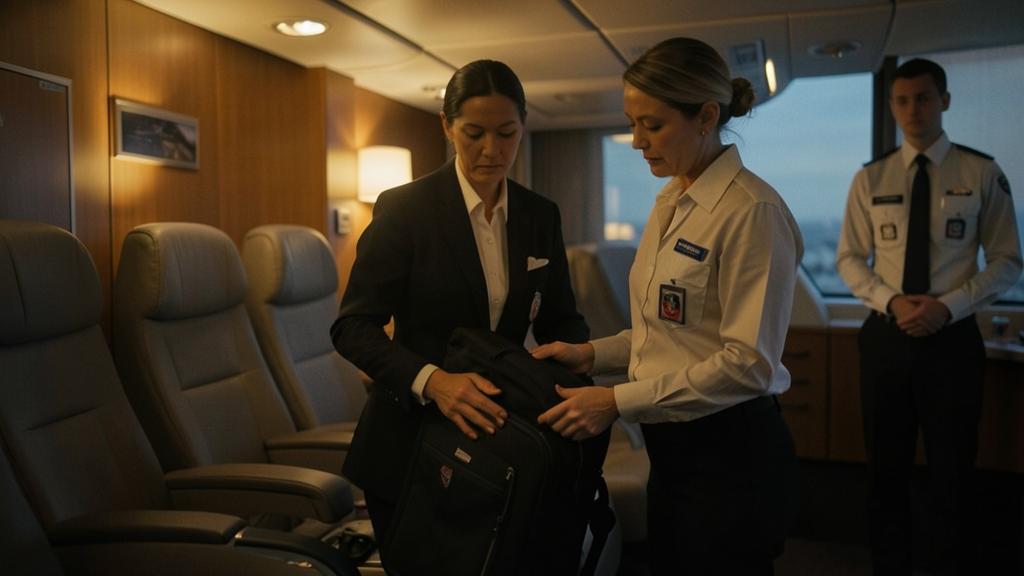
The candidate served the tray with a smile, apologised for the delay, offered another drink. He is eliminated. The passenger played by the assessor, meanwhile, refused to stow his bag during the cabin preparation, and won three polite postponements within a few minutes. The brief announced a service exercise; the scoring grid, for its part, counted the number of times a safety limit had been stated, then verified.
The brief speaks of service, the grid speaks of limits
Cabin crew selection runs into a practical contradiction: it must screen for a safety competency among candidates who, for the most part, have never practised it. The recruiter can neither verify experience nor settle for a declarative answer — everyone knows how to say that a bag must be stowed before take-off. Only one lever remains: provoke a behaviour, then watch it. The commercial role-play is that provocation, because it is the only scene a candidate with no training understands immediately.
Hence a constant misunderstanding. The candidate hears “service”, so he plays service: pace, smile, apology, fallback solution. The assessor holds a grid whose headings speak of something else entirely — stating an instruction without ambiguity, holding it against a reasonable objection, verifying that the action was carried out, informing the rest of the crew, staying at the level of firmness the situation warrants. Courtesy appears there only as a floor: it is disqualifying from below, never rewarding from above.
This hierarchy is not a recruiter’s whim. In the regulations, cabin crew is a safety function to which commercial duties are entrusted incidentally. Initial training and the attestation that sanctions it cover evacuation, fire, first aid, decompression and the handling of unruly passengers. A carrier’s commercial style is then taught afterwards, over a few days of coursework. Authority, on the other hand, does not build up in the same timeframe: it is selected for.
What a role-play exercise actually measures
An interview produces statements; a role-play exercise produces a sample of behaviour under load. The entire value of the exercise lies in that difference.
Three loads are injected, almost always the same ones. The first is ambiguity: the rule is never stated in the brief, it has to be recognised. A passenger keeping his bag on his lap does not announce that he is breaking a rule. The second is social load: the actor gives you a reasonable excuse, or calls on bystanders as witnesses, or is plainly likeable. The third is time: the scene has an implicit deadline — door closure, pushback, the seatbelt sign going off.
Against these three loads, four quantities are read. Latency: how many seconds separate the first usable signal from the first explicit instruction. Stability: does the instruction survive the first objection, then the second. Proportionality: no jump to threat, no escalation without cause. Closure: was execution verified, was the information passed on. A candidate who obtains the result without closure has not done half the exercise, and almost always fails to realise it.
The exercise tests how well you handle real safety rules in a fake situation. It’s not about being nice—it’s about making sure people follow rules, even when they argue or delay. The key is to act fast, stay firm, and check that the rule was followed.
On an Airbus A320, a passenger refuses to stow a bag during boarding. The crew must give a clear instruction within 30 seconds, offer help, and verify the bag is secured before pushback. If they delay, the plane may need to return to the gate, costing 15 minutes and extra fuel.
Time is the hidden variable
The majority reflex is to defer: we’ll come back to it, no need to make a drama out of a bag. That reasoning is wrong, and the curve below shows why.
Every minute during which the limit is not stated turns the passenger’s position into an accomplished fact. What he simply had to do, he must now concede — hence lose face, often in front of neighbours who have become spectators. At the same time, the crew’s options close one by one: a refusal handled at boarding is settled on the ground; the same refusal after pushback costs a return to the parking stand and triggers a decision that no longer belongs to the cabin. The effort needed to regain control does not grow linearly; it has a knee point.
It is this knee point that the assessor seeks to locate: they note at what moment the first explicit instruction was given relative to the first available signal. An instruction given early, in a normal voice, with no bystanders alerted, is settled between two people. The same instruction given much later generally mobilises a second crew member and leaves a trace in the flight report.
The board looks for steps, not a leap
The expected response is graduated. This gradation is not a courtesy: it is precisely what makes coercion defensible after the fact, because it demonstrates that less intrusive means were used and that they failed. A crew that skips steps ends up justifying the unjustifiable; a crew that climbs none of them ends up with an unresolved problem at the exact moment it can no longer be resolved.
| Step | Trigger | Form | Record |
|---|---|---|---|
| Request | First signal, deviation still probably unintentional | Oral, one-to-one, no bystanders involved | None |
| Instruction | The request did not produce the expected effect | Oral, non-negotiable, safety reason stated once | Rest of the crew informed |
| Notification | The instruction is refused, circumvented or reversed | Written where the operator’s procedures require it, handed over in person | Flight deck informed, noted in the report |
| Coercion | Immediate risk to flight safety or to persons | Captain’s decision, means provided for in the manual | Detailed report, authorities on arrival |
Two rules hold this scale together. First, never announce a step you will not take: “I will have to inform the captain”, said as a threat and then not followed through, destroys the credibility of every step above it. Second, do not linger on a step. Politely repeating the same request a fourth time is not patience, it is slow surrender, and one of the most common causes of failure, alongside negotiating over the reason given.
Two axes, not one
Candidates picture the grid as a single scale running from curt to charming. It in fact has two, largely independent, and that is where the eliminations that seem unfair come from.
The “likeable but untenable” profile stakes everything on the horizontal axis: it makes a good impression, then establishes nothing. Conversely, the “firm but curt” profile passes more often than one would think, because manner can be corrected in training, whereas a lack of authority reappears intact on the first busy flight. This is not leniency towards abruptness: it is a judgement call about what can be taught.
| Signal in the cabin | Service-minded response, marked insufficient | Expected conduct | Quantity observed |
|---|---|---|---|
| Bag not stowed during cabin preparation | “I’ll come back in a moment” | Immediate instruction, reason stated, help offered, visual verification | Latency, closure |
| Alcohol brought on board by the passenger, consumed at the seat | Offering another drink to divert attention | Reminder of the rule — only alcohol served by the crew may be consumed on board —, removal of the bottle, crew informed | Stability against the objection |
| Seatbelt refastened as soon as the crew member walks away | Another polite request, identical to the first | Moving up to the next step, reason repeated only once | Proportionality |
| Voices rise, neighbouring passengers are called on as witnesses | Arguing loudly to win the point | Lowering the volume, isolating the exchange, handing over if needed | Composure under pressure |
The reasonable excuse, and the loop that neutralises it
The trap. The actor almost never plays the aggressive passenger: they play the passenger with a good reason. A fragile work laptop, a sleeping child, a medical treatment, a missed connection. The candidate then enters into a discussion of the merits of the reason, finds it reasonable, and grants a delay. At that exact moment, the safety instruction has become negotiable, and everything that follows in the exercise deteriorates. The content of the reason has no bearing whatsoever on the obligation; it does, however, have a bearing on the manner and on the help you offer.
The right reflex. Close the loop in a single sequence: what you are asking for, the safety reason in one sentence, the concrete help you offer, then the verification. “The bag goes under the seat in front of you, it must be secured for take-off, let me help you slide it in” — and you come back to check. Verification is not a petty control: it is the box the assessor ticks, and it is the one most often missing.
The scene involves a crew, not a candidate
In a group exercise, the assessor observes a second thing that most candidates do not suspect: what you do with the others. The competitive reflex — taking over from a colleague, handling it alone, showing that you know — is spotted immediately and marked down. The expected conduct is the opposite: stating in a normal voice what you have observed, requesting reinforcement when the next step calls for it, and knowing how to hand over.
Handing over is a technical point, not an admission. Once you have become the object of the conflict — the passenger is now addressing you rather than the instruction — your presence fuels the spiral. A colleague who takes over the exchange starts again from a neutral position, with no history of lost face. Boards immediately notice a candidate who does this of their own accord.
What remains is informing the flight deck and the written record. Informing is not alerting: the captain needs a calibrated status report, delivered while a decision is still theirs to make — wait, request assistance on arrival, return to the parking stand. As for the report, it is the only document that will exist if matters later turn judicial, and it is built during the event, from time-stamped observations, not from memory six hours later.
What to check in your own carrier’s documentation
Once at a carrier, the generic scale described here takes on a precise form, and it varies from one operator to another. Five points deserve a careful reading rather than an assumption: the exact name your manual gives to each step and what triggers it; the existence, form and signatory of a written notification to the passenger; what information the captain must receive and in what format; the conduct required when a passenger consumes alcohol they have brought on board themselves, a frequent case handled very differently between carriers; and finally the reporting chain and its deadline.
A grey area remains, and it is more honest to name it: the available definitions of an unruly passenger stay qualitative, and none sets the precise threshold separating them from a simply difficult passenger. That threshold is a judgement call, made in the cabin, within seconds, by someone who will not get the chance to replay the scene. The graduated scale does not exist to remove that judgement call — it exists so that it remains contestable, that is to say documented, proportionate and shared with the rest of the crew as it takes shape.
For anyone preparing for a qualification, the consequence is direct: what selection observes, line checks will observe again. The same four quantities — latency, stability, proportionality, closure — recur in behavioural competency grids throughout a career, and they are worked on like a technique, repeated aloud until the sentence comes out without hesitation, rather than as a character trait one either has or does not. The preparation courses that make you rehearse the full sequence, help and verification included, are worth more than a review of typical questions.
The applicable regulations and the operator’s approved documentation prevail in all circumstances over this article, which describes an assessment mechanism and not an enforceable procedure.
Questions fréquentes
Should you cite the regulation to the passenger during the role-play?
No, and doing so is generally marked down. No grid asks for a regulatory reference, which the passenger can neither verify nor find credible in the moment. What is expected is the safety reason stated in plain language, in one sentence, once. The reference belongs in the report, not in the exchange.
Does raising your voice show authority?
Almost always the opposite. Volume shifts the exchange onto the terrain of a power struggle, turns neighbouring passengers into an audience, and makes the next step harder to take without a scene. Authority is read in the content and the stability of the instruction, not in its loudness. Boards specifically score the ability to lower the volume as tension rises.
What should you do if the passenger genuinely has a good reason?
The reason never changes the obligation, it changes the manner. You acknowledge the reason in one sentence, you maintain the instruction unchanged, and you offer concrete help to make compliance possible: a different stowage spot, a hand with it, a later moment to retrieve the item. Granting a delay on the instruction itself, however, makes it negotiable for the rest of the flight.
Can you fail a role-play by being too firm?
Yes, but markedly less often than by being too accommodating. Failure through excess comes from skipping a step — jumping straight to a threat or the announcement of coercion — or from announcing a measure you cannot actually carry out. Proportionate, justified and verified firmness is never penalised, even when its manner remains rough around the edges.
Is handing over to a colleague seen as a personal failure?
No, it is a recognised technique and one that assessors actively look for. As soon as you become the object of the conflict, your presence sustains the situation, whereas a colleague can restate the same limit from a neutral position. What is scored is announcing the handover and passing on what has already been requested, not the mere act of stepping back.
At what point should the flight deck be informed?
As soon as the situation crosses the level at which a decision from the captain might become necessary — that is, before it actually is. The information given must be a calibrated status report: what has been observed, what has already been requested, what is being considered. The exact format and the triggering threshold are set out in the operations manual, which takes precedence over any general rule.


Leave a Reply
You must be logged in to post a comment.