

On a fuel invoice, sustainable fuel does not appear as a product: it appears as a premium, a spread line pegged to the day’s Jet A-1 price. That is where the misunderstandings begin. This premium is not passed on like an airport tax, because it is not levied on a passenger but on a mass of fuel, which is then spread across seats whose number, density and load factor change the outcome entirely. Here we follow the full path of that spread, from the purchase contract to the line the customer sees, and what remains genuinely sellable once the regulatory obligation is stripped out of the calculation.
The premium is not a price, it is a spread
Sustainable aviation fuel is a blending component. Once mixed with fossil kerosene and released for use, the blend meets the specification for conventional turbine fuel and receives the same quality certificate as the rest of the tank farm’s stock. That is the very definition of « drop-in » character: no separate pipeline, no dedicated tank, no special refuelling procedure, nothing to add to flight preparation. The economic consequence is immediate and often misunderstood: there is no price for sustainable fuel in the sense that there is a price for kerosene. There is a price for kerosene, and a spread.
This spread is negotiated on the neat product, before blending. It depends first on the production pathway. Hydroprocessing of used oils and fats remains the cheapest, because the technology is mature and the units are already depreciated or financed; alcohol-to-jet routes and synthesis from captured hydrogen and carbon cost considerably more, and nothing suggests they will catch up with hydroprocessing until their units are built at scale. It then depends on the competition exerted on the same feedstock by road diesel, which values it through its own support schemes and thus sets a floor that aviation must clear to be supplied. As an order of magnitude, the neat molecule sells for several times the day’s kerosene price: the spread is counted in multiples, not percentage points.
The second factor is technical. The specification caps the blend ratio, and that cap depends on the pathway: at most half the volume for the most common routes, substantially less for others. Above all, nobody blends at the cap: the actual rate is set by availability and by obligation. The spread billed at the wing is therefore the product of two terms, the premium on the neat product and the effective blend ratio. As an arithmetic illustration, a premium worth three times the kerosene price applied at five percent blending raises the cost of a full load by fifteen percent, not three hundred percent. Keeping that product in mind avoids three quarters of the sterile arguments.
The premium is like a markup on top of regular fuel. It’s not a fixed price but depends on how much sustainable fuel is mixed in and how expensive that fuel is to make. The more sustainable fuel you use, the higher the cost, but it’s not a 1-to-1 increase because the blend is diluted in the total fuel.
An airline buys sustainable fuel at a premium of 3x the price of regular kerosene. If they blend 5% sustainable fuel into their tanks, the total fuel cost increases by 15% (3x premium x 5% blend). This means the extra cost isn’t as high as it might seem at first glance.
From the tank to the seat, a chain of dilution
The extra cost of a flight is calculated simply: fuel mass uplifted multiplied by the effective premium. The whole interest of the subject lies in what comes next, that is, in the division. On a dense short-haul flight, consumption per seat is low in absolute terms, and the spread is squeezed flat. On a long-haul flight, the same premium, applied to a considerable mass, produces a per-seat amount of an entirely different order — but it applies to a ticket that is itself far more expensive, so that the relative weight does not follow the same slope as the amount.
Second level of dilution: fuel’s share of costs. Depending on the operator, the aircraft generation and the price of a barrel, fuel accounts for on the order of a quarter of direct operating costs, sometimes more. A rise in the cost of a full load of that magnitude represents, on that basis, a few points of direct cost — an order of magnitude comparable to an ordinary market swing, except that it is structural and cannot be hedged. Third level: load factor. The extra cost is incurred at the moment of refuelling; it does not depend on the number of passengers boarded — it is therefore a flight cost passed on to the seats actually sold, and a half-empty flight concentrates it on fewer payers.
Four payers for a single bill
The premium is paid once, by the operator, at the time of delivery. What follows is no longer logistics but contract: four possible bearers, each with its own basis, its own consideration and its own limit. Confusing these bases is the most common mistake in internal presentations, because it creates the impression that the same euro could be collected twice.
| Bearer | Basis | Consideration received | What limits its share |
|---|---|---|---|
| Operator | flight margin | compliance, access to constrained airports | the spread cannot be hedged on any liquid market |
| Individual passenger | fare, via an embedded surcharge or a booking-time option | nothing traceable if the expense is pooled; a certificate if it is an option | price elasticity and low take-up rate on the option |
| Corporate client or shipper | travel programme, tonnage carried, annual contract | a named certificate usable in its own inventory | the quality of the certificate and the rigour of its auditor |
| The public | blending obligation and support mechanisms | an emissions trajectory and an industrial supply chain | the risk of refuelling being shifted outside the perimeter |
The only one of these four bearers with a clear-cut economic reason to pay is the third. A company reporting on its indirect emissions needs an attested reduction in a category where it has almost no leverage: purchased transport. It is therefore not buying fuel, it is buying an accounting document. An individual passenger, by contrast, buys a feeling, and the take-up rate shows it. That is why the schemes that work are contractual and multi-year, not tick-boxes at the moment of payment.
Freight pays the same premium in a different unit
On the freight side, the basis is no longer the seat but the tonne-kilometre, and the difficulty changes in nature. A shipment is billed on chargeable weight, that is, on the greater of actual weight and volumetric weight; consumption, however, knows only the mass actually carried. Passing on a fuel premium against chargeable weight therefore over-bills light, bulky shipments and under-bills dense ones. Operators who take the matter seriously allocate it against actual mass and document the rule, failing which the shipper, who redoes the calculation, disputes it.
Second particularity: the hold of a passenger flight carries freight and passengers in the same aircraft. Attributing consumption between the two customer bases requires an allocation key — mass carried, revenue, or volume — and that key directly determines the amount each is billed. It must be chosen once, written down, and applied on both sides of the house, otherwise the sum of the reductions announced exceeds the reduction actually obtained. On an all-cargo aircraft the problem disappears, but the basis becomes highly concentrated: a handful of shippers bear the entire premium of a flight.
The attribute travels without the molecule
A station cannot dispense sustainable fuel if local logistics do not bring it there, and it would be absurd to run trucks a thousand kilometres to deliver a product whose whole point is climate benefit. Hence the mass-balance and book-and-claim mechanism: the volume is blended where it is rational to do so, while the environmental attribute is transferred to a customer whose flights depart from elsewhere. The certificate is then retired in that customer’s name, and no one else can claim it.
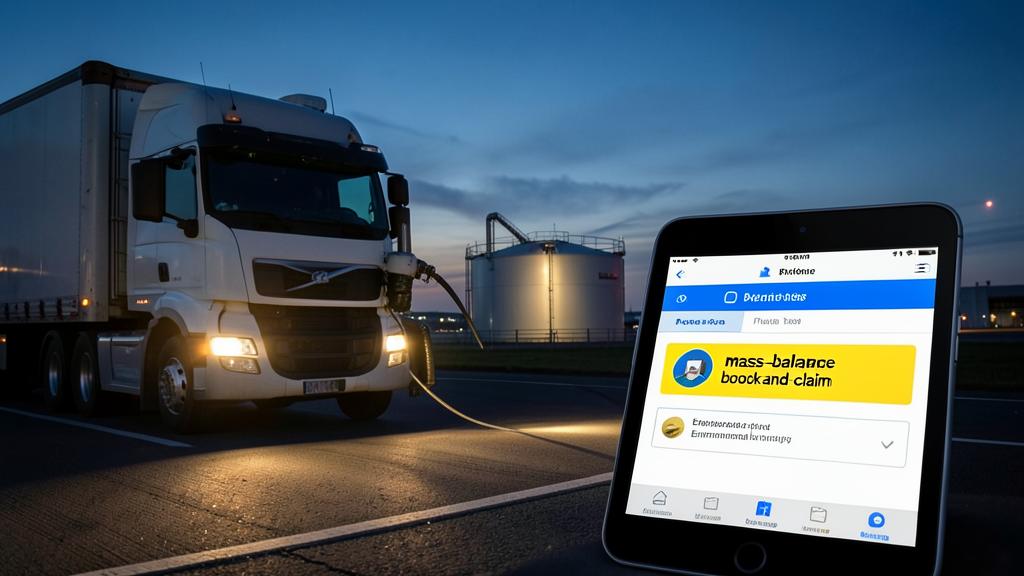
This mechanism is only as sound as the chain of traceability behind it. It rests on a recognised certification scheme, on mass-balance rules that forbid attributing the same volume twice, and on a retirement registry. A certificate that mentions neither the period, nor the scheme, nor the retirement in the beneficiary’s name is not an accounting document: it is a marketing brochure.
The pitfall: reselling to a customer the blend share that is already mandatory. The volume imposed by regulation is blended regardless, it is funded by every ticket in the perimeter, and it is already counted in the national trajectory. Billing it a second time to a shipper as a voluntary reduction is double counting, which the customer’s auditor will detect simply by asking above what reference level the reduction is calculated. Only the layer purchased beyond the obligation can be transferred.
The right reflex: demand the certificate before the commercial commitment, never the other way round. Five items make the difference between an enforceable document and a sales pitch: the volume and its unit, the production period, the certification scheme and batch number, the voluntary nature of the volume beyond the obligation, and the retirement in the final beneficiary’s name. If one is missing, the announcement to the customer waits.
What the obligation changes about the nature of the expense
Where blending is a matter of choice, the premium is a communications budget; where it is a matter of obligation, it is a compliance cost. The difference is structural. A compliance cost applies to every operator refuelling within the perimeter concerned: it creates no disadvantage between them, it shows up in the price delivered at the wing for everyone, and it no longer has to be justified to the customer since it is no longer optional. It does, however, create a gap with airports located outside the perimeter, hence the requirement on operators to refuel the bulk of their needs locally, which has no other purpose than to prevent circumvention through excess fuel tankering.
The second effect is that the regulatory trajectory is known in advance and rises in steps. An operator can therefore model its compliance spend over several years, which makes multi-year purchase contracts possible — the only form of hedging actually available for this premium, since no liquid financial instrument backs it. These contracts generally take the form of a volume commitment paired with either a fixed premium, a cap, or indexation to a basket of raw materials; the choice between these three formulas is the real financial trade-off of the matter, well ahead of the question of who, passenger or shipper, will pay.
What to check in your own documentation
For anyone in operations, the essentials are checked across four documents. The fuel supply contract first: read who bears the premium, how it is indexed, and whether it is broken out or buried in the delivered price — a buried premium cannot be cleanly passed on to a customer. The commercial policy next: find out who collects the voluntary option, over what perimeter it is calculated, and what is promised in writing to the buyer. The emissions accounting documentation, to verify the same reduction does not appear both in the operator’s inventory and in its customer’s. Finally the operations manual, where nothing should need to change: if a specific refuelling procedure appears there, it is a sign of an unreleased blend or a trial, not a line operation.
Two grey areas remain, and it is better to name them than to dress them up. The first is the split between cabin and hold on a mixed flight: no single key is self-evidently correct, each one favours a different customer base, and the only workable discipline is to choose one, write it down, and not change it depending on the audience. The second is the value of a book-and-claim certificate in an auditor’s eyes: accounting frameworks accept it under conditions, but those conditions are tightening, and a multi-year contract signed today will be re-read under tomorrow’s rules. For anyone preparing to take up a role in operations or safety, the question worth mastering is not a chemistry question: it is being able to state, without hesitation, what falls under obligation, what falls under voluntary action, and why the former is never a sales argument.
The applicable regulations, the operator’s approved documentation, and the specific terms of purchase contracts take precedence over this article, whose only purpose is to explain the mechanism.
Questions fréquentes
Does sustainable fuel require a special refuelling procedure?
No. Once blended and released for use, the product meets the specification for conventional turbine fuel and receives the same quality certificate as the rest of the tank farm’s stock. The procedures, water and cleanliness checks, and flight documents are unchanged. The only difference is documentary, upstream, in the sustainability certification chain.
Can a full load be entirely sustainable fuel?
Not in line operations: the specification caps the blend ratio, at most half the volume for the most common pathways and substantially less for others. Demonstration flights have been flown with non-conventional blends under special approvals. Use at one hundred percent is the subject of certification work, for both engine and airframe, that is not yet complete across the whole fleet.
Can an airline sell a customer the mandatory blend share?
No, and that is the main control point for an auditor. The volume imposed by regulation is already funded by every ticket in the perimeter and already counted in the public trajectory. Only the layer purchased beyond the obligation can be transferred by name, with the certificate retired in the beneficiary’s name.
Why is the per-passenger extra cost lower on a short-haul flight?
Because the premium applies to a mass of fuel, and the mass uplifted per seat is far lower on a short sector. The per-passenger amount therefore follows sector length. Relative to the ticket price, however, the relative gap stays of the same order, since a long-haul fare is itself much higher too.
Is a book-and-claim certificate acceptable in a corporate emissions inventory?
The usual emissions accounting frameworks admit it under conditions: a recognised certification scheme, documented mass-balance rules, no double claiming, and named retirement of the certificate. These conditions are tightening over time. It is therefore worth checking that the contract provides for updated supporting documents, not just a volume.
How can one hedge against the premium's volatility?
Unlike kerosene, no liquid financial instrument backs this premium. The only hedge available is contractual: a multi-year volume commitment with a fixed premium, with a cap, or indexed to a basket of raw materials. The choice between these three formulas is the main financial trade-off of the matter.


Leave a Reply
You must be logged in to post a comment.