

Four days, eight sectors, two layovers where the wake-up call comes before dawn: on return, the numbers add up on paper. Every rest period was granted, every limit respected, no overrun to report. And yet the crew steps off the aircraft with a fatigue that bears no resemblance to that of the first evening. Minimum rest restored hours; it did not restore sleep. The entire mechanics of the debt lies in that gap.
Legal rest counts clock hours, not sleep cycles
A rest period is defined by what the operator can control: a moment when duty ends, a moment when it resumes, and the duration between the two. The regulation reasons in terms of duration because that is the only measurable quantity that can be enforced. It requires that this duration be sufficient to cover transfer, meals, physiological needs and an opportunity for uninterrupted sleep. The word matters: an opportunity. No one can regulate the act of falling asleep.
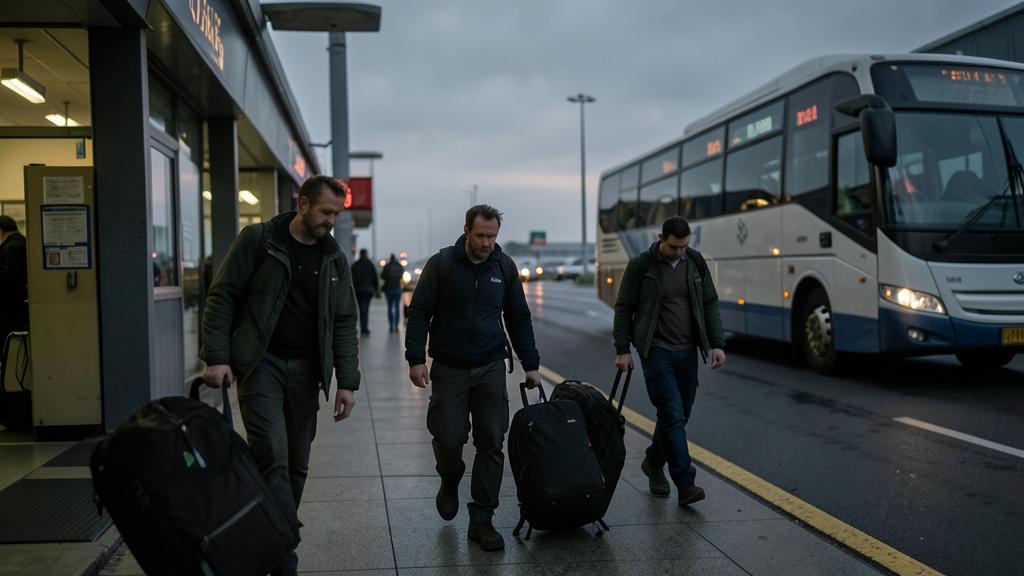
Between the end of duty and the moment one is actually lying down come disembarkation, the debrief, the bus, hotel check-in, sometimes a meal because nothing has been eaten in six hours. At the other end, one must get up before report time, get ready, retrace the journey. The granted duration is therefore trimmed at both ends, then a third time from within: sleep-onset latency, awakenings, a room facing the street. A comfortable-looking out-of-base rest on the roster sheet can leave only a short opportunity for sleep, and actual sleep shorter still.
The rules say you must have a certain number of hours to rest, but they can’t force you to actually sleep during that time. Real sleep depends on many things, like how long it takes to fall asleep, how comfortable your room is, and how much time you waste on travel or meals. So even if you get the required rest time, you might not get enough real sleep.
This reasoning is not a criticism of the text: it describes its scope. The rule sets a floor of available time; what fills that time is a matter of physiology, which does not shrink proportionally.
What exactly is lost when the end of the night is cut short
A night is not a homogeneous block that can be cut anywhere without consequence. It is made up of successive cycles, roughly ninety minutes long, whose composition changes as the night goes on. The early cycles are dominated by deep slow-wave sleep, which weighs most heavily in physical recovery and in dissipating the sleep pressure built up during the day. The later cycles give an increasing share to REM sleep, associated with memory consolidation and emotional regulation.
Imagine a flight crew has a 7-hour rest period after a night flight. If they go to bed at 3 AM and wake up at 10 AM, they miss the last two hours of sleep, which are mostly REM sleep. But if they go to bed at 1 AM and wake up at 8 AM, they miss the first two hours, which are mostly deep sleep. Both cases lose 2 hours of sleep, but the effects are different: the first case makes them more irritable and forgetful, while the second makes them feel physically exhausted.
The practical consequence is direct and rarely stated. Waking two hours early does not remove a quarter of each stage: it removes primarily the portion richest in REM sleep. Conversely, a delayed bedtime cuts into the start of the night, hence into deep slow-wave sleep, and leaves shallower sleep afterward, since homeostatic pressure has already been partly dissipated by the extended time awake.
Two rotations totalling the same number of rest hours therefore do not produce the same fatigue on the third day: this is the first limit of hour-counting accounting.
The trap. Catch-up sleep taken during the day, after a night duty ends, is systematically shorter and more fragmented than the same number of hours taken at night. The room is brighter and noisier, but above all the circadian wake signal rises at the very moment one is trying to sleep. Counting these hours as equivalent to a night is the most common estimation error on short rotations, and it is paid for two days later.
Two accounts that never settle together
Sleep regulation operates on two registers that run in parallel. The first is homeostatic: the longer the wakefulness lasts, the more sleep pressure builds up, and sleep brings it back down. The second is circadian: an internal clock, set by light, modulates wakefulness according to local time, independently of accumulated fatigue. These two accounts do not add up; they intersect.
This intersection explains why one can be exhausted at three in the afternoon yet unable to fall asleep, then perfectly able to sleep at four in the morning. It also explains the window of low performance at the end of the night, which European flight time limitation schemes treat as a period in its own right: it corresponds to the trough of the clock, when core body temperature is at its lowest and vigilance drops even without any debt.
A sleep debt does not shift this trough, it lowers the whole curve. A well-rested crew goes through the end of the night with a reduced margin; an indebted crew goes through it with no margin at all. The same unexpected event — a runway change, a passenger needing attention, a diversion — then no longer costs the same effort or the same reaction time.
How the debt builds up over a four-day rotation
On a short rotation, the daily deficit is rarely dramatic: on the order of an hour a night, sometimes a little more, it is not felt on waking on the second day and is easily offset by the stimulation of work, cabin lighting and coffee. That is what makes it treacherous. The subjective sense of fatigue stabilises much faster than the objective decline in performance: one feels at the same level as yesterday even though reaction time and tolerance for the unexpected have kept falling.
The deficit piles up, and it piles up on nights whose composition is already degraded. By the fourth day, the crew is not only short on hours: it is selectively short on certain stages, with a clock that has never had two consecutive days to settle.
| What is compared | Rotation with early departures | Rotation with late duty endings |
|---|---|---|
| Portion of night cut | The end of the night, by an early wake-up | The start of the night, by a delayed bedtime |
| Stage mainly lost | REM sleep | Deep slow-wave sleep |
| Sleep-onset latency | Low: sleep pressure is high | High: residual wakefulness from the end of duty persists |
| Position relative to the clock | Waking in or just after the circadian trough | Bedtime during the high-vigilance phase |
| Dominant sign on the third day | Irritability, reading errors, sequence omissions | Physical heaviness, brief dozing off at the seated station |
| What actually restores it | An extended morning, which gives back the end of the night | An earlier bedtime, which gives back the start of the night |
The last row is the most useful one in practice: recovery is not symmetrical. Lengthening the night on the right side restores the missing stage; lengthening it on the wrong side mostly adds light sleep, with an impression of rest greater than the actual benefit.
Why a single free night does not settle the account
After several truncated nights, the first free night shows a recognisable signature: rapid falling asleep, a high proportion of deep slow-wave sleep early in the night, few awakenings. The body repays the most costly debt first. REM sleep, meanwhile, comes back later, through a rebound effect that plays out more on the following nights than on the first. A single night therefore restores part of the deficit, never the whole of it, and not the same components.
The clock adds to this. A recovery night taken at home, in the usual time window, works on both registers: it repays sleep pressure and re-anchors the circadian phase. A night taken on layover, at an offset time, does only half the job. It is no accident that weekly rest schemes are built around local nights, in the plural, rather than a simple number of consecutive hours.
The matrix summarises the reasoning to apply when reading one’s own rotation: the same duration of rest changes in nature depending on the time it begins, and a full local night is worth more than a few hours tacked onto a poorly placed rest.
What remains within the crew’s control
No individual technique replaces a night’s sleep, but some limit the damage — provided they are decided in advance, not at the moment one starts yawning. The most robust is anchoring: keeping, even on layover, a core of sleep in the same time window from one day to the next, completing it if needed with a second episode. A clock that receives a stable signal holds up better than a clock shifted in a different direction every night.
Next comes the prophylactic nap, taken before the deficit and not after: short, in early afternoon, ahead of a duty that will encroach on the night, it costs little in wake-up inertia and preserves some of the margin. Split sleep — one main episode plus a secondary one — remains less effective than a continuous night of the same duration, but clearly superior to a single truncated night. Light, finally, is the most powerful lever on the phase: expose oneself to it deliberately at the right moment, and shield oneself from it before the intended bedtime.
The right reflex. Set the bedtime the moment the rotation becomes known, not once evening comes. Starting from report time, subtract the journey, getting ready, and a realistic margin for falling asleep: the time obtained is a working schedule, on the same footing as a departure time. Everything that follows — the meal, light exposure, any nap — is set around it.
Caffeine deserves separate treatment: it is the main confounding factor. It blocks the perception of sleep pressure without removing a single unit of it — the debt keeps running under its effect, and the bill arrives on the way down, often at the end of the night. In a targeted dose ahead of an identified critical phase, it renders real service; used as a continuous background, it degrades the following night and feeds the very cycle it claimed to offset.
Reporting, tracking, and what remains grey
An operator can only act on what it sees. Fatigue reports are not an admission of weakness: they are the data input of the fatigue risk management system. Without them, a rotation that systematically produces a deficit remains statistically irreproachable, since it respects every limit. A useful report does not merely say that one was tired; it says where the rest time went, what made the sleep opportunity unusable, and when the degradation was felt.
The grey zone, for its part, will not close. The rule is collective and sets a floor applicable to everyone; tolerance is individual and varies with age, chronotype, and life outside the flying schedule. Declaring oneself unfit remains a personal decision, the only safeguard that accounts for the gap between the floor and the actual state. One still has to recognise the signs of an established debt rather than those of a long day: sequencing errors in otherwise automated gestures, repeated re-reading of the same line, losing track of an instruction received thirty seconds earlier.
What remains is to check one’s own documentation, which varies more than one might think from one operator to another: the fatigue policy published in the operations manual, the exact reporting channel and its processing time, the criteria for choosing layover hotels, what is or is not counted in transfer time. For anyone preparing for a type rating or an interview, these are also the questions that separate someone who has mastered the vocabulary from someone who has understood the mechanism; the FL330 training courses address this aspect from the same angle.
In the event of any discrepancy, the applicable regulation, the corresponding certification specifications and the operator’s approved documentation take precedence over this article, which has explanatory value only.
Questions fréquentes
Is a rest period compliant with the regulation enough to erase accumulated fatigue?
No. The regulation guarantees a duration sufficient to cover transfer, meals and a sleep opportunity; it guarantees neither that this opportunity is usable nor that the sleep obtained has the right composition. Rest that is compliant but poorly placed on the clock restores time without restoring the missing stages. Compliance is a floor, not proof of recovery.
Why doesn't sleeping eight hours during the day equal eight hours at night?
Because sleep regulation obeys two simultaneous mechanisms: the pressure accumulated by wakefulness and the circadian clock. During the day, the circadian wake signal rises at the very moment one is trying to sleep, which shortens and fragments the sleep obtained. For the same time spent in bed, actual sleep is shorter, lighter and less restorative.
How many nights does it take to recover from a short rotation with several truncated nights in a row?
A single free night repays deep slow-wave sleep first and gives a clear impression of recovery, but REM sleep only fully returns with an additional night. This is why weekly rest schemes are built around several local nights. A rest period of a single night generally leaves a residue of debt, which becomes the starting point of the next rotation.
Is it better to have a rotation with very early departures or one with late duty endings?
Both cut into the night, but not in the same place: early departures remove the end of the night, hence mostly REM sleep, while late endings remove the start of the night, hence mostly deep slow-wave sleep. The problem arises when the two alternate within the same rotation, since the clock then receives no stable signal. For the same volume, a homogeneous sequence costs less than an alternating one.
Does caffeine allow one to hold on without worsening the debt?
It masks the perception of sleep pressure without removing its cause: the debt keeps accumulating during the effect, and the drop in vigilance returns as it wears off. In a targeted dose ahead of an identified critical phase, it renders a real service. Consumed as a continuous background over several days, it degrades the following sleep and sustains the cycle.
What must a fatigue report contain to be usable by the operator?
It must describe where the rest time was consumed, what made the sleep opportunity unusable, and at what point in the rotation the degradation was felt. A report that merely flags a feeling of tiredness allows no analysis. It is the factual elements — transfer times, accommodation conditions, an imposed wake-up time — that drive changes in planning.


Leave a Reply
You must be logged in to post a comment.