
Wheels on the ramp at six local after a night flight, return scheduled the next day at ten p.m. local: in between, a hotel room and twenty-four hours to fill. The only question that matters is not whether you will sleep well, but what time your body will believe it is when you arm the doors for the return sector. Staying on base time or shifting to local time is not a matter of comfort: it decides whether the circadian trough falls during the service or during the climb.
What is really being decided: the position of the trough, not the quality of sleep
Two processes govern alertness, and only one can be steered during a layover. The first is homeostatic: the debt accumulated since the last sleep, which is repaid more or less on demand, provided darkness, quiet and a low temperature can be found. The second is circadian: an oscillation of roughly twenty-four hours, driven above all by light, which fixes the moment when core temperature passes through its minimum and performance is at its lowest. European flight time regulations gave it an operational name, the WOCL, and place it, in substance, in the two-to-six-in-the-morning window, read in the crew’s acclimatised time zone rather than in the layover’s.
Everything hinges on those last few words. The acclimatised time zone is not the hotel’s: it is the one the body still refers to. A crew that has just crossed six to eight time zones is strictly acclimatised to neither, and the regulation acknowledges this by placing it in a state of unknown acclimatisation until a sufficient elapsed time has been added to the stay. The practical consequence is blunt: the trough does not move just because the watch shows different numbers.
What is actually decided when walking into the room is therefore not the quality of the rest, but the position of that trough relative to the return flight. You can sleep seven hours straight and still find yourself arming the doors at the lowest point of your cycle; you can have slept three hours less and be at the peak of your curve. The debt is repaid in one night; the phase is negotiated over days.
Your body has two clocks: one for sleep debt, which you can fix quickly, and one for your natural rhythm, which takes days to adjust. The key is where your body’s low-energy time falls during the return flight, not just how much you slept.
A crew flying from Paris to Tokyo (eight-hour eastward shift) with a 24-hour layover. If they stay on Paris time, their body’s lowest point (2-6 a.m. Paris time) falls at 10 a.m.-2 p.m. local time. If they try to adapt, by the return flight, they’ve only shifted about 1-2 hours, so the trough is still near 10 a.m. local time. The return flight at 10 p.m. local time (2 p.m. Paris time) avoids the trough either way, but a return at 10 a.m. local time (2 a.m. Paris time) would hit the trough if they stayed on Paris time.
Layover duration: the input that settles the question before all others
The speed at which the internal clock resets to a new time zone is slow, and the orders of magnitude used in aviation medicine converge: roughly one hour per day eastward, about an hour and a half westward. These are averages, not individual guarantees; age, chronotype and the quality of sleep obtained make the result vary, but never enough to reverse the order of magnitude. The asymmetry is not incidental. Lengthening one’s day, which a westbound flight requires, follows the natural slope of an endogenous rhythm slightly longer than twenty-four hours; shortening it, which an eastbound flight demands, works against that slope and costs more.
Set these orders of magnitude against a twenty-four-hour layover and the debate settles itself. With a six-to-eight-hour gap, even the best light discipline will recover at best one or two hours before the return departs: that is not adaptation, it is a further shift added to the one already carried. Under roughly thirty hours on the ground, the question is therefore not should you shift, but how do you hold base time without sacrificing too much sleep.
Shifting becomes worthwhile again as soon as the stay is long enough to pay for itself, in practice from two full nights on the ground, and especially if the layover is part of a sequence of local rotations. Between the two lies the only zone that is genuinely debatable, and it deserves to be treated as such rather than settled by habit.
The time of the return flight, second input: do the arithmetic
The duration says whether shifting is possible; the time of the return says whether it would be desirable. The operation fits in one line: convert the return departure time into base time, then look at where it falls relative to the two-to-six-in-the-morning window.
Take the opening case again, with a base eight hours earlier than the layover. A departure at ten p.m. local corresponds to two p.m. at base: the middle of the physiological afternoon, when alertness is high and stable. Staying on base time therefore places the crew in the best possible conditions for a flight that, in local time, nonetheless runs entirely through the night. Conversely, a departure at ten a.m. local corresponds to two a.m. at base: the trough, right in the middle of the early-flight service. Same layover, same duration, opposite decision.
This arithmetic explains why two crews on the same destination can each be right with opposite strategies: the return schedule differs, so the target differs. It also rules out importing an answer from one station to another based on its reputation as an easy or difficult layover.
| Time on the ground | Return during local night | Return during local day | What drives the decision |
|---|---|---|---|
| Less than 24 h | Base time, anchor sleep from arrival | Base time, nap close to departure | The clock has no time to move |
| 24 to 48 h | Base time, strict light discipline | Base anchor shifted one to two hours toward local | The return arrives before adaptation is of use |
| More than 48 h | Full shift, deliberately committed to | Full shift, deliberately committed to | Light exposure has time to act |
| Return unconfirmed or multiple bases | Base time | Base time | The plan must survive a schedule change |
Holding base time: what it actually requires
Keeping base time is not a matter of leaving your watch on departure time and enduring everything else: it is an active plan, and it plays out in the first two hours after arriving at the hotel.
Anchor sleep should be taken immediately, while the homeostatic pressure from the night flight is high: it is the only moment when falling asleep will be easy, and waiting for the local midday meal amounts to sacrificing it. Darkened room, phone silenced, mask and earplugs rather than trust in hotel curtains, and a set alarm: a block of roughly five hours is enough, whereas sleep carried through to its natural end would drain the sleep pressure the following nap will need.
Light is then the decisive lever, and the one most often triggered by accident. Going out into full sun at the wrong point in one’s own cycle is shifting without meaning to: two hours on a terrace while the body crosses its trough shift the phase more surely than any resolution. Dark glasses if you must go out during that window, bright light on the other hand during what is the middle of the day at base.
Meals and physical activity are set against the same markers, with a clear order of priority: they reinforce the light signal, they do not replace it. As for caffeine, its clearance is measured in hours and varies widely between individuals, which makes it fuel for the end of the layover, never for arrival: the cup taken to make it to the crew dinner is paid for on the nap that precedes departure.
The right reflex. Before even leaving the aircraft, do the calculation once and for all: return departure time converted to base time, then a target bedtime and wake time, written down. A plan decided in the crew van holds; a plan left to the mood of the moment gives way at the first group dinner.
Shifting: when it pays off, and why the half-measure is the worst case
Beyond two nights on the ground, the trade-off reverses. A genuinely committed adaptation restores full sleep cycles and avoids stringing together two services in an intermediate state. It is driven by light: strong exposure in the late local afternoon to delay the phase after a westbound flight, in the early local morning to advance it after an eastbound flight, strict darkness at the opposite end. Sleep follows this signal; it does not precede it.
The type of operation shifts the balance, and a rule learned on one sector does not transfer as-is. On a long-haul flight with an augmented crew and in-flight rest, part of the debt is repaid on board: the layover then serves less to sleep than to avoid unsettling the phase, and holding base time becomes all the more worthwhile as the in-flight rest slots are themselves planned against that reference. On repeated night-cargo rotations, the crew already lives on a schedule offset from its base’s civil time zone, and the right reference is neither local time nor base time, but the line’s habitual working schedule. On a short-haul overnight, finally, the time-zone gap is small or nil: the anchoring question disappears and the only remaining subject is the amount of sleep obtained, not its position.
The real danger is neither base nor local time: it is the undecided in-between. You accept the crew dinner at eight p.m. local, you linger on the terrace, you go to bed at local time without having taken the morning light, and you get up at base time because the body did not follow. Result: neither the departure phase nor the arrival phase, and a sleep deficit on top. This is the configuration in which crews most often report being surprised by their own state during the descent.
The trap. The half-shift is never decided, it settles in. It takes the shape of an outing planned at local time and a bedtime planned at base time, each defensible on its own, incompatible together. If something has to give on the group programme, give on the meal, never on light exposure or on the timing of the anchor sleep.
What this changes in the cabin, and what the matrix does not say
Circadian debt does not first show up as visible drowsiness, but as the degradation of procedural tasks: cross-check before door closure, slide-arming verification, monitoring of instructions during critical phases, headcounts. These are exactly the gestures that training has made automatic, and so they are the ones that appear to continue normally while attention is quietly disengaging. Service work also masks fatigue through physical activity, and reveals it all at once on descent, when the workload drops away.
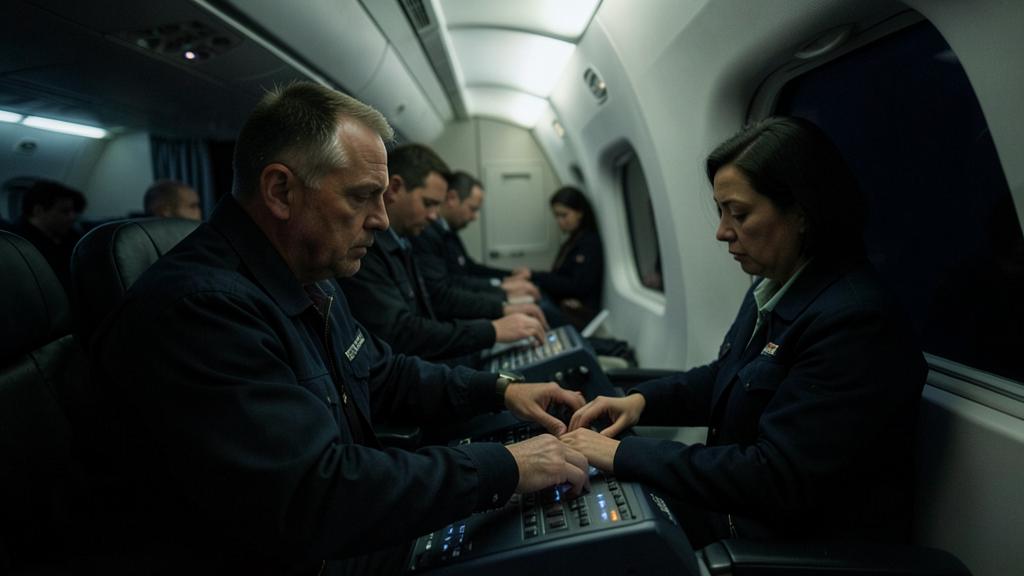
- Circadian debt affects procedural tasks first, not just visible drowsiness.
- Service work masks fatigue until descent, when workload drops.
- Cross-checks, slide-arming, and monitoring are particularly vulnerable.
- Automatic gestures may continue normally while attention wanes.
The matrix gives a strategy, not a guarantee. It assumes an on-time return, and that is where it cracks: a delay does not just move the departure, it above all moves the end of the flight. A departure set on the middle of the physiological afternoon tolerates being pushed back a few hours without harm; the landing, however, slides by just as much, and it is the landing that comes looking for the trough. Yet descent and approach concentrate the workload at the exact moment when alertness is at its lowest and service activity no longer masks it.
A robust plan is therefore judged on the arrival time converted to base time, not just on the departure time: a nap placed as close as possible to departure rather than in the middle of the layover, margin for a second short rest if the wait drags on, and the division of return-leg tasks settled before door closure rather than during descent. The matrix also assumes a crew acclimatised to its base at departure, which is already no longer true by the third day of a sequence: at that point base time is no more than a convenient convention, and the only honest reference is that of the last sleep block actually obtained.
What remains is the collective dimension. The chosen strategy is stated at the layover briefing: a crew in which part stayed on base time and part shifted does not divide up the return-leg tasks the same way and does not place its breaks at the same moments. This is also what makes a fatigue report usable, with the reference time held and the sleep plan actually followed being worth far more than a mention of fatigue with no context.
What to check in your own documentation
Three points deserve a careful read before the next long rotation, and they are not found in the same chapters. First, the way your operator handles acclimatisation in its limitation tables: moving into a state of unknown acclimatisation changes the maximum service times, and knowing the applicable threshold changes the reading of a schedule that looked generous. Next, the provisions on layover rest: minimum duration, but also commitments on room darkening and noise level, since a sound sleep plan collapses behind a window exposed to the midday sun.
Finally, the incapacitation declaration procedure and the fatigue-reporting channel, whose exact wording determines what will be accepted. Anyone preparing a rating or a fleet change would do well to treat these three points as a subject in their own right: it is one of the areas where continuing training resources distinguish crews who endure their schedule from those who anticipate it.
A grey area remains, and it deserves to be named rather than glossed over: the thirty-to-forty-hour layover with a return during local daytime, where neither pure strategy dominates and where the answer depends on the flight direction, the fatigue state on arrival and the actual quality of the accommodation. In this specific case, a partial shift capped at two hours and announced at the briefing beats an implicit choice that nobody actually made.
The applicable regulations, the operations manual and your operator’s approved documentation take precedence over this article, whose sole purpose is to lay out the mechanism behind the rule.
Questions fréquentes
Below what layover duration should you give up adapting to local time?
In practice, under roughly thirty hours on the ground with a six-to-eight-hour offset, adaptation does not have time to occur. Circadian resynchronisation progresses on average by roughly an hour a day eastward and an hour and a half westward: a twenty-four-hour layover covers only a fraction of that. Attempting to shift then amounts to adding a further offset to the one already carried, with no benefit whatsoever for the return flight.
How do I know whether the return flight will fall in my circadian trough?
Convert the return departure time into your base time, then compare it to the two-to-six-in-the-morning window, which corresponds in substance to the window of circadian low performance read in the acclimatised time zone. If the conversion falls in the middle of the day at base, staying on base time puts you at the best point of your curve. If it falls in the depths of the base night, a countermeasure is needed: a nap close to departure and task allocation planned accordingly.
Is it better to take one long sleep, or an anchor sleep followed by a nap?
On a short layover, the two-stage pattern is more robust. The anchor block taken right on arrival pays off the night flight’s debt while sleep pressure is still high, and it is best kept to around five hours. A short nap taken a few hours before departure then recharges alertness for the return. A single sleep that runs too long drains sleep pressure and makes the following nap impossible.
Why is adaptation harder eastward than westward?
The human endogenous rhythm is slightly longer than twenty-four hours, so lengthening one’s day follows the system’s natural slope while shortening it works against it. A westbound flight requires that lengthening, an eastbound flight that shortening. This is why westward resynchronisation runs at roughly an hour and a half per day against an hour eastward, and why eastbound returns are felt for longer.
Can meal times and exercise replace managing light exposure?
No. Light is the primary synchroniser of the circadian clock; meal times and physical activity are secondary signals that reinforce a strategy already decided by light exposure. Aligning them with the chosen reference time is useful, but going out into full sun at the wrong point in the cycle cancels their effect. Caffeine, whose clearance stretches over several hours and varies widely between individuals, should be reserved for the end of the layover.
What should be described in a fatigue report if a delay pushes the departure into the trough?
A report is only usable if it specifies the context: the reference time held during the layover, the sleep plan actually followed, the duration and quality of the rest obtained, and the offset the schedule suffered. These elements feed the operator’s fatigue risk management programme. If the state observed no longer allows safety duties to be carried out, it is the operations manual’s incapacitation declaration procedure that applies.


Leave a Reply
You must be logged in to post a comment.