

A passenger falling ill three hours after take-off. On a forty-minute sector, the question comes down to a single sentence: will he hold out until the stand. In the middle of the North Atlantic, the same fainting episode commits the crew for the six hours that follow, and sometimes for a diversion that nobody decides on lightly. The licence is the same, the cabin looks like yesterday’s, the safety drills have not changed. What changes when you move to long-haul is the time available before the ground — and the whole job reorganises itself around that single variable.
The time available before the ground
On a short-haul network, the distance to a usable aerodrome is counted in minutes. The crew works permanently with a nearby way out: you interrupt the service, you stabilise, you report, and the matter is settled on the ground. The cabin inherits there a perfectly rational culture of deferral — deferring is the right answer when the wheels touch the concrete within a quarter of an hour.
Over an oceanic or polar sector, that door closes. Depending on the route and the diversion area authorised for the operator, the nearest aerodrome may be two or three hours away. The event is no longer a parenthesis to be endured: it is a situation to be managed, with relief, with traceability, and with a consumption of resources — therapeutic oxygen, ice, available staff — which itself becomes a parameter of the decision.
On short flights, you can wait for the ground to handle problems. On long flights, you must manage issues yourself because the nearest airport is hours away. This changes how crews plan and act.
On a Boeing 787 flying from Paris to Singapore (14,000 km, 14h30 flight time), a medical emergency at 3h30 into the flight means the crew must assess the passenger’s condition for the next 11h, manage oxygen supply, and decide if a diversion is needed to the nearest airport (e.g., Delhi, 3h away).
This shift appears as such in no manual. It is deduced: for an event of equal duration, long-haul lengthens by an order of magnitude the period during which the cabin crew is the sole decision-maker in its own domain. Everything else — autonomy, the shape of the roster, sleep management — is merely a consequence of it.
Autonomy is not a title, it is arithmetic
The senior cabin crew member no longer simply informs the flight deck of a situation that will end on the ground. He or she supplies the elements of a diversion decision, which presupposes three things that medium-haul almost never requires. First a projection: not the passenger’s condition now, but his probable condition in four hours. Then an inventory: what is genuinely available on board — first-aid kit, emergency medical kit usable by a practitioner who happens to be travelling, oxygen reserve and duration of supply at a given flow rate. Finally a reading of the cost of the option, because diverting consumes crew limits, passengers to be re-routed and an aircraft off its line.
The link with the contracted ground-based medical assistance service also changes the nature of the exchange. The recommendation comes from outside, it rests on what the cabin describes, and the quality of the report directly conditions the quality of the advice. Describing a patient to a remote doctor is a long-haul skill, not a formality.
The same lengthening applies to the other classics. An unruly passenger can be contained for forty minutes; over ten hours, an escalation has to be decided on early, surveillance organised, relief planned and everything documented as it happens. A battery thermal runaway does not end when the flame is out: the item must remain monitored and cooled for hours, whereas on a short sector the landing settles the question. In both cases it is not the procedure that differs, it is the length of time over which it has to be sustained.
The trap. Importing the reflex of deferral. On a long sector, a twenty-minute wait taken “just to see” is not neutral: it is paid for in distance flown beyond the last favourable decision point. The right question is never “must we act now” but “where will we be when it is no longer possible to choose”.
The economics of the roster: the units counted are no longer the same
On medium-haul, the workload variable is the number of sectors per duty day and the report time. On long-haul, it is the number of days away and the position of the night stops. The cumulative duty-time ceilings over seven, fourteen and twenty-eight days therefore do not bite in the same place: on one side they penalise a run of dense days, on the other they mainly frame flight time per rotation and the recovery rest owed after exposure to time-zone shift.
One more tempting equivalence has to be given up: a layover day is not a rest day. It is constrained time, spent far from base, at a body-clock hour that is not the local one, with a return to duty to prepare for. A long-haul month often counts fewer worked days than a medium-haul month, but the remaining days do not spread out: they arrive in blocks, and life outside work reorganises itself accordingly.
| Dimension | Medium-haul | Long-haul |
|---|---|---|
| Planning unit | the sector, the duty day | the rotation, the block of days |
| Time to a usable aerodrome | a few minutes | up to a few hours |
| Nature of a cabin event | to be contained until arrival | to be managed over time |
| Dominant regulatory constraint | cumulative duty over consecutive days | flight time per rotation, recovery after time-zone shift |
| Crew complement carried | close to the regulatory floor | above it, to staff the service and in-flight rest |
| Main origin of fatigue | repeated partial deprivation | circadian desynchronisation |
| Recovery | full nights at base | fragmented nights, deferred recovery |
| Upkeep of safety drills | daily repetition | scarce cycles, deliberate upkeep |
On crew complement, the regulatory floor is the same on both sides: one cabin crew member per fifty installed passenger seats. The difference lies in what is added to it. Long-haul carries above that floor, not out of generosity but because a long service has to be staffed at the same time as everyone must be able to take in-flight rest without dropping below the minimum required crew.
Two sleep debts, two countermeasures
The word fatigue covers two mechanisms that have neither the same cause nor the same treatment. Medium-haul manufactures chronic partial deprivation: report times before the biological hour, awakenings torn from the circadian low, days strung together without the following night giving back what has been taken. Long-haul adds something else: desynchronisation. The internal clock stays set on base time for several days, and sleep is asked for out of step with what that clock commands.
The night-time efficiency low, situated in the early morning on reference time, does not move at the speed of the aircraft. Resynchronisation is counted in days, of the order of one day per hour of time difference, and it is slower eastbound, where the clock has to be advanced, than westbound where it merely has to be put back. This asymmetry is not a crew member’s impression: it is the consequence of an endogenous rhythm slightly longer than twenty-four hours.
| Medium-haul | Long-haul | |
|---|---|---|
| Dominant mechanism | cumulative partial deprivation | desynchronisation, then deprivation |
| Early sign | drop in alertness on the last sector, irritability | early awakenings impossible to make up, shifted appetite |
| What makes it worse | alternating very early and very late report times | layover too short to sleep, light received at the wrong moment |
| Countermeasure in flight | energy management, short breaks, hydration | allocation of rest, darkness, control of sleep inertia |
| Countermeasure on the ground | protecting the night before an early report | choosing the layover strategy before departure |
In-flight rest and the layover: a resource to be allocated
In-flight rest is not a tolerated break, it is a regulatory counterpart. The duty-time extension granted to an augmented crew is traded against the quality of the facility provided: a horizontal bunk in a separate compartment does not open the same entitlements as a seat separated from the cabin by a curtain, which is itself more favourable than a seat in the cabin. The classification of these facilities appears in the operator’s documentation, by aircraft type and by configuration — it is operational data, not a detail of comfort.
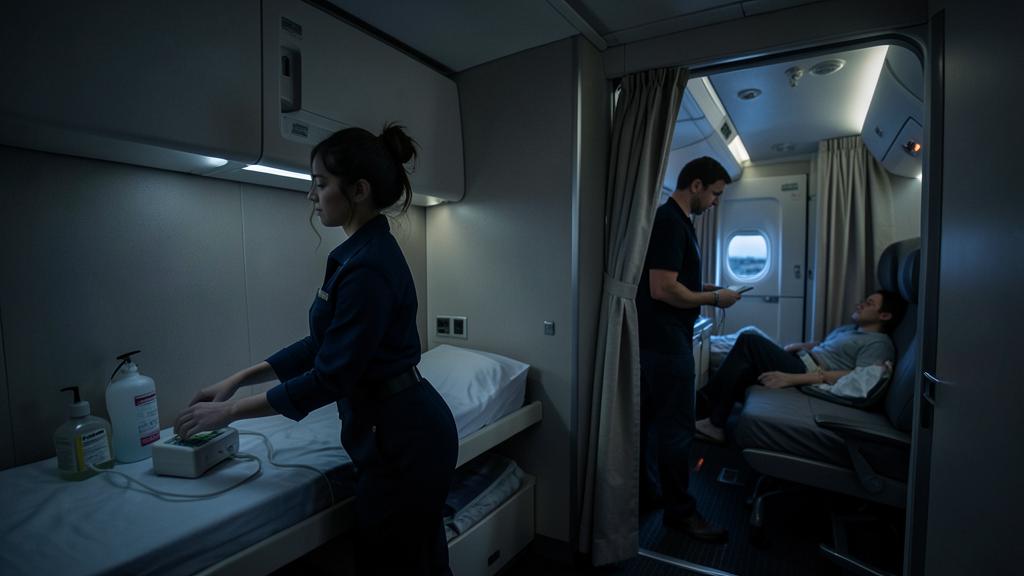
The allocation counts as much as the duration. The first rest is the hardest to obtain: the service pushes to delay it, and falling asleep is slow for anyone who has not yet built up a debt. The last rest protects the most demanding phase, but it leaves a sleep inertia that must have dissipated before the start of descent. An allocation decided by seniority rather than by base time produces crews rested at the wrong moment.
The right reflex. Set the allocation of rest periods at the briefing, reasoning on base time and on arrival time, never on rank. And state the margin explicitly: the last rest ends early enough for the inertia to have passed when the descent begins, which means counting backwards from the estimated landing time.
The layover obeys the same logic of anticipated decision. Three strategies exist and only one is right for a given rotation: staying anchored on base time, switching decisively to local time, or holding a hybrid regime based on an anchor sleep. The criterion is not the time difference alone but its combination with the length of the layover and the report time for the return.
A short layover with a large time difference is handled by refusing to adapt: sleeping on base time, even if it means going out at odds with the local time zone. This is counter-intuitive for anyone coming from short-haul, where sleeping through the local night is always the right answer. These trade-offs are passed on mainly between peers, and discussions between aircrew often say more than a company notice.
What the switch changes for anyone preparing for the qualification
One grey area deserves to be named, because it does not show up on a roster. Long-haul makes cycles rare: two or three landings in the week instead of several in a single day. The safety drills — arming and disarming doors, opening in emergency mode, evacuation — lose the repetition that kept them alive. Recurrent training is still due, but it does not replace frequency. The compensation is individual: reviewing the location of equipment before each flight, silently verbalising the door briefing, mentally running through the evacuation sequence during taxi.
Three checks are worth making in one’s own documentation before applying, and not after selection: the policy for allocating in-flight rest and the classification of facilities by aircraft in the fleet; the recovery rules after exposure to a marked time-zone shift, which determine real availability between two rotations; the procedure for calling medical assistance, with what is expected of the cabin in terms of reporting. These are the three points on which one operator differs from another, far more than on the service.
Finally, what is assessed in an internal selection is not mastery of the service but the ability to manage a long event and to report on it in writing. Working on the drafting of an occurrence report is worth more than revising tray references; it is an angle found again in the training programmes designed for aircrew, and it discriminates more than one might think.
This article sets out mechanisms; it replaces nothing. The applicable regulation, the associated certification specifications and the operator’s approved documentation — operations manual, cabin procedures, fatigue risk management scheme — prevail in all circumstances over what is written here.
Questions fréquentes
Does in-flight rest interrupt the duty period?
No: it is taken inside the flight duty period, which it allows to be extended when the crew is augmented. The extension granted depends on the quality of the rest facility, a horizontal bunk not opening the same entitlements as a seat in the cabin. The classification adopted for each aircraft in the fleet appears in the operator’s documentation.
Should you adapt to local time as soon as you arrive on a layover?
Not systematically, and this is the most frequent mistake made by those arriving from medium-haul. On a short layover with a marked time difference, it is better to stay anchored on base time and organise your sleep accordingly, even if it means living out of step with the local time zone. Switching to local time generally only becomes worthwhile from two nights on the spot, because resynchronisation is counted in days and not in hours.
Why is long-haul fatigue felt several days after the rotation?
Because the debt is not only quantitative: the internal clock remains desynchronised after the return and continues to command sleep at the wrong hours. Realignment takes of the order of one day per hour of time difference, and it is slower when the clock has to be advanced, that is on return from a trip eastbound. Recovery rest at base serves precisely to cover that period.
How many cabin crew members are required on board a long-haul aircraft?
The regulatory floor is identical to that of medium-haul: one cabin crew member per fifty installed passenger seats. The actual complement on a long-haul flight is above that floor, because a long service has to be provided and in-flight rest made possible without ever dropping below the minimum required crew. The figure applicable to each aircraft and each configuration is set out in the operations manual.
Does moving to long-haul cause a loss of safety competence?
The qualification is not lost, but the frequency of real drills collapses: a few landings a week replace several cycles a day. Recurrent training maintains the required level, it does not restore the repetition. The compensation is individual and is played out before each flight, by reviewing the location of equipment and mentally rehearsing the opening and evacuation sequences.
Does a layover day count as a rest day?
No, neither in roster terms nor in physiological terms. Rest away from base is regulated and cannot be arbitrarily shortened, but it takes place out of phase, far from home, with a return to duty to prepare for, and it does not restore what a night at base provides. That is why the regulation additionally requires recovery rest after significant exposure to time-zone shift.


Leave a Reply
You must be logged in to post a comment.