
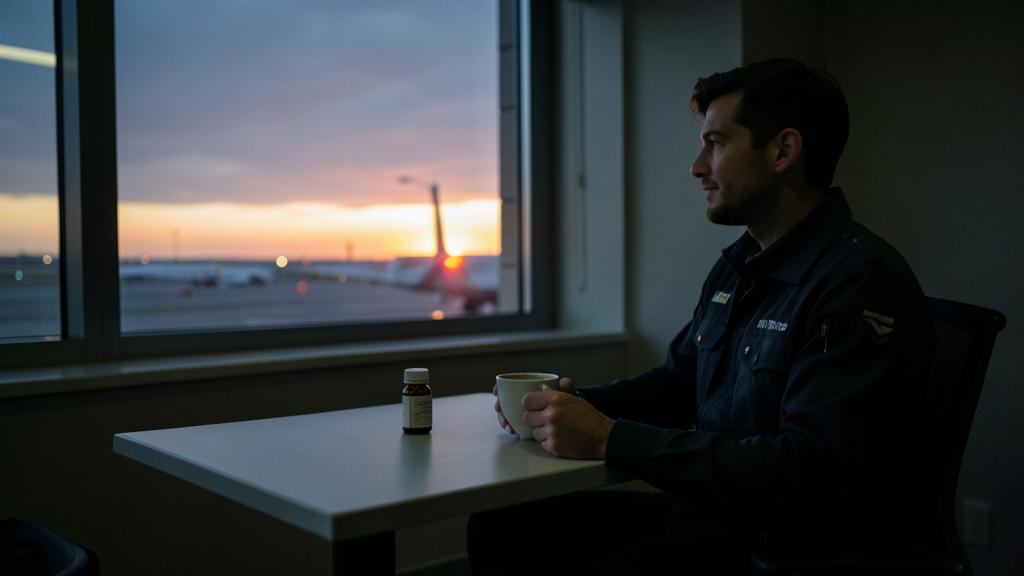
Return from a long-haul flight heading west, a nine-hour time difference, a hotel room at three in the afternoon local time. A coffee in the crew rest room before leaving the airport, curtains drawn on arrival, melatonin at ten in the evening local time, waking at three in the morning wide awake and useless for the evening service. All three levers were pulled. None was placed. That is the difference between stacking tools and ordering them, and that order cannot be read off the local clock.
The useful reference is not local time, it is the temperature trough
The internal clock does not set itself to the time zone; it has a phase, and that phase is located by an observable event, the minimum of core body temperature. It falls near the end of the biological night, typically one to three hours before the habitual wake time, and it serves as the pivot for everything else: melatonin secretion rises several hours before it, alertness is at its lowest around it, the upward slope of temperature accompanies waking. No crew measures its core temperature on layover. That is not necessary: the trough is estimated from the habitual wake time at base, then converted to the local time of the destination.
The exercise takes two lines and it changes everything. Habitual wake time at six thirty base time: the trough sits around four thirty, base time. On a destination nine hours west, this trough falls at seven thirty local time the previous evening. In other words, on arrival the body places its biological night over the local evening, and late-afternoon light falls before the trough. On a destination seven hours east, the same trough falls at eleven thirty local time: the early-morning local light, the light one spontaneously seeks by going for a walk to “reset,” also falls before the trough.
The shift of the trough is not instantaneous. The clock moves by a fraction of a day per twenty-four hours — on the order of one hour a day in the advancing direction, a little faster in the delaying direction. The estimated trough must therefore be recalculated every day of the layover, shifting it by as much as was gained the day before. A crew that reasons on day two with day one’s position applies its levers to the wrong spot.
Your body’s internal clock doesn’t just follow the local time. It has its own rhythm, marked by the lowest point of your body temperature (the “trough”). This trough moves slowly when you travel across time zones. To adjust properly, you need to know where this trough is in the new time zone, not just what the clock says.
An A330 crew flying from Paris to Los Angeles (9 hours west) lands at 4 PM local time. Their habitual wake time in Paris is 6:30 AM, so their trough is around 4:30 AM Paris time. Converted to LA time, that’s 7:30 PM the previous day. So at 4 PM local time, they’re still in their biological night. If they go outside for light exposure, they’ll actually delay their adjustment instead of helping it.
Light: the same exposure advances or delays depending on which side of the trough
Light is the only lever that clearly moves the clock, and it is also the only one whose effect changes sign within the day. Received in the hours before the trough, it delays the phase: the body pushes its night later. Received in the hours after, it advances the phase: the body pulls its night forward. Right around the trough, the effect flips from one sign to the other within a short span, which explains why the same morning outing can produce two opposite results two days apart.
Three parameters modulate the amplitude: intensity, duration, and spectral content. The orders of magnitude are worth keeping in mind, because they are counter-intuitive. A well-lit hotel room or a cabin in service tops out at a few hundred lux; an overcast sky outdoors comfortably exceeds a thousand; full sunlight runs into the tens of thousands. The practical consequence is blunt: staying indoors with the curtains open does not constitute exposure. Walking outside for twenty minutes, even under a grey sky, does.
Darkness is a symmetrical and too-often neglected lever. Avoiding light on the wrong side of the trough is worth as much as seeking it on the right side: dark glasses on stepping off the aircraft when arrival is in the local early morning after an eastbound flight, blackout curtains actually closed, screens dimmed to the minimum if they cannot be avoided. On a short layover, avoidance is even the only lever really available.
Caffeine masks the debt, it does not move the clock
Caffeine acts on a different layer than light does. It occupies adenosine receptors, a molecule that accumulates during wakefulness and signals sleep pressure. The signal is blocked, drowsiness recedes; the debt, meanwhile, keeps building at the same rate and will present itself in full when due. It is a tactical mask, useful and legitimate, that does nothing at all to the phase of the clock. Expecting a coffee to help “reset” to local time is like expecting a coat of paint to change the framing.
The quantity that matters for placing it is its half-life, on the order of five hours in an adult, with considerable variation from one person to another — hepatic metabolism varies genetically, certain hormonal treatments lengthen it, tobacco shortens it. In practical terms: a mid-afternoon dose still leaves roughly half of it in circulation by early evening, and about a quarter at bedtime. That quarter is enough to fragment sleep and shave down deep slow-wave sleep, even in someone who falls asleep with no trouble and who will swear the next day that coffee does nothing to them.
The placement rule follows without arbitrariness: the last dose should sit at least two half-lives before the targeted sleep time, on the order of eight to ten hours for an ordinary metabolism. The caffeine-nap tactic remains compatible with this: caffeine followed immediately by a short nap, with the absorption peak arriving at the moment of waking from the nap — provided that waking is well clear of the main sleep window.
Caffeine doesn’t reset your internal clock – it just temporarily blocks your brain’s signals that you’re tired. If you drink coffee too late in the day, you’ll still feel the effects when you try to sleep, even if you don’t realize it’s keeping you from getting good quality sleep.
A B787 captain flying from Tokyo to London (9 hours east) lands at 8 AM local time. Their trough is estimated at 4:30 AM base time (Tokyo), which is 1:30 PM London time. If they have coffee at 3 PM (just 2.5 hours before their trough), about 25% of that caffeine will still be in their system when they try to sleep, potentially disrupting their sleep quality even if they fall asleep easily.
Melatonin is a time signal, not a sleeping pill
Exogenous melatonin also acts according to the timing of the dose, and its phase effect is roughly the mirror image of light’s: taken in the hours before the start of the biological night — so well before the trough — it advances the clock; taken after the trough, in the biological morning, it delays it. This is not a dosing detail, it is the mechanism itself: the body reads it as the announcement of evening. Announcing evening at the wrong moment shifts the clock the wrong way.
This chronobiotic effect must be distinguished from the sedative effect, which appears mainly at high doses and is neither the same thing nor necessarily desirable. A heavily dosed intake in the middle of the local day can induce sleep without advancing anything, dull the alertness of a crew that needed to stay up, and scramble the light lever that had just been correctly applied. For jet lag, it is the timing of the dose that does the work, not the amount.
The legal and medical framework, for its part, is not derived from any chronobiological reasoning. Depending on the country, melatonin is treated as a food supplement at low doses or as a medicine above a certain threshold; use by an active crew member falls under the operator’s policy and the aviation medical examiner’s opinion, with the usual precautions regarding interactions, medical history, and the period immediately preceding a duty. The practical principle fits in one sentence: nothing that affects alertness gets decided alone between two flights.
Ordering: light decides, the rest falls into line
The order is not a matter of style, it follows from what precedes. First, set the target: is the clock actually going to be shifted, or kept on base time? That decision depends on the length of the layover and the sequence of duties that follow, not on any wish to experience the layover on local time. Second, estimate the trough and convert it to local time. Only third, place the light sought and the light avoided. Fourth, if needed, set melatonin at the far end of the arrangement, in the same direction as the light. Fifth, place caffeine to hold the imposed periods of wakefulness, checking that it does not fall within two half-lives of the sleep window.

The classic trap. Morning arrival after an eastbound flight: the crew heads out for a walk in the sun “to reset.” At that moment the body’s trough has not yet passed — it will fall later, in the local late morning. This light delays the clock when it needed to be advanced: it moves further from the goal instead of closer, and the deficit is paid over the following two days. The first days of an eastbound layover should instead be handled by avoidance in the morning and exposure late in the day.
The reflex that avoids it. Before stepping off the aircraft, write down two lines: habitual wake time minus two hours, then convert to local time. That hour is the pivot of the layover. Every decision about exposure, darkness, or melatonin is made by comparing it to the room’s clock, and is recalculated each morning by shifting it roughly one hour in the intended direction.
| Situation | Clock target | Light sought | Light avoided | Melatonin | Caffeine |
|---|---|---|---|---|---|
| Short layover, under two nights | None: stay on base time | During hours when base is in daytime | During hours when base is at night, whatever the local day | Not applicable, except to anchor a base-time nap | At the start of duty, never in the hours before the anchor sleep |
| Long layover, eastbound flight | Advance, on the order of one hour per day | After the trough: late morning then local afternoon, outdoors | Before the trough: local early morning of the first two days, dark glasses on landing | Early local evening, before the trough, consistent with daylight | After waking, stopped by local midday |
| Long layover, westbound flight | Delay, easier to achieve than an advance | Before the trough: late afternoon and local evening | After the trough, if too-early waking sets in | Possibly local morning, if the delay is slow to come | Local late afternoon, to hold until the targeted bedtime |
| Overnight return to base | Recover without shifting | Full light in the middle of the day after recovery sleep | Return journey in the early morning, room blacked out | Rarely justified: the phase does not need to move | Single dose at the end of duty, never after landing |
Short layover: the best shift is often no shift at all
On a layover of twenty-four to thirty-six hours, trying to shift the clock is a poor economy: the cost of the move is paid without ever reaching the target, and the crew returns with an intermediate phase that suits neither the destination nor the base. The workable strategy is to hold the anchor: sleep over the span corresponding to the base night, even if it falls in the middle of the local afternoon, and handle the imposed waking periods with tactical means — a short nap, well-placed caffeine, bright light during wakefulness.
This choice has material consequences worth anticipating: a room on the quiet side, blackout checked on arrival rather than at bedtime, an effective do-not-disturb, shifted meals. It also has a social consequence, which is the real difficulty: turning down the collective late-afternoon outing when it falls on the anchor sleep window. That is where the reasoning about the trough helps, because it turns a choice that feels personal into an operational fact that can be discussed with the crew.
What to check in your own documentation
The reasoning presented here is physiological; it replaces neither flight and duty time limitations, nor the operator’s fatigue risk management system, nor applicable medical policy. Three points deserve to be checked in your own texts rather than assumed. The first is the status of melatonin and sleep aids: authorization, minimum delays before a duty, the obligation to inform the aviation medical examiner. The second is what the manual provides for layover rest — minimum blackout duration, the hotel’s commitment to quiet and darkness, the possibility of requesting a room change — because such clauses often exist and are little used. The third is the fatigue reporting channel: it is the only route by which a rotation whose construction makes adaptation impossible eventually gets corrected.
One grey area remains that nothing will resolve: the trough estimate rests on a habitual wake time, a notion that is not very stable for someone who chains night duties, reserve, and irregular rest. When that reference no longer exists, the reasoning loses precision and the only robust lever again becomes sleep itself, in quantity, wherever it falls. For anyone preparing a qualification or an interview where fatigue management comes up, that is exactly the nuance expected: knowing how to state the mechanism, and knowing at what point it stops applying. The FL330 training programs cover this aspect within the broader framework of threat and error management.
In case of any discrepancy between this text and what the applicable regulations, the operator’s approved documentation, and the aviation medical examiner’s opinion prescribe, the latter prevail without discussion: this article explains a mechanism, it creates no rule and authorizes no practice.
Questions fréquentes
How can you estimate your temperature trough without measuring anything?
Start from your habitual wake time at base and subtract roughly two hours: the core temperature minimum falls in the last third of the biological night. That hour is then converted to the layover time zone, and it serves as the pivot for every exposure decision. It must be shifted by about one hour per layover day, in the intended direction, because the clock moves slowly.
Should you always seek out morning light on arrival at your destination?
No, and in one common case it is actually counter-productive. After an eastbound flight with a morning arrival, the body’s trough has not yet passed: light received at that moment delays the clock when the goal is to advance it. The first two days should be handled by avoidance in the morning, dark glasses included, and exposure late in the local day.
What time should you stop drinking coffee before a layover sleep?
Caffeine’s half-life is on the order of five hours, with strong individual variability. The workable rule is to place the last dose at least two half-lives before the targeted sleep window, on the order of eight to ten hours for an ordinary metabolism. Beyond falling asleep, it is the continuity and depth of sleep that suffer, without the sleeper noticing.
Does melatonin help you sleep in the middle of the local day?
Two effects must be distinguished. The chronobiotic effect, which shifts the clock, depends on the timing of the dose rather than the amount: before the trough it advances the phase, after the trough it delays it. The sedative effect appears mainly at high doses and can induce sleep without shifting anything, or even work against the light lever applied the same day. Use by a crew member falls under the operator’s policy and the aviation medical examiner’s opinion.
On a twenty-four-hour layover, is it better to switch to local time?
No. A layover that short does not allow the destination phase to be reached, and the crew returns with an intermediate clock that no longer suits the base either. The workable strategy is to keep the anchor on base time, sleep over the span corresponding to the base night even if it falls during the local day, and handle the imposed wakefulness with tactical means.
What should you do when duty requires being awake during your own trough?
The clock is not shifted on that timescale: it is masked and protected instead. A short nap before duty when possible, well-placed caffeine to cover the lowest period, bright light and activity during wakefulness, then protected recovery as soon as possible. If the rotation’s construction repeatedly makes adaptation impossible, fatigue reporting is the only route that can change it.


Leave a Reply
You must be logged in to post a comment.