
A landing gear fitting whose quoted lead time runs well past a year, and a buyer asking why the other supplier isn’t simply used instead: the scene replays itself at every titanium tension. The answer is neither commercial nor logistical. It comes down to what one actually buys when buying aerospace titanium — not a metal, but a melting practice, a traceability chain, and a statistical property base that took years to build. As long as these three things do not exist at the second supplier, it is not a source, only a producer.
From sponge to billet: four transformations, four approvals
Titanium is not found in metallic form. It occurs as an oxide, in ilmenite and rutile, and the path from that dark sand to a machined fitting involves four major transformations, each carried out in a different plant, each approved separately.
First stage, chlorination. The oxide reacts with chlorine in the presence of carbon to give titanium tetrachloride, which is purified by distillation. The purity of the final metal is already decided here: whatever is not removed at this stage will never quite be removed later.
Second stage, reduction. The tetrachloride is reduced with magnesium under an inert atmosphere, in retorts that run batch cycles lasting several days. The product is a porous mass, the sponge, which is extracted, crushed and sorted. The magnesium chloride formed is electrolysed to regenerate magnesium and chlorine: the loop is closed, but power-intensive. This is why these plants are built where energy is abundant and cheap, not where the airframers are.
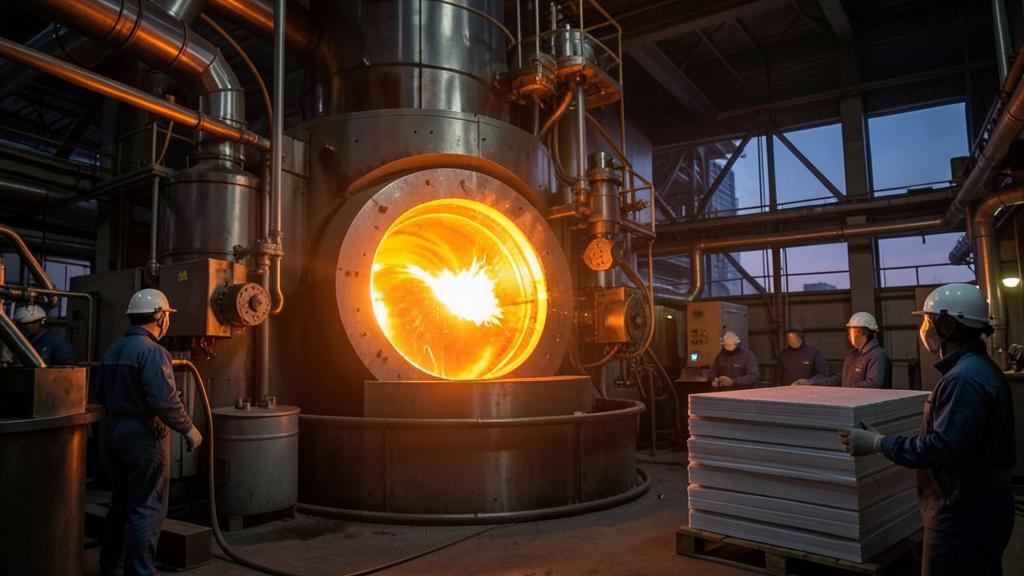
Third stage, melting. The sponge is blended with alloying elements and a share of revert, pressed into compacts, assembled into a consumable electrode, then vacuum arc remelted. A single melt is never enough: it is remelted twice, three times for the most critical parts, and a cold-hearth melt, using an electron beam or plasma, is sometimes inserted, whose role is not to alloy but to trap whatever has no place in the melt pool.
Fourth stage, conversion. The ingot is worked into billet, bar, sheet or plate, through thermomechanical cycles that set the microstructure as much as the geometry. Only after this do forging, machining and surface treatments come in.
Aerospace titanium isn’t just a metal—it’s a carefully controlled process. Each step from ore to final part must be approved separately, and switching suppliers means rebuilding years of quality data. You can’t just buy titanium; you buy the entire history of how it was made.
A Boeing 787 landing gear fitting might require titanium billet from a specific melting practice. If the original supplier has a 12-month lead time, switching to a new supplier would require at least 24 months of testing and approvals, even if the new supplier meets the same chemical specifications.
None of these stages can substitute for another, and none can be duplicated within a few months. A reduction retort, a vacuum arc furnace, a high-capacity forging press are investments whose horizon is measured in years and whose order book is booked quarters in advance. This is the first structural reason for the inertia: upstream capacity is physically rigid.
What is actually being paid for: melting practice
The grade is what appears on the drawing, but it is not what makes the value of the ingot. What makes it is the absence of defects that chemistry does not see.
Two families haunt the trade. High-density inclusions come from tooling or poorly sorted scrap: a fragment of refractory metal that does not melt in the pool and ends up trapped in the ingot. So-called hard-alpha defects are more insidious: zones enriched in nitrogen or oxygen, stabilised in the alpha phase, very hard, very brittle, and whose modulus differs from the surrounding metal. Under cyclic loading, such a zone cracks first and initiates a failure without anything having signalled its presence. The failure of a titanium fan disc in the late nineteen-eighties, attributed to a defect of this type, durably fixed the practices of the sector: multiple remelts, cold-hearth melting, ultrasonic inspection of billets at several zones, limitation and traceability of manufacturing revert.
From this follows a distinction that the practitioner knows by name but rarely measures the cost of: so-called rotating-grade quality and structural-grade quality do not come off the same production line. The former imposes a heavier melting practice, a smaller and better-traced share of revert, finer non-destructive inspection, and documentation that must be kept for the entire life of the part. Both qualities can carry the same alloy designation. They are not interchangeable, and the price per kilogram does not compare from one column to the other.
Grades are not variants of the same thing
Aerospace titanium is not a single material but a family whose members share neither the processes, nor the service temperatures, nor the sources.
| Family | What it provides | Its limit | Common use |
|---|---|---|---|
| Unalloyed titanium, commercially pure grades | Formability, weldability, corrosion resistance | Low mechanical strength | Ducting, hot sheet metal parts, scoops, low-pressure piping |
| Common alpha-beta alloy, 6-4 type | Best-documented strength-to-weight compromise, abundant allowables | Limited hardenability in thick sections | Fittings, frames, engine mounts, low-pressure compressor blades |
| Heavily alloyed metastable beta alloys | High strength retained in thick sections | Demanding heat treatments, difficult machining, scarce sources | Large landing gear parts, heavily loaded fittings |
| High-temperature alloys | Properties maintained beyond the range of common alloys | Thermal ceiling well below that of nickel-base alloys, beyond which a different material family is required | Front compressor stages, hot rotating parts |
| Low-alloy piping alloy | Seamless, bendable, pressure resistance for reduced mass | Very concentrated tube supply | High-pressure hydraulic circuits |
Substituting one grade for another on the grounds that the data sheet announces similar properties amounts to ignoring everything the data sheet does not say: notch sensitivity, cracking behaviour, response to heat treatment across the actual thickness of the part, compatibility with the welding and surface-treatment processes already qualified. Added to this is a constraint peculiar to titanium: beyond a certain temperature and in the presence of friction, it burns. This limit dictates compressor architecture far more than the cost of the metal.
Finally, titanium machines poorly. Its poor thermal conductivity concentrates heat on the cutting edge, its reactivity attacks the tool, its relatively low modulus favours elastic spring-back and chatter. Cutting speeds sit an order of magnitude below those of aluminium: machining capacity is a bottleneck just as much as melting capacity.
Why composites drove up demand for titanium
The point is counter-intuitive for anyone who associates composite with metal weight reduction: every square metre of carbon added to an airframe increases the amount of titanium surrounding it.
The reason is electrochemical. Carbon is strongly cathodic. Brought into contact with an aluminium alloy in the presence of moisture, it turns the aluminium into a sacrificial anode and corrosion sets in at the interface, precisely where the loads pass. Titanium, by contrast, is practically inert with respect to carbon, and its coefficient of thermal expansion is markedly closer to that of a laminate than aluminium’s is: the joint does not work in fatigue on every thermal cycle. The result is that everything that passes through or holds a composite panel — attachment fittings, splice plates, fasteners, cut-out frames — migrates toward titanium.
This migration cannot be corrected by design: it stems from a primary material choice made ten years earlier. It also explains why the tension on titanium follows the programme cycle more than the rate cycle: a rate increase on an airframe with a high proportion of composite consumes more titanium per aircraft than an equivalent rate increase on a metal airframe.
Qualifying a second source means buying a statistic
This brings up the question that triggers every discussion: why not simply open a second supplier that meets the same specification?
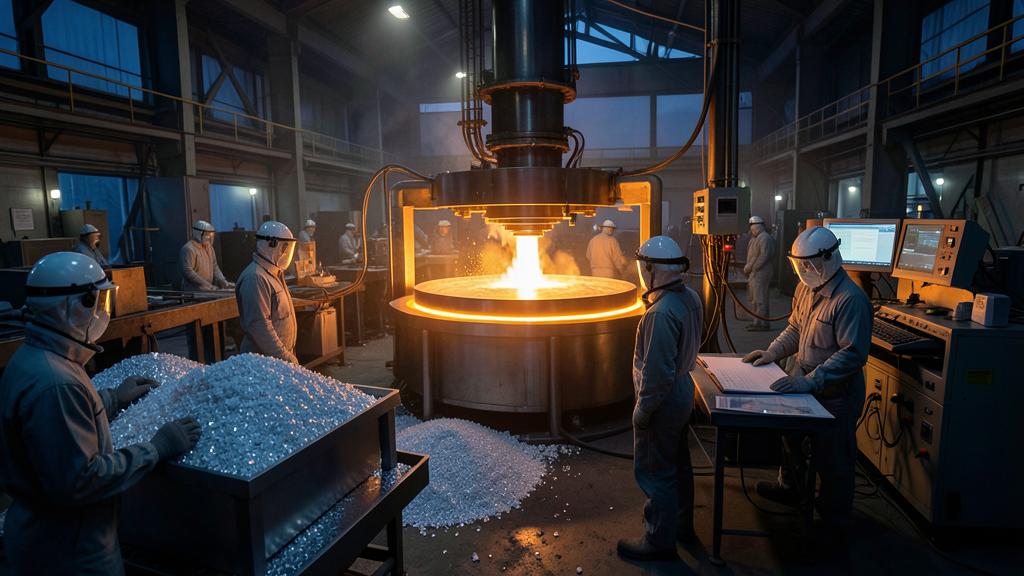
Because the specification is not enough to define the product. The design office does not size parts using the value measured on a test coupon, but using an allowable value: a lower bound of the population, coupled with a confidence level. Recognised property compendia distinguish a basis covering nearly the entire population, required for elements whose failure alone would compromise the structure, and a less severe basis, allowable for redundant elements. This bound depends on scatter, and scatter can only be known by multiplying heats, positions within the ingot, thicknesses and operators. With three lots, the statistical uncertainty forces a knock-down so severe that the metal appears mediocre when it is in fact excellent.
To this property base are added the special processes. Heat treatment, non-destructive inspection, chemical surface treatment, welding: each falls under its own sector accreditation and process qualification at the chosen supplier, with its control charts, calibrated pyrometers and certified operators. Next comes first-article inspection, which checks characteristic by characteristic everything the definition carries, then, depending on criticality, tests on the actual part rather than on a coupon.
Finally, none of this counts for anything without the decision of the design definition holder. Adding a source on a critical part constitutes a design change, whose classification determines the depth of substantiation and the level of approval required. It is the approved design organisation that classifies, substantiates and bears the responsibility; the operator and the workshop are left with the resulting schedule.
Three ways out, three horizons
Faced with a lasting tension, there is not one option but three, and they do not play out on the same timescale.
| Route | What must be demonstrated | Who decides | Realistic horizon |
|---|---|---|---|
| Add a source for the same specification and the same grade | Equivalence of melting practice, trial heats, coupons, first-article inspection | Design definition holder, with the authority depending on classification | On the order of two to three years for a critical part |
| Change grade at constant geometry | New allowables base, fatigue and crack-growth behaviour, requalification of special processes | Design definition holder, generally a major change | Longer than adding a source, part-level testing almost systematic |
| Change production route at constant grade, forging to additive manufacturing | Control of porosity, anisotropy, effect of isostatic pressing, suitable non-destructive inspection | Design definition holder and authority, process still young on loaded parts | Credible first on secondary parts and spares |
| Redesign the part in another material | Complete redo of sizing, interfaces, galvanic corrosion, mass, recurring cost | Design office, programme-level arbitration | Full development cycle, out of reach of a supply crisis |
The trap. A material specification is not a purchase authorisation. A drawing calls out a specification, but the approved definition is almost always accompanied by a list of approved sources, sometimes named down to the melter and not only the forger. A product that is chemically compliant, delivered with an impeccable material certificate, but produced by a melter absent from that list, is not the approved article. On the maintenance side, the reasoning runs the same way in reverse: a part whose traceability chain shows a break cannot be returned to service, whatever the apparent quality of the document that accompanies it.
The right reflex. Before negotiating a price or a lead time, trace back to the source clause. Read in the material specification the melting-practice clause and the authorised share of revert, check the source note carried by the definition, and ask the design definition holder for a written position on the source under consideration. If the answer opens a qualification, launch it in parallel with the commercial negotiation, not afterwards: the critical path is the statistics, not the contract.
What to go and check at home
Three concrete checks, depending on the position one occupies.
- On the production and procurement side. For your long-lead titanium articles, identify whether the constraint is the melter, the forger or the machinist: months are often lost negotiating with the wrong link. The ratio between mass purchased and mass delivered is a good indicator: beyond a certain threshold, the useful action is to bring the rough shape closer to final dimensions, not to look for a second supplier.
- On the maintenance and airworthiness side. Make sure your receiving procedures distinguish documentary conformity from source traceability, and that your staff know that a conforming certificate does not amount to source approval. Check your documentation’s position on alternative design parts for high-criticality articles.
- On the engineering side. What is presented to the authority is not a plant but a file. The number of heats, the thickness coverage and the representativeness of the coupons determine the allowable value retained, and hence the final mass of the part. A test plan built too short is paid for in knock-down for the entire life of the programme.
One grey area remains that nobody has closed: manufacturing revert. Recycling chips and offcuts is economically obvious, but their traceability is fragile and their admission into rotating-grade quality is tightly bounded. Until this boundary is pushed back by finer sorting and inspection means, a significant share of the titanium purchased by the sector will keep leaving the shop as chips and dropping down to less demanding uses. It is probably here, more than in opening an additional plant, that the room for manoeuvre of the coming years lies. Practitioners preparing this kind of file share their feedback on the FL330 forum.
This text describes general industrial and regulatory mechanisms. In the event of any discrepancy, the applicable specifications, the definition approved by its holder, and the approved documentation of the operator or maintenance organisation prevail over everything stated above.
Questions fréquentes
Why can't titanium compliant with the same specification simply be bought from another melter?
Because the specification describes composition and minimum properties, not the melting practice or the actual scatter of the product. Sizing relies on allowable values — that is, lower bounds coupled with a confidence level — which are only justified with a sufficient number of heats and representative thicknesses. The approved definition additionally carries, for critical articles, a list of approved sources that only the definition holder can modify.
What is the concrete difference between rotating-grade and structural-grade quality for the same alloy?
The alloy designation is the same, but the production line conduct is not. Rotating-grade quality requires additional remelts, often a cold-hearth melt, a smaller and fully traced share of revert, finer ultrasonic inspection of the billet, and documentation kept for the entire life of the part. The two products are therefore neither substitutable nor comparable by the kilogram.
Why does an airframe with a high proportion of composite consume more titanium?
Carbon is strongly cathodic: in contact with an aluminium alloy in the presence of moisture, it causes galvanic corrosion at the interface, precisely where the loads pass. Titanium is practically inert with respect to carbon and its coefficient of expansion is closer to that of a laminate. All the fittings, splice plates and fasteners that hold a composite panel therefore migrate toward titanium, which increases the mass of titanium per aircraft.
How much time should be allowed to qualify a second forging source on a critical part?
As an order of magnitude, two to three years for a programme run without incident: agreement and specification, trial heats and conversion, a coupon campaign to establish the allowables, first parts with first-article inspection, then part-level testing, file and approval. The purely demonstrative phases weigh more heavily than the manufacturing. A scrapped heat early in the process delays everything that follows.
Does additive manufacturing solve the titanium supply problem?
It sharply reduces the mass committed per kilogram delivered, and therefore the pressure on melting and machining capacity, which is a genuine contribution. It does not remove the upstream dependence, since the powder also comes from the same metal and the same processes. On heavily loaded parts, mastering porosity, anisotropy and suitable non-destructive inspection for now keeps its use confined to secondary articles and spares.
What should be checked first when receiving a titanium part in a maintenance workshop?
The continuity of the traceability chain back to an approved source, not merely the apparent conformity of the material certificate. An impeccable document issued by a link absent from the list of approved sources does not make the part eligible for return to service. Your receiving procedures must explicitly distinguish documentary conformity from source traceability, and your staff must know that the latter takes precedence.


Leave a Reply
You must be logged in to post a comment.