
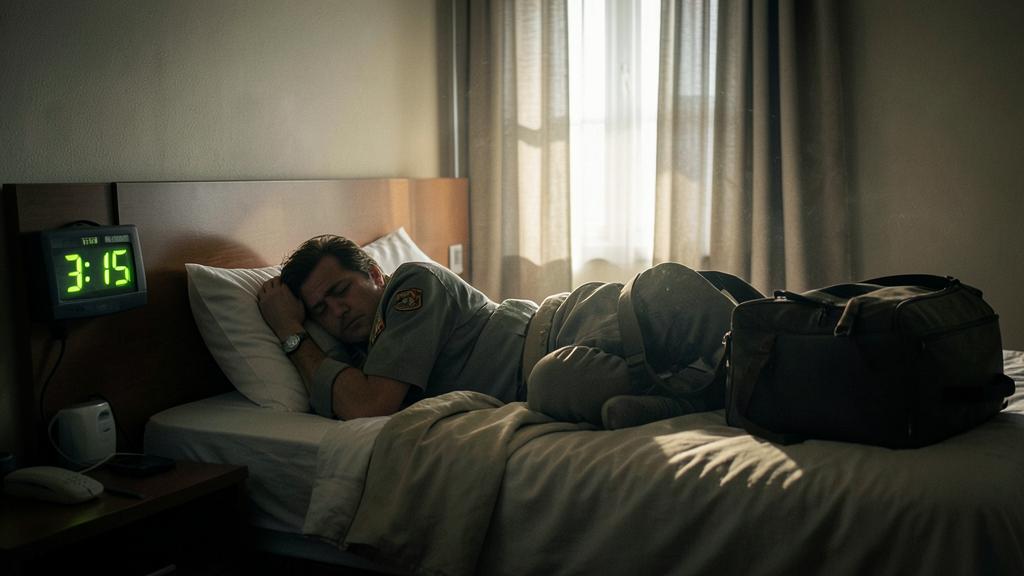
Eight months off, a return cleared, a first roster that strings together three overnights, two of them night duties. The body holds up: the legs cope with the service, the stamina has been back for a long time. It is the fourth day that breaks, without warning — falling asleep proves impossible at the hotel in the middle of the afternoon, then a night flight where self-assessment is no longer worth much. Physical condition was ready; tolerance to irregular hours was not, and no one had measured it.
Two clocks that do not reset at the same speed
The return after a long break — parental leave, sick leave, unpaid leave, ground secondment — is judged almost always by visible signs. One looks at weight, endurance, the ability to stand through a service, sometimes a fitness test. These indicators have one merit: they move fast. Regular retraining restores most of the lost aerobic capacity within a few weeks, and functional strength follows roughly the same timetable. The message the body sends back is genuinely positive, and it is accurate.
Adaptation to irregular hours does not follow that logic. It is not built like an energy reserve but like a setting: that of an internal clock synchronised by light, meals and activity, whose flexibility is maintained through repetition. Several months of regular life — a stable wake time, full nights, daylight at the right moment — reset this clock into a comfortable, and above all solid, position. A well-set clock resists attempts to shift it. That is exactly what one does not need when it is time to sleep at three in the afternoon or stay alert at four in the morning.
Two practical consequences follow. First, speed: the recovery of physical capacity is counted in weeks of training, the recovery of circadian flexibility in cycles of duty actually lived, which is far slower because it cannot be trained at will without degrading something else. Second, order: physical condition reaches its plateau well before tolerance to nights has moved in any clear way. The most exposed period is therefore precisely the one in which one feels fit, and in which colleagues and family alike consider the matter settled.
Your body gets fit quickly, but your internal clock takes much longer to adjust to irregular hours. This means you might feel physically ready, but your ability to sleep and stay alert at odd times hasn’t fully recovered.
A pilot returning after 8 months off starts a roster with three overnights. On the fourth day, they struggle to sleep in the afternoon and feel unusually fatigued during a night flight, even though their physical fitness is good. This shows the gap between physical readiness and circadian adaptation.
What a long break really undoes
Reducing deconditioning to « the clock » is a convenient shorthand. What is actually lost is broader, and much of it has nothing to do with physiology.
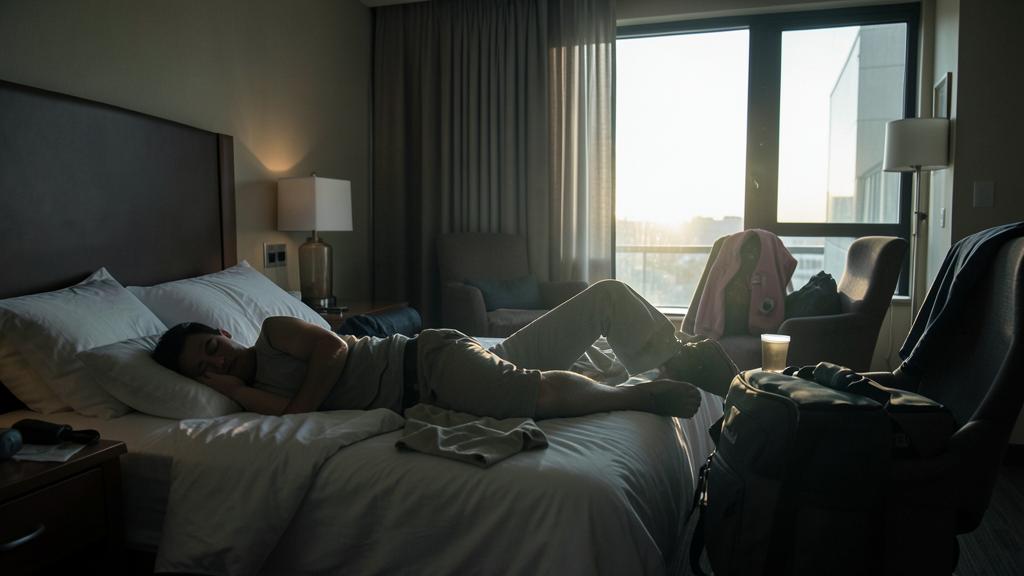
The first element is the ability to fall asleep outside the usual window. Sleeping in the early afternoon before a night duty, or getting back to sleep after an early wake-up on a layover, is a maintained skill: it depends on a routine, on an environment reproduced from one room to the next, and on the absence of performance anxiety. Someone who has slept eight straight months in their own bed no longer knows how to do this. They try, they fail, and the failure itself becomes an arousal factor that feeds the next one.
The second is anchor sleep — that common window kept from one day to the next regardless of the roster, which stops the clock drifting in every direction at once. In regular life it comes free; on an irregular roster it must be defended, and it is defended all the better when the habit has been kept up.
The third is logistical, and it is systematically underestimated: the household, meals, childcare, managing noise and light at home. A domestic organisation set around normal days does not protect daytime sleep; it chips away at it piece by piece — a phone call, a delivery, a school run.
The fourth is the most insidious: the calibration of self-assessment. Estimating one’s own fatigue is a learned judgement, made by comparison with states already experienced. After a long absence, the reference point has been wiped. One underestimates the degradation in the circadian trough because the recent feel of it is gone, overestimates a simple digestive slump, and decides badly in both cases.
What does come back quickly, on the other hand, are the actions. Safety checks, equipment reference points, cabin sequences reinstall themselves within a few rotations, often as early as the first. This is good news and a trap: recovered technical mastery serves as an implicit argument that everything else has followed suit.
The regulation does not know deconditioning
Flight and duty time limitations reason in terms of sequences, time windows and minimum rest. They apply identically to the crew member returning after a long absence and to the one who never stopped. That is consistent: the text sets bounds, it does not steer individual physiology. But the exact consequence must be drawn, and it is rarely stated: at the first roster back, the margin between the regulatory limit and actual capacity is at its lowest, and nothing in the schedule signals it.
The system does nonetheless provide two channels through which this reality can pass. The first is fatigue risk management, where the operator has one: it allows a known factor — here, the return — to be treated as a roster-building parameter, not a personal matter to be quietly sorted out. The second is the declaration of unfitness, whose use is not a failure but part of the system. A crew member who does not consider themselves fit to hold their duty must say so, and say so early — that is, before check-in rather than at the third sector.
Added to this is the part one prepares better because it is formalised: the validity of medical fitness, the maintenance of competence, recurrent training, the refresher of practical exercises after a prolonged absence. These deadlines are written down, dated, checked. They give the illusion of covering the entire return, when in fact they only cover what is verifiable in the classroom, the simulator and the pool.
The trap. The refresher training that reopens the licence to fly almost always takes place during the day: classroom, simulator, pool, on office-hours slots. It therefore checks actions, never the ability to produce them in the depths of the night — the one parameter that has genuinely shifted during the absence is not sampled by the check that authorises the return. The competence-maintenance calendar gives the green light on the day the regulation is satisfied, not on the day one again tolerates a run of nights, and it is the first date that drives the roster.
Spreading out the return to the line: vary only one factor at a time
A return is organised like a protocol, on a principle borrowed from any progressive loading: vary only one factor at a time. The factors are known — start time of duty, duration of duty, number of sectors, presence of a night, number of consecutive nights, extent of the time-zone shift, density of the series. Stacking them all at once does not make the return more efficient: it makes its outcome unreadable, since one will not know which factor produced the degradation, nor which one to ease off.
| Parameter | Return at full speed | Spread-out return |
|---|---|---|
| Hours of the first roster | those of the current roster, nights included | day duties at stable start times |
| First night | inserted into a series | isolated, framed by two long rest periods |
| Time-zone shift | introduced at the same time as the night | introduced only after a night is tolerated |
| Criterion for moving to the next step | none, other than the calendar | quality of the restorative sleep |
| Available warning signal | late, often in flight | early, on the ground, between two rotations |
| Cost to scheduling | nil in the short term | a few constrained duties for a few weeks |
Three stages suffice in most situations. The first rebuilds the trade under favourable conditions: day duties, stable hours, return home each night. It tests nothing; it re-establishes professional reflexes and domestic organisation. The second introduces a single clear departure — an isolated night, or an overnight with no significant time shift — and is judged on the recovery that follows, not on the duty itself. The third rebuilds the series. The length of each stage is not counted in calendar days but in rotations lived through without measurable degradation.
The right instinct. Place the first isolated night, framed by two long rest periods, before any series. It serves as a measuring instrument: if restorative sleep does not come, the following series should not be attempted as is, and the request for a delay is then made on a fact, not on an impression.
What the levers that hold do, and the ones that mislead
Three levers have a real effect and cost almost nothing. Light first, by its timing more than its intensity: seek strong exposure on waking when trying to hold an advanced schedule, avoid it at the end of a night duty — dark glasses on the way back, blinds closed before lying down — when trying to sleep on arrival. The trip to the hotel in the early morning is precisely the moment when one undoes, without thinking about it, the expected benefit of the rest that follows.
The nap next, as prophylaxis rather than repair. A short nap taken before a night duty, as long as sleep pressure remains moderate, costs little and pays off a lot. The same nap, left long in the middle of the trough, leaves an inertia that takes a long time to shake off — which is not trivial when one may be called to the cabin within the minute.
Caffeine last, whose whole value lies in its timing. Useful at the entrance to the circadian trough, it becomes a problem as soon as it encroaches on the following restorative sleep. The return is precisely the period when too much of it is consumed, because one is compensating for a deficit one has not yet learned to anticipate.
Two strategies mislead, and they are popular. Alcohol on a layover, which shortens sleep-onset latency and fragments the second half of the night — that is, the part where recovery happens. And intensive physical training placed on the day of a night duty, tempting because it « tires you out », but which raises alertness and core temperature at the wrong moment and eats into the preventive nap. Physical fitness is built on rest days; it does not act as a sleeping pill.
What the type of operation changes
The staged method stays the same, but the factor to watch first is not the same across operations, and getting the factor wrong amounts to validating a stage that measured nothing.
On short- and medium-haul, the clock is almost never shifted: one stays within one’s own time zone. What wears a crew member down is sleep restriction, not desynchronisation — pre-dawn wake-ups, sector-dense days, sleep shortened at the morning end. The debt builds up by subtraction, series after series, and the return must first be spread over density: number of sectors, then start time pushed back toward early morning, then a run of early rises. An isolated first night is not the best measuring instrument here; a series of three very early rises is a better one, because it reproduces the actual constraint of the roster targeted.
On long-haul, the relationship reverses. Sectors are few, layover rests are long, and the difficulty comes from their placement: the body is asked to sleep when its clock is calling for wakefulness. There is a useful and well-established asymmetry to add: a phase delay — flying west, going to bed later — is easier to negotiate than a phase advance flying east, because the internal clock spontaneously runs a little slower than the day. A long-haul return to the line therefore gains by introducing the shift via the west before introducing it via the east, and by not stacking, from the very first rotation, both the crossing of time zones and a night flight.
In regional operation, aerial work or business aviation, the dominant parameter is different again: unpredictability. Standby, short notice, a destination unknown the day before make it impossible to plan a daytime sleep in advance. The only workable anchor is then anchor sleep — a common window defended regardless of the roster. On return, the request to make is not « less flying » but « a standby with a restricted time window », which costs scheduling far less and protects precisely the variable that has not yet come back.
What to go and check in your own documentation
The return is prepared through specific documents, and experience shows they are rarely opened before the first roster is published.
In the operations manual, look for the provisions relating to prolonged absence. Depending on the operator, they specify a duration threshold beyond which refresher training is required, the nature of that refresher training, and sometimes — this is what matters here — scheduling instructions for the first duties. The second point to check is the procedure for declaring unavailability: who to contact, within what deadline, with what consequences for the roster. A practitioner who does not know the procedure will hesitate at the exact moment it needs to be used. The third is the existence of a fatigue-reporting scheme, and above all what becomes of it: a report that reaches no one builds nothing.
A grey area remains that nothing fills today. No provision makes a spread-out return enforceable on the sole ground of reduced circadian tolerance, and no examination measures it: medical fitness concludes on clinical criteria, not on the flexibility of a clock. The progressive return therefore rests on an agreement — between a crew member who asks early and in writing, and a scheduling function that agrees to spend a little flexibility for a few weeks. For anyone preparing a type change or a return with another operator, the practical conclusion is clear: asking to see an example of a return roster before committing is worth more than discovering online that the operator has not planned for one.
This article describes a mechanism and practices; it replaces no document. The applicable regulation, the operator’s approved documentation and the decisions of aeromedical examiners take precedence in all circumstances over what is written here.
Questions fréquentes
How long does it take to regain tolerance to night duties after a year without flying?
There is no regulatory duration, and individual variability is high. The useful order of magnitude is not a number of days but a ratio: physical capacity returns within a few weeks of regular training, while tolerance to shifted hours typically takes several times longer, because it can only be rebuilt through duty cycles actually lived. The best indicator remains the quality of restorative sleep after an isolated night: as long as it does not come, elapsed time proves nothing.
Can I ask my airline for a progressive return, and on what basis?
The request is generally not enforceable on any direct regulatory basis, since flight and duty time limitations do not distinguish a crew member returning from one in continuous activity. It is therefore made to scheduling and, where it exists, to the fatigue risk management system, where a return after a prolonged absence is a legitimate factor in building a roster. A written request, sent before the roster is published, carries far more weight than a phone call the night before.
Does the medical fitness examination assess tolerance to irregular hours?
No. The aeromedical examination concludes on clinical criteria and on the absence of conditions incompatible with the role, particularly after a prolonged condition or incapacity. It measures neither the flexibility of the internal clock nor the ability to fall asleep outside the usual window. A renewed certificate of fitness means nothing stands in the way of flying, not that the body has readapted to night work.
Should you train physically before returning, and does it help with nights?
Regular retraining is useful and it works fast: endurance, functional strength and tolerance to standing return within a few weeks. However, it does not directly improve tolerance to time-zone shift, which depends on a different mechanism. Placing an intensive session on the day of a night duty is even counterproductive, since it raises alertness at the moment one is trying to obtain a preventive nap.
What should be done if restorative sleep does not come after the first night of the return?
Treat the stage as not validated and do not move on to a series. In practice: report the situation through the fatigue-reporting channel if one exists, request a delay or a lighter following roster, and repeat an isolated night framed by long rest periods. If daytime insomnia persists beyond several attempts, the matter falls to the doctor, since an established sleep disorder is not resolved by scheduling alone.
Are safety actions lost as much as tolerance to irregular hours?
No, and the gap between the two is precisely what makes the return misleading. Safety checks, equipment reference points and cabin sequences generally reinstall themselves from the first rotations onward, all the more so as the practical refresher has just brushed them up. The consequence to watch is social as much as personal: a crew who sees you operating cleanly during the day has no reason to suspect the fourth night will be difficult, and will stop watching. That is why the request to spread out the return should be made before the first roster, while the question is still open.


Leave a Reply
You must be logged in to post a comment.