
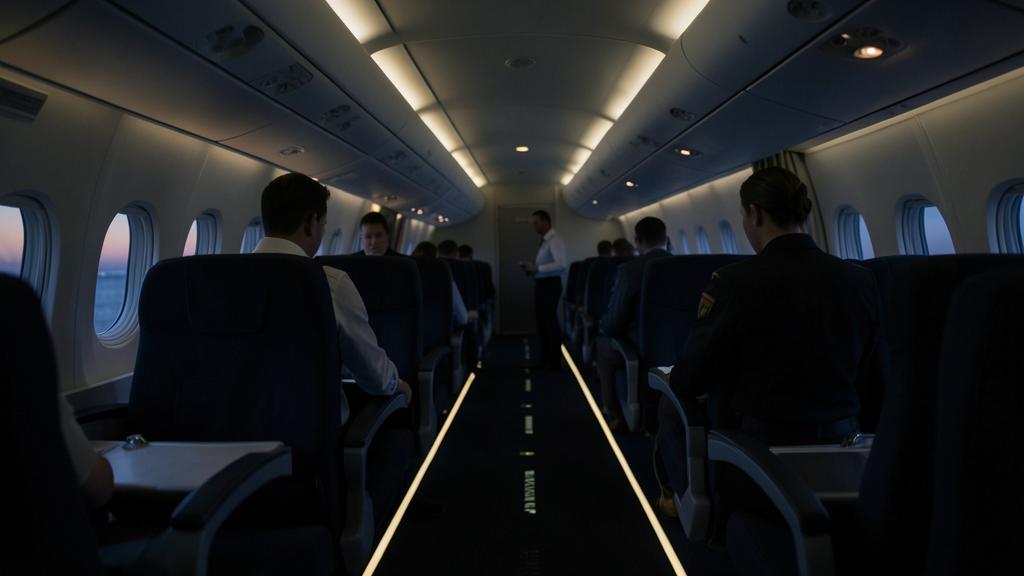
Before a night landing, the cabin is darkened, the window shades are raised, and the reason given to passengers — if any is given at all — is usually the atmosphere , or helping passengers fall asleep. Neither is true. Darkening the cabin is a physiological advantage: it buys the eyes the minutes of adaptation they won’t have after an impact, and makes the floor markings of the escape routes readable in the only moment they need to be read. The gesture is cost-effective, reversible, and one of the few cabin actions whose benefit is measurable in seconds of evacuation time.
A gesture that looks like courtesy and functions like equipment
Cabin secured for landing is a checklist of small, reversible actions: seatbacks, tray tables, armrests, overhead bins, galley latches, window shades, lighting. Most of these serve to remove loose masses and clear the escape path. Two of them — shades up and lights down — do something else. They don’t change the cabin; they change the people in it. They put every occupant, including the crew, in a visual state that cannot be quickly achieved on demand.
The distinction matters because it ties into the rest of the system design. Emergency lighting, floor markings for escape routes, and exit signs are all designed to be seen by an eye already working in the dark, in a cabin that could also be full of smoke. They are not bright. They should never be bright: brightness at floor level would create glare, would wash out the contrast the markings depend on, and would strain an independent power supply that must last through the entire evacuation. The system assumes an adapted eye. Darkening the cabin before landing is how the crew fulfills that assumption.
What actually happens in the eye
The retina carries two families of photoreceptors with very different tasks. Cones are concentrated in the fovea, at the center of the visual field; they provide color, fine detail, and fast response, and they need an adequate amount of light. Rods sit outside the fovea, they carry no color information and poor detail, but they are far more sensitive — they are what remains when the light disappears.
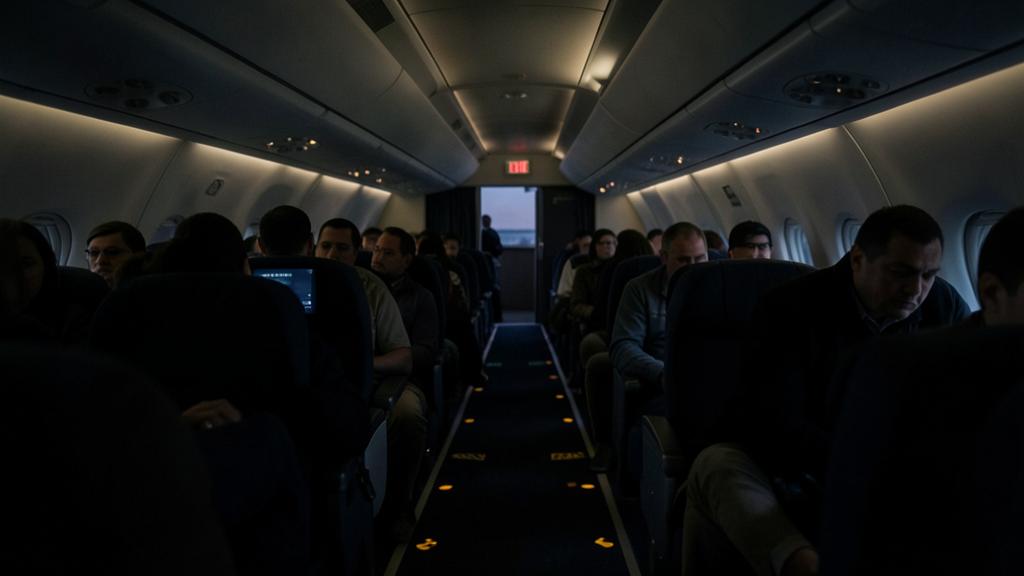
The switch between the two is not immediate, because it is chemical. Bright light bleaches the photopigment in the receptors, and the eye only recovers when this pigment regenerates. The classic dark adaptation curve has two branches: the cone branch improves quickly and flattens out within about five to ten minutes, and the rod branch takes over afterward and improves for twenty to thirty minutes, still rising beyond that. Those are the orders of magnitude taught in aviation medicine, and the exact numbers vary with the individual, with age, with fatigue, and with the brightness of the previous exposure. What does not vary is the asymmetry: adaptation to the dark takes minutes, and it can be destroyed in a fraction of a second by a single bright source.
Two consequences follow directly, and both are operationally useful.
- Peripheral vision. The fovea has essentially no rods. In true dim light, looking directly at a dim object is the surest way to lose it; scanning slightly to the side brings it back. Therefore, a crew member searching a dark cabin for a smoke source or a blocked exit should sweep and not stare.
- Local loss of adaptation. An illuminated screen held at arm’s length keeps that person’s eye in a photopic state, regardless of what the rest of the cabin is doing. The same goes for a reading light. Dimming the general cabin lighting doesn’t force anyone to stop reading, and the crew is not there to police it — but it’s worth knowing that the passenger who has been on a bright screen during the approach is, at the moment of an evacuation, the least prepared person in the row.
When it’s dark, your eyes adjust slowly to see better in low light. If a bright light suddenly appears, your night vision is ruined for a while. That’s why planes dim the lights before landing—so everyone’s eyes are ready if an emergency happens.
On an Airbus A320, the cabin lights are dimmed 15 minutes before landing at an airport like Paris Charles de Gaulle. If a passenger uses a bright phone screen during the final approach, their eyes will take 5-10 minutes to adjust again, making them slower to react in an emergency evacuation.
| Time elapsed in dim light | Dominant receptor | What the eye can do | Operational significance |
|---|---|---|---|
| First seconds | Bleached cones | Very little; the cabin appears uniformly black | An evacuation starting here is effectively blind |
| About five to ten minutes | Cones regenerated | Shapes, contrast, exit signs, seat rows | Sufficient to move along a row and find an aisle |
| Twenty to thirty minutes | Rods dominant | Low-contrast details, movement in the periphery, outside terrain | Floor markings and outside conditions both readable |
| Any bright illumination | Bleaching | Back to square one | A cabin light cycle wipes out most of the gain |
Why darkness is specifically used for takeoff and landing
The industry term for the takeoff and landing phases — the critical phases — is no rhetorical flourish. For decades, accident statistics have shown survivable events concentrated in these windows: low energy margins, proximity to the ground, high rate of configuration changes, and a runway environment with obstacles, other traffic, and hard surfaces. If a cabin ever needs to be evacuated in the dark, that is the time.
The certification side of the argument is the 90-second evacuation demonstration required of airliners above a certain seating capacity: the full certified passenger load must be able to leave the aircraft within 90 seconds, using no more than half of the exits, assuming some exits may not be usable. This demonstration is performed under conditions that include dimmed cabin lighting, precisely because the emergency lighting system must carry the evacuation. Ninety seconds is the design budget for the entire procedure, and none of them are reserved for eyes that are not yet working.
The trap. Dimming the lights on final approach, once landing is decided, is almost useless. Adaptation is a slow process, and the useful part of it happens long before landing. If the cabin is not dark when the crew is seated and secured, the gesture has become symbolic. Operators who treat cabin lighting as part of the cabin securing sequence, rather than as the last thing done before sitting down, are the ones who actually get the benefit.
Window shades up: three separate reasons, none of which has to do with the view
Raising the window shades is the other half of the same configuration, and it is often poorly explained. It serves three different purposes, and these do not overlap.
Assessing conditions outside before opening an exit. The cabin crew at a door must, in the seconds after the aircraft stops, decide whether that exit is usable: fire on that side, debris, a wing that is no longer where it should be, water, an unusual attitude. This decision is made by looking out. A closed shade at a door or overwing exit removes the only available information. Passengers seated at overwing exits are briefed on the same logic — they are asked to look before acting.
Orientation for everyone else. With shades up, the occupants have some sense of which direction is out and what is on each side. With shades down and cabin lighting off, the cabin becomes a sealed box with no external reference.
Letting the outside world look in. Rescue and firefighting teams arriving at an aircraft use the windows to read the situation inside: where people are, whether there is smoke, whether an area is already cleared. This is no marginal advantage when the alternative is opening a blind fuselage.
A note on the interaction with lighting. A bright cabin at night turns every window from the inside into a mirror — the crew at the door sees the reflection of the cabin, not the wing. Shades up and lights out are a configuration, not two habits that happen to be performed together.
What the emergency lighting is and what it needs from the cabin
Certification of large aircraft requires an emergency lighting system independent of the main power supply, illuminated exit signs, and floor markings for escape routes that guide the occupants to the exits if the cabin is obscured by smoke. The markings are at floor level for a reason known to anyone who has done smoke training: smoke layers, and the last breathable, transparent layer is the one closest to the floor.
How this marking is powered depends on the installation, and here a crew habit can have a real technical consequence. Electrically powered systems draw from the emergency power supply, which is sized for a duration set by the certification basis and not unlimited. Photoluminescent systems store energy from the cabin’s ambient lighting and release it over time — meaning they must be charged and will discharge, whether needed or not. Operators with photoluminescent markings therefore have rules about how long the cabin can be kept at a very low level and when the lighting must be brought back up. These rules are type-specific and operator-specific; they belong in the cabin operations manual and nowhere else.
| Element | Contribution | Nullified by |
|---|---|---|
| General cabin lighting dimmed | Starts dark adaptation for all occupants, including the crew | Acting too late; galley or lavatory light on and visible |
| Window shades raised | Exit assessment, orientation, visibility from outside | A bright cabin that turns the windows into mirrors |
| Floor markings for escape routes | Guides occupants under a smoke layer | An unadapted eye; carry-on luggage left in the aisle; discharged photoluminescent strips |
| Illuminated exit signs | Identify usable exits from a distance | Smoke density; occupants staring directly at a dim sign with foveal vision |
| Crew flashlight | Directed lighting where the crew needs it | Aimed at occupants, bleaching their eyes again |
The crew’s eyes are part of the equipment
All of the above applies to the cabin crew first. They are the ones who must see a jammed door mechanism, read the state of an overwing area, count rows in a dark aisle, and identify a physically capable passenger. Their adaptation is more valuable than anyone else’s, and it is the easiest to destroy — galley lighting, a phone screen during the sterile phase, a flashlight checked at the wrong time.
Flashlight discipline follows the same physiology. A flashlight is a pointing tool aimed at a mechanism, a floor, a door frame. Aimed at a cabin or a face, it sets back the adaptation of everyone it reaches. During an evacuation, the crew gives commands and points; pointing is done with the arm, not with the beam.
The right reflex. Treat cabin lighting as a timed action, not a last one. Dim as part of the cabin securing sequence before taking the brace position, and protect your own adaptation from that point on: no bright galley lighting, no screen, flashlight checked earlier in the sequence and then kept low. The minutes you give yourself are the ones you cannot ask for later.
Where the sterile phase fits and where regulatory authorities differ
The cabin configuration for landing sits within a broader idea — that critical flight phases are protected from non-essential activities. The concept is common to both major regulatory systems, but the definitions are not identical, and it is worth being precise rather than repeating a number heard in another fleet.
The FAA defines the sterile phase for its air carriers in terms of ground movement, takeoff, landing, and all other operations below ten thousand feet, except cruise. EASA defines it as the critical flight phases — the runway and takeoff flight path, the approach, the go-around, and the landing including the landing roll — plus any other phase the commander determines. The practical effect is similar; the trigger is not. In a mixed fleet or for crews transitioning between operators, this is exactly the kind of detail that gets miscommunicated. The operations manual of the operator you are flying for is the only authority on which definition applies to you.
The silent review and why darkness is the right moment for it
The silent review in every critical phase — where are my exits, what is my procedure, who is next to me, what is my brace command — is designed to be performed in exactly this configuration. The cabin is dark, secured, and quiet; there is nothing to do and nothing that can be interrupted. Crews who fill this phase with conversation or a last galley task lose the one moment in the flight when the mental rehearsal and physiological preparation happen together.
This combination is the real content of the darkened cabin. It is not a mood. It is a crew whose eyes work, seated at a door they have just instructed themselves on, and looking out a window that shows them what is on their side of the aircraft. Everything in this sentence must be true at the same time, and each element takes some minutes to set up. That is why the sequence starts early and is non-negotiable when a passenger asks for the lights back.
Explain without making it a lecture
Passengers ask about it, and the honest answer is short: so that all eyes are already adapted to the dark in case we need to exit quickly, and so that the lights on the floor can be seen. This answer takes four seconds, is true, and is far more effective than the “atmosphere” explanation — which invites the request to turn the lights back on. It also closes the question rather than negotiating it, which is a small operational win in itself.
It is also the answer that makes the rest of the configuration understandable. Once someone understands that the dark cabin is preparation and not decoration, the window shade, the bag under the seat in front, and the upright seatback are no longer arbitrary. They become parts of a plan whose unit of measure is the 90 seconds the aircraft is certified against. Crews who want to go further into the physiology and the sequence will find the cabin safety track on formations.fl330.com useful, and the operational variations between fleets are regularly discussed on forums.fl330.com.


Leave a Reply
You must be logged in to post a comment.