
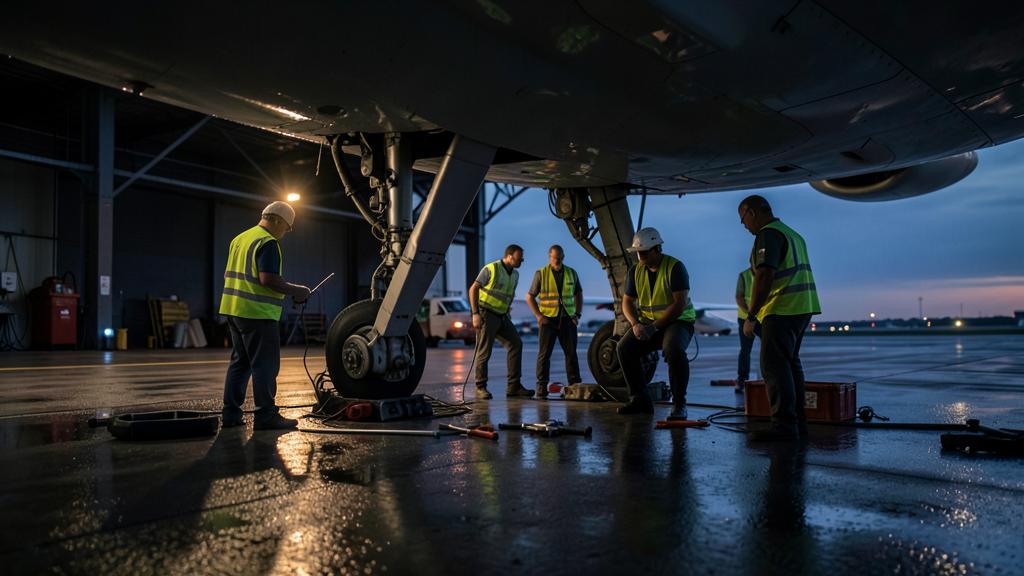
The day after a runway excursion with no injuries, the operator faces a simple contradiction: the aircraft and its recorders no longer belong to them, the official report won’t appear for months, and the same rotation departs that very morning with a different crew. Waiting is not an option; concluding is not either. Between the two lies perfectly legitimate internal work, with a scope narrower than one might think and a far higher yield.
Two investigations seeking different things
The safety investigation conducted by an investigative authority has a single, clearly stated objective from its founding texts: to prevent future accidents. It does not determine fault or responsibility, and its independence is the very condition of its value. An operator expecting a favorable verdict has misunderstood the first page.
The operator, however, has no choice but to act. Its safety management system requires it to identify hazards, assess risk, and monitor the effectiveness of its measures; its event reporting system requires it to analyze what it collects and ensure follow-up. Doing nothing while waiting for the official report is not prudence—it is a breach of its own certification conditions.
The question “is it allowed to investigate while the bureau is investigating?” is therefore poorly framed: what is at issue is the scope. The bureau reconstructs the sequence of a singular event; the operator examines the state of its barriers, of which the event is merely a revealer. The first object is closed—a flight, a date, an aircraft. The second is open: it also applies to other flights that, the same week, nearly produced the same outcome without producing anything at all. Hence a consequence that many internal reports miss: an internal investigation can conclude “we do not know why this happened” and yet provide useful findings on weak defenses. That is its normal yield.
The vast majority of internal investigations, moreover, concern events that no investigative authority will ever open: poorly executed go-arounds, confusion over holding points corrected, discrepancies between two loading documents. The case of the accident, where two investigations coexist, is the rare one—and it is the one that must be planned in advance, for lack of time to improvise.
L’enquête officielle cherche à comprendre un accident spécifique pour éviter qu’il ne se reproduise. L’enquête interne, elle, vérifie si les systèmes de sécurité de la compagnie fonctionnent bien. Même si on ne trouve pas la cause exacte, on peut découvrir des failles à corriger. La plupart des enquêtes internes concernent des incidents mineurs qui n’intéressent pas les autorités.
| Procedure | Purpose | Control of evidence | Treatment of statements | Useful timescale |
|---|---|---|---|---|
| Official safety investigation | Prevent future events; neither blame nor liability | Custody of the wreckage, the site and the flight recorders | Information gathered is protected, not passed back to the operator | Months to years; public report, recommendations |
| Judicial proceedings | Establish individual or corporate liability | Priority over sealed evidence, depending on the State and the case | Procedural documents subject to their own regime | Open-ended duration; no safety benefit expected |
| Operator’s internal investigation | Restore barriers and manage the fleet risk | None over items in custody; full over its own records | Internal notes, not covered by the official investigation regime | Weeks; traceable operational decisions |
What the operator does not touch, and what no one will preserve in its place
The first scope is that of physical evidence. The wreckage, the site, the flight recorders, and certain removed equipment come under the control of the investigative authority, sometimes in competition with a judicial authority. The rule admits no exceptions: nothing is moved, nothing is recorded, nothing is examined—except to provide assistance, prevent a secondary accident, or on instruction from the authority in charge.
The best-documented temptation remains downloading flight data “just to know.” It costs twice: it alters a piece under control, and it destroys an asset more valuable than the information obtained—the demonstration that the operator has not tampered with anything. Being able to establish that one never had access to the data before the authority is worth, two years later, more than an answer obtained two days earlier.
The second scope is the mirror of the first, and it is almost always neglected. The operator’s documentary heritage remains its own, and no one will freeze it in its place: technical logs, work orders, training and control files, service history, already downloaded flight tracking data, actual weather data consulted, load and trim sheets, refueling receipts. These are living systems, and a living system overwrites its previous states—cleanly, silently, without anyone deciding to do so.
Added to these are traces held by third parties, often with short retention periods: recordings by a control authority, traffic area surveillance videos, reports from a ground assistant or refueler. A written request for preservation requires no one’s approval: it only asks that nothing be deleted.
Après un atterrissage dur sur un Airbus A320, l’opérateur doit préserver les données de vol avant qu’elles ne soient effacées lors du prochain vol. Les enregistreurs de bord sont sous contrôle des autorités, mais les logs techniques de l’avion et les rapports de maintenance doivent être sauvegardés par la compagnie. Un retard de 24h peut faire perdre des données critiques comme les paramètres de vitesse et de pression au moment de l’impact.
The freeze window, or what disappears before one thinks to ask
Technical traces disappear in stages, at known deadlines. A voice recording loop is time-bound—several hours on older systems, significantly more on newer ones—and rewrites itself as soon as power is restored. Computer memories and maintenance messages are purged in the next cycle; flight data not downloaded is lost upon first reuse of the medium. Each of these stages is predictable, and thus avoidable, provided a decision is made before reaching them.
Human memory, however, does not degrade in stages: it degrades continuously from the first hour, and it becomes contaminated. Crews talk, read, hear rumors, and unconsciously construct a shared narrative. A testimony collected three days later is not more mature than that of the same evening: it is smoother, more coherent, and thus less informative.
The action that addresses both at once fits on a page: a dated preservation order, which names the systems, media, and holders, and suspends all automatic purging until further notice. It is not written in haste.
The right reflex. Prepare the preservation order as a template, with a list of internal systems and external holders to be contacted, and a field for the date and time. On the day it takes a few minutes to send, even before knowing if there will be an official investigation—and it costs nothing if there isn’t.
Trigger, yes, but to what depth
Opening a full investigation for every report is the best way to conduct none properly. The response is graduated, and the graduation criterion clearly separates robust organizations from the rest: it is graduated based on potential severity, never on the observed consequence.
A tail strike with no damage and a terrain proximity warning corrected at the last alarm have produced, each in their own way, no consequence. Their potential is not comparable. An organization that classifies by consequence mechanically ends up investigating only events that have already cost something—that is, too late.
The second criterion is the number of barriers breached. An event where a single defense failed, the others holding, describes a functioning system. An event where it is discovered after the fact that three defenses had been breached for months without anything signaling it describes a blind system: that one deserves an investigation even if the outcome was minor.
Two additional criteria apply. Recurrence: the third event of the same type in a year warrants an investigation regardless of its individual severity, because it is no longer the event at issue but the defense supposed to address it. Novelty of the mechanism next: an event that cannot be described with the categories of one’s own system is richer than a well-categorized event—it is the only case where the absence of explanation is in itself information.
The written mandate, without which the internal investigation becomes something else
An internal investigation without a written mandate drifts in three weeks toward one of the two objectives it must precisely avoid: the search for a responsible party, or the preparation of a legal position. The mandate is not a quality system formality; it is what protects the investigator, the people interviewed, and the operator itself.
It fits in a few lines and must state the objective and its scope, what the investigation does not do—no attribution of fault, no legal qualification, no causal conclusion published before the official investigation—the expected deliverables, the deadline, the recipients, and the dissemination regime of the report.
Then comes the question of the person. The investigator cannot be the author or owner of the barrier being examined—that who wrote the procedure in question will never conclude that it was unclear—or the direct hierarchical superior of the people interviewed. This independence is not an abstract principle: it is what makes the interviews usable.
For the breaking point is there. If the crew perceives the safety interview as the first act of a disciplinary procedure, they will respond politely, cautiously, without adding anything. The separation between the safety process and the disciplinary process must exist before the event, written, signed, and known, its boundary described by concrete cases rather than adjectives. A just culture policy written after the first serious event convinces no one.
The trap. The internal report that identifies a cause and a person. It will be contradicted or nuanced by the official report months later, it becomes in the meantime an enforceable document that its author no longer controls, and it teaches the entire line that declaring exposes. An internal report describes barriers, gaps between prescribed and actual work, and decisions—never a culprit.
Acting without knowing the cause
Between the event and the establishment of a mechanism, operations continue, and decisions are made whose nature must be explicit, otherwise they will be read later as admissions. A precautionary measure is taken on a plausible, undemonstrated hypothesis. It is reversible, proportionate, dated, and includes a review deadline: temporarily restricting a runway, a configuration, a minimum, or the pairing of two crew members in the process of being released. It claims to prove nothing and commits to no conclusion.
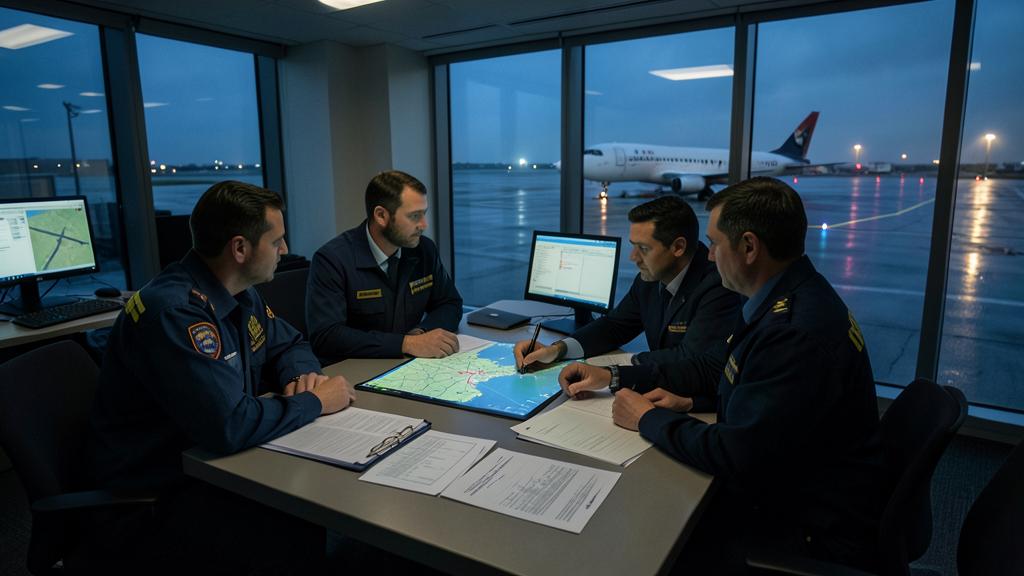
- A precautionary measure is taken when we suspect a problem but aren’t sure. It’s temporary and can be reversed. Example: restricting a runway after a near-miss until further investigation.
- A corrective action is taken when we know the cause. It’s permanent and changes procedures or training. Example: modifying a checklist after finding it was followed incorrectly.
A corrective action, on the other hand, is taken on an established mechanism. It permanently modifies a barrier and costs—training, documentation, acquired habits. Confusing the two produces two symmetrical damages: one engraves in the manual a defense based on a false cause, and one gives the entire organization the feeling that the subject is addressed.
| Criterion | Mesure conservatoire | Action corrective |
|---|---|---|
| Trigger | Plausible hypothesis, not demonstrated | Mechanism established and documented |
| Reversibility | Reversible by design | Lasting, costly to undo |
| Expiry | Dated, with scheduled review | No end date, until the risk is reassessed |
| Approval route | Recorded operational decision | Change management process |
| What is written | “pending further information” | “because we know” |
| Risque propre | Lasting through neglect and becoming an unjustified constraint | Locking in a defence based on a wrong cause |
Then comes the choice of the defense itself. Eliminating the dangerous situation requires no maintenance effort; a technical lock works as long as it is not bypassed; a procedure works as long as it is read; training works as long as memory lasts; a service note works not at all. Yet it is the service note that is written on Friday evening, because it is the only one that can be.
Finally, an action closed without an indicator is not closed, it is forgotten. The indicator must predate the action, otherwise one will choose after the fact the one that shows it works. And it must relate to the behavior of the system, not the execution of the task: “the procedure has been disseminated” measures nothing; “the frequency of the configuration in question has decreased over three months of flight tracking” measures something.
The right reflex. Write the indicator in the same sentence as the action, with its data source and review date. An action whose effect no one knows where to read is an intention, and the effectiveness follow-up that the authority will examine will then be based on closed lines without proof.
What the internal investigation reports, and to whom it must return
The first recipient is the one who reported. A reporting system that returns nothing dries up in a year: the reporter concludes, correctly, that their report has fallen into a black hole. The return does not need to be a report, but it must be dated, addressed, and state what has been decided—including when the decision was to change nothing, and why.
The second recipient is the official investigation, in a precise sense. The operator provides it with facts about its own system: actual configurations, history of documentation amendments, training and control status, programming constraints, internal precedents. It does not provide it with causal hypotheses, of no added value to the investigator and fraught with disadvantages for their author. The reverse flow is narrower than one might imagine: the statements collected and the content of the flight recorders are protected and will not return.
The third contribution is defensive, and it must be assumed without making it the goal. An operator capable of producing, two years later, a dated chronology of what it froze, what it restricted on a precautionary basis, and the reasons why it waited before modifying a procedure, demonstrates a diligence that nothing else demonstrates. It is not a shield against the facts; it is the only proof that it has not remained motionless.
The return of the official investigation remains: preliminary information, recommendations, sometimes urgent measures. They are not always addressed specifically to the operator, hence the need for an internal circuit that receives and processes them as inputs to the management system.
What to open in your manual before the next event
Four checks fit in a morning. The first: does the safety management manual name who conducts an internal investigation, with what standard mandate and what independence from the concerned services? If the answer is “the designated person decides on a case-by-case basis,” the case-by-case will be decided at the worst possible moment.
The second: does the preservation order exist as a template, or will it have to be invented at 2 a.m.? The third: is the just culture policy signed, disseminated, and its boundary described by cases? The fourth: is a single person designated to speak to the supervisory authority, the investigative authority, and the press, with a deputy named and reachable?
A gray area remains, and it is better to state it than to deny it: the status of internal documents in a judicial procedure depends on the state, the jurisdiction, and the nature of the case. No operator can promise its navigators that an internal report will never be read by a third party. What it can hold is that this report will contain only what a safety file must contain: facts, barriers, dated decisions—no judgment on persons.
For those preparing for a designated manager or safety management system manager role, this is the part of the file that the authority looks at first: not the quality of a report, but the existence of a written mechanism before the facts and the trace that it has already turned once. The training paths for management functions benefit from starting with this document rather than the general theory of risk.
The applicable texts, the decisions of the competent authority, and the approved documentation of the operator prevail over this article, which has only an explanatory value of the mechanism.


Leave a Reply
You must be logged in to post a comment.