
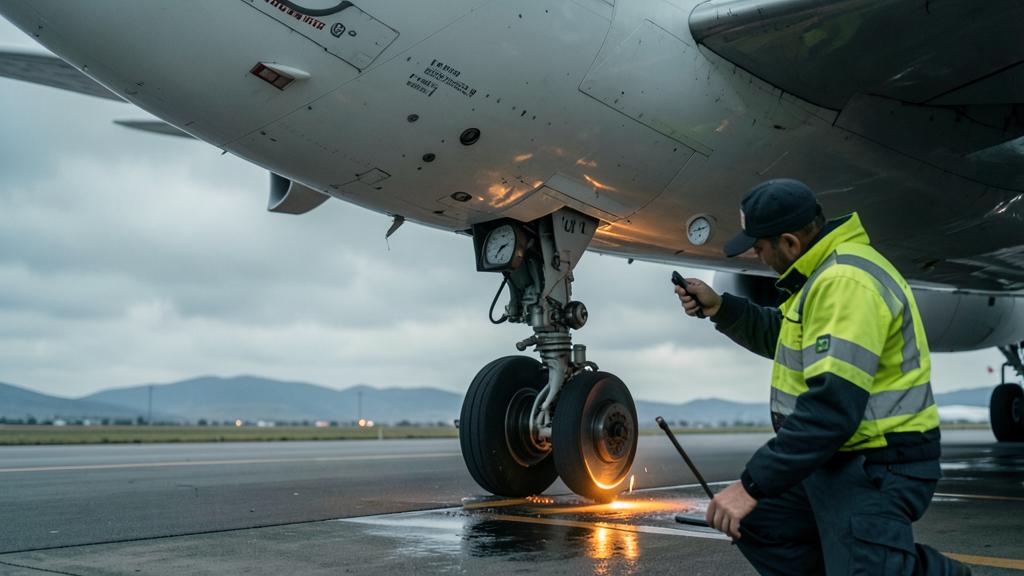
The brake cooling time printed in the operating manual is not there to protect the brake. It is there to protect the next rejected takeoff. A brake that starts the takeoff roll still holding a large share of the previous sector’s energy cannot absorb what an aborted takeoff will ask of it — and the accelerate-stop distance on the performance page silently assumes it can. This is where that number comes from, and what it is really guarding.
A brake is a converter, and energy has to go somewhere
A wheel brake does one job: it turns kinetic energy into heat. Nothing else happens. The aeroplane arrives at the brake with a quantity of energy fixed by its mass and the square of its speed, and whatever the spoilers, the reversers and the aerodynamic drag do not take away, the brakes absorb and store as temperature in the heat pack.
Two consequences follow immediately, and they explain nearly every operational rule on the subject.
First, the speed term is squared. Ten per cent more ground speed at brake application is roughly twenty per cent more energy into the same heat sink. This is why the technique of braking — a firm early application at moderate speed, versus a late hard one from high speed — changes the outcome more than the modest weight differences of a typical turnaround, and why a high-elevation aerodrome on a hot day loads the brakes as well as the runway: the true ground speed for the same indicated airspeed is higher, and the energy follows the true speed.
Second, heat leaves a brake slowly. A heat sink is a mass of steel or carbon designed specifically to store energy, and the same property that makes it a good absorber makes it a poor radiator. Cooling is by conduction and convection into moving air, and once the aeroplane is stationary on the stand there is almost no moving air. The energy sits there.
Brakes turn speed into heat, and that heat stays trapped unless air flows over them. If the brakes are still hot from a previous landing, they can’t handle another hard stop safely.
An Airbus A320 lands at 120 knots ground speed (33.3 m/s) with a weight of 70,000 kg. Its kinetic energy is 0.5 × 70,000 × (33.3)² = 3.9 billion joules. If the next takeoff is rejected at V1, the brakes must absorb all that energy again—but if they’re still hot from the landing, they may not have enough capacity left.
What the energy index is, and what it is not
Manufacturers present this in different forms — an energy figure per brake, a dimensionless index, a brake temperature indication, a lookup entry into a cooling schedule — but every form is a proxy for the same physical quantity: the energy delivered into one brake during the last stop, plus whatever had not yet dissipated from the stop before it.
It is essential to see that this is an energy statement, not a temperature statement. Temperature is a downstream symptom, measured at a sensor that sits some distance from where the heat is actually generated. The index is computed from the things that determine energy: weight, speed at brake application, use of reverse thrust, use of autobrake and which setting, taxi distance and braking during it, pressure altitude, ambient temperature and wind.
| Factor | Effect on energy per brake | Why |
|---|---|---|
| Landing or reject weight | Increases roughly in proportion | Energy scales linearly with mass |
| Ground speed at brake application | Increases with the square | The dominant term; late braking is expensive |
| Pressure altitude and temperature | Increases | Higher true speed for the same indicated speed |
| Tailwind component | Increases | Higher ground speed for the same air speed |
| Reverse thrust used | Decreases | Energy removed before it reaches the heat sink |
| Speedbrake deployment | Decreases | Aerodynamic drag removes energy the brakes would otherwise absorb |
| Downhill runway slope | Increases | Gravity adds energy along the roll |
| Long taxi with continuous light braking | Increases, sometimes substantially | Small applications, sustained, with no cooling airflow |
| Residual heat from the previous sector | Adds directly | The heat sink has not returned to ambient |
That final line is the one crews under-weight. The cooling schedule is cumulative by design. A short sector flown to a short sector, twice, on a hot day, can put a heat sink in a state that neither landing would have produced alone.
Why the delay protects the takeoff, not the hardware
Here is the reasoning that makes the whole rule coherent.
The accelerate-stop distance on your performance page comes from certification work in which the aeroplane rejects at V1 and stops on the brakes alone — with no credit for reverse thrust on a dry runway and, under the current certification basis, with the brakes at their fully worn limit. A separate demonstration, the maximum-energy rejected takeoff, establishes how much energy one brake is certified to absorb in a single event.
A certified maximum energy is a maximum total, not a maximum addition. If the heat sink already contains a substantial fraction of that energy when the takeoff roll begins, then the energy it can still accept before reaching its limit is reduced by exactly that fraction. The stopping capability the performance calculation promised is no longer available, and nothing on the flight deck will tell you at the moment you need it.
The trap. Reading the brake cooling schedule as a maintenance protection — “so we do not wear out the brakes” or “so the fusible plugs do not melt” — leads to treating it as negotiable when the turnaround is late. It is not a hardware rule. It is a performance rule wearing a maintenance disguise, and the consequence of ignoring it appears only in the one event you cannot rehearse.
The fusible plugs make the same point from the other side. They are a designed release: a low-melting-point core in the wheel that yields and deflates the tyre in a controlled way when the wheel gets hot enough, rather than allowing the tyre to burst. When a plug releases, it has done its job correctly. But it also tells you the heat sink reached a state you did not intend, and every part of the assembly is now a maintenance item.
Reading the cooling schedule without misreading it
The schedule is a lookup, and the traps are in the corrections rather than in the main table.
| Condition | Effect on required time | Point to watch |
|---|---|---|
| Brake cooling fans fitted and serviceable | Shorter, where the schedule provides for it | Many schedules carry separate entries for fans on and fans off; read the one that applies |
| Brake fans inoperative under the minimum equipment list | Longer, sometimes considerably | The penalty is in the MEL, not in the normal chart |
| High ambient temperature | Longer | The temperature difference driving convection is smaller |
| Strong wind on stand | Shorter in reality, rarely creditable | Do not improvise a credit the manufacturer has not published |
| Aeroplane parked with parking brake set | Longer, and locally hotter | Heat soaks into the wheel and the fusible plug instead of escaping |
| Chocks in, parking brake released | Shorter | The recommended configuration when brakes are hot |
| Taxi-in with repeated braking | Adds after landing | The clock starts when braking stops, not at touchdown |
The clock question is worth stating plainly, because it is where two crews reading the same chart reach different answers. The cooling period is counted from the end of the braking that produced the energy — typically brakes-off at the end of the landing roll or the end of the taxi-in — not from the moment somebody looked at the gauge, and not from on-blocks.
The right reflex. Compute the cooling requirement on the inbound sector, before the aeroplane is even on stand. If the answer is longer than the scheduled ground time, you have a planning problem with options — a lower takeoff weight, a different derate, a discussion with operations — rather than a decision made under pressure at the door with the pushback crew waiting.
The gauge lags, and the lag is the dangerous part
Brake temperature indication systems read a sensor, and the sensor is not in the friction interface. Heat generated in the discs has to conduct outward before it reaches the probe. The practical consequence is well established and consistently surprises people: the indicated brake temperature continues to rise after the aeroplane has stopped, and the peak reading appears several minutes later.
So a temperature check taken immediately after arriving on stand is the least representative reading of the whole turnaround. It is low precisely because the heat has not yet arrived at the sensor. A crew that sees a comfortable number at on-blocks, concludes the brakes are fine, and starts a quick turn is reading the gauge at the one moment it is guaranteed to understate the situation.
Two related points. Temperature indications are also asymmetric: a single brake reading much higher than its neighbours on the same gear is a defect signal — a dragging brake, a seized piston, an autobrake anomaly — not simply a hotter brake, and it deserves an entry rather than a shrug. And the absence of an indication system does not remove the requirement; on types without it, the cooling schedule is the only instrument you have, which is an argument for computing it rather than estimating it.
Carbon and steel do not behave the same way
Heat sink material changes the operational technique, and mixing up the two produces confident advice that is wrong for the aeroplane you are on.
Steel brakes lose material as a function of the energy they absorb: hot, heavy stops are what wears them. Carbon brakes behave differently — their wear is driven far more by the number of brake applications than by the energy of each one, and they are relatively insensitive to a single firm stop. This is the origin of the standard carbon-brake taxi technique: allow the speed to build, then apply the brakes once, firmly, to a lower speed, rather than riding them continuously. The continuous technique feels gentler and is, for carbon, both more wearing and thermally worse, because it delivers a steady stream of energy with no airflow to remove it.
Carbon also has a higher energy storage capacity for its mass, which means a carbon brake can be very hot while still being well inside its energy limit. It does not mean cooling times are optional; it means the relationship between the temperature you read and the energy state you care about is different, and only the manufacturer’s schedule encodes it correctly.
Ground handling around a hot brake
The turnaround happens around people, and a hot wheel assembly is a hazard with a specific geometry. When a fusible plug releases or a tyre fails, the energy departs along the axis of the wheel. The standing rule is therefore to approach a hot wheel from fore and aft, never from the side, and to keep personnel and equipment out of the lateral arcs until the assembly has cooled. Clearance distances and the definition of “hot” are set locally — by the operator, the handling agent and the aerodrome — and they differ enough that the local number is the one to use.
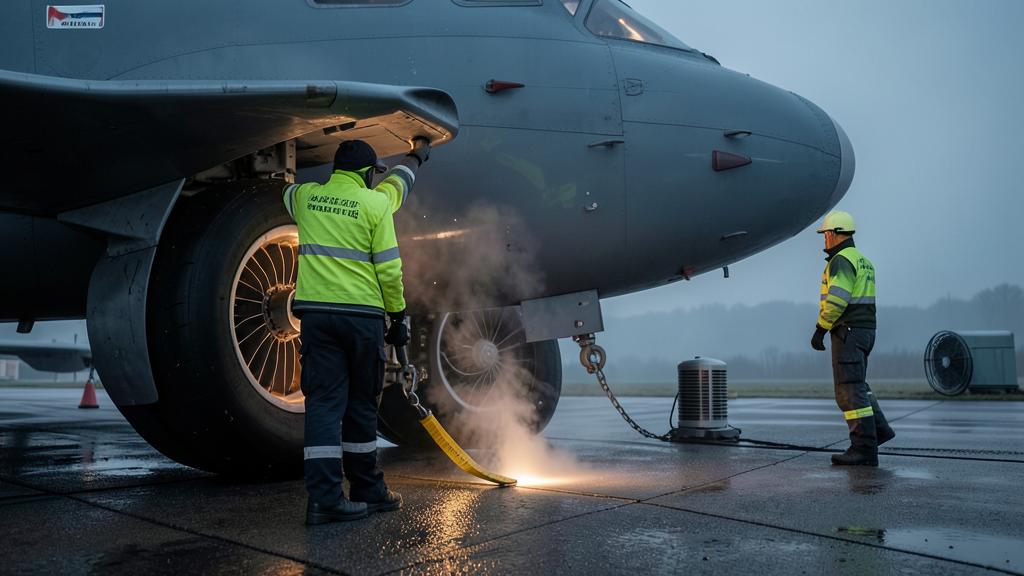
The configuration rules follow the same logic. Chocks in and parking brake released, so that the discs are not clamped and the heat can escape rather than soaking into the wheel and the fusible plug. Ground cooling equipment only where the manufacturer’s documentation supports it. And no attempt to close out a hot-brake event as a normal turnaround: once brake fans, a hot-brake indication or a plug release are in play, it is a technical event with a technical log entry.
| Action | Reason |
|---|---|
| Chocks in, parking brake released | Clamped discs trap heat and drive it into the wheel and the fusible plug |
| Approach fore and aft only, keep the lateral arcs clear | A plug release or tyre failure vents along the wheel axis |
| Hold the ground crew back until the local clearance time has elapsed | The peak thermal state arrives minutes after the aeroplane stops |
| No refuelling under the wing until released | Fuel and a heat source at the same point is a hazard combination, not a delay question |
| Technical log entry for any plug release or hot-brake indication | The wheel, tyre and heat sink become maintenance items, not turnaround items |
One airborne consequence deserves a mention here because it belongs to the same energy story. After a takeoff following heavy braking — a low-speed reject followed by a second attempt, or a short turnaround at the limit — manufacturers commonly advise delaying gear retraction so that the airflow carries heat away, rather than sealing a hot assembly into an enclosed wheel well next to hydraulic lines. The delay is published per type; the reasoning is the same one that runs through the whole subject.
When the cooling time exceeds the ground time
The commercial pressure in this decision is real and should be named. A cooling requirement that exceeds the ground time is not a refusal to depart; it is an input to a set of options, and the options are better the earlier they are surfaced.
- Reduce the energy the next stop would need. A lower takeoff weight lowers the certified requirement, and a longer runway or a more favourable wind can do the same.
- Reduce the energy the last stop delivered — retrospectively impossible, which is why the inbound sector matters: a lower autobrake setting with more reverse, and an early rather than late application, change the number you will be reading on stand.
- Extend the ground time. A delay taken deliberately, with a reason recorded, is cheaper than a hot-brake event and far cheaper than the alternative it protects against.
- Use the equipment. Serviceable brake fans have their own entry in the schedule; unserviceable ones carry a penalty that must be read from the minimum equipment list rather than guessed.
What is not on the list is departing on the assumption that a rejected takeoff will not happen. That is exactly the assumption the number exists to remove. Crews and performance engineers comparing type-specific practice on this will find the topic regularly discussed on the FL330 forums.
The one-line version
The cooling time is the price of keeping a promise already printed on the performance page. Accelerate-stop distance assumes a brake with room in it. Cooling time is how you make sure there is room. Everything else — the fusible plugs, the fans, the approach geometry, the carbon technique — is consequence.


Leave a Reply
You must be logged in to post a comment.