
On the same approach, two voices can pronounce the same word within less than a minute of each other without saying anything comparable. One comes from a sensor interrogating the air in front of the aircraft; the other from a calculation noting what the aircraft is already experiencing. At five hundred feet, the first still leaves room for maneuver, the second imposes it and freezes the configuration. The distinction is not documentary: it determines the margin available.
What costs is not the wind, but its variation.
An established tailwind, as long as it remains within the type’s limits, costs almost nothing once the approach is stabilized on it: the indicated speed is the one chosen, the ground slope is simply steeper, and the landing calculation has already taken it into account. What costs is the transition from one wind state to another while the aircraft’s mass, for its part, takes several seconds to change state. During this interval, the trajectory continues to follow inertia while the indicated speed follows the air mass: the gap between the two is paid in energy, and near the ground the only remaining currency is altitude.
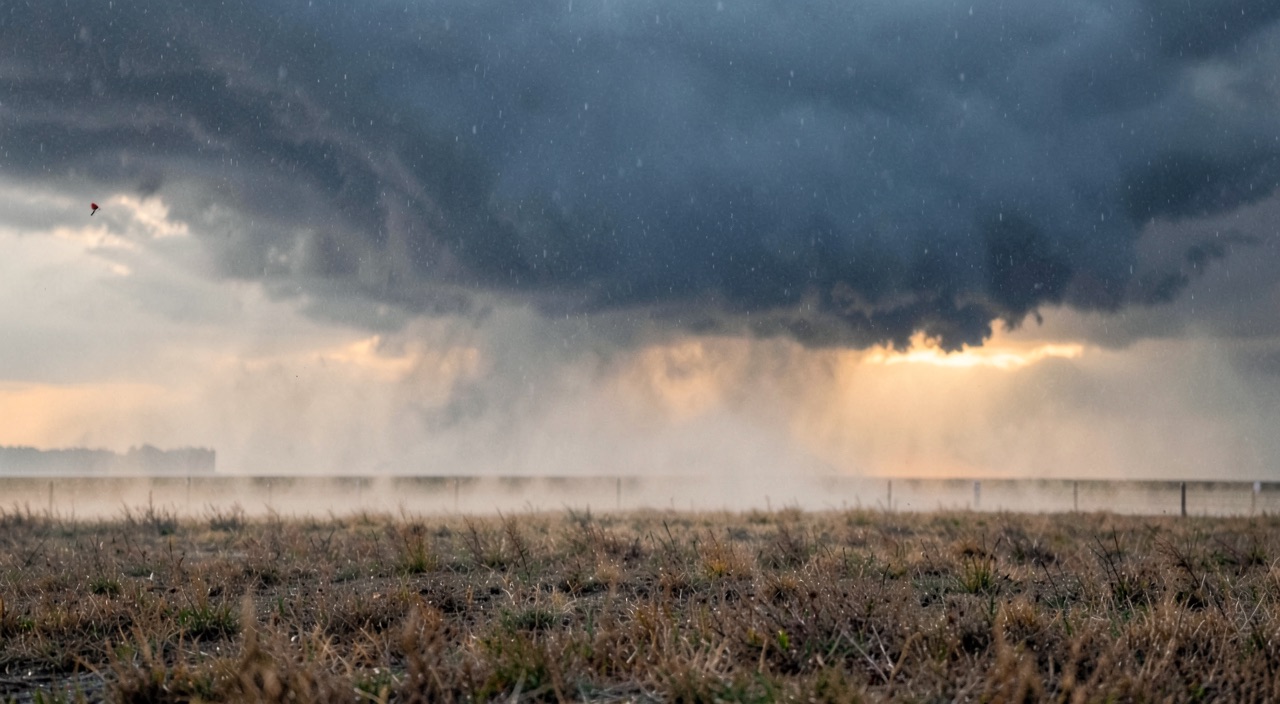
The microburst gives this mechanism its most documented form. A column of cold air descends, crashes to the ground, and spreads radially. The aircraft crossing it first encounters a strengthening of the headwind, then the descent itself, then a tailwind that grows as quickly as the headwind had. The first phase is the most dangerous because it is pleasant: the speed increases, the aircraft rises above the glide path, and the natural correction is to reduce thrust and push. Thus, the second phase is approached with engines near idle, a low attitude, and already reduced altitude, i.e., with the three quantities that should have been maintained. The engine acceleration time then becomes the dimensioning constraint.
The scale of the phenomenon explains the rest. A microburst is measured in hundreds of meters to a few kilometers, lasts a few minutes, and reaches its maximum intensity shortly after touching the ground. It is therefore too small to be described by ground observation, too brief to appear in a forecast, and perfectly capable of forming between the passage of the previous aircraft, which reported nothing, and the next one. The two alert families exist only because neither the forecast nor the testimony work at the right scale.
When wind changes suddenly, the plane’s speed and path don’t adjust instantly. This mismatch costs altitude, which is critical near the ground. A microburst is a sudden, intense wind change that can catch pilots off guard, making it dangerous.
An Airbus A320 on final approach at 500 feet encounters a microburst. The headwind increases by 20 knots, then suddenly shifts to a 15-knot tailwind. The plane gains speed and altitude briefly, then loses 50 feet before the crew can react. The engines take 5 seconds to spool up, delaying recovery.
Three families of encounters, three signatures for the sensors.
The convective encounter is the one for which the systems were designed. Wet microburst under a cell, dry microburst under virga when the layer below the base is dry enough to evaporate the rain before the ground, gust front preceding the storm by several kilometers: in all cases the structure is the same, a divergent flow near the ground, of limited horizontal extent and short duration. It is a clear signature, and it is the one sought both by an onboard radar and by a network of anemometers.
The layer encounter is of a different nature. Passage of an active front, low-level jet installed above an inversion, sea breeze established across the runway: the gradient is mainly vertical, the aircraft crosses an interface between two masses and not a cell, and the variation can last much longer than a microburst crossing. There is no marked radial divergence to detect, so nothing that resembles what the radar computer knows how to recognize.
The orographic encounter, finally, is stationary. Rotor under a mountain wave, detached flow behind a ridge or a building, site effect on an enclosed runway: the disturbance is often in clear air, without precipitation, and above all it repeats identically each time the wind returns to the same sector. This is the domain of local instructions, annotated maps, and knowledge of the terrain rather than that of sensors, and it is also where crew reports often prove more valuable than a general rule.
These three families do not arrive at the same season or in the same operational context. The layer encounter, in particular, frequently accompanies a front that degrades the surface condition at the same time: the decision taken at five hundred feet then engages not only a trajectory, but also a landing distance calculated on a runway that is no longer that of the last surface condition report.
The predictive alert: a measurement made in air that no one has crossed.
On board, the predictive function is not a separate sensor: it is a mode of the weather radar. In a low-altitude window, open during takeoff and approach and closed beyond, part of the scan is devoted to a low-level examination of the sector ahead. The system does not measure the wind. It measures the radial velocity of suspended scatterers—drops, crystals, dust—and looks for a specific configuration: echoes approaching, then, a few hundred meters further, echoes moving away. The amplitude of this gap, relative to the distance over which it occurs, gives an intensity compared to a threshold. Two levels are generally returned, an attention alert that refers to the radar image and an emergency alert with a voice command. The useful warning time is counted in tens of seconds.
On the ground, three devices coexist depending on the aerodromes, and it is useful to know which one is speaking. A network of anemometers distributed around the runways compares its measurements two by two and declares a divergence when the gap exceeds a threshold: the resolution is that of the mesh, and the phenomenon must pass over the sensors. A terminal Doppler radar does for the entire approach area what the onboard radar does for the aircraft’s axis ahead. A Doppler lidar, finally, measures on aerosols instead of hydrometeors, making it the only equipment really useful where the air is too dry for a radar. The transmitted message names a runway, a corridor, and a loss value.
To these instrumental sources is added the oldest one: the crew report. An aircraft that reports a speed loss at the same point in the final approach provides the following one with predictive information, dated and localized, whose value decreases quickly but which has the merit of existing where no equipment is installed. The three sources share a property and a weakness: they describe the air, never the aircraft, and they all need something to measure, at the right place and at the right time.
The reactive alert: the aircraft takes itself as an instrument.
The reactive function does not interrogate anything outside. It confronts two descriptions of the same movement: the inertial reference, which says where the aircraft is going relative to the ground, and the aerodynamic reference, which says what the flow is doing around it. Their difference is the wind; the derivative of this difference is the shear. The computer derives a dimensionless quantity that adds two effects, the time variation of the longitudinal wind, relative to the acceleration of gravity, and the vertical component of the wind, relative to the speed. This sum is read directly as a slope: it expresses the fraction of the available climb slope that the wind field is consuming. Beyond a certain value, there is not enough left to maintain the trajectory.
The trigger does not obey the sole crossing of the threshold. It requires persistence, otherwise an isolated gust would make the system speak several times during a turbulent approach and the alert would lose all authority. The activation envelope is also bounded in height and, on some types, in configuration: the function is neither armed at the parking lot nor active in cruise.
What this architecture buys is considerable. It does not depend on any atmospheric condition: night, dry air, clear air, relief, total absence of precipitation, none of this bothers it. It is the only one of the two families to assert something about the aircraft and not about the air. When it speaks, the question is no longer whether there is shear or whether it is on the trajectory: it is, and the aircraft too. Its price is full and it is paid in advance: at the moment it speaks, part of the energy is already gone, and the maneuver begins with what remains.
The warning, the only difference that changes the decision.
Everything else—technology, signal source, message formulation—is secondary. What really separates the two families lies in the position of the alert relative to a unique moment: that when the aircraft enters the wind field. Before this moment, the decision concerns a trajectory that can still be chosen, and its cost is known in advance, in fuel and minutes. After, it concerns an already engaged trajectory, and its cost is counted in lost altitude, a quantity that no one knows before having spent it.
| Criterion | Airborne predictive | Ground-based predictive | Airborne reactive |
|---|---|---|---|
| Measured quantity | Radial velocity of suspended scatterers ahead of the aircraft | Wind measured on the ground by a sensor network, or radial velocity seen by a terminal radar or lidar | Difference between the aircraft’s inertial reference and aerodynamic reference |
| Condition for the alert to exist | Targets present to measure, and height within the activation window | Equipment installed at the aerodrome, phenomenon within the covered area | Height and configuration within the envelope; no atmospheric condition |
| What the alert proves | That a divergence is measured along the axis scanned | That a divergence was measured in a corridor, at the time of the last refresh | That the aircraft is in the field, now |
| Warning time offered | Of the order of a few tens of seconds | Longer, but affected by network latency and movement of the phenomenon | None, by design |
| Typically associated decision | Discontinue before entry, often with a normal go-around | Do not start the approach or take-off, change runway, wait | Escape manoeuvre, configuration frozen |
| Main blind spot | Dry-air shear, contaminated radome, orographic phenomenon | Sensor grid spacing, latency, phenomenon outside the monitored corridor | Slow shear that stays below the threshold, and everything before entry |
Two blind spots that do not overlap.
On the predictive side, the first blind spot is physical and the least known: a dry microburst, under a high base and virga that evaporate before the ground, offers very few targets to a radar. The divergence signature may be perfectly developed without any echo allowing it to be measured. Then come the installation causes: a radome loaded with water or ice attenuates the beam, a ground clutter treatment that is too severe erases the lower part of the signal, nearby terrain returns more than the phenomenon. Finally, the activation window, which closes the function above a certain height and sometimes below another.
On the reactive side, the blind spot is not the absence of signal but its shape. The system measures a derivative: a spread shear, which removes about fifteen knots in half a minute, can remain below the threshold for the entire duration it cuts into the approach. The crew then sees the thrust increase, the speed not return, and the glide path deepen, without any alert being triggered, because at each moment the variation is too slow to count as shear in the computer’s sense. Added to this are the envelope limits: in the very last seconds of the flight, the function may no longer be the one that protects.
The trap. The absence of an alert is not information about the atmosphere, it is information about the sensors. A silent predictive radar says it has measured nothing, not that there is nothing: in dry air, it will measure nothing even in a severe wind field. Conversely, a microburst alert transmitted by the control describes a past state, recorded at a place that is not exactly yours, and a growing cell may have changed in intensity between the message and your passage. The only indicator that speaks about your aircraft in real time is the reactive function, and it only speaks once it is too late to avoid.
At five hundred feet: what each alert authorizes, what it prohibits.
A predictive alert received in the final approach says that the wind field is ahead, not below. The aircraft still has its speed, height, and configuration: nothing forces one to be sacrificed for the other. That is why many operational documents associate this case with a normal go-around rather than the avoidance maneuver, and the difference is far from cosmetic. The normal go-around maintains the margin relative to the stall, allows the gear to be retracted and the flaps to be changed, is flown with the automatics in place, and fits into a published procedure. The avoidance maneuver, on the other hand, deliberately exchanges speed for trajectory and prohibits any configuration change: it is a survival tool, not a comfort tool.
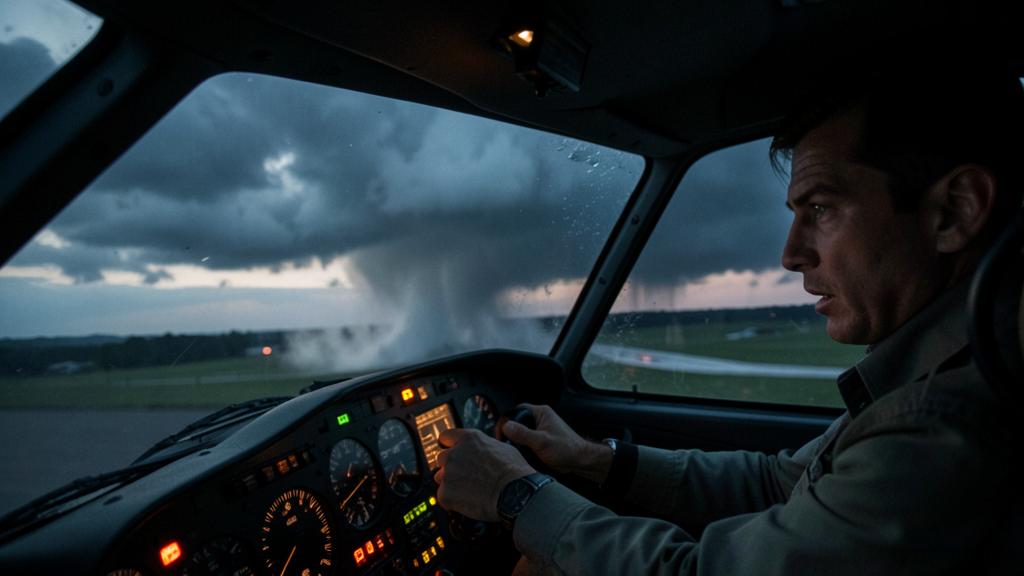
A reactive alert at the same location no longer leaves this choice. The sequence is short and its order matters more than its speed of execution: maximum available thrust, wings level, attitude increased to the guidance reference or, failing that, to the stall warning limit, then nothing. No gear, no flaps, no change of objective until the exit from the field is noted on a speed that rises and an altitude that increases clearly. The treatment of the autopilot, maintained or disconnected, differs according to the types and is read in the manufacturer’s documentation, not in a general principle.
| Moment | Predictive information | Reactive alert |
|---|---|---|
| Preparation, before top of descent | Delay the approach, choose another runway, plan holding fuel, brief the case | Sans objet |
| Approach, above the stabilisation gate | Early discontinuation, at a known and low cost | Immediate escape manoeuvre |
| Approach, below five hundred feet | Immediate go-around; the normal manoeuvre is sufficient in many manuals, the aircraft not yet being in the field | Escape manoeuvre, configuration unchanged, speed traded for flight path |
| Take-off, before decision speed | Rejected take-off | Rejected take-off |
| Take-off, after decision speed | Continue, then escape manoeuvre from lift-off | Escape manoeuvre |
| After touchdown | Sans objet | Braking and stopping: a go-around is no longer an option once the reversers are deployed |
The right reflex. Decide at the briefing, once and for all, what each of the four inputs will trigger: alert transmitted by the control, radar attention alert, radar emergency alert, reactive alert. One sentence is enough, provided it names the maneuver and not the intention. Add the fifth input, the one that emits no sound: a speed deviation of about fifteen knots, a descent rate clearly higher than the expected value, abnormal activity of the autothrottle or a deepening flight path justify an interruption on their own, without waiting for a system to confirm. No documentation requires an alert to go around.
What needs to be checked, and what remains gray.
Six points deserve to be noted in your own documentation, preferably before you need it. The height and configuration limits within which each of the two functions is armed on the operated type. The operating condition of the predictive function: depending on the installations, it requires that the radar be in service, or it arms itself without crew action. The exact wording of the alerts and the level they carry, an attention alert not calling for the same response as an emergency alert. The maneuver prescribed for a predictive alert received at low altitude, normal go-around or avoidance maneuver, a point on which the documents really diverge. The treatment of the autopilot and the autothrottle during the avoidance. Finally, the availability of a ground alert service on frequented airfields, and the form in which it is transmitted.
Two gray areas remain, and it is better to name them than to ignore them. The first is orographic shear: neither the predictive function, designed for convective divergence, nor the reactive function, bounded in height, treat it satisfactorily, and the only protection remains the local instruction and the refusal of a known problematic wind configuration. The second is the slice of the very last seconds, below the activation floor, where the crew is left alone with what they have conserved as energy. It is precisely there that the value of an approach conducted with a small thrust reserve rather than at idle is judged, a habit that is acquired in line and not at the moment the alert speaks.
For those preparing a type qualification or a control session, a final point is worth hearing. What is observed in the simulator is not the recitation of the procedure, but the delay between the alert and the first action on the controls, then the ability to let the speed drop to the warning limit without touching it and without changing the configuration. These two behaviors go against instinct: they are acquired through repetition, and a session in dedicated preparation installs them more surely than a manual review.
The applicable regulation, the operator’s approved operations manual, and the manufacturer’s documentation prevail over everything written here; in case of discrepancy, they are the ones that apply.


Leave a Reply
You must be logged in to post a comment.