

A sharp crack during climb, a faint glow, an ozone smell in the cockpit — and all parameters remain normal. Most lightning strikes boil down to this in flight. The real work begins on the ground: where did the current enter, where did it exit, and what did it cross in between? These three questions structure the entire post-strike inspection and explain the time spent on electrical connections as much as on burn marks.
The aircraft does not suffer the lightning strike: it is part of it
The image of a lightning strike that « falls » on the aircraft poorly describes the event: in most cases, the airframe itself triggers the discharge. By entering an area of intense field, its extremities — radome, probes, wingtips, fin tip — concentrate the field until they initiate precursors that join the surrounding charges. The aircraft becomes a conductive segment of the channel, between two charge zones.
Typical conditions are known: near the freezing level, in precipitation, often during climb or descent, and more frequently at the periphery of an active zone than in its core — a compliant avoidance does not immunize. Saint Elmo’s fire and radio interference that sometimes precede the event signal that the field is building.
The current is brief and violent: a peak that certification waveforms place at around 200 kiloamperes for a few dozen microseconds, sometimes followed by a few hundred amperes persisting for a fraction of a second — and it’s this tail that burns. By skin effect, everything flows on the outer surface: the cabin behaves like a Faraday cage and the occupants only perceive the noise and light. The challenge is therefore on the outside: the exact path of the current on the skin, and what it encountered along the way.
The aircraft doesn’t just get hit by lightning—it helps create the strike. The current flows along the outside, not the inside, so inspectors focus on the skin to see where it entered, traveled, and exited.
On a Boeing 737-800, a lightning strike might enter at the radome, travel along the fuselage, and exit near the tail. Inspectors would then check the radome, fuselage seams, and tail cone for damage, especially around electrical connections.
Entry, sweep, exit: the geography of an impact
The current attaches where the field concentrates: most often at the forward extremities. Then the kinematics does the rest: the ionized channel remains almost stationary in the air mass while the aircraft advances — at 250 kt, about 130 meters every second. Over the duration of a complete lightning strike, the attachment point therefore « retreats » along the fuselage through successive re-ignitions. This is the sweep of the channel, and it explains the characteristic pattern of the marks: not a single mark, but a string of aligned punctures from the nose to the rear.
The exit occurs at the aft extremities: tail cone, trailing edges, control surface tips, very often in line with a static discharge wick. A common misconception to correct: the wicks are not lightning rods. They discharge the static electricity accumulated in flight to protect radiocommunications, and are simply installed where the current wants to exit — hence the burned wicks found after impact. And the exit mark is not a detail: as long as it is not located, the path is not bounded, and the inspection cannot determine what was exposed.
The trap: stopping at the entry. The entry marks, grouped at the front, are quickly found. The exit may reduce to a puncture the size of a pinhead under a trailing edge or on a wick — invisible without oblique lighting. Documenting the entry without the exit is half the work: the current exited somewhere, and that somewhere is often the most damaged area.
Metal and composite do not mark the same way
On an aluminum alloy skin, the metal conducts so well that the energy disperses: surface punctures, localized melting points, scorched paint around the attachments. It is visible, superficial, and the restoration often involves minor touch-ups.
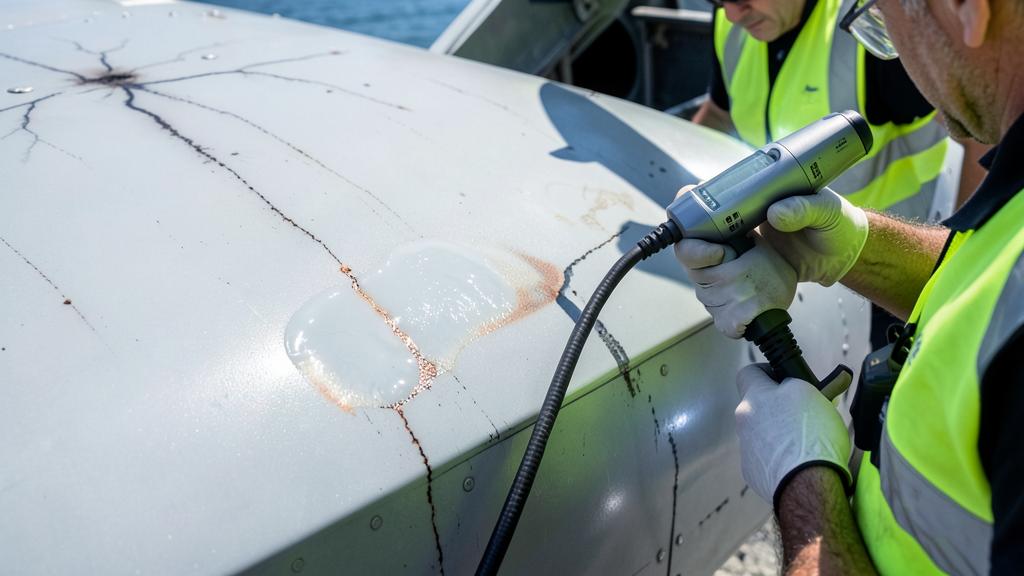
The carbon composite tells a different story. The fiber conducts poorly, the resin not at all: without protection, the energy would deposit locally and vaporize the resin in the thickness. Composite structures therefore carry dedicated protection — mesh or copper foil deployed under the paint — tasked with spreading the current as a sheet would. After an impact, the visible mark may be deceptively modest: blistered paint, mesh vaporized over a few centimeters. The real damage, however, may be underneath: a delamination between plies, wider than the mark, under a surface that appears healthy. Hence the non-destructive inspections after impact on composite, where metal often suffices with a detailed visual examination.
Two areas concentrate attention. The radome: dielectric by function, it cannot be meshed and carries diversion strips that offer the current an external path; a poorly diverted attachment can perforate it, and a discreet perforation sometimes reveals itself through water infiltrations or degraded radar. The tank areas: a current in an assembled structure can create micro-sparks at the interface of fasteners. Certification requires the absence of ignition sources in vapor spaces — fastener design, electrical continuity, interface treatments — hence the specific checks whenever a mark is near a wing box, even if it appears harmless.
| Aspect | Metal skin | Protected composite skin |
|---|---|---|
| Conduction | Excellent: the current spreads | Poor: the copper mesh does the work |
| Trace typique | Pitting, melt points, scorched paint | Blistered paint, mesh locally vaporised |
| Hidden damage | Rare except at fasteners and bonding | Delamination wider than the visible mark |
| Detection method | Detailed visual inspection, grazing light | Targeted non-destructive testing |
| Typical decision | Local touch-up often sufficient | Delamination mapping before any decision |
What is not visible: connections, bearings, magnetism
If the inspection were limited to marks, it would miss the essential. The skin is not continuous: each control surface, each hatch is connected to the rest of the airframe only by its hinges — and by its metallization braids, which exist precisely to offer the current a path of least resistance bypassing the bearings. When a braid is missing, broken, or corroded, the current passes through the hinge, and the arc punctures the tracks and rolling elements. The damage is not visible, does not immediately hinder, and manifests itself hundreds of hours later through abnormal wear or a hard spot. Hence the verification of braids near the marks and, in some protocols, electrical continuity measurements: we are not looking for the burn, we are looking for proof that the current passed where it should.
Two indirect effects complete the picture. The first is magnetic: the DC component of the current can magnetize ferromagnetic parts, and this residual magnetization distorts the standby compass — hence the compass check in post-impact protocols, with compensation if the deviation exceeds tolerances. The second is electromagnetic: the radiated field induces transients in the wiring. Modern aircraft are certified to withstand them — shielding, return paths, computer protections — but each anomaly observed at the time of the event guides a functional test. A computer that reset during the impact deserves more than a fault reset.
The inspection: an organized hunt, not a glance
Maintenance documentation classifies post-lightning as non-programmed, or conditional, inspections: an event triggers a procedure, the procedure bounds the search. A first visual phase covers the entire surface, focusing on privileged attachment zones, up close, with a lamp held at oblique lighting — a millimeter puncture is only visible with a cast shadow. Every mark found becomes the center of a detailed inspection within a defined radius: underlying structure, nearby fasteners, braids in the area, non-destructive inspections if the skin is composite.
Cross-system tests are added: compass, systems reported by the crew, static discharge wicks, probes and their heaters — a current exiting through a Pitot tube can damage the heating element without spectacular marks. The bounding logic applies all the way: an entry without an exit means the search is not complete. The reported impact without a found mark also exists — some attachments barely mark — but « nothing found » is signed after the complete search, not in its place.
The crew report decides half of the search
From the cockpit, an impact reduces to a few seconds of information — and these seconds are priceless. The exact time allows cross-referencing recordings. Flight phase, altitude, temperature, conditions — precipitation, icing, Saint Elmo’s fire, radio interference — document the context. The perceived location of the noise or light, « front left, » « somewhere behind, » guides the first pass. Every effect observed on a system, even fleeting, designates a functional test to perform. A report limited to « lightning strike during climb » condemns the search to look everywhere; a precise report divides the work.
The right reflex: freeze the moment. Note the time to the second as soon as the workload allows, with the altitude, conditions, and perceived location, then go through the systems one by one instead of relying on the impression that « everything is fine. » This hot report is the only thing that maintenance will never be able to reconstruct without you.
What you need to check in your documentation
The mechanism is generic, the protocols are not. Three points merit verification in your operator’s and type’s documentation. The trigger: crew report, discovery on preflight, both? The answer determines the fate of an unreported impact — a mark found on the ground may date back several flights. The scope of tests: systematic or conditional compass check, required or not continuity measurements, treatment of tank areas. The return to service: who signs what, and what the minimum equipment list allows to defer when a wick is missing or a radome goes for repair. For those preparing a qualification or technical maintenance, it’s the mechanism that counts: entry at the extremities, sweep, exit at the rear, electrical connections — an examiner quickly distinguishes between someone who understands the current path and someone who recites a list of zones.
These lines describe mechanisms and orders of magnitude, not instructions: the applicable texts, the manufacturer’s documentation, and your operator’s approved procedures take precedence in all circumstances over the content of this article.


Leave a Reply
You must be logged in to post a comment.