
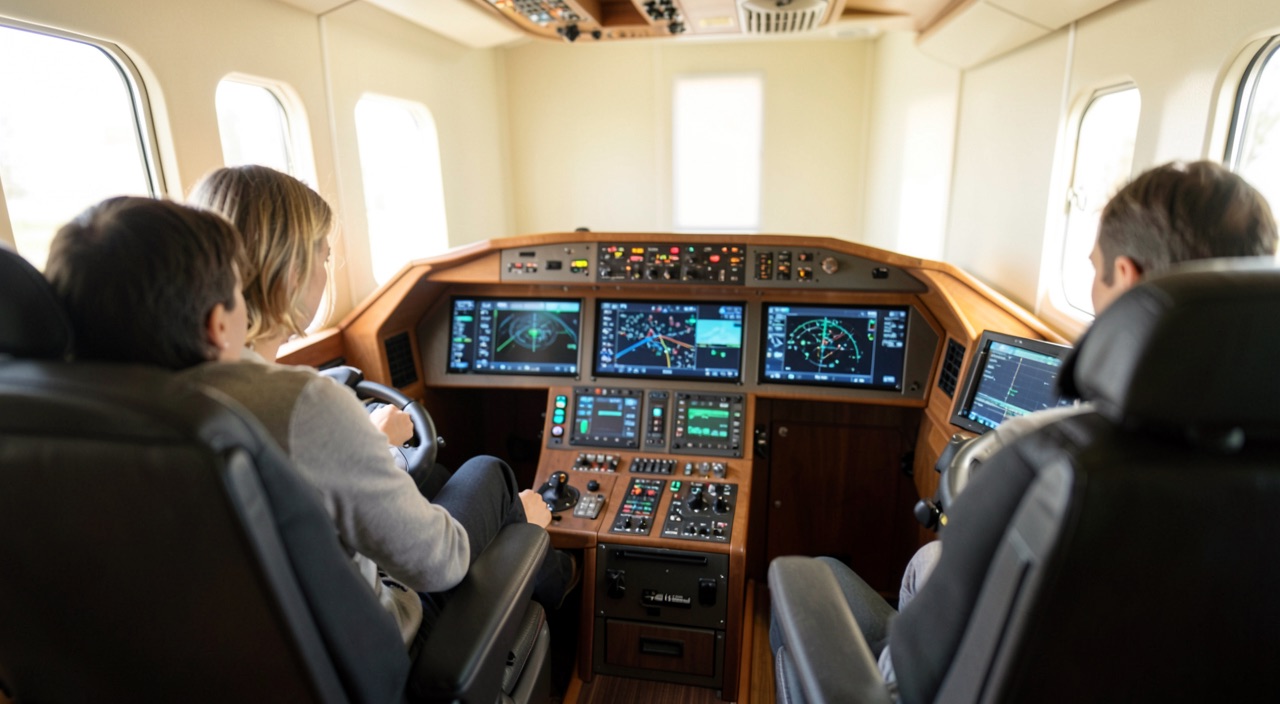
Nose below the horizon, airspeed climbing, vertical speed indicator against its bottom stop, altimeter unwinding, aerodynamic noise rising: these five indications are exactly the same whether the aircraft is in a wings-level dive, to be pulled out of without further ado, or in a spiral dive at sixty degrees of bank. A single parameter separates the two cases, and it governs the order of everything that follows. Pulled before that parameter has been settled, the control column makes worse precisely what it was meant to save.
Three indications that tell the same story
The resemblance is not an impression, it is mechanical. In both situations, the component of weight along the flight path accelerates the aircraft, the flight path descends steeply, and the load factor is already greater than one. That last point is the most treacherous. The pilot who questions the feel of the seat finds a firm pressure there, concludes that a pull-out is under way, and waits for a result that never comes. In the spiral, that g recovers almost nothing: it turns the aircraft.
What separates the two cases comes down to three indications, and none of them is the one the eye goes to spontaneously when the pressure rises. First the bank scale of the attitude indicator, which gives the answer in a fraction of a second provided it is read for its own sake. Then the heading indicator: it runs steadily in the spiral, it stays frozen in the dive. Finally the turn indicator, whose needle remains deflected on the side of the bank. The ball, for its part, says nothing useful: a spiral dive can be perfectly balanced, and most often it is, since it is nothing but the continuation of a turn that no one interrupted.
For the spiral almost never sets in all at once. It begins with a few degrees of bank that have not been corrected: an autopilot disconnected without the warning being noticed, a chart being picked up, an entry into instrument meteorological conditions. The share of lift opposing weight falls with the cosine of the bank angle, the nose drops, the speed increases, the nose-down attitude further increases the residual roll rate, and the flight path tightens at the same time as it accelerates. The regime is divergent: each turn makes the next one worse. That is why the time available is not counted in minutes.
In both a wings-level dive and a spiral dive, the aircraft is descending rapidly, speed is increasing, and the pilot feels pressure in the seat. The key difference is the bank angle. In a spiral, the aircraft is turning, which means the bank angle is high. If the pilot pulls up without first correcting the bank, the turn tightens, making the situation worse.
An Airbus A320 in a spiral dive at 60 degrees of bank, 250 knots indicated airspeed, and 5,000 feet per minute descent rate. The pilot pulls back on the control column without first rolling wings level. The load factor increases to 4g, but only 1g of that actually helps recover from the dive, while 3g tightens the turn, making the spiral worse.
| Source | Wings-level dive | Spiral dive |
|---|---|---|
| Pitch attitude | nose-down | nose-down |
| Bank scale | zero | large, often steady |
| Airspeed indicator | increasing rapidly | increasing rapidly |
| Vertical speed indicator | steep descent | steep descent |
| Altimeter | unwinding | unwinding |
| Heading indicator | frozen | running steadily |
| Turn indicator | needle centred | needle deflected |
| Ball | centred | centred as well, most of the time |
| Load factor felt | close to one as long as nothing has been pulled | already greater than one |
| First useful control | elevator | ailerons |
Bank is read before pitch
The attitude indicator displays both parameters at once, but they do not have the same reading priority. Pitch says what will have to be done at the end; bank says whether one is allowed to do it now. Any pitch input made with bank applied is at best wasted. A useful scan therefore begins with the bank scale, that is to say with the reference mark at the top of the face and not with the horizon line, continues with pitch, then with the airspeed trend, and ends with altitude or radio altimeter height when it is available. It is a learned order, contrary to the natural reading that grasps the horizon line as a whole and derives an overall impression from it.
There remains the immediate objection: what if the attitude indicator were itself the cause of the affair? A slowly drifting attitude reference leads to exactly the same situation, except that the instrument remains credible to the very end. The answer is corroboration, not general mistrust: a second attitude source, the standby indicator, the heading running or not, the consistency between an increasing airspeed and a decreasing altitude. Two independent parameters telling the same story are worth more than one primary instrument stared at harder. On recent aircraft, automatic comparison and the disagree flag do part of the work, but they announce a disagreement, not which of the two is right.
Why pulling on the control column recovers nothing
The demonstration rests on an elementary decomposition. Lift is perpendicular to the wings. For a given bank angle and a given applied load factor, the share opposing weight is the product of the load factor and the cosine of the bank angle, and the share that turns the aircraft is that same factor multiplied by the sine. At thirty degrees, the efficiency remains acceptable. At sixty, it falls by half: four g applied, four g for the airframe and for the crew, provide only two g of vertical component, of which only one actually serves to stop the descent. The remaining three point five g go into the turn, in other words into the tightening of the spiral.
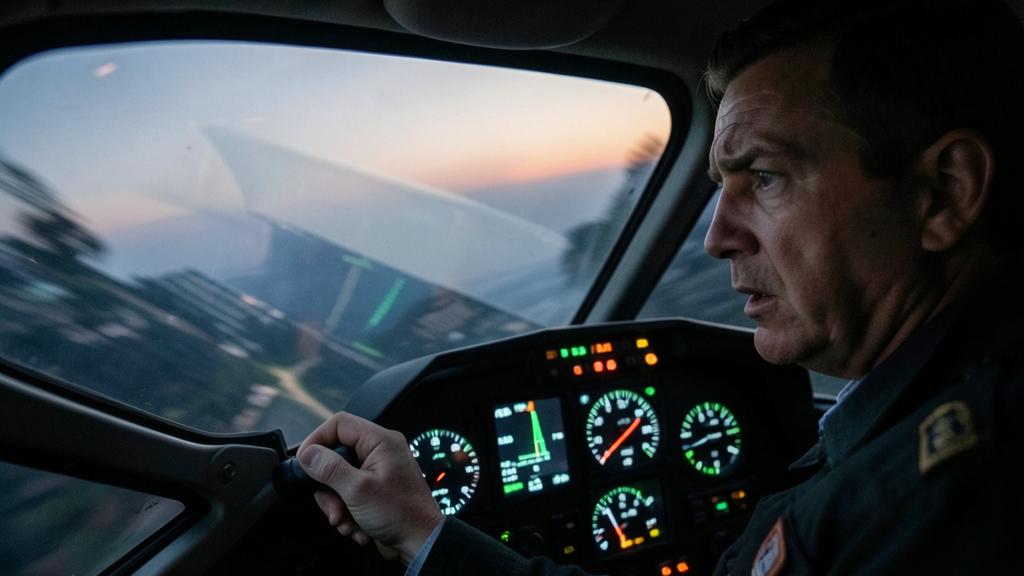
The effect is doubly unfavourable. The additional load factor increases induced drag without bringing the speed back down, since the flight path angle remains steeply negative; and the rate of turn increases, which further shortens the time available. The pilot who does not obtain the expected recovery then applies the only correction he knows: he pulls harder. The loop is closed, and it closes fast.
| Bank angle | Cosine | g applied | Share that turns the aircraft |
|---|---|---|---|
| 0 degrees | 1.00 | 2.00 | 0.00 |
| 30 degrees | 0.87 | 2.31 | 1.15 |
| 45 degrees | 0.71 | 2.83 | 2.00 |
| 60 degrees | 0.50 | 4.00 | 3.46 |
| 75 degrees | 0.26 | 7.73 | 7.46 |
One must add the corner of the flight envelope in which all this occurs. At high indicated airspeed, the elevator is very effective: a control column movement that looks ordinary produces a large load factor. Below manoeuvring speed, the wing stalls before the structure is loaded beyond its limit; above it, that natural protection disappears, and that is precisely where the spiral has taken the aircraft. A pull-out made with bank applied therefore combines both dangers: it lets the airspeed keep growing towards its limit while pushing the load factor towards its own, and it buys neither of the two margins it spends.
The trap. The g that is felt is no proof of a pull-out. A spiral dive is experienced with firm seat pressure, a control column already pulled back and a flight path still descending, that is to say with the three signs spontaneously associated with a recovery in progress. As long as the bank is not removed, that load factor is spent on rate of turn, and the only counter really rising is the accelerometer.
What the inner ear is saying meanwhile
The semicircular canals respond to angular acceleration, not to angular velocity. A sufficiently slow roll into a turn passes below their detection threshold — of the order of a few degrees per second, varying between individuals and with whatever occupies attention — and then produces no sensation of roll at all. And a sustained rotation, even one clearly felt at the start, dies away: the cupula returns to its neutral position in ten to twenty seconds, so that the crew is left with the sensation of straight flight while the aircraft is banked and still turning.
What follows is the complete mechanism of what is called the graveyard spiral. No longer perceiving the bank, one reads a decreasing altitude and an increasing airspeed, which, in straight flight, is corrected by moving the control column aft. The action is right in the world one believes one inhabits and wrong in the one where one actually is. Worse still: if the wings are indeed rolled level, that roll-out produces an angular acceleration in the opposite sense, hence the distinct sensation of rolling the other way. The reflex is then to bank again to cancel a roll that does not exist, and the spiral re-forms after having been half resolved.
A second illusion is superimposed on the first. The longitudinal acceleration of the descent tilts the gravito-inertial vector perceived by the inner ear backwards, producing a sensation of pitching up while the nose is low. It argues either for moving the control column further forward at a moment when one should first be rolling, or for the conviction that the attitude indicator is wrong. None of these illusions wears off with experience: they are physiological, and the number of flight hours changes nothing. The only defence is a scan order trained until it survives surprise.
Unload, roll, pull out: the order and its reasons
The effective order follows from everything above, and it begins with the most counter-intuitive action: releasing. Unloading the wing, that is to say bringing the control column back towards neutral or even forward depending on attitude and angle-of-attack margin, gives back three things at once. A less heavily loaded wing has a greater angle-of-attack margin, and therefore tolerates aileron deflection without risk of an asymmetric stall. The available roll rate increases. And the load factor, hence the structural loading, stops growing during a manoeuvre that as yet produces nothing.
Then comes bank. One rolls towards the nearest horizon, which, beyond ninety degrees, means continuing in the direction of the roll rather than coming back. The deflection can be firm. On transport aircraft, using the rudder to assist the roll calls for the caution set out in the operating manuals, particularly above manoeuvring speed and in reversed deflections, where the load on the vertical stabiliser is not the simple sum of the successive deflections.
Thrust is dealt with next, and that is where one has to know one’s type. On a twinjet with underwing engines, reducing thrust removes a nose-up pitching moment at the very moment when one wants to pitch up; but the energy already acquired and the limiting speed generally call for the reduction, completed where applicable by the speedbrakes when the documentation provides for them. Only the third step is the pull-out: progressive, flown at the load factor the situation allows and not at the maximum available, watching for the onset of the pre-stall buffet. The radius of the pull-out varies as the square of the speed, according to R = V² / (g (n − 1)): every knot gained during the spiral is paid for in height lost during the recovery. That is the real reason why no time is wasted pulling before rolling.
The right reflex. Three steps, called out aloud: unload, roll, pull out. The first control touched is the elevator forward, the second the ailerons, the third and only then the elevator aft. Calling out the order while executing it occupies the verbal channel and prevents sensation from taking back control of the decision, which is exactly the service a standard call-out provides.
What the simulator does train, and what it cannot train
Upset prevention and recovery training (UPRT) is conducted mainly in the simulator, and it is worth knowing what one is buying there. The machine trains remarkably well everything procedural and cognitive: the scan order, the sequence, the division of tasks between the two seats, the call-out, and the management of surprise when the instructor knows how not to announce the exercise. It trains badly, and sometimes not at all, everything vestibular.
Three limits deserve to be known by the trainee himself, and not only by the instructor. The motion of a platform is bounded: it reproduces the beginning of an acceleration then gently washes it back to zero, so that a sustained load factor does not exist there and a prolonged rotation does not produce the decay of sensation described above. The aerodynamic model is only validated within the envelope in which the aircraft was actually flight-tested; beyond that, extrapolation may teach a response that is not the aircraft’s, which is the very definition of negative training. Finally, knowing that one is in a simulator removes most of the startle effect, which is nevertheless the limiting factor in a real situation.
Hence the place of the on-aircraft element in advanced training, on an aerobatic-capable aeroplane, where the trainee really experiences sustained load factor, disorientation after a few turns and the need to believe the instrument against himself. What is learned there is not one more piloting technique, it is a hierarchy: the instrument before the sensation, bank before pitch. Trainee feedback and comparisons of programmes are usefully discussed on the FL330 forum.
The trap. A spiral exercise always introduced in the same way, in the same conditions and at the same point in the session, is learned as a choreography. The trainee anticipates the entry, the hand moves before the reading, and the line check goes very well, until the day the situation arises unannounced and it is sensation that speaks first. Asking for variation in the entry conditions is part of the training, not an affectation.
The right reflex. In the session, explicitly ask for the nose-low, steeply banked case at two different altitudes. At low altitude, the ground dictates the height lost and the pull-out is flown close to the buffet. At high altitude, the margin between the buffet and the Mach number limits is narrow and the load factor actually available is small: the same sequence is executed there far more gently.
What to go and check in one’s own documentation
Three checks are worth the time they take. The first concerns the exact wording of the nose-low recovery manoeuvre in the type’s operating manual: manufacturers do not all write it in the same terms, and the relative order of thrust reduction and rolling level is not universal. The second concerns behaviour in a degraded control law: a bank protection present in normal law may disappear in exactly the failure that causes the event, and a crew that has never seen the aircraft without it discovers the situation and the control input at the same instant. The third is more prosaic: where is the standby indicator in the flight deck, and from what head position can it be read? The question seems trivial until the moment it has to be found in two seconds.
For anyone preparing a type rating or a selection assessment, one point deserves to be stated plainly. What the examiner observes in a spiral exercise is not the quality of the recovery, which is easy to obtain, but the order: what was looked at, what was called out, and whether the first control touched was the right one. A clean recovery obtained in the wrong order shows up immediately in the simulator trace, and it will be commented on. The subject is therefore revised as a sequence to be recited, not as an intuition to be matured; the advanced modules and their prerequisites are detailed on formations.fl330.com.
There remains a grey area better acknowledged than concealed: the boundary between a spiral recovered by the classic sequence and a situation where the wing is already stalled in the turn, which calls first for a stall recovery. The two resemble each other less than one fears, the buffet and the roll behaviour separate them, but the transition from one to the other plays out in a few seconds, and it is the only case where reading angle of attack takes precedence over reading bank. Being able to name that limit case is better than discovering in the session that one had not allowed for it.
What precedes describes a mechanism, not a procedure. The aircraft flight manual, the operator’s approved documentation and the applicable regulations prevail over this article in all circumstances, and it is their wording that governs, in the session as on the line.
Questions fréquentes
How can a spiral dive be told from a simple dive in two seconds?
By reading the bank scale of the attitude indicator before the horizon line itself, then confirming on the heading indicator. A heading running steadily indicates the spiral; a frozen heading indicates the wings-level dive. Airspeed, vertical speed and altimeter are of no use for this distinction, since they display the same thing in both cases.
Why must one not pull until the wings are level?
Because lift is perpendicular to the wings: only the share multiplied by the cosine of the bank angle opposes weight. At sixty degrees, four g applied give only two g of vertical component, of which only one actually stops the descent, and nearly three point five g go into the turn. One therefore pays the whole structural load for a fraction of the recovery, while tightening the spiral.
How long does it take for the sensation of turning to disappear?
Of the order of ten to twenty seconds of steady bank is enough for the cupula of the semicircular canals to return to neutral and for the sensation of rotation to die away. A sufficiently slow roll into the turn, below the detection threshold of those canals — of the order of a few degrees per second — is not even perceived at the start. That is why a spiral can set in without any bodily signal announcing it.
What should be done if the attitude indicator is suspected of having failed?
One corroborates instead of choosing by feel: standby indicator, second attitude source, heading running or not, consistency between increasing airspeed and decreasing altitude. Two independent, agreeing parameters are worth more than one primary instrument stared at longer. A disagree flag signals a divergence but does not identify the faulty instrument.
Should thrust be reduced in a spiral dive?
As a general rule yes, because the energy already acquired drives the speed towards its limit, and the type documentation states any use of the speedbrakes. It should be known that on a twinjet with underwing engines, the reduction removes a nose-up pitching moment at the very moment one is seeking to pitch up. It is the manufacturer’s procedure that settles this trade-off, not general reasoning.
Is the simulator enough to train the recovery from a spiral?
It trains the procedural and cognitive part very well: the scan order, the sequence of control inputs, the call-out and crew coordination. It reproduces sustained load factor poorly and does not obtain the decay of vestibular sensation, and its model is only validated within the envelope flight-tested. That is what justifies the element conducted in flight in advanced training.


Leave a Reply
You must be logged in to post a comment.