
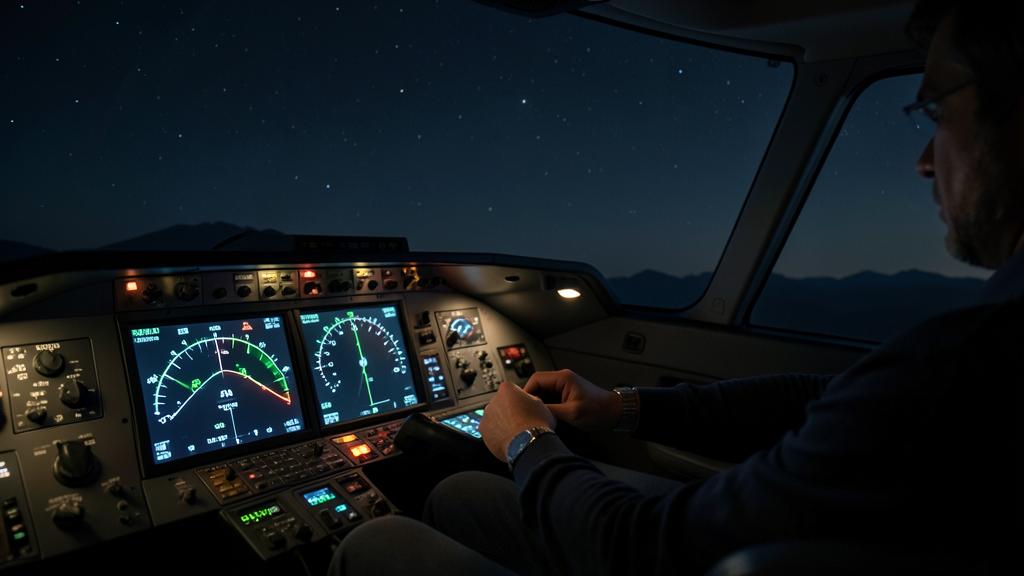
Night cruise, chain crossed perpendicularly, air perfectly smooth. Yet the autothrottle is pulled back to the maximum cruise power setting, the Mach number erodes tenth by tenth, and maintaining altitude requires two more degrees of pitch. Nothing has shaken, nothing may shake: the relief wave has already taken what it came for — the climb margin, the buffet margin, part of the usable ceiling. This silent deficit precedes any turbulence, and it is what decides the margins above the terrain.
A stationary oscillation, not a disturbed area
The mechanism boils down to one sentence: a stable air particle, lifted by the crest, finds itself colder than its surroundings and oscillates around its equilibrium level while drifting with the wind. The period of this oscillation is determined by the stability of the layer — the Brunt-Väisälä period — and the wavelength by the product of this period and the wind speed: typically in the range of five to twenty-five kilometers. The decisive point for the crew is not the formula, but its consequence: the wave is stationary relative to the ground. The ascending and descending branches do not drift with the air mass; they are anchored to the terrain like the waves of a stream are to the rocks. An aircraft crossing the chain encounters them one after the other at regular intervals, and an aircraft following an axis parallel to the crests may remain in the same branch for dozens of minutes.
The ingredients are found on the forecast charts: a strong crest wind — on the order of twenty to thirty knots or more — oriented within thirty degrees of the perpendicular to the chain, increasing with altitude, and a stable layer near the summits. When these conditions are met, vertical speeds in the branches commonly reach several hundred feet per minute, and exceed a thousand in marked episodes.
As long as the wave does not break, all this happens in a laminar flow. Turbulence, on the other hand, lies elsewhere: in the rotors below the crest level, downstream, and at the altitudes where the wave breaks, often near the jet stream. Between the two, the wave works in silence.
L’onde de relief crée des courants d’air montants et descendants fixes par rapport au sol. L’avion les traverse sans turbulence, mais perd de la vitesse et de la marge de montée. C’est ce qui réduit son plafond utilisable avant même de rencontrer des secousses.
Un Airbus A320 croise une chaîne de montagnes avec un vent de crête à 25 nœuds. En entrant dans une branche descendante, l’automanette passe à 95% N1 pour maintenir 35 000 pieds, le Mach chute de 0,79 à 0,75 en 5 minutes. Le plafond utilisable tombe de 37 000 à 34 000 pieds sans que le pilote ne ressente de turbulence.
The descending branch works against the gradient
At cruise altitude, the residual climb capability of a transport aircraft is measured in hundreds of feet per minute — it is precisely this residual that limits the recommended maximum altitude of the day. However, the descending branch of an established wave moves air downward at a similar rate. The arithmetic conclusion is brutal: to maintain level, the aircraft must climb through the air mass at the same rate it is descending, drawing on a power surplus that, at this level, barely exists.
As long as the autothrottle has reserve, it compensates. When it reaches maximum power, the energy budget has only one adjustment variable: speed. Altitude is maintained, impeccable in appearance, while the Mach number erodes — the aircraft trades its kinetic energy for trajectory maintenance. Altitude does not change, and that is precisely why the situation deteriorates without alerting anyone.
In climb, the same mechanism reduces the gradient. A crossing planned with a comfortable margin in calm air may see its slope disappear in a descending branch, with two consequences: the planned level is not reached at the planned point, and the margin built above the terrain is based on a neutral air hypothesis that the wave has just invalidated. The limiting case is an engine failure: escape trajectories and progressive descent profiles are established without vertical wind, and the stationary descending branch is exactly above the terrain that the escape trajectory must cross.
Major wave situations, in our latitudes, are winter situations: fast jet stream, strong and stable flow over the ranges. The day that requires deicing at departure is often the one that tightens the wave aloft — the two phenomena sign the same meteorological regime.
The signatures before the first jolt
Everything hinges on reading the parameters, because sensations reveal nothing. In altitude hold and speed management, crossing a descending branch has a complete signature: the pitch increases by about one to two degrees, the autothrottle advances, the Mach number decreases despite increasing thrust, and the ground speed deviates from the flight plan prediction. None of these signs are spectacular; it is their combination that indicates the wave, and especially their alternation. A few minutes later, the ascending branch reverses everything — reduced thrust, Mach rising toward Mmo, pitch to dive. This periodicity, calibrated on the wavelength divided by the ground speed, is the most discriminating criterion: a simple wind change does not produce a cycle.
| Observation | Branche ascendante | Branche descendante |
|---|---|---|
| Tendance Mach | rises towards Mmo | erodes towards low-speed buffet |
| Automanette | reduced, sometimes towards idle | increases up to maximum rating |
| Attitude and angle of attack | nose down to hold the level | nose up, angle of attack increasing |
| Immediate risk | overspeed, temptation to climb | buffet margin eroded, reduced ceiling |
| Reflex | refuse the “offered” climb | advise ATC, prepare a lower level |
The ascending branch deserves particular caution because it presents itself as a gift: the aircraft climbs without touching the thrust, the variometer races upward, and the higher level seems within reach.
The trap: accepting the climb that the ascending branch offers you. This is choosing to arrive in the next descending branch at a level where the buffet margins are thinner and the residual climb capability even weaker. The wave lends the elevator in one direction to take it back in the other, a little higher — where it costs the most.
The typical chronology is counterintuitive: thrust saturates first, the Mach number decreases next, the buffet margin is silently eroded — and turbulence, if it comes, comes last, when the aircraft approaches the breaking zones or when the reduced speed brings it closer to aerodynamic buffet. Waiting for the jolt to act is acting after having spent the margin.
Displayed ceiling, actual ceiling
The ceiling calculated by the flight management system is a calm air ceiling: it guarantees a residual climb capability and maneuvering margins around the buffet on either side of the cruise point. The wave attacks both limits at once. The descending branch pushes the Mach toward the lower limit while the high altitude has already narrowed the gap between low-speed buffet and high-speed limit. Flying near the maximum altitude in a predicted wave zone is accepting that the first descending branch consumes a margin that barely exists anymore.
The response is not symmetrical: descending restores margins on both sides. A few thousand feet lower, the gap between the two buffet limits widens, the residual climb capability is restored, and the same descending branch becomes a non-event — the autothrottle crosses it without saturating. This is the logic of the level retained in a wave zone: not the highest achievable level, but the highest level that maintains a power surplus greater than the predictable descending flow.
The right reflex: treat thrust saturation in smooth air as a performance information, not as an engine anomaly. Note the wind and ground speed, announce, compare the Mach to the displayed buffet margin, and request a lower level or an altitude block early — as long as the request is a choice and not an emergency.
The altitude block deserves to be requested more often than it is: allowing the aircraft to oscillate a few hundred feet at the whim of the branches costs less margin than holding a level to the foot in exchange for trading speed for altitude at each cycle.
Altimetry, the other silent front
The wave does not just move the aircraft: it deforms the pressure field used to locate it. The acceleration of the flow over the crests locally lowers the static pressure, and the sensors read it as is: the altimeter then overestimates the true altitude, precisely where the terrain is closest. The phenomenon adds to the cold temperature error, in the same unfavorable direction, and is sufficiently documented for aeronautical information publications to prescribe, in mountainous areas with strong winds, additional margins beyond the usual temperature corrections.
For the crew, the practical consequence is threefold. First, minimum altitudes in mountainous regions carry margins that assume a reasonably conforming atmosphere; in strong crest winds, the operator’s documentation may require — or allow choosing — increased minima. Next, a descent to a confined airfield under the wave successively crosses the breaking levels, the branches, then the rotor stage: the most turbulent part of the system awaits below the crest level, at the moment when speed is reduced and the configuration is evolving. Finally, the static source itself belongs to the measurement chain: anything that disrupts the pressure near the probe — ice, crystals, deposits — adds to the deviations in the pressure field, and the wave winter is also a winter of ground icing.
What flight preparation must acknowledge
A wave situation is prepared on the ground, because the parameters that matter are better read there than in flight: orientation of the flow relative to the crossed ranges, crest wind, stability profile, jet stream position, and SIGMETs for orographic waves when they exist. Clouds will do the rest in flight — lenticular clouds at the crests, rotor rolls downstream — but their absence proves nothing: a dry air mass carries invisible waves.
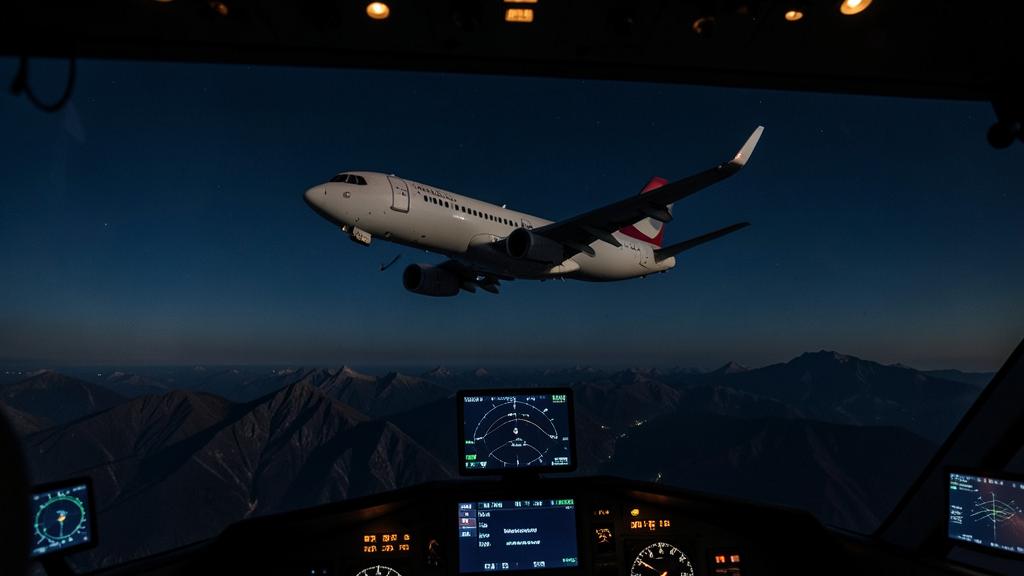
Four points deserve to be decided before engine start rather than endured in cruise. The level choice: aim in a predicted wave zone for a level that maintains a clear power surplus, even if it means sacrificing a few points of economic optimum for consumption. The crossing strategy: a route deviation that takes the chain more perpendicularly shortens the crossing of the branches, while an axis parallel to the crests may keep the aircraft durably in a single one. The degraded scenarios: re-read the engine-out escape trajectory for the mountainous section by asking what a stationary descending flow would change there, and where the lateral exits are. And the altimetry: identify what the operator’s documentation provides for strong winds in the mountains, including increased margins.
There remains an assumed gray area: wave forecasting gives zones and probabilities, not branch positions. Two aircraft twenty minutes apart on the same route may give contradictory reports, because the wave evolves with the flow that carries it. This is the purpose of frequency reports: the position of a descending branch reported by the previous aircraft is one of the few meteorological information whose accuracy exceeds that of the model.
The mechanisms described here illuminate the rule, they do not replace it: the applicable regulations and the approved documentation of the operator — operations manual, performance documentation, crossing procedures and minima — prevail in all circumstances over the content of this article.


Leave a Reply
You must be logged in to post a comment.