
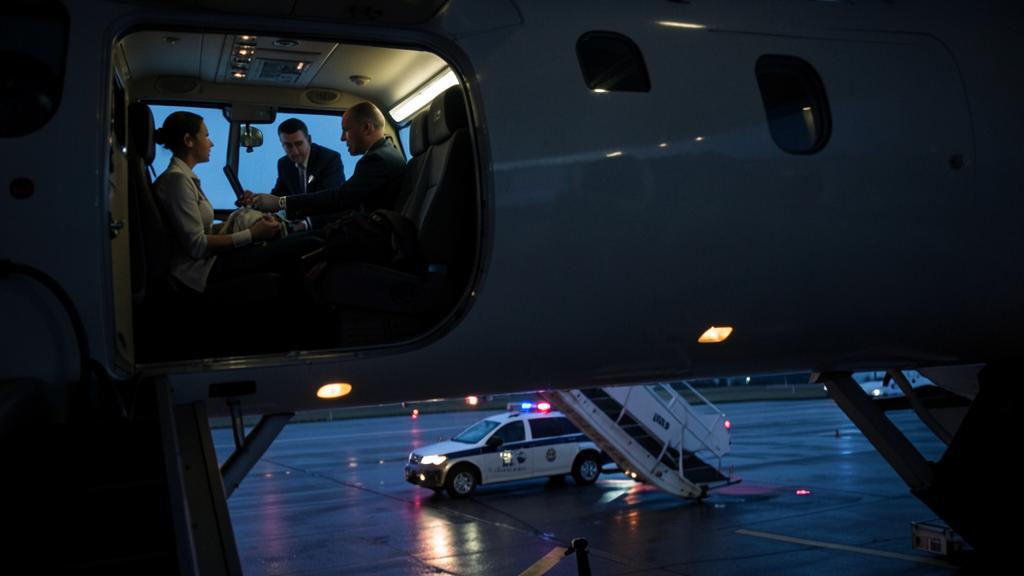
The passenger was restrained in cruise, the stopover went smoothly, the police were waiting at the bottom of the stairs — and three months later, the public prosecutor’s office closes the case: insufficiently characterized facts. This outcome is nothing exceptional; it is the ordinary fate of improvised removals. For the judicial follow-up to a handover to authorities does not play out at the police station: it plays out in flight, doors closed, in the hour preceding landing.
« To hand over » is not « to disembark »: two acts, two regimes
The conventional law that underpins the powers of the aircraft commander distinguishes two actions that practice often confuses. Disembarkation is an operational measure: it aims to restore order and discipline on board, is executed at the first suitable stopover, and closes the matter from the flight’s perspective. A handover is something else: the commander delivers to the competent authorities a person whom he has serious reasons to believe has committed a serious on-board offense. This second action entails obligations that the first does not: notifying the authorities, as far as possible before landing, of the intention to hand over and its reasons, then transmitting the evidence and information elements that the crew legitimately possesses.
The mechanism deserves to be looked at squarely: the police service that boards has seen nothing. It has neither witnessed the facts, nor heard the threats, nor suffered the gesture. All its action rests on what the aircraft brings it — and a person handed over without evidence can hardly be the subject of anything more than an identity check and an entry in the log.
| Criterion | Disembarkation | Delivery to the authorities |
|---|---|---|
| Purpose | Restore order on board and continue the operation | Place the person at the disposal of the judicial authorities |
| Fondement | Captain’s police powers | Reasonable grounds to believe a serious offence has been committed on board |
| Informing the ground | Desirable, often informal | Reasoned notification, before landing whenever possible |
| Evidence to provide | No particular formality | Timeline, accounts, witnesses, physical evidence handed to the authority |
| Suite typique | Passenger released, possible internal report | Hearing, proceedings — if the file stands up on its own |
Un débarquement simple est pour rétablir l’ordre dans l’avion. Une remise aux autorités, c’est pour donner une personne à la police avec des preuves. Si tu confonds les deux, la police n’aura rien pour faire une enquête.
The collection window closes with the opening of the doors
As long as the aircraft is flying, the investigative situation is ideal without anyone thinking in those terms: the witnesses are seated, identifiable by their seats, available; the material traces are in place; the memories are fresh and, above all, not coordinated. Upon opening the doors, everything dissolves. Passengers in transit disperse in a few minutes to destinations where no investigator will go to find them for a matter of this scale. The stopover cleaning erases the traces before anyone has thought to photograph them. And memories degrade in a particular way: passengers who comment on the incident among themselves during disembarkation align their accounts without meaning to, which weakens each individual testimony.
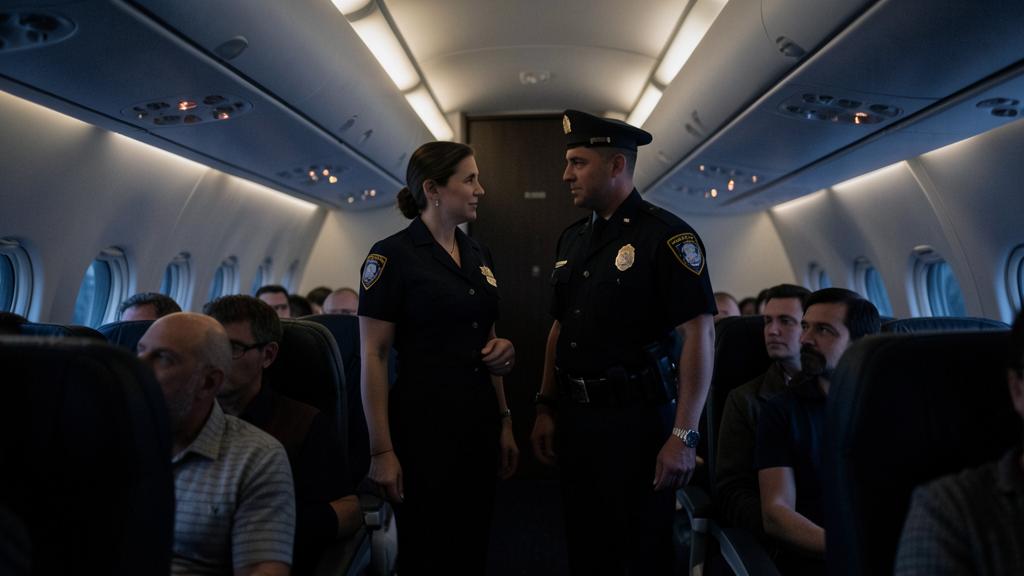
There is also a legal fact that the crew knows but rarely applies in this case: once the doors are open, no one on board has the power to detain anyone. The commander’s powers of constraint target the dangerous person, for the duration of the flight — never the witnesses. The cooperation of a passenger in a hurry is obtained in cruise, seatbelt fastened; it is no longer obtained on the stairs.
The trap: disembarking everyone « to hold connections. » The cabin empties in a few minutes, the witnesses disperse into several terminals and sometimes several countries, and the police board an empty aircraft. Then only the crew’s word is left against that of the passenger — a file that stops at the hearing. General disembarkation awaits the police on board and the designated witnesses to have left their contact details.
Sur un Airbus A320 avec 180 passagers, un incident grave survient à 30 minutes de l’arrivée. Si l’équipage n’identifie pas les témoins avant l’atterrissage, les passagers en transit partent vers 12 destinations différentes. 3 mois plus tard, le procureur classe l’affaire car aucun témoin n’est joignable.
What must be ready before landing
The preparation consists of five blocks, each answering a question the investigator will ask within the hour:
- A time-stamped chronology. UTC times, raw facts, warnings given — including the formal notification if the operator provides a warning card — and the passenger’s reactions. The verbs describe gestures and words, never intentions: « grabbed the wrist, » « repeated three times after warning, » not « was aggressive. »
- The identification of the passenger. Seat, description, registration data obtained via the ground when possible. A handover targets a person, not a row of the cabin.
- Identified and consenting witnesses. Two or three passengers who directly witnessed the facts: name, seat, contact method, possible connection. This is the block missing in most closed files.
- The material elements. Photographs of damage, items retained and handed over with acknowledgment, affected seats and equipment logged.
- The formalized decision of the commander. A handover is decided and stated as such: the ground message says « handed over to authorities, » not « difficult passenger to disembark. »
The right reflex: designate a single « clerk. » As soon as the incident stabilizes, one crew member — only one — is tasked with time-stamping and recording, while the others maintain the cabin. And it is during the descent, passengers fastened, that witness identities are collected: they are known where they are, they cannot leave, and the on-the-spot request obtains a rate of agreement that no witness appeal will recover.
The ground message: transmit to trigger, not to narrate
What the police mobilize upon arrival depends almost entirely on what has been announced to them. A vague message — « unruly passenger on board » — produces a welcome patrol, which notes that calm has returned and leaves. A structured message produces a service capable of acting, with an OPJ available. The difference lies in a few headings, relayed by ATC or by the company’s operations:
- the factual nature of the facts: violence against a crew member, repeated refusal of safety instructions, damage;
- the commander’s decision — handover to authorities — explicitly stated;
- the number of identified witnesses ready to testify;
- specific needs: interpreter, medical care, presence at the door before any disembarkation;
- the arrival time at the parking stand, so that the setup is in place before the doors open.
The timing counts as much as the content: a message passed on the final turn arrives after the on-duty service has committed its personnel elsewhere. And the notification of the intention to hand over, with its reasons, is a conventional obligation — not an operational courtesy.
Upon arrival: the choreography of the handover
A successful handover follows an order that nothing improvises. The police board first, before any disembarkation. The passenger remains in place, under surveillance, with their personal effects. The designated witnesses are presented to the officers, or their contact details are handed over. General disembarkation only begins afterward. The crew then transmits the prepared elements — chronology, individual accounts, photographs, items — while keeping a copy of each piece, and notes the receiving service.
Remains availability and the complaint. The crew’s hearing is conducted immediately when the duty time allows, by appointment otherwise — but it is offered, it is not awaited. As for the complaint, it gives the procedure a victim and a reason to act: that of the operator for the damage and disruption of the flight, that of the crew member for the violence or threats suffered. The handover puts a person at the disposal; the complaint gives the prosecutor’s office a reason to take it up.
Two documentary chains that do not replace each other
The same incident feeds two chains that do not communicate. The event report required by European regulations serves prevention: it goes to the operator then the authority, it is covered by the principles of just culture, and it is not intended to feed the judicial procedure — this protection is the foundation of the device, not a gap. The judicial chain requires other documents: individual signed accounts, handed over to the police, and if necessary a complaint.
Two symmetrical errors follow. Believing that the safety report « will serve as » a complaint: it is not designed to leave the safety circuit, and nothing guarantees that it will ever do so. And drafting a collective account signed by the entire crew: identical statements word for word are worth less than independent accounts, and they offer the defense the argument of collusion. Each writes what they saw, alone, before having extensively compared their memories with those of others.
What your documentation should already provide
The real question for a crew is not to memorize this list but to check what their own documentation says about it. Does the operations manual distinguish disembarkation from handover? Is there a ground message template, a witness collection form to distribute, a systematic complaint policy by the operator, legal assistance for the crew member who testifies? Each missing item will one day be paid for in improvisation, at the 7 a.m. block after a night flight.
A gray area remains: the foreign stopover. The competence of the landing state for acts committed in flight on an aircraft registered elsewhere has long been lacking; a more recent protocol extends it, but its effect depends on ratifications. Hence the practical rule: document as if the handover were to fail on site, in order to be able to file later in the state of registration with a complete file. And for those preparing for a selection or a cabin chief qualification, this is the mechanism to remember: a handover is not a law enforcement gesture, it is the constitution of a file that will have to stand on its own without you.
The applicable texts, the procedures of the concerned states, and the operator’s approved documentation — operations manual and associated instructions — prevail over this article: in case of discrepancy, it is your documentation that is authoritative.


Leave a Reply
You must be logged in to post a comment.